Product Image

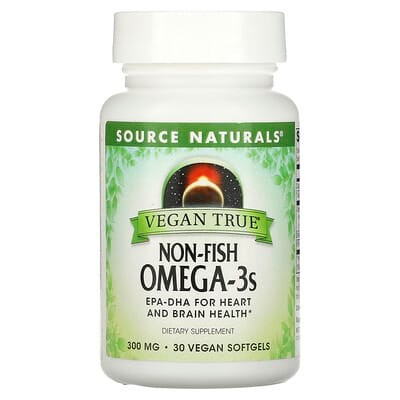
Vegan True Non-Fish Omega-3s 300 mg

Source Naturals
4.7
★ ★ ★ ★ ★
(219 ratings)
Omega-3 600 mg
DHA 360 mg
EPA (Eicosapentaenoic Acid) 180 mg
Product Image
Score70
A clearly dosed, DHA-forward algal oil for fish-free omega-3 use, offset by moderate potency and limited source-quality detail.
How scoring works
Quantity:30 Softgel(s) • (15 servings)
Goals:
Skin Health

Score 70

A clearly dosed, DHA-forward algal oil for fish-free omega-3 use, offset by moderate potency and limited source-quality detail.
How scoring works
$15.39($1.02 per serving)
Pure Formulas
$ 15.39
iHerb
$ 15.39
Vitacost
$ 15.39
Report prices

Analysis

Algal oil provides a DHA-forward profile with a smaller but useful EPA contribution. The formula can support skin and general omega-3 intake without relying on fish-derived oil.

Total omega-3s, DHA, and EPA are individually listed, which gives clear active dosing. The label does not identify the algal species, molecular form, or freshness markers, and one combined DHA/EPA entry contains no usable amount.

Vegans, vegetarians, and people who avoid fish may value the direct long-chain omega-3 source. Cost-conscious users or those wanting a stronger EPA amount may find better value elsewhere.

Who is it for
  • Vegans and vegetarians seeking EPA and DHA
  • Adults avoiding fish-derived oils
Best for
  • Fish-free DHA support
  • General skin and omega-3 nutrition

Pros

  • Uses algal oil
  • DHA and EPA are listed separately
  • DHA-forward fatty-acid profile
  • No fish source required

Cons

  • Total EPA and DHA amount is moderate
  • Algal species is not disclosed
  • Molecular form and oxidation markers are missing
  • Two softgels per serving

Warnings

  • Algal omega-3s may still add to bleeding tendency with anticoagulant or antiplatelet medicines
  • Softgels may cause digestive upset or reflux
  • Review the capsule shell if strict vegan suitability matters, because shell composition is not supplied

Nutrient quality

84 Highest impact

A vegan algal source provides a meaningful DHA-forward omega-3 amount. Missing molecular form, oxidation protection, and independent purity details limit quality confidence despite the focused formula.

Ingredient transparency

79 High impact

EPA and DHA have clear amounts, and no blend hides the key fatty-acid doses. Molecular-form, daily-direction, and inactive-ingredient details remain incomplete.

Customer satisfaction

68 High impact

The supplied aggregate rating is favorable and supported by a useful review volume. Detailed feedback is unavailable, so repeated complaints and fit with the intended use cannot be judged.

Value for money

40 Lower impact

The formula provides weak practical value for its key fatty-acid content. The focused active profile preserves category competitiveness.

Report analysis

Goals

Skin Health
Impact
High effect
B- Goal FitA- Strength of SupportC CoverageA Formula Quality
Omega-3 · 600 mg

Algal DHA and EPA may support skin-barrier lipids and a balanced inflammatory response. The formula is narrow but supplies a meaningful marine-type omega-3 amount without fish.

Exact DHA and EPA amounts are disclosed, and algal oil is a suitable direct source. People using anticoagulants or preparing for surgery should discuss concentrated omega-3 use with a clinician because it can modestly affect bleeding tendency.

Study evidence
Omega-3 Supportive 35 studies

Ingredients

IngredientAmount per serving
Calories
10 Calorie(s)
Total Fat
1 Gram(s)
Saturated Fat
0 Gram(s)
Trans Fat
0 Gram(s)
Omega-3 Fatty Acids
600 mg
DHA/EPA
0 NP
Docosahexaenoic Acid
360 mg
Eicosapentaenoic Acid
180 mg
Gluten Free Adults 18–50 Vegan Dairy Free Sugar Free Vegetarian
Report overview
Omega-3 · 600 mg OverallScore47
D+ Active Ingredient Quality & BioavailabilityC- Dose, Safety & Label TransparencyF Value

The algal source is vegan and sustainable, but the molecular form is not disclosed, which limits confidence in absorption. Separate EPA and DHA amounts provide 540 mg of relevant actives, although they make up only slightly more than half of the listed oil weight. No independent purity verification is supplied, and the cost per active dose is high.

DHA · 360 mg OverallScore31
F Active Ingredient Quality & BioavailabilityD+ Dose, Safety & Label TransparencyF Value

The vegan algal source is transparent and supplies a moderate DHA dose in one softgel. The label does not identify the DHA chemical form, antioxidant protection, or contaminant testing, leaving important quality questions. Cost per gram of DHA is high despite the convenient serving.

D- Active Ingredient Quality & BioavailabilityF Dose, Safety & Label TransparencyF Value

The EPA dose is modest and unlikely to meet an EPA-focused goal on its own. DHA is present at twice the EPA amount, so the balance favors DHA rather than an EPA-centric profile. The algae source suits non-fish preferences, but the molecular form, oxidation protection, purity testing, and cost efficiency are not competitive.

Loading alternative details
Report alternatives

Sources

Published studies used for the product analysis and the top-ranked studies for each ingredient and goal.

  1. The Effects of α-Linolenic Acid Intake on Skin and Blood Vessel Health and Subjective Fatigue in Middle-Aged Japanese Females: A Randomized, Double-Blind, Placebo-Controlled, Parallel-Group Comparative Trial.
    Ando N; Nosaka N; Arai C; Kato K · The Journal of nutrition · 2025
    Randomized trial120 participantsSkin Health forOmega-3
  2. Dietary supplementation with very long-chain n-3 fatty acids in patients with atopic dermatitis. A double-blind, multicentre study.
    Søyland E; Funk J; Rajka G; Sandberg M; Thune P; Rustad L; Helland S; Middelfart K; Odu S; Falk ES · The British journal of dermatology · 1994
    Randomized trial145 participantsSkin Health forOmega-3
  3. Prenatal Omega-3 Supplementation and Eczema Risk among Offspring at Age 36 Months.
    Berman D; Clinton C; Limb R; Somers EC; Romero V; Mozurkewich E · Insights in allergy, asthma & bronchitis · 2020
    Randomized trial84 participantsSkin Health forOmega-3
  4. Omega-3 fatty acid supplement skin cancer prophylaxis in lung transplant recipients: A randomized, controlled pilot trial.
    Miura K; Vail A; Chambers D; Hopkins PM; Ferguson L; Grant M; Rhodes LE; Green AC · The Journal of heart and lung transplantation : the official publication of the International Society for Heart Transplantation · 2019
    Randomized trial49 participantsSkin Health forOmega-3
  5. Randomized controlled trial of oral omega-3 PUFA in solar-simulated radiation-induced suppression of human cutaneous immune responses.
    Pilkington SM; Massey KA; Bennett SP; Al-Aasswad NM; Roshdy K; Gibbs NK; Friedmann PS; Nicolaou A; Rhodes LE · The American journal of clinical nutrition · 2013
    Randomized trial79 participantsSkin Health forOmega-3
  6. Clinical and metabolic response to flaxseed oil omega-3 fatty acids supplementation in patients with diabetic foot ulcer: A randomized, double-blind, placebo-controlled trial.
    Soleimani Z; Hashemdokht F; Bahmani F; Taghizadeh M; Memarzadeh MR; Asemi Z · Journal of diabetes and its complications · 2018
    Randomized trial60 participantsSkin Health forOmega-3
  7. Dietetic intervention in psoriatic arthritis: the DIETA trial.
    Leite BF; Morimoto MA; Gomes CMF; Klemz BNC; Genaro PS; Shivappa N; Hébert JR; Damasceno NRT; Pinheiro MM · Advances in rheumatology (London, England) · 2022
    Randomized trial97 participantsSkin Health forOmega-3
  8. Treatment of hard-to-heal wounds in ischaemic lower extremities with a novel fish skin-derived matrix.
    Lee YJ; Han HJ; Shim HS · Journal of wound care · 2024
    Randomized trial50 participantsSkin Health forOmega-3
  9. Effect of eicosapentaenoic acid, an omega-3 polyunsaturated fatty acid, on UVR-related cancer risk in humans. An assessment of early genotoxic markers.
    Rhodes LE; Shahbakhti H; Azurdia RM; Moison RM; Steenwinkel MJ; Homburg MI; Dean MP; McArdle F; Beijersbergen van Henegouwen GM; Epe B; Vink AA · Carcinogenesis · 2003
    Randomized trial42 participantsSkin Health forOmega-3
  10. Allergic disease in infants up to 2 years of age in relation to plasma omega-3 fatty acids and maternal fish oil supplementation in pregnancy and lactation.
    Furuhjelm C; Warstedt K; Fagerås M; Fälth-Magnusson K; Larsson J; Fredriksson M; Duchén K · Pediatric allergy and immunology : official publication of the European Society of Pediatric Allergy and Immunology · 2011
    Randomized trial145 participantsSkin Health forOmega-3