
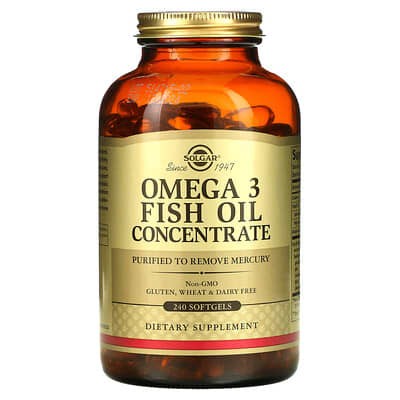
Nutrient quality
Triglyceride-form fish-oil concentrate in softgels gives the formula reasonable ingredient quality. Dose uncertainty or limited delivery detail prevents a confident quality assessment.
 Pure Formulas Pure Formulas | $ 13.49 | |
 Daily Vita Daily Vita | $ 14.84 | |
 iHerb iHerb | $ 11.99 | |
 Vitacost Vitacost | $ 13.19 |
The serving provides 320 mg of EPA and 200 mg of DHA in a triglyceride-form oil. That form improves absorption confidence compared with an unspecified or ethyl ester product, although the total amount remains geared to maintenance.
Clear active quantities and an efficient serving cost make routine use practical. The supplied label does not name the fish species, antioxidant protection, or independent purity verification.
The formula works well for adults who want a reasonably absorbed, budget-friendly daily fish oil. Higher-intake cardiovascular, inflammatory, or DHA-focused goals would require a more concentrated serving.
Triglyceride-form fish-oil concentrate in softgels gives the formula reasonable ingredient quality. Dose uncertainty or limited delivery detail prevents a confident quality assessment.
The meaningful actives and their amounts are clearly identified. Serving guidance and the complete inactive-ingredient list are not fully supplied.
The aggregate rating is strong and supported by useful review volume. No review excerpts are supplied to assess repeated complaints or purpose-specific experiences.
Formula quality provides fair value for the category. The effective serving and focused ingredient list compare favorably with similar options.

EPA and DHA may support skin-barrier lipids and balanced inflammatory signaling. The combined active amount is useful, while the triglyceride form supports favorable absorption.
Separate EPA and DHA labeling improves dose clarity. Generic sourcing and missing antioxidant or independent purity details remain meaningful limitations.

EPA and DHA provide useful support for ocular-surface balance and retinal membrane structure. Their moderate amounts create a focused lipid strategy rather than complete vision coverage.
The triglyceride form and individual fatty-acid quantities are clearly disclosed. No carotenoids, zinc, or antioxidant vitamins are included for complementary protection.

EPA and DHA provide strong evidence for inflammation-resolving lipid pathways, but the combined 520 mg amount falls below the stated minimum. The fish-oil total is clearly listed, so the more important limitation is low active omega-3 concentration.
The focused formula avoids unrelated additions and supplies both key fatty acids. A higher EPA and DHA amount would provide better depth for systemic anti-inflammatory support.

EPA and DHA directly support triglyceride management and cardiovascular membrane function. Fish oil has strong human evidence for lowering triglycerides, although clinical benefit depends on dose and user context.
The combined EPA and DHA amount is modest for targeted cardiovascular effects. The triglyceride form supports absorption, but fish source, purification, and antioxidant protection are not disclosed.
| Ingredient | Amount per serving |
|---|---|
Calories | 20 Calorie(s) |
Total Fat | 2 Gram(s) |
Saturated Fat | 0.5 Gram(s) |
Polyunsaturated Fat | 1 Gram(s) |
Monounsaturated Fat | 0.5 mg |
Cholesterol | 20 mg |
Fish Oil concentrate | 2000 mg |
Total Omega-3 Polyunsaturates | 600 mg |
Eicosapentaenoic Acid | 320 mg |
Docosahexaenoic Acid | 200 mg |
The triglyceride form supports favorable absorption, and EPA and DHA are disclosed separately. Active fatty acids still make up only a modest share of the fish oil, while source detail, antioxidant protection, and independent testing are absent. A low serving cost provides excellent value per combined EPA and DHA amount.
An explicitly stated triglyceride form supports absorption; ePA density is low, and no protective antioxidant is listed. The serving provides a standard EPA amount with a clearly EPA-centric ratio. No purification or third-party verification is shown, while normalized cost is excellent.
Triglyceride form supports absorption, though purification and fish species are not disclosed. EPA and DHA are listed separately, but the combined amount and concentration are low. Cost efficiency is excellent, while antioxidant protection is not shown.
Published studies used for the product analysis and the top-ranked studies for each ingredient and goal.