Product Image

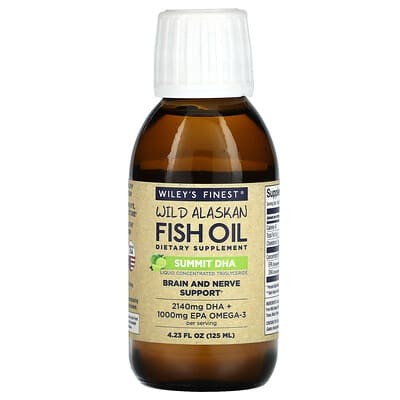
Wild Alaskan Fish Oil Summit DHA Natural Lime Flavor

Wiley's Finest
4.9
★ ★ ★ ★ ★
(439 ratings)
Omega-3 200 mg
Fish Oil 4600 mg
DHA 2140 mg
EPA (Eicosapentaenoic Acid) 460 mg
Product Image
Score83
An unusually high DHA serving makes this liquid a focused choice for DHA-led goals. Measurement, cost, and missing quality-control details limit its broad appeal.
How scoring works
Quantity:4 Fluid Ounce(s) • (25 servings)
Goals:
Cardiovascular Support
Anti-Inflammatory Support
Vision Support

Score 83

An unusually high DHA serving makes this liquid a focused choice for DHA-led goals. Measurement, cost, and missing quality-control details limit its broad appeal.
How scoring works
$31.99($1.27 per serving)
Pure Formulas
$ 31.99
Vitacost
$ 35.19
iHerb
$ 31.99
Report prices

Analysis

A serving provides 2,140 mg of DHA and 460 mg of EPA, plus 200 mg of other omega-3 fats. The strongly DHA-led profile is distinct from common EPA-heavy fish oils and offers substantial depth for vision-related pathways.

Liquid delivery avoids swallowing many capsules but requires accurate measurement. The supplied data do not identify chemical form, antioxidant protection, or independent purity verification for the concentrated oil.

The product is best for adults intentionally seeking a high-DHA formula rather than basic maintenance. Its large serving and premium cost make it excessive for users who only want a moderate daily amount.

Who is it for
  • Adults deliberately seeking high DHA
  • Users prioritizing vision-related omega-3 support
  • People who prefer liquid dosing
Best for
  • DHA-dominant supplementation
  • High-potency liquid use
  • Users who need more DHA than EPA

Pros

  • Provides 2,140 mg of DHA
  • Includes 460 mg of EPA
  • Supplies 2,800 mg of total omega-3 fats
  • Liquid format avoids multiple softgels

Cons

  • Large serving requires careful measurement
  • Premium serving cost
  • Molecular form is not disclosed
  • No antioxidant protection or independent purity verification
  • Too intensive for basic maintenance

Warnings

  • Contains fish oil and is not suitable for people with a fish allergy
  • Fish oil may cause fishy aftertaste, reflux, or digestive discomfort in sensitive users
  • The substantial EPA and DHA amount may be relevant for people using anticoagulant or antiplatelet medicines

Nutrient quality

86 Highest impact

Concentrated wild Alaskan liquid fish oil with an unspecified molecular form gives the formula reasonable ingredient quality. The disclosed amounts are meaningful and the ingredient selection stays focused.

Ingredient transparency

86 Highest impact

The meaningful actives and their amounts are clearly identified. Serving guidance and the complete inactive-ingredient list are not fully supplied.

Customer satisfaction

69 High impact

The aggregate rating is strong but the review volume limits confidence. No review excerpts are supplied to assess repeated complaints or purpose-specific experiences.

Value for money

89 Highest impact

Formula quality provides fair value for the category. The effective serving and focused ingredient list compare favorably with similar options.

Report analysis

Goals

Cardiovascular Support
Impact
Highest effect
A+ Goal FitA+ Strength of SupportB- CoverageA+ Formula Quality
Fish Oil · 4600 mg

A high disclosed amount of EPA and DHA offers strong support for healthy triglyceride levels and vascular function. The concentration provides clear depth in a well-supported cardiovascular pathway.

The formula remains focused on omega-3 benefits rather than covering rhythm or calcium handling. Fish-derived omega-3s may not suit people with a fish allergy, and high supplemental intake deserves extra care alongside anticoagulant or antiplatelet medicines.

Study evidence
Fish Oil Supportive 185 studies
Anti-Inflammatory Support
Impact
Highest effect
A+ Goal FitA+ Strength of SupportB- CoverageA+ Formula Quality
Fish Oil · 4600 mg

The high DHA amount plus substantial EPA directly supports omega-3 pathways involved in resolving inflammation. Clear disclosure of both fatty acids makes the active strength easy to judge.

The liquid concentrate delivers strong depth in one foundational pathway rather than broad multi-ingredient coverage. People using anticoagulant or antiplatelet medicines should discuss this high EPA and DHA intake with a clinician because it may increase bleeding tendency.

Study evidence
Fish Oil Supportive 68 studies
Vision Support
Impact
Highest effect
A- Goal FitB+ Strength of SupportB- CoverageA Formula Quality
EPA (Eicosapentaenoic Acid) · 460 mg

The DHA-heavy fish oil provides substantial structural lipid support for retinal membranes, while EPA may support the ocular surface. Its focused omega-3 profile does not supply lutein, zeaxanthin, zinc, vitamin C, or vitamin E for macular filtering and broader antioxidant defense.

The DHA and EPA amounts are clearly disclosed and far above token levels. The supplied label does not identify the oil's molecular form, antioxidant protection, or independent contaminant testing, leaving quality verification incomplete.

Study evidence

Ingredients

IngredientAmount per serving
Calories
41 Calorie(s)
Total Fat
4.6 Gram(s)
Cholesterol
5 mg
concentrated Fish Oil
4600 mg
Eicosapentaenoic Acid
460 mg
Docosahexaenoic Acid
2140 mg
Other Omega-3 Fatty Acids
200 mg
Gluten Free Adults 18–50 Dairy Free Sugar Free
Report overview
Omega-3 · 200 mg OverallScore62
D- Active Ingredient Quality & BioavailabilityC Dose, Safety & Label TransparencyA+ Value

The concentrated fish oil gives separate EPA and DHA amounts with a moderate active concentration. Its molecular structure is not confirmed, and no antioxidant or independent purity certification is stated. The large DHA-rich serving delivers excellent cost efficiency per active gram.

Fish Oil · 4600 mg OverallScore52
F Active Ingredient Quality & BioavailabilityB Dose, Safety & Label TransparencyB+ Value

The serving supplies 2,600 mg of combined EPA and DHA, providing a high active dose at about 57% concentration. Wild Alaskan sourcing is a strength, but molecular form, purification method, and independent testing are not disclosed. The cost per active gram is competitive, although no antioxidant stabilizer is shown.

DHA · 2140 mg OverallScore47
F Active Ingredient Quality & BioavailabilityD Dose, Safety & Label TransparencyA+ Value

The concentrated liquid delivers a very high DHA dose and excellent cost efficiency for the active amount. Its omega-3 density is moderate, while the chemical form and antioxidant protection are not stated. The fish source is only broadly described and no contaminant-testing credential is provided.

Loading alternative details
Report alternatives

Sources

Published studies used for the product analysis and the top-ranked studies for each ingredient and goal.

  1. Dose-dependent effects of fish oil on cardio-metabolic biomarkers in healthy middle-aged and elderly Chinese people: a double-blind randomized controlled trial.
    Song J; Hu M; Li C; Yang B; Ding Q; Wang C; Mao L · Food & function · 2018
    Randomized trial201 participantsAnti-Inflammatory Support forFish Oil
  2. Eicosapentaenoic acid supplementation alleviates pruritus, enhances skin moisture, and mitigates depression in maintenance hemodialysis patients.
    Lin YL; Wang CL; Chiang TI · Frontiers in nephrology · 2024
    Randomized trial60 participantsAnti-Inflammatory Support forFish Oil
  3. Lowering effects of fish oil supplementation on proinflammatory markers in hypertension: results from a randomized controlled trial.
    Yang B; Ren XL; Li ZH; Shi MQ; Ding F; Su KP; Guo XJ; Li D · Food & function · 2020
    Randomized trial77 participantsAnti-Inflammatory Support forFish Oil
  4. The effects of ω-3 fish oil emulsion-based parenteral nutrition plus combination treatment for acute paraquat poisoning.
    Meng Z; Dong Y; Gao H; Yao D; Gong Y; Meng Q; Zheng T; Cui X; Su X; Tian Y · The Journal of international medical research · 2019
    Randomized trial174 participantsAnti-Inflammatory Support forFish Oil
  5. Effects of Omega-3 Fatty Acid Intake in Patients Undergoing Dialysis: A Systematic Review and Meta-Analysis of Randomized Controlled Trials.
    Liu R; Jiang J; Fu Z; Liu C; Yao L; Quan H · Journal of the American Nutrition Association · 2022
    Meta-analysis49 studies pooledAnti-Inflammatory Support forFish Oil
  6. Marine Omega-3 Supplementation and Cardiovascular Disease: An Updated Meta-Analysis of 13 Randomized Controlled Trials Involving 127 477 Participants.
    Hu Y; Hu FB; Manson JE · Journal of the American Heart Association · 2020
    Meta-analysis127,477 participants13 studies pooledCardiovascular Support forFish Oil
  7. Impact of omega-3 fatty acids on hypertriglyceridemia, lipidomics, and gut microbiome in patients with type 2 diabetes.
    Lu J; Liu R; Ren H; Wang S; Hu C; Shi Z; Li M; Liu W; Wan Q; Su Q; Li Q; Zheng H; Qu S; Yang F; Ji H; Lin H; Qi H; Wu X; Wu K; Chen Y; Xu Y; Xu M; Wang T; Zheng J; Ning G; Zheng R; Bi Y; Zhong H; Wang W · Med (New York, N.Y.) · 2025
    Randomized trial309 participantsCardiovascular Support forFish Oil
  8. A systematic review of fish-oil supplements for the prevention and treatment of hypertension.
    Campbell F; Dickinson HO; Critchley JA; Ford GA; Bradburn M · European journal of preventive cardiology · 2013
    Meta-analysis1,524 participants17 studies pooledCardiovascular Support forFish Oil
  9. Effects of fish oil-derived fatty acids on suboptimal cardiovascular health: A multicenter, randomized, double-blind, placebo-controlled trial.
    Zeng Q; Dong SY; Liu YP; Fu J; Shuai P; Zhao ZM; Li TX · Nutrition, metabolism, and cardiovascular diseases : NMCD · 2017
    Randomized trial422 participantsCardiovascular Support forFish Oil
  10. Effect of High-Dose Marine Omega-3 Fatty Acids on Atherosclerosis: A Systematic Review and Meta-Analysis of Randomized Clinical Trials.
    Sekikawa A; Cui C; Sugiyama D; Fabio A; Harris WS; Zhang X · Nutrients · 2020
    Meta-analysis6 studies pooledCardiovascular Support forFish Oil
  11. Dietary omega-3 LCPUFA intake in the prevention of neovascular age-related macular degeneration: a systematic review and meta-analysis.
    Meng XT; Shi YY; Hong-Yan Z · Nutricion hospitalaria · 2022
    Meta-analysis5 studies pooledVision Support forEPA (Eicosapentaenoic Acid)
  12. Dietary omega-3 polyunsaturated fatty acids and fish intake and risk of age-related macular degeneration.
    Jiang H; Shi X; Fan Y; Wang D; Li B; Zhou J; Pei C; Ma L · Clinical nutrition (Edinburgh, Scotland) · 2022
    Meta-analysis21 studies pooledVision Support forEPA (Eicosapentaenoic Acid)
  13. Dietary fatty acid intake, plasma fatty acid levels, and the risk of age-related macular degeneration (AMD): a dose-response meta-analysis of prospective cohort studies.
    Zhong Y; Wang K; Jiang L; Wang J; Zhang X; Xu J; Yao K · European journal of nutrition · 2021
    Meta-analysis167,581 participants11 studies pooledVision Support forEPA (Eicosapentaenoic Acid)
  14. Dietary ω-3 fatty acid and fish intake and incident age-related macular degeneration in women.
    Christen WG; Schaumberg DA; Glynn RJ; Buring JE · Archives of ophthalmology (Chicago, Ill. : 1960) · 2011
    Cohort study38,022 participantsVision Support forEPA (Eicosapentaenoic Acid)
  15. Can Omega-3 Fatty Acids Serve as a Preventive Strategy for Age-Related Macular Degeneration? A Systematic Review and Meta-Analysis.
    Chen KY; Chan HC; Chan CM · The Journal of nutrition · 2026
    Meta-analysis18 studies pooledVision Support forEPA (Eicosapentaenoic Acid)