Product Image

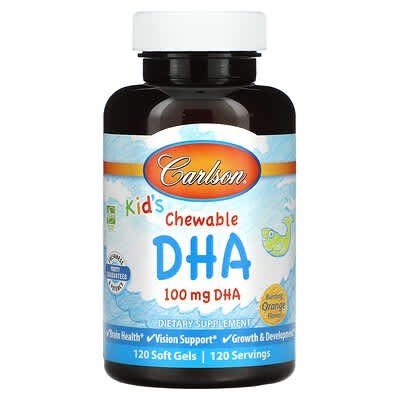
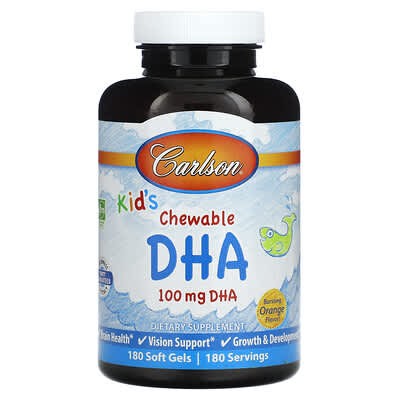
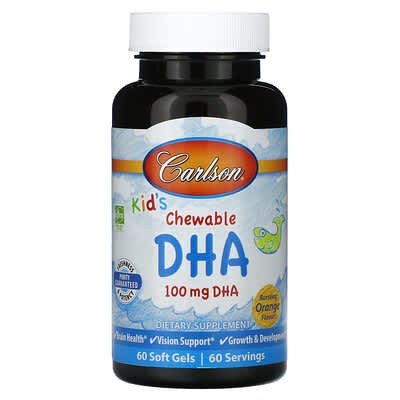
Kid's Chewable DHA 100 mg Bursting Orange Flavor!

Carlson
4.9
★ ★ ★ ★ ★
(19827 ratings)
Omega-3 175 mg
DHA 100 mg
EPA (Eicosapentaenoic Acid) 50 mg
Fish Oil 600 mg
Product Image
Score68
A small-bottle, child-oriented DHA chewable with clear actives but incomplete age, purity, and inactive-ingredient details.
How scoring works
Quantity:60 Softgel(s) • (60 servings)
Goals:
Cardiovascular Support

Score 68

A small-bottle, child-oriented DHA chewable with clear actives but incomplete age, purity, and inactive-ingredient details.
How scoring works
$10.95($0.18 per serving)
Vitacost
$ 10.95
Vitacost
$ 10.95
iHerb
$ 10.95
iHerb
$ 10.95
Report prices

Analysis

Each chewable provides 100 mg DHA and 50 mg EPA within 175 mg total omega-3s. The dose supports modest routine intake rather than high-strength cardiovascular or inflammatory use.

Triglyceride form and natural d-alpha-tocopherol are disclosed, which helps with formulation assessment. Specific fish species, independent purity information, complete inactive ingredients, and usage instructions are not shown.

The 60-serving bottle limits upfront commitment and suits families testing acceptance of the orange flavor. Larger companion sizes provide a longer supply at similar or better serving value.

Who is it for
  • Families trialing a chewable fish oil
  • Children needing a modest DHA-led supplement
Best for
  • Shorter trial supply
  • Children who dislike liquid fish oil

Pros

  • DHA-led active profile
  • Triglyceride form is stated
  • Natural vitamin E accompanies the oil

Cons

  • Only a modest omega-3 dose
  • No complete inactive-ingredient list
  • Usage directions by age are missing

Warnings

  • Have a parent or pediatric professional verify the serving because age directions are absent
  • Avoid in children with a fish allergy
  • Only give to a child who can chew the softgel without choking

Nutrient quality

72 High impact

Triglyceride delivery and vitamin E are meaningful formulation strengths. Low active concentration and modest fatty-acid amounts substantially limit dose quality.

Ingredient transparency

71 High impact

Core fatty-acid quantities are visible and no proprietary blend hides the formula. Malformed entries, missing full directions, and undisclosed excipients substantially reduce clarity.

Customer satisfaction

73 High impact

The supplied average rating is very strong and the rating volume is substantial. No specific experience details were provided to judge repeated complaints or purpose alignment.

Value for money

55 Moderate impact

Quality, dose, or safety limitations weaken practical value. Better-dosed or safer alternatives are more competitive.

Report analysis

Goals

Cardiovascular Support
Impact
Moderate effect
B Goal FitD+ Strength of SupportF CoverageA Formula Quality
Fish Oil · 600 mgVitamin E · 6.7 mg

EPA and DHA have direct cardiovascular relevance through lipid and inflammatory pathways, and the triglyceride form supports absorption. The serving supplies only 150 mg combined EPA and DHA, which is low for a cardiovascular goal.

Vitamin E helps protect the oil from oxidation but does not compensate for the modest omega-3 amount. The formula is suitable as a small children’s serving rather than a targeted cardiovascular dose.

Study evidence
Fish Oil Supportive 185 studies
Vitamin E Mixed 79 studies

Ingredients

IngredientAmount per serving
Calories
5 Calorie(s)
Total Fat
0.5 Gram(s)
Vitamin E
6.7 mg
Norwegian Fish Oil
600 mg
Total Omega-3 Fatty Acids
175 mg
DHA
100 mg
EPA
50 mg
Children 4+
Report overview
Omega-3 · 175 mg OverallScore61
B- Active Ingredient Quality & BioavailabilityC- Dose, Safety & Label TransparencyD+ Value

The triglyceride form supports absorption, while vitamin E helps protect the oil from oxidation. Separate EPA and DHA listing is clear, but together they make up only one quarter of the fish oil. The low active dose limits omega-3 delivery per softgel, and value per active gram is moderate.

DHA · 100 mg OverallScore46
B Active Ingredient Quality & BioavailabilityF Dose, Safety & Label TransparencyF Value

The triglyceride form and vitamin E offer useful support for absorption and oil stability. DHA potency is low, and the combined DHA and EPA content represents only a small share of the fish oil. Value per gram of DHA is fairly weak, with no fish species or verified contaminant testing listed.

B Active Ingredient Quality & BioavailabilityF Dose, Safety & Label TransparencyF Value

The triglyceride form is a quality strength, but each serving supplies very little EPA. DHA clearly outweighs EPA, which makes the product a poor match for an EPA-centered collection. Basic vitamin E protection helps oil stability, yet missing purity verification and inefficient EPA value remain drawbacks.

Loading alternative details
Report alternatives

Sources

Published studies used for the product analysis and the top-ranked studies for each ingredient and goal.

  1. Marine Omega-3 Supplementation and Cardiovascular Disease: An Updated Meta-Analysis of 13 Randomized Controlled Trials Involving 127 477 Participants.
    Hu Y; Hu FB; Manson JE · Journal of the American Heart Association · 2020
    Meta-analysis127,477 participants13 studies pooledCardiovascular Support forFish Oil
  2. Impact of omega-3 fatty acids on hypertriglyceridemia, lipidomics, and gut microbiome in patients with type 2 diabetes.
    Lu J; Liu R; Ren H; Wang S; Hu C; Shi Z; Li M; Liu W; Wan Q; Su Q; Li Q; Zheng H; Qu S; Yang F; Ji H; Lin H; Qi H; Wu X; Wu K; Chen Y; Xu Y; Xu M; Wang T; Zheng J; Ning G; Zheng R; Bi Y; Zhong H; Wang W · Med (New York, N.Y.) · 2025
    Randomized trial309 participantsCardiovascular Support forFish Oil
  3. A systematic review of fish-oil supplements for the prevention and treatment of hypertension.
    Campbell F; Dickinson HO; Critchley JA; Ford GA; Bradburn M · European journal of preventive cardiology · 2013
    Meta-analysis1,524 participants17 studies pooledCardiovascular Support forFish Oil
  4. Effects of fish oil-derived fatty acids on suboptimal cardiovascular health: A multicenter, randomized, double-blind, placebo-controlled trial.
    Zeng Q; Dong SY; Liu YP; Fu J; Shuai P; Zhao ZM; Li TX · Nutrition, metabolism, and cardiovascular diseases : NMCD · 2017
    Randomized trial422 participantsCardiovascular Support forFish Oil
  5. Effect of High-Dose Marine Omega-3 Fatty Acids on Atherosclerosis: A Systematic Review and Meta-Analysis of Randomized Clinical Trials.
    Sekikawa A; Cui C; Sugiyama D; Fabio A; Harris WS; Zhang X · Nutrients · 2020
    Meta-analysis6 studies pooledCardiovascular Support forFish Oil
  6. Supplementation with vitamin E alone is associated with reduced myocardial infarction: a meta-analysis.
    Loffredo L; Perri L; Di Castelnuovo A; Iacoviello L; De Gaetano G; Violi F · Nutrition, metabolism, and cardiovascular diseases : NMCD · 2016
    Meta-analysis16 studies pooledCardiovascular Support forVitamin E
  7. Vitamin E ameliorates blood cholesterol level and alters gut microbiota composition: A randomized controlled trial.
    Chen B; Li Y; Li Z; Hu X; Zhen H; Chen H; Nie C; Hou Y; Zhu S; Xiao L; Li T · Nutrition, metabolism, and cardiovascular diseases : NMCD · 2025
    Randomized trial90 participantsCardiovascular Support forVitamin E
  8. Effects of long-term vitamin E supplementation on cardiovascular events and cancer: a randomized controlled trial.
    Lonn E; Bosch J; Yusuf S; Sheridan P; Pogue J; Arnold JM; Ross C; Arnold A; Sleight P; Probstfield J; Dagenais GR; HOPE and HOPE-TOO Trial Investigators · JAMA · 2005
    Randomized trial9,541 participantsCardiovascular Support forVitamin E
  9. Independent and combined associations of dietary antioxidant exposure with all-cause and cause-specific mortality in the general population.
    Liu Z; He Z; Xing Y · Journal of nutritional science · 2026
    Cohort study34,955 participantsCardiovascular Support forVitamin E
  10. Tocotrienol rich fraction supplementation improved lipid profile and oxidative status in healthy older adults: A randomized controlled study.
    Chin SF; Ibahim J; Makpol S; Abdul Hamid NA; Abdul Latiff A; Zakaria Z; Mazlan M; Mohd Yusof YA; Abdul Karim A; Wan Ngah WZ · Nutrition & metabolism · 2011
    Randomized trial62 participantsCardiovascular Support forVitamin E