Product Image

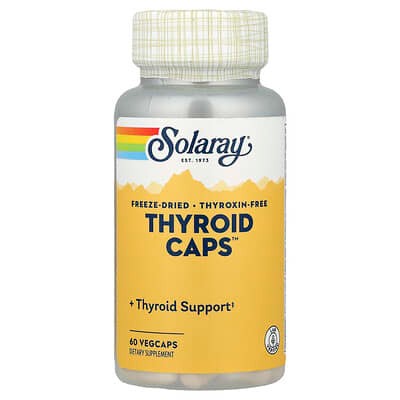
Thyroid Caps

Solaray
4.7
★ ★ ★ ★ ★
(999 ratings)
Iodine 150 mcg
Manganese 3 mg
Tyrosine 100 mg
Product Image
Score49

A thyroid glandular formula with moderate iodine and tyrosine but serious label and safety concerns. Verify the 50 mg molybdenum entry and seek clinical guidance before use.

How scoring works
Quantity:60 VegCap(s) • (60 servings)
Goals:
Energy
Metabolism Boost

Score 49

A thyroid glandular formula with moderate iodine and tyrosine but serious label and safety concerns. Verify the 50 mg molybdenum entry and seek clinical guidance before use.

How scoring works
$18.89($0.31 per serving)
Vitacost
$ 18.89
iHerb
$ 18.89
Report prices

Analysis

The capsule provides 150 mcg iodine from potassium iodide, 100 mg magnesium, 3 mg zinc, 3 mg manganese, and 100 mg L-tyrosine. Those amounts create a more moderate nutrient base than products using extreme iodine.

Bovine thyroid substance is included at 150 mg, making the formula materially different from an ordinary mineral supplement. Molybdenum is listed at 50 mg, an implausibly high amount that may reflect a unit error and must be verified.

No one should use the formula until the current label confirms the molybdenum amount and a clinician approves the bovine thyroid ingredient. Magnesium oxide also lowers the quality of part of the mineral blend.

Who is it for
  • Adults using a glandular product under medical supervision
  • People who have verified the molybdenum label
  • Users receiving thyroid-function monitoring
Best for
  • Clinician-directed thyroid glandular use
  • Moderate iodine and tyrosine intake
  • Targeted thyroid nutrition after label verification

Pros

  • Uses potassium iodide
  • Includes clearly stated tyrosine
  • Provides magnesium, zinc, and manganese
  • One-capsule serving

Cons

  • Contains bovine thyroid substance
  • Molybdenum is listed at an implausible 50 mg
  • Part of the magnesium is oxide
  • Copper amount is very small
  • Not suitable for unsupervised use

Warnings

  • Do not use until the 50 mg molybdenum entry is verified on the current label
  • Bovine thyroid substance should be used only with direct medical supervision
  • Thyroid medication may interact with or be complicated by the glandular and iodine components
  • People avoiding bovine-derived ingredients should not use it
  • Seek care for new palpitations, tremor, or marked thyroid-related symptoms

Nutrient quality

41 Lower impact

Potassium iodide and molybdenum glycinate are specific forms, but magnesium oxide lowers absorption quality. A possibly extreme molybdenum amount and unstandardized bovine thyroid material create major safety concerns.

.
Ingredient transparency

59 Moderate impact

Most nutrient amounts and forms are named, but key safety-relevant details remain unresolved. Bovine thyroid hormone content, complete directions, non-active ingredients, and the suspect molybdenum listing require clarification.

.

Customer satisfaction

72 High impact

The aggregate rating is strong and supported by a large feedback volume. Specific experience details are missing, so recurring problems and purpose fit remain uncertain.

.

Value for money

25 Situational impact

Serious safety and label-accuracy concerns make the formula poor value. Serving value is weak because safe use cannot be judged confidently.

.

Report analysis

Goals

Energy
Impact
Moderate effect
B- Goal FitF Strength of SupportC- CoverageB- Formula Quality
Iodine · 150 mcgMagnesium · 100 mg

Iodine, magnesium, tyrosine, and bovine thyroid substance create a thyroid-centered formula with potential metabolic-energy effects. The design covers thyroid substrate and several mineral cofactors.

Magnesium and tyrosine are below preferred energy amounts, magnesium oxide lowers absorption, and the active hormone content of bovine thyroid substance is not disclosed. Bovine thyroid material may contain thyroid hormones and can cause palpitations, tremor, or excessive thyroid activity, especially with levothyroxine or antithyroid medicines.

Study evidence
Iodine Adverse 3 studies
Magnesium Supportive 4 studies
Metabolism Boost
Impact
Moderate effect
C Goal FitD- Strength of SupportC+ CoverageC Formula Quality
Zinc · 3 mgMagnesium · 100 mg

Iodine, tyrosine, magnesium, zinc, and bovine thyroid tissue target thyroid-related metabolism more directly than a general multivitamin. Their usefulness is difficult to judge because several nutrient doses are low, magnesium includes oxide, and the glandular material has no hormone-content standard.

The listed 50 mg molybdenum amount is far above the adult upper limit and may reflect a serious label-data error that should be verified before use. Bovine thyroid tissue also creates a specific risk of unpredictable thyroid-active exposure, especially for people with thyroid disease or those taking levothyroxine or antithyroid medicine.

Study evidence
Iodine Mixed 17 studies
Magnesium Supportive 61 studies
Zinc Supportive 12 studies

Ingredients

IngredientAmount per serving
Iodine (Potassium Iodide)
150 mcg
Magnesium (Magnesium Asporotate, Magnesium Oxide)
100 mg
Zinc (Zinc Gluconate)
3 mg
Copper (Copper Asporotate)
0.1 mg
Manganese (Manganese Asporotate)
3 mg
Molybdenum (Molybdenum Glycinate)
50 mg
Thyroid Substance (Bovine)
150 mg
L-Tyrosine
100 mg
Adults 18–50
Report overview
A+ Active Ingredient Quality & BioavailabilityA+ Dose, Safety & Label TransparencyB+ Value
Potassium iodide is stable, water-soluble, and readily absorbed. 150 mcg fits the optimal daily-support range. The label clearly states the active iodine amount. Per-serving cost falls in the low-cost tier without a qualifying cofactor adjustment.
B+ Active Ingredient Quality & BioavailabilityA- Dose, Safety & Label TransparencyB+ Value

Manganese is supplied as manganese asporotate. The organic complex offers good expected absorption potential. The 3 mg amount suits maintenance better than targeted bone-matrix support. Cost per serving is reasonable for the formulation.

Tyrosine · 100 mg OverallScore50
B- Active Ingredient Quality & BioavailabilityD+ Dose, Safety & Label TransparencyF Value

The disclosed L-tyrosine form is appropriate, but the serving provides only a small amount for acute cognitive support. Its quantity is transparent, yet no specific purity or sourcing evidence is supplied. Added bovine thyroid tissue and iodine make the formula a poor fit for someone who only wants tyrosine and may complicate use alongside thyroid hormone.

Loading alternative details
Report alternatives

Sources

Published studies used for the product analysis and the top-ranked studies for each ingredient and goal.

  1. Association of radioactive iodine treatment with survivorship symptoms and primary care utilisation in women of reproductive age with thyroid cancer: a retrospective cohort study.
    Devanarayan P; Hartman M; Partin M · Family medicine and community health · 2026
    Cohort study10,882 participantsEnergy forIodine
  2. Energy level and fatigue after surgery for thyroid cancer: A population-based study of patient-reported outcomes.
    Hughes DT; Reyes-Gastelum D; Kovatch KJ; Hamilton AS; Ward KC; Haymart MR · Surgery · 2020
    Cohort study2,584 participantsEnergy forIodine
  3. Health-Related Quality of Life in Differentiated Thyroid Cancer Survivors: A Cross-Sectional Study From Turkey.
    Gültekin A; Kahraman MY; Şengöz T; Şimşek FS · Head & neck · 2026
    Cross-sectional study202 participantsEnergy forIodine
  4. Magnesium-L-threonate improves sleep quality and daytime functioning in adults with self-reported sleep problems: A randomized controlled trial.
    Hausenblas HA; Lynch T; Hooper S; Shrestha A; Rosendale D; Gu J · Sleep medicine: X · 2025
    Randomized trial80 participantsEnergy forMagnesium
  5. Total magnesium intake and risk of frailty in older women.
    Struijk EA; Fung TT; Bischoff-Ferrari HA; Willett WC; Lopez-Garcia E · Journal of cachexia, sarcopenia and muscle · 2024
    Cohort study81,524 participantsEnergy forMagnesium
  6. Red blood cell magnesium and chronic fatigue syndrome.
    Cox IM; Campbell MJ; Dowson D · Lancet (London, England) · 1991
    Randomized trial32 participantsEnergy forMagnesium
  7. Exercise, magnesium and immune function.
    Laires MJ; Monteiro C · Magnesium research · 2008
    Narrative reviewEnergy forMagnesium
  8. Iodine Supplementation Decreases Hypercholesterolemia in Iodine-Deficient, Overweight Women: A Randomized Controlled Trial.
    Herter-Aeberli I; Cherkaoui M; El Ansari N; Rohner R; Stinca S; Chabaa L; von Eckardstein A; Aboussad A; Zimmermann MB · The Journal of nutrition · 2015
    Randomized trial163 participantsMetabolism Boost forIodine
  9. Effect of oral iodized oil on thyroid size and thyroid hormone metabolism in children with concurrent selenium and iodine deficiency.
    Zimmermann MB; Adou P; Torresani T; Zeder C; Hurrell RF · European journal of clinical nutrition · 2000
    Single-arm trial51 participantsMetabolism Boost forIodine
  10. Serum Iodine Concentration as a Biomarker for Individual Iodine Nutrition and Thyroid Function in Pregnant Women: A Cross-Sectional Study in Hubei Province.
    Xu M; Dai X; Wang Z; Guo C; Zhang B; Guo H · Public health nutrition · 2026
    Cross-sectional study1,197 participantsMetabolism Boost forIodine
  11. Iron status influences the efficacy of iodine prophylaxis in goitrous children in Côte d'Ivoire.
    Zimmermann MB · International journal for vitamin and nutrition research. Internationale Zeitschrift fur Vitamin- und Ernahrungsforschung. Journal international de vitaminologie et de nutrition · 2002
    OtherMetabolism Boost forIodine
  12. Persistence of goiter despite oral iodine supplementation in goitrous children with iron deficiency anemia in Côte d'Ivoire.
    Zimmermann M; Adou P; Torresani T; Zeder C; Hurrell R · The American journal of clinical nutrition · 2000
    Non-randomized trial109 participantsMetabolism Boost forIodine
  13. Association of magnesium consumption with type 2 diabetes and glucose metabolism: A systematic review and pooled study with trial sequential analysis.
    Zhao B; Deng H; Li B; Chen L; Zou F; Hu L; Wei Y; Zhang W · Diabetes/metabolism research and reviews · 2021
    Meta-analysis1,168 participants26 studies pooledMetabolism Boost forMagnesium
  14. Magnesium supplementation for glycemic status in women with gestational diabetes: a systematic review and meta-analysis.
    Tan X; Huang Y · Gynecological endocrinology : the official journal of the International Society of Gynecological Endocrinology · 2022
    Meta-analysis4 studies pooledMetabolism Boost forMagnesium
  15. Impact of oral magnesium supplementation on glycemic and cardiometabolic outcomes in prediabetic adults: a systematic review and meta-analysis.
    Basit A; Kumar S; Ahmed H; Babar R; Saeed SS; Siddiqui TA; Khan S; Saeed A; Khan M; Hanif H; Fasih A; Shabbir S; Kumar H; Kumar L; Raja A; Kumar S; Chander S · Journal of diabetes and metabolic disorders · 2026
    Meta-analysis384 participants5 studies pooledMetabolism Boost forMagnesium
  16. Oral magnesium supplementation improves insulin sensitivity and metabolic control in type 2 diabetic subjects: a randomized double-blind controlled trial.
    Rodríguez-Morán M; Guerrero-Romero F · Diabetes care · 2003
    Randomized trial63 participantsMetabolism Boost forMagnesium
  17. Magnesium Supplementation and the Effects on Wound Healing and Metabolic Status in Patients with Diabetic Foot Ulcer: a Randomized, Double-Blind, Placebo-Controlled Trial.
    Razzaghi R; Pidar F; Momen-Heravi M; Bahmani F; Akbari H; Asemi Z · Biological trace element research · 2018
    Randomized trial70 participantsMetabolism Boost forMagnesium
  18. The effect of curcumin and zinc co-supplementation on glycemic parameters in overweight or obese prediabetic subjects: A phase 2 randomized, placebo-controlled trial with a multi-arm, parallel-group design.
    Karandish M; Mozaffari-Khosravi H; Mohammadi SM; Cheraghian B; Azhdari M · Phytotherapy research : PTR · 2021
    Randomized trial84 participantsMetabolism Boost forZinc
  19. Relationship between zinc and glucose metabolism in Japanese adults.
    Suka M; Tsuruta H; Takao T; Yanagisawa H · Diabetology international · 2026
    Cross-sectional study533 participantsMetabolism Boost forZinc
  20. Zinc and the Innovative Zinc-α2-Glycoprotein Adipokine Play an Important Role in Lipid Metabolism: A Critical Review.
    Banaszak M; Górna I; Przysławski J · Nutrients · 2021
    Narrative reviewMetabolism Boost forZinc
  21. Capsaicin and Zinc Signalling Pathways as Promising Targets for Managing Insulin Resistance and Type 2 Diabetes.
    Ferdowsi PV; Ahuja KDK; Beckett JM; Myers S · Molecules (Basel, Switzerland) · 2023
    Narrative reviewMetabolism Boost forZinc
  22. Zinc and Diabetes: A Connection between Micronutrient and Metabolism.
    Ahmad R; Shaju R; Atfi A; Razzaque MS · Cells · 2024
    Narrative reviewMetabolism Boost forZinc