
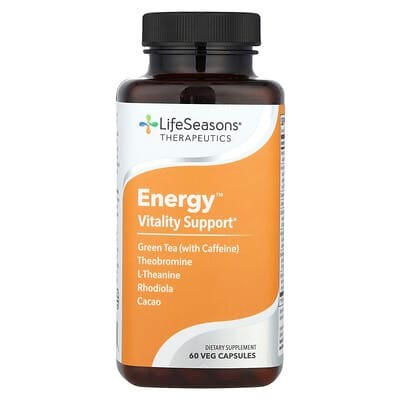

$33.99 $1.13 per serving

Product analysis
Energy combines herbs with theanine, which has limited support for some thinking tasks in selected users. Undisclosed proportions in several extracts make the full combination harder to compare.
AI assessment of the formula, label and price. How scoring works
Nutrient Quality50
Eleuthero’s plant part and the rhodiola species are clearly identified, which helps distinguish those herbs. Quality remains uncertain for several other ingredients.
Ingredient Transparency69
All listed amounts and most forms are disclosed. Missing forms and extract proportions limit a complete comparison.
Value For Money37
The cost is relatively high when considered for eleuthero and the declared rhodiola amount. Theobromine value is moderate, while the other comparisons remain uncertain.
Customer Satisfaction66
Customer feedback is positive, but based on very few ratings. The small sample gives limited confidence about wider satisfaction.
Product Focus57
Theanine has limited support for selected thinking tasks, mainly in people starting with lower performance. Its serving amount is below the amount used in the small trial, so the full blend’s effects remain uncertain.
- Format
Capsule - Container
- 60 Capsule(s)
- Per serving
- $1.13
- Customer rating
- 4.5 · 13 ratings
Goals

Impact
Lower effect
Theanine Not classified
No linked studies yet.

Impact
High effect
Green Tea · 150 mgTheanine · 125 mg
Theanine has limited evidence for verbal fluency and executive tasks, with the favorable findings concentrated in people starting with lower performance. This does not establish a uniform improvement in memory or attention. The 125 mg per serving is below the 200 mg daily amount used in the small four-week trial. Rhodiola and eleuthero amounts received no contribution, and the caffeine declaration remains unresolved.
How this product is rated for Cognitive Support
Ingredient fit76
The included ingredients are focused on the cognitive goal, although the product is also linked to other uses. The counted amounts provide only partial exposure relative to the comparison amounts; smaller or unresolved doses limit the contribution.
Goal fit
The included ingredients are focused on the cognitive goal, although the product is also linked to other uses.
Dose adequacy
The counted amounts provide only partial exposure relative to the comparison amounts; smaller or unresolved doses limit the contribution.
Pathways19
The strongest assigned connection concerns stress and arousal regulation, without proving improved cognitive performance. None of the reviewed mechanisms reached the required coverage level.
Depth
The strongest assigned connection concerns stress and arousal regulation, without proving improved cognitive performance.
Breadth
None of the reviewed mechanisms reached the required coverage level.
Evidence81
Theanine leads the saved evidence comparison, but its specific population and outcome limitations still apply.
Evidence strength
Theanine leads the saved evidence comparison, but its specific population and outcome limitations still apply.
Studied preparation
The counted preparations were treated as matching the comparison; this does not remove the ingredient-specific evidence limitations.
Formulation logic100
The counted ingredients meet the partner and minimum-amount comparisons, and no configured conflict was identified. These findings do not establish combination benefits.
Partner coverage
No counted ingredient was missing a required partner; this does not establish an added benefit from combining ingredients.
Conflicts
No configured ingredient conflict was identified from the supplied facts.
Effective doses
All counted ingredients exceed the minimum comparison amount, which is not a proven effective-dose threshold.
Ingredients
| Ingredient | Amount per serving | Score |
|---|---|---|
Andean Cocoa extract | 250 mg | |
Green Tea extract (total Polyphenols, EGCG) | 150 mg | |
Theobromine | 150 mg | |
L-Theanine | 125 mg | |
Eleuthero root extract (Eleutherosides) | 75 mg | |
Holy Basil extract (Oleanolic Acid, Ursolic Acid) | 75 mg | |
Rhodiola root extract (Rosavin, Salidroside) | 75 mg | |
Schisandra berry extract (Schisandrins) | 75 mg |
Theobromine · 150 mg OverallScore88
The label lists 150 mg of theobromine per serving. A whole-product serving costs about $1.13.
How this ingredient is rated
Active Ingredient Quality & Bioavailability91
Theobromine has a separate listed amount, though its purity is not established by that amount alone. The evaluation recognizes ordinary excipients or capsule material, which does not establish a minimal ingredient list.
Theobromine Purity and Standardization
Theobromine has its own listed amount of 150 mg per serving; that alone does not establish purity.
Excipient Profile and Clean Label
The evaluation recognizes ordinary excipients or capsule material, which does not establish a minimal ingredient list.
Dose, Safety & Label Transparency100
The label specifies 150 mg of theobromine per serving across 2 capsules.
Theobromine Dosage Efficacy and Safety
150 mg per serving is an amount assessed for potential mood and blood-flow support.
Labeling Transparency and Disclosure
The exact theobromine amount is listed as 150 mg per serving.
Value60
A whole-product serving costs about $1.13.
Price Per Serving Efficiency
A whole-product serving costs about $1.13.
Eleuthero (Eleutherosides) · 75 mg OverallScore84
A serving lists 75 mg of eleuthero root extract. The saved facts report 0.8% eleutherosides for that preparation.
How this ingredient is rated
Composition and Label Disclosure100
The root is identified, and the saved facts report 0.8% eleutherosides for the preparation.
Eleutheroside Marker Disclosure
The saved facts report 0.8% eleutherosides for the eleuthero root extract.
Target Plant-Part Identification
The saved facts identify the root as the plant part.
Composition and Label Disclosure100
The eleuthero amount is specified for the selected serving.
Eleuthero Amount Disclosure
The amount of eleuthero root extract is given as 75 mg per serving.
Commercial Price and Usability20
The whole-product price is about $1.13 per serving.
Selected-Serving Price Comparison
The whole-product price is about $1.13 per serving.
Rhodiola (Rosavin, Salidroside) · 75 mg OverallScore84
Alternative products
Report alternatives
Sources
Published studies used for the product analysis and the top-ranked studies for each ingredient and goal.
- No benefit adding eleutherococcus senticosus to stress management training in stress-related fatigue/weakness, impaired work or concentration, a randomized controlled study.
- Safety and efficacy of cognitive training plus epigallocatechin-3-gallate in young adults with Down's syndrome (TESDAD): a double-blind, randomised, placebo-controlled, phase 2 trial.
- Association between tea consumption and risk of cognitive disorders: A dose-response meta-analysis of observational studies.
- Investigating the Impact of Tea Consumption on Cognitive Function and Exploring Tea-Genetic Interactions in Older Adults Aged 65-105 Years: Findings from the 2002-2018 CLHLS Data.
- Consumption of green tea, but not black tea or coffee, is associated with reduced risk of cognitive decline.
- Green Tea Consumption and the Risk of Incident Dementia in Elderly Japanese: The Ohsaki Cohort 2006 Study.
- Evidence-based efficacy of adaptogens in fatigue, and molecular mechanisms related to their stress-protective activity.
- Effects of a Rhodiola rosea extract on mental resource allocation and attention: An event-related potential dual task study.
- Central additive effect of Ginkgo biloba and Rhodiola rosea on psychomotor vigilance task and short-term working memory accuracy.
- Clinical evidence for the adaptogenic effects of Withania somnifera and Rhodiola rosea - A systematic review with molecular interpretation of psychometric outcomes.
- A randomised, double-blind, placebo-controlled, parallel-group study of the standardised extract shr-5 of the roots of Rhodiola rosea in the treatment of subjects with stress-related fatigue.
- Assessing the effects of caffeine and theanine on the maintenance of vigilance during a sustained attention task.
- Effects of Tea (Camellia sinensis) or its Bioactive Compounds l-Theanine or l-Theanine plus Caffeine on Cognition, Sleep, and Mood in Healthy Participants: A Systematic Review and Meta-Analysis of Randomized Controlled Trials.
- Effects of L-Theanine Administration on Stress-Related Symptoms and Cognitive Functions in Healthy Adults: A Randomized Controlled Trial.
- Dose-response effect of L-theanine on psychomotor speed, sustained attention, and inhibitory control: a double-blind, placebo-controlled, crossover study.
- Acute effects of theanine, caffeine and theanine-caffeine combination on attention.
- Randomized controlled trial of Siberian ginseng for chronic fatigue.
- The effect of eight weeks of supplementation with Eleutherococcus senticosus on endurance capacity and metabolism in human
- The Effect of Short-Term Rhodiola rosea Supplementation on Simulated Game Time, Perceived Fatigue, and Performance in Basketball Players.
- Effects of Rhodiola rosea on Physical and Decision-Making Performance in Football Players: A Randomised Controlled Trial.