
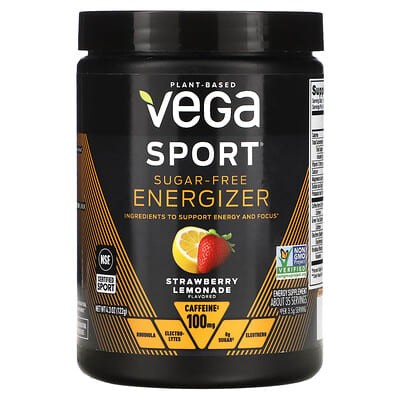
Sugar-Free Energizer Strawberry Lemonade Flavored

Goals
$30.00 $0.85 per serving


Product analysis
Sugar-Free Energizer Strawberry Lemonade Flavored includes rhodiola, which may help with stress-related fatigue. Unclear caffeine declarations make its alertness effect difficult to predict.
AI assessment of the formula, label and price. How scoring works
Nutrient Quality28
Several mineral sources are named, while the botanical preparations are mostly unspecified. Those missing details limit quality comparisons.
Ingredient Transparency70
Most listed amounts are stated, but the sugar entry lacks a quantity. Several preparations are unspecified, limiting comparison.
Value For Money41
The serving cost is favorable in the sodium comparison and moderate for eleuthero. Rhodiola is costly for its amount, while value for much of the remaining formula is uncertain.
Customer Satisfaction69
Customer ratings are generally positive across several hundred reviews. They reflect satisfaction, without establishing a dependable energy or focus effect.
Product Focus47
The formula centers on energy and mental performance under stress. Uncertain caffeine content and preparation-specific botanical findings limit expectations.
- Format
Powder - Container
- 4 Ounce(s)
- Per serving
- $0.85
- Customer rating
- 4.2 · 727 ratings
Goals

Impact
Lower effect
Magnesium · 8 mgEleuthero · 400 mgEleuthero · 400 mg
Eleuthero Not classified
No linked studies yet.

Impact
Moderate effect
Magnesium · 8 mg
Eleuthero and rhodiola connect mainly to mental performance during stress or fatigue, with findings limited by population and preparation. Caffeine is present but its amount is undisclosed, so a dependable alertness contribution cannot be assessed. Magnesium at 8 mg adds little to the saved focus assessment.
How this product is rated for Mental Focus
Ingredient fit53
3 relevant ingredients contribute to mental focus, alongside 3 other actives that broaden the formula beyond this goal. Low or undisclosed amounts limit the assessed contribution.
Goal fit
3 relevant ingredients contribute to mental focus, alongside 3 other actives that broaden the formula beyond this goal.
Dose adequacy
Low or undisclosed amounts limit the assessed contribution.
Pathways43
The main connection is stress and fatigue resilience, with meaningful support in the saved findings.
Depth
The main connection is stress and fatigue resilience, with meaningful support in the saved findings.
Breadth
Meaningful support is concentrated in stress and fatigue resilience, with less support across the other assessed pathways.
Evidence45
Eleuthero provides the strongest assessed evidence contribution, with results applying to specific outcomes and populations. Preparation matching limits the evidence for Rhodiola; the relevant trial findings cannot be transferred directly.
Evidence strength
Eleuthero provides the strongest assessed evidence contribution, with results applying to specific outcomes and populations.
Studied preparation
Preparation matching limits the evidence for Rhodiola; the relevant trial findings cannot be transferred directly.
Formulation logic92
The relevant ingredients can contribute alone or have the partners required by the saved findings. No conflict was identified in the supplied checks. 2 of 3 relevant ingredients meet the saved minimum amount criterion; Caffeine is below it or has an undisclosed amount.
Partner coverage
The relevant ingredients can contribute alone or have the partners required by the saved findings.
Conflicts
No conflict was identified in the supplied checks.
Effective doses
2 of 3 relevant ingredients meet the saved minimum amount criterion; Caffeine is below it or has an undisclosed amount.

Impact
Moderate effect
Magnesium · 8 mgPotassium · 40 mg
Rhodiola is the main botanical connection to fatigue resistance, but the 150 mg declaration has an unidentified preparation and cannot automatically inherit SHR-5 findings. Vitamin C provides nutritional support when intake is low.
The caffeine source declaration remains unreconciled with the ingredient inventory, and its amount is unresolved, limiting expectations for alertness. Eleuthero also has an undisclosed amount; potassium and the small magnesium amount add no established routine energy boost.
How this product is rated for Energy
Ingredient fit60
The ingredients provide a partial connection to energy support, with amounts considered separately from normal nutrient roles.
Goal fit
The relevant ingredients sit within a formula with several intended uses, giving a partial specific match to energy support.
Dose adequacy
The assessed amounts provide a limited match to the saved exposure comparisons, with small or unresolved amounts reducing the match.
Pathways17
The strongest connection in the saved findings is stress-fatigue resistance, with partial coverage.
Depth
The strongest connection in the saved findings is stress-fatigue resistance, with partial coverage.
Breadth
None of the specified energy mechanisms reaches the saved coverage threshold.
Evidence60
The saved evidence finding is led by the assessed ingredients, with limits related to nutritional status and preparation identity.
Evidence strength
Potassium leads the saved evidence comparison among ingredients meeting the amount criterion. The expected benefit remains limited by nutritional status or the research scope.
Studied preparation
Preparation matching is incomplete in the saved findings, including Rhodiola.
Formulation logic90
The saved assessment flags no missing required partners or ingredient conflicts; some amounts may still be small or unresolved.
Partner coverage
The assessed ingredients can stand alone or have the partners required by the saved assessment.
Conflicts
No configured ingredient conflicts were flagged.
Effective doses
3 of 5 assessed ingredients meet the saved minimum amount criterion. Below it: Caffeine, Eleuthero. Meeting that criterion does not establish an energy benefit.

Impact
Moderate effect
Magnesium · 8 mgGreen Tea · 150 mg
Rhodiola and eleuthero relate to mental work under stress or fatigue, with limited evidence for generic preparations. Green tea supplies the main antioxidant-related connection in the saved findings. Caffeine is present but its amount is undisclosed, so the 132 mg tea, coffee and cocoa source amount cannot be treated as a caffeine dose or a reliable alertness contribution.
How this product is rated for Cognitive Support
Ingredient fit52
5 relevant ingredients contribute to the goal, alongside 3 other active ingredients that make the formula less focused on cognition. Low or undisclosed amounts limit the contribution of the relevant ingredients.
Goal fit
5 relevant ingredients contribute to the goal, alongside 3 other active ingredients that make the formula less focused on cognition.
Dose adequacy
Low or undisclosed amounts limit the contribution of the relevant ingredients.
Pathways12
The clearest connection is oxidative and inflammatory protection, with a limited contribution in the saved findings.
Depth
The clearest connection is oxidative and inflammatory protection, with a limited contribution in the saved findings.
Breadth
Support remains too limited to show meaningful breadth across the assessed cognitive pathways.
Evidence68
Green Tea provides the strongest evidence contribution at an assessed amount, with benefits limited to the populations and outcomes described in the supplied evidence. Eleuthero, Rhodiola are not matched to the preparations used in the relevant trials, which limits how directly those findings apply.
Evidence strength
Green Tea provides the strongest evidence contribution at an assessed amount, with benefits limited to the populations and outcomes described in the supplied evidence.
Studied preparation
Eleuthero, Rhodiola are not matched to the preparations used in the relevant trials, which limits how directly those findings apply.
Formulation logic94
No conflict was identified in the supplied checks. 3 of 4 relevant ingredients meet the saved minimum amount criterion; Caffeine falls short or has an undisclosed amount.
Partner coverage
The relevant ingredients can contribute alone or have the partners required by the saved findings.
Conflicts
No conflict was identified in the supplied checks.
Effective doses
3 of 4 relevant ingredients meet the saved minimum amount criterion; Caffeine falls short or has an undisclosed amount.

Impact
Moderate effect
Magnesium · 8 mgVitamin C · 62 mgEleuthero · 400 mg
Rhodiola may help with stress-related fatigue, but its effects depend on the extract, and this preparation isn't identified. Eleuthero doesn't add a demonstrated benefit beyond stress-management training. The serving also contains 92 mg caffeine, so its ingredients shouldn't be taken as a promise of feeling calm.
How this product is rated for Stress Relief
Ingredient fit62
Rhodiola supplies 150 mg and eleuthero extract 400 mg per serving; their preparation-specific applicability differs.
Goal fit
Rhodiola and eleuthero mainly relate to stress-hormone regulation, with a smaller mood-related connection.
Dose adequacy
Rhodiola supplies 150 mg and eleuthero extract 400 mg per serving; their preparation-specific applicability differs.
Pathways11
Rhodiola and eleuthero mainly relate to stress-hormone regulation, with a smaller mood-related connection.
Depth
Rhodiola and eleuthero mainly relate to stress-hormone regulation, with a smaller mood-related connection.
Breadth
The practical connection is concentrated in the main area described, rather than broad relief across stress-related effects.
Evidence28
Rhodiola may help stress-related fatigue, but applicability depends on the extract. Eleuthero offers no demonstrated added benefit beyond stress-management training.
Evidence strength
Rhodiola may help stress-related fatigue, but applicability depends on the extract. Eleuthero offers no demonstrated added benefit beyond stress-management training.
Studied preparation
The rhodiola preparation is unidentified; the eleuthero root extract has a more specific preparation identity.
Formulation logic100
The relevant ingredients need no additional missing partner, and no particular ingredient conflict is identified.
Partner coverage
The relevant ingredients can contribute without an additional missing partner.
Conflicts
No particular ingredient conflict is identified.
Effective doses
Rhodiola supplies 150 mg and eleuthero extract 400 mg per serving; their preparation-specific applicability differs.
Ingredients
| Ingredient | Amount per serving | Score |
|---|---|---|
Calories | 10 Calorie(s) | |
Sugars | 0 Gram(s) | |
Vitamin C (Acerola Cherry extract) | 62 mg | |
Calcium | 10 mg | |
Magnesium (Magnesium Carbonate) | 8 mg | |
Sodium (Sodium Carbonate) | 120 mg | |
Potassium (Potassium Chloride) | 40 mg | |
Coffee Berry fruit extract | 132 mg | |
Green Tea leaf extract | 150 mg | |
Eleuthero root extract | 400 mg | |
Rhodiola | 150 mg |
Eleuthero · 400 mg OverallScore66
A serving lists 400 mg of eleuthero root extract. The saved facts do not specify an eleutheroside percentage.
How this ingredient is rated
Composition and Label Disclosure40
The root is identified, but the saved facts do not specify an eleutheroside percentage or a standardization claim.
Eleutheroside Marker Disclosure
The saved facts do not specify an eleutheroside percentage or a standardization claim.
Target Plant-Part Identification
The saved facts identify the root as the plant part.
Composition and Label Disclosure100
The eleuthero amount is specified for the selected serving.
Eleuthero Amount Disclosure
The amount of eleuthero root extract is given as 400 mg per serving.
Commercial Price and Usability50
The whole-product price is about $0.86 per serving.
Selected-Serving Price Comparison
The whole-product price is about $0.86 per serving.
Sodium (Sodium Carbonate) · 120 mg OverallScore63
A serving provides 120 mg of sodium from sodium carbonate. It may offer limited replacement during intense activity, and the whole-product serving costs about $0.86.
How this ingredient is rated
Active Ingredient Quality & Bioavailability42
The identified sodium source is sodium carbonate. Potassium chloride and a less readily absorbed supporting electrolyte form are identified.
Sodium Source Purity & Quality
The identified sodium source is sodium carbonate.
Bioavailability of Supporting Electrolytes
Potassium chloride and a less readily absorbed supporting electrolyte form are identified.
Trace Mineral Complex & Buffering Forms
No trace mineral complex or sodium bicarbonate is identified in the saved facts.
Dose, Safety & Label Transparency65
A serving provides 120 mg of sodium, which may offer limited replacement during intense activity. The available other-ingredients information identifies no artificial color or sweetener.
Sodium Dosage for Athletic Replenishment
A serving provides 120 mg of sodium, which may offer limited replacement during intense activity.
Ingredient Label Transparency
The saved facts list 120 mg of sodium, 40 mg of potassium, 8 mg of magnesium individually per serving.
Artificial Color and Sweetener Disclosure
The available other-ingredients information identifies no artificial color or sweetener.
Value100
A whole-product serving costs about $0.86.
Price Per Serving vs. Collection Median
A whole-product serving costs about $0.86.
Rhodiola · 150 mg OverallScore48
Each serving contains 150 mg of rhodiola. The supplied facts do not identify its species or rosavin and salidroside percentages.
How this ingredient is rated
Composition and Label Disclosure9
The supplied facts do not identify the rhodiola species. The supplied facts do not show rosavin or salidroside percentages.
Declared Rhodiola Marker Profile
The supplied facts do not show rosavin or salidroside percentages.
Rhodiola Species Detail
The supplied facts do not identify the rhodiola species.
Composition and Label Disclosure100
The selected serving declares 150 mg of rhodiola. The evaluation records no flagged artificial additives or flow agents; it does not test purity or contaminants.
Rhodiola Amount Disclosure
The selected serving declares 150 mg of rhodiola.
Other Ingredients Disclosure
The evaluation records no flagged artificial additives or flow agents; it does not test purity or contaminants.
Commercial Price and Usability20
Based on the whole-product price, 200 mg of rhodiola corresponds to about $1.15.
Cost per 200 mg Declared Rhodiola
Based on the whole-product price, 200 mg of rhodiola corresponds to about $1.15.
Alternative products
Report alternatives
Sources
Published studies used for the product analysis and the top-ranked studies for each ingredient and goal.
- No benefit adding eleutherococcus senticosus to stress management training in stress-related fatigue/weakness, impaired work or concentration, a randomized controlled study.
- Safety and efficacy of cognitive training plus epigallocatechin-3-gallate in young adults with Down's syndrome (TESDAD): a double-blind, randomised, placebo-controlled, phase 2 trial.
- Association between tea consumption and risk of cognitive disorders: A dose-response meta-analysis of observational studies.
- Investigating the Impact of Tea Consumption on Cognitive Function and Exploring Tea-Genetic Interactions in Older Adults Aged 65-105 Years: Findings from the 2002-2018 CLHLS Data.
- Consumption of green tea, but not black tea or coffee, is associated with reduced risk of cognitive decline.
- Green Tea Consumption and the Risk of Incident Dementia in Elderly Japanese: The Ohsaki Cohort 2006 Study.
- Magnesium sulphate for women at risk of preterm birth for neuroprotection of the fetus.
- Effects of magnesium valproate adjuvant therapy on patients with dementia: A systematic review and meta-analysis.
- Effects of magnesium supplementation on serum brain-derived neurotrophic factor levels and cognitive function in patients undergoing fluoxetine therapy for depression.
- Magnesium-L-threonate improves sleep quality and daytime functioning in adults with self-reported sleep problems: A randomized controlled trial.
- Could intraoperative magnesium sulphate protect against postoperative cognitive dysfunction?
- Evidence-based efficacy of adaptogens in fatigue, and molecular mechanisms related to their stress-protective activity.
- Effects of a Rhodiola rosea extract on mental resource allocation and attention: An event-related potential dual task study.
- Central additive effect of Ginkgo biloba and Rhodiola rosea on psychomotor vigilance task and short-term working memory accuracy.
- Clinical evidence for the adaptogenic effects of Withania somnifera and Rhodiola rosea - A systematic review with molecular interpretation of psychometric outcomes.
- A randomised, double-blind, placebo-controlled, parallel-group study of the standardised extract shr-5 of the roots of Rhodiola rosea in the treatment of subjects with stress-related fatigue.
- Cognitive and mood improvements of caffeine in habitual consumers and habitual non-consumers of caffeine.
- Caffeine-containing energy drink improves physical performance of elite rugby players during a simulated match.
- Differential cognitive effects of energy drink ingredients: caffeine, taurine, and glucose.
- Does Single or Combined Caffeine and Taurine Supplementation Improve Athletic and Cognitive Performance without Affecting Fatigue Level in Elite Boxers? A Double-Blind, Placebo-Controlled Study.