
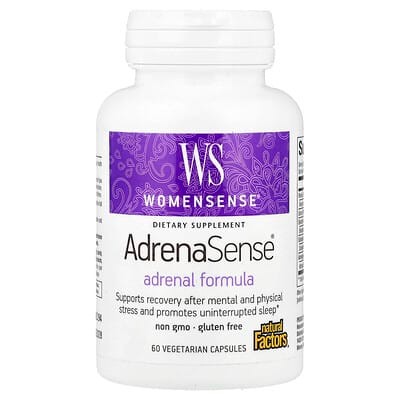

$14.67 $0.48 per serving


Product analysis
AdrenaSense may help with fatigue linked to stress, chiefly through rhodiola and ashwagandha. Benefits depend on the exact herbal preparations, and several are not clearly matched to those behind the available evidence.
AI assessment of the formula, label and price. How scoring works
Nutrient Quality74
Rhodiola and eleuthero clearly identify their plant sources, which helps you check what you are getting. Quality remains less certain for the other herbs, and clear plant names alone do not confirm the effects of a particular extract.
Ingredient Transparency93
All herb amounts and most preparation details are listed. Suma lacks form details, limiting a complete comparison of the mixture.
Value For Money49
The eleuthero comparison suggests favorable value, while rhodiola looks less economical. Value for ashwagandha and schisandra remains uncertain.
Customer Satisfaction84
Feedback is favorable across thousands of ratings. The large number of opinions gives a broader picture of buyer satisfaction.
Product Focus56
The main focus is stress-related fatigue rather than immediate stimulation. Its many related uses have uneven support and depend on the exact herbal preparations.
- Format
Capsule - Container
- 60 Capsule(s)
- Per serving
- $0.48
- Customer rating
- 4.7 · 2,056 ratings
Goals

Impact
Moderate effect
Ashwagandha · 160 mg
Ashwagandha may help with emotional strain associated with stress, but that benefit depends on the preparation used. The declared extract isn't identified as a matching preparation, which limits how confidently that benefit transfers here. Rhodiola's connection with stress-related fatigue adds no clear answer about whether this combination improves everyday mood.
How this product is rated for Mood Support
Ingredient fit60
Everyday mood benefits remain uncertain for the declared ingredients.
Goal fit
Several ingredients have mood-related roles, alongside ingredients serving other purposes.
Dose adequacy
Ashwagandha: 160 mg per serving; Rhodiola : 200 mg per serving; Eleuthero: 200 mg per serving; Schisandra: 160 mg per serving
Pathways18
The ingredients relate to stress-hormone regulation. A role in these processes does not guarantee an emotional benefit.
Depth
The strongest ingredient connection concerns stress-hormone regulation, without guaranteeing a mood benefit.
Breadth
The ingredients have limited connections with mood-related processes; this does not predict how much you will benefit.
Evidence72
Everyday mood benefits remain uncertain for the declared ingredients.
Evidence strength
Everyday mood benefits remain uncertain for the declared ingredients.
Studied preparation
Preparation-specific benefits cannot be assumed for Ashwagandha.
Formulation logic100
No particular ingredient conflict is identified, and no additional partner is required for the ingredients described here.
Partner coverage
No additional ingredient partner is required for the ingredients described here.
Conflicts
No particular conflict between the declared ingredients is identified.
Effective doses
The declared amounts allow an ingredient comparison, but do not guarantee effective mood relief.

Impact
High effect
Ashwagandha · 160 mgEleuthero · 200 mg
Rhodiola may help with stress-related fatigue, though extract-specific findings and uncontrolled designs limit expectations. Ashwagandha adds a connection to perceived stress, but this ordinary root extract cannot be assumed equivalent to preparations used in trials, and its 160 mg serving is below the saved reference. Eleuthero is present, but the supplied trial did not demonstrate added benefit beyond stress-management training. The main contribution centers on stress-hormone regulation, with less coverage of mood and sleep-related functions.
How this product is rated for Stress Relief
Ingredient fit71
Rhodiola is fully represented by amount, while ashwagandha and eleuthero have smaller serving contributions in a broader herbal formula.
Goal fit
Three herbs contribute within a formula that also includes herbs without assessed stress contributions.
Dose adequacy
Rhodiola meets its amount reference; ashwagandha and eleuthero fall below theirs.
Pathways54
The strongest contribution concerns stress-hormone regulation, with lesser mood, sleep and calming coverage.
Depth
Stress-hormone regulation is the strongest area across the contributing extracts.
Breadth
Only stress-hormone regulation reaches substantial coverage.
Evidence64
Ashwagandha has the strongest saved evidence contribution, but its ordinary extract does not match the studied-preparation finding.
Evidence strength
Ashwagandha leads the saved evidence comparison at its declared amount.
Studied preparation
Rhodiola and eleuthero pass the preparation check; the ashwagandha extract does not.
Formulation logic100
The three contributing herbs have no missing partner requirement or evaluated conflict.
Partner coverage
Each contributing herb retains its contribution without an additional partner.
Conflicts
No evaluated ingredient conflict was identified.
Effective doses
All three contributing extracts clear the saved minimum amount threshold.

Impact
Moderate effect
Ashwagandha · 160 mg
Rhodiola at 200 mg and eleuthero at 200 mg provide the saved contribution through stress and arousal regulation. Their cognitive relevance is limited and depends on the preparation and context, particularly fatigue or stress. Ashwagandha at 160 mg does not reach the saved minimum dose threshold.
How this product is rated for Cognitive Support
Ingredient fit64
The saved ingredient and dose findings describe how closely the relevant actives support cognitive needs.
Goal fit
Relevant cognitive ingredients account for much of the formula, alongside ingredients serving other purposes.
Dose adequacy
The assessed amounts provide partial coverage of the saved dose comparison; this is an exposure comparison, not proof of benefit.
Pathways12
The contribution centers on a limited set of cognitive processes rather than broad coverage.
Depth
The strongest represented process is stress and arousal regulation, with limited coverage in the saved findings.
Breadth
No assessed cognitive process reaches the saved coverage threshold.
Evidence33
The saved evidence findings distinguish ingredient relevance from a match to the reviewed preparation.
Evidence strength
Rhodiola supplies the strongest evidence contribution at the assessed amount. The supplied evidence retains its limitations and does not imply uniform cognitive improvement.
Studied preparation
None of the ingredients meeting the saved dose threshold is matched to the reviewed trial preparation.
Formulation logic100
The saved formulation checks consider companion ingredients, opposing effects and minimum amounts.
Partner coverage
The assessed ingredients can contribute independently or have their required companion present.
Conflicts
No ingredient conflict was identified by the saved checks.
Effective doses
All ingredients included in the saved dose check reach its minimum threshold.
Impact
Moderate effect
Ashwagandha · 160 mg
Rhodiola and ashwagandha relate mainly to stress and mental fatigue. Their relevance to thinking depends on the preparation and circumstances; the unidentified ashwagandha extract cannot be assumed to match the extracts used in cognitive-task research.
How this product is rated for Brain Health
Ingredient fit50
The ingredients and their declared amounts provide the saved basis for the product’s fit with brain health.
Goal fit
2 assessed ingredients relate to brain health, alongside 3 other active ingredients (Eleuthero, Schisandra, Suma). The product’s broader uses also affect its focus.
Dose adequacy
The assessed amounts provide limited support relative to the saved comparison amounts; any undisclosed amount cannot add dose support.
Pathways18
The saved findings show where support is concentrated and how widely it extends across brain-related functions.
Depth
The strongest saved support concerns stress and arousal regulation, with partial coverage.
Breadth
No assessed function reaches the saved level for broad coverage.
Evidence70
The saved evidence assessment distinguishes the strongest ingredient contribution from preparation matching.
Evidence strength
Rhodiola supplies the strongest saved evidence contribution at an assessed amount. The support remains subject to that ingredient’s preparation and population limits.
Studied preparation
Preparation matching is incomplete: Ashwagandha is not matched to a studied preparation.
Formulation logic100
The saved findings consider ingredient partners, identified conflicts and how many assessed amounts provide a meaningful contribution.
Partner coverage
The assessed ingredients can contribute independently or have their required partner present.
Conflicts
No configured ingredient conflict was identified in the supplied assessment.
Effective doses
2 of 2 assessed ingredients reach the saved minimum for a meaningful amount.

Impact
Moderate effect
Ashwagandha · 160 mg
Rhodiola and ashwagandha relate most closely to stress resilience and sleep. The 200 mg rhodiola and 160 mg ashwagandha servings have narrower support than a broad everyday-health claim, and findings in people with stress or fatigue do not establish benefits for unstressed adults.
How this product is rated for Everyday Health
Ingredient fit49
2 relevant ingredients underpin the saved finding, alongside other actives less directly related to everyday health. The relevant amounts only partly meet the saved dose comparisons; undisclosed amounts cannot support a dose assessment.
Goal fit
2 relevant ingredients underpin the saved finding, alongside other actives less directly related to everyday health.
Dose adequacy
The relevant amounts only partly meet the saved dose comparisons; undisclosed amounts cannot support a dose assessment.
Pathways44
The strongest supported area is stress resilience and sleep. 1 area reaches the saved coverage benchmark, so support is concentrated in one aspect of everyday health.
Depth
The strongest supported area is stress resilience and sleep.
Breadth
1 area reaches the saved coverage benchmark, so support is concentrated in one aspect of everyday health.
Evidence96
Ashwagandha provides the strongest support in the saved finding. Evidence remains specific to its nutritional or studied role. The relevant ingredients meeting the saved dose benchmark use preparations accepted by the supplied assessment.
Evidence strength
Ashwagandha provides the strongest support in the saved finding. Evidence remains specific to its nutritional or studied role.
Studied preparation
The relevant ingredients meeting the saved dose benchmark use preparations accepted by the supplied assessment.
Formulation logic100
The relevant ingredients can contribute on their own or have their needed nutritional partners present. No ingredient conflict was flagged by the supplied checks. All ingredients included in the saved dose finding reach its minimum amount benchmark.
Partner coverage
The relevant ingredients can contribute on their own or have their needed nutritional partners present.
Conflicts
No ingredient conflict was flagged by the supplied checks.
Effective doses
All ingredients included in the saved dose finding reach its minimum amount benchmark.

Impact
Moderate effect
Rhodiola, ashwagandha and eleuthero relate chiefly to stress-associated fatigue rather than immediate stimulation. The supplied findings are preparation-specific and limited, including an uncertain rhodiola preparation match; the declared herb amounts alone do not imply the effects of the exact preparations used in research.
How this product is rated for Energy
Ingredient fit59
Three stress-fatigue ingredients contribute, alongside schisandra and suma aimed at other purposes. The counted amounts have a partial match to the saved dose comparison.
Goal fit
Three stress-fatigue ingredients contribute, alongside schisandra and suma aimed at other purposes.
Dose adequacy
The counted amounts have a partial match to the saved dose comparison.
Pathways49
A limited contribution was assigned to central alertness.
Depth
A limited contribution was assigned to central alertness.
Breadth
Stress-fatigue resistance is the only area reaching the saved breadth threshold.
Evidence64
Ashwagandha provides the strongest saved evidence finding at the assessed amount. Most counted preparations meet the saved criteria; the unmatched ingredient is Rhodiola .
Evidence strength
Ashwagandha provides the strongest saved evidence finding at the assessed amount.
Studied preparation
Most counted preparations meet the saved criteria; the unmatched ingredient is Rhodiola .
Formulation logic100
The counted ingredients work independently or have their required partners. No configured ingredient conflict was found in the supplied facts.
Partner coverage
The counted ingredients work independently or have their required partners.
Conflicts
No configured ingredient conflict was found in the supplied facts.
Effective doses
3 of 3 counted ingredients meet the saved minimum amount comparison.
Ingredients
| Ingredient | Amount per serving | Score |
|---|---|---|
Rhodiola extract (Rosavins) | 200 mg | |
Suma | 200 mg | |
Eleuthero extract (eleutherosides) | 200 mg | |
Schisandra extract (Schisandrins) | 160 mg | |
Ashwagandha extract (Withanolides) | 160 mg |
Eleuthero (eleutherosides) · 200 mg OverallScore96
Rhodiola (Rosavins) · 200 mg OverallScore69
Ashwagandha (Withanolides) · 160 mg OverallScore85
Alternative products
Report alternatives
Sources
Published studies used for the product analysis and the top-ranked studies for each ingredient and goal.
- Acute and Repeated Ashwagandha Supplementation Improves Markers of Cognitive Function and Mood.
- Effect of ashwagandha (Withania somnifera) extract with Sominone (Somin-On™) to improve memory in adults with mild cognitive impairment: A randomized, double-blind, placebo-controlled study.
- Efficacy of Withania somnifera supplementation on adult's cognition and mood.
- A clinical assessment of the therapeutic effects of Ashwagandha root extract on cognitive performance, sleep, and fatigue in children aged 6-12 years.
- Efficacy and Safety of Ashwagandha Root Extract on Cognitive Functions in Healthy, Stressed Adults: A Randomized, Double-Blind, Placebo-Controlled Study.
- Dose-Response Effects of Short-Term Rhodiola rosea (Golden Root Extract) Supplementation on Anaerobic Exercise Performance and Cognitive Function in Resistance-Trained Athletes: A Randomized, Crossover, Double-Blind, and Placebo-Controlled Study.
- A combination of green tea, rhodiola, magnesium and B vitamins modulates brain activity and protects against the effects of induced social stress in healthy volunteers.
- Rosenroot (Rhodiola rosea): traditional use, chemical composition, pharmacology and clinical efficacy.
- Rhodiola rosea in stress induced fatigue--a double blind cross-over study of a standardized extract SHR-5 with a repeated low-dose regimen on the mental performance of healthy physicians during night duty.
- Effects of a Rhodiola rosea extract on mental resource allocation and attention: An event-related potential dual task study.
- A standardized Ashwagandha root extract alleviates stress, anxiety, and improves quality of life in healthy adults by modulating stress hormones: Results from a randomized, double-blind, placebo-controlled study.
- Efficacy and safety of ashwagandha root extract in children and adolescents with mild attention-deficit/hyperactivity disorder: a randomized, double-blind, placebo-controlled trial.
- No benefit adding eleutherococcus senticosus to stress management training in stress-related fatigue/weakness, impaired work or concentration, a randomized controlled study.
- Evidence-based efficacy of adaptogens in fatigue, and molecular mechanisms related to their stress-protective activity.
- Central additive effect of Ginkgo biloba and Rhodiola rosea on psychomotor vigilance task and short-term working memory accuracy.
- Clinical evidence for the adaptogenic effects of Withania somnifera and Rhodiola rosea - A systematic review with molecular interpretation of psychometric outcomes.
- A randomised, double-blind, placebo-controlled, parallel-group study of the standardised extract shr-5 of the roots of Rhodiola rosea in the treatment of subjects with stress-related fatigue.
- Effects of multi-herb and ashwagandha root formulas on stress modulation: a randomized, double-blind, placebo-controlled clinical study.
- Efficacy and Safety of Low-Dose Ashwagandha Supplementation on Exercise Endurance: A Randomized, Placebo-Controlled, Double-Blind, Clinical Trial.
- Enhancing healthspan with Ashwagandha (Withania somnifera): a comprehensive review of its multifaceted geroprotective benefits.