



Vitamin D Supportive
$48.53 $1.61 per serving
Product analysis
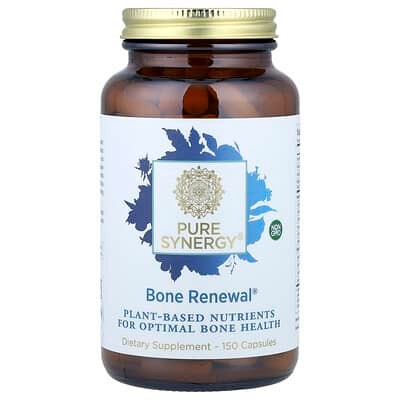
Pure Synergy Bone Renewal combines minerals and vitamins for bone nutrition, with 840 mg of calcium, 420 mg of magnesium and 50 mcg of vitamin D3 per five capsules. Calcium provides the mineral needed for normal bone structure, while vitamin D supports its absorption; the sizeable serving and unclear chemical forms of the minerals are important trade-offs.
AI assessment of the formula, label and price. How scoring works
Nutrient Quality10
The formula's calcium and magnesium are derived from named materials, but their exact chemical forms are unclear. Vitamin D3 is identified, while the vitamin K preparations and plant blends are not fully specified.
Ingredient Transparency43
The five-capsule label gives useful calcium, magnesium and vitamin D amounts. Several blend amounts and individual mineral forms or proportions are missing, limiting detailed comparisons.
Value For Money47
The calcium compares well in price and is central to the formula's purpose. Magnesium offers more limited value given its uncertain form, while vitamin D and K provide less favorable or middling comparisons.
Customer Satisfaction81
Customers report favorable experiences, averaging 4.7 out of 5. That average is based on 954 ratings, providing a substantial base of feedback.
Product Focus36
Bone nutrition is the clearest focus, supported by substantial mineral amounts and vitamin D. The various trace nutrients and blends make it a broad formula whose effects beyond nutrition are less well established.
- Format
Capsule - Container
- 150 Capsule(s)
- Per serving
- $1.61
- Customer rating
- 4.7 · 954 ratings
Goals

Impact
Highest effect
Vitamin K · 120 mcgMagnesium · 420 mgCalcium · 840 mgVitamin D · 50 mcg
Bone Renewal combines substantial mineral provision with vitamin D for bone nutritional support. Its 840 mg calcium supplies bone mineral, while 420 mg magnesium contributes to normal bone metabolism. Vitamin D at 50 mcg supports calcium absorption. Vitamin K2 is claimed on the stored label but lacks a matching imported declaration and reliable amount, limiting assessment of its bone-protein support.
Calcium Supportive
Vitamin K Supportive
Magnesium Supportive

Impact
Highest effect
Vitamin D · 50 mcgMagnesium · 420 mgVitamin K · 120 mcg
Bone Renewal offers substantial mineral support, but the supplied amounts refer to five capsules rather than the catalogue’s three-capsule serving. Its 420 mg of magnesium supports normal energy metabolism, while 50 mcg of vitamin D and 840 mg of calcium contribute to bone and mineral functions. These nutrients are most useful when they fill dietary gaps.
Vitamin D Supportive
Magnesium Supportive
Vitamin K Supportive

Impact
High effect
Magnesium · 420 mgVitamin K · 120 mcgVitamin D · 50 mcg
Bone Renewal offers nutritional support with a limited connection to longevity-related function. The selected comparison uses five capsules, rather than the catalogue’s three-capsule serving. Magnesium at 420 mg supports normal energy reactions, while vitamin D at 50 mcg can help preserve muscle function when vitamin D status is low. A separate 120 mcg vitamin K declaration is retained, but its active preparation is unresolved and cannot be treated as a confirmed vascular-support ingredient.
Vitamin D Supportive
Vitamin K Supportive
Magnesium Supportive

Impact
High effect
Vitamin K · 120 mcgMagnesium · 420 mgVitamin D · 50 mcg
Bone Renewal offers a narrow heart-health fit through magnesium’s limited support for blood-pressure regulation. The assessed five-capsule serving provides 420 mg magnesium, while the catalogue lists three capsules, so the serving difference matters when comparing amounts. Magnesium’s blood-pressure effects are marginal and inconsistent.
Vitamin D Mixed
Magnesium Supportive
Vitamin K Mixed

Impact
High effect
Vitamin D · 50 mcgMagnesium · 420 mg
Bone Renewal has a nutritional energy role mainly when low magnesium or vitamin D status is relevant to fatigue. It supplies 420 mg magnesium and 50 mcg vitamin D per serving, which lead its supplied comparison. The magnesium and vitamin D address nutrient sufficiency rather than providing an immediate stimulant effect.
Vitamin D Supportive
Magnesium Supportive

Impact
High effect
Vitamin D · 50 mcgMagnesium · 420 mg
Bone Renewal offers indirect nutritional stress support through 420 mg magnesium and 50 mcg vitamin D. Magnesium's calming relevance is strongest in low-magnesium or selected clinical settings. Vitamin D's stress relevance also depends on nutritional or clinical context.
Vitamin D Supportive
Magnesium Supportive
Ingredients
| Ingredient | Amount per serving | Score |
|---|---|---|
Vitamin D3 | 50 mcg | |
Vitamin K1 | 120 mcg | |
Calcium (Japanese White Sesame, Red Algae) | 840 mg | |
Magnesium (Brown Rice Chelate, Dead Sea Mineral Concentrate) | 420 mg | |
Plant-Based Trace Minerals & Cofactors | 0 NP | |
SuperPure Plant Extracts | 0 NP |
Calcium (Japanese White Sesame, Red Algae) · 840 mg OverallScore58
Pure Synergy Bone Renewal provides calcium. The serving supplies 840 mg calcium. A large single serving may be absorbed less efficiently. The chemical form of the calcium is unspecified. The calcium price is low at $0.18 per 100 mg; the full formula costs $1.53 per serving.
Pure Synergy Bone Renewal offers a substantial amount of magnesium at 420 mg per serving. The magnesium form is unspecified. At $0.37 per 100 mg of magnesium, with the full formula costing $1.53 per serving, its magnesium represents limited value.
Vitamin K · 120 mcg OverallScore25
Pure Synergy Bone Renewal has an incompletely specified vitamin K mixture: each serving supplies 170 mcg of vitamin K1 and an incompletely specified form. No MK-7 amount is supplied. The comparison cost is moderate at $0.72 per 80 mcg of vitamin K, with a $1.53 serving price; the serving price pays for the full formula.
Alternative products
Report alternatives
Sources
Published studies used for the product analysis and the top-ranked studies for each ingredient and goal.
- What is the impact of daily oral supplementation of vitamin D3 (cholecalciferol) plus calcium on the incidence of hip fracture in older people? A systematic review and meta-analysis.
- Calcium supplementation prevents seasonal bone loss and changes in biochemical markers of bone turnover in elderly New England women: a randomized placebo-controlled trial.
- The effects of calcium supplementation (milk powder or tablets) and exercise on bone density in postmenopausal women.
- The efficacy of calcium supplementation alone in elderly Thai women over a 2-year period: a randomized controlled trial.
- Calcium-enriched foods and bone mass growth in prepubertal girls: a randomized, double-blind, placebo-controlled trial.
- Association between Serum Magnesium and Fractures: A Systematic Review and Meta-Analysis of Observational Studies.
- Bioabsorbable Magnesium-Based Materials Potential and Safety in Bone Surgery: A Systematic Review.
- Vascularized bone grafting fixed by biodegradable magnesium screw for treating osteonecrosis of the femoral head.
- An update on magnesium and bone health.
- Sex-specific differences in the association of magnesium intake with femoral neck bone mineral density among older adults.
- Pregnancy vitamin D supplementation and offspring bone mineral density in childhood follow-up of a randomized controlled trial.
- Vitamin D analogs and bone: preclinical and clinical studies with eldecalcitol.
- Efficacy of vitamin D fortified foods on bone mineral density and serum bone biomarkers: A systematic review and meta-analysis of interventional studies.
- Cholecalciferol Supplementation Attenuates Bone Loss in Incident Kidney Transplant Recipients: A Prespecified Secondary Endpoint Analysis of a Randomized Controlled Trial.
- Vitamin D supplementation and bone health in post-menopausal women: a 24-month randomized controlled intervention with enhanced bioavailability formulations.
- Vitamin K and the prevention of fractures: systematic review and meta-analysis of randomized controlled trials.
- Three-year low-dose menaquinone-7 supplementation helps decrease bone loss in healthy postmenopausal women.
- Effect of combined administration of vitamin D3 and vitamin K2 on bone mineral density of the lumbar spine in postmenopausal women with osteoporosis.
- Efficacy and safety of vitamin K2 for postmenopausal women with osteoporosis at a long-term follow-up: meta-analysis and systematic review.
- Low-dose vitamin K2 (MK-4) supplementation for 12 months improves bone metabolism and prevents forearm bone loss in postmenopausal Japanese women.