
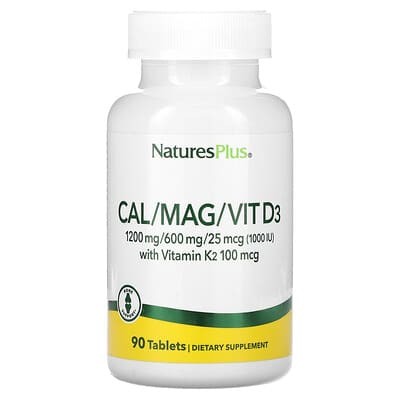

$17.38 $0.79 per serving


Product analysis
Cal/Mag/Vit D3 with Vitamin K2 may help cover nutritional gaps that affect normal bone and muscle function.
AI assessment of the formula, label and price. How scoring works
Nutrient Quality56
Magnesium uses a reasonably favourable form, while calcium and vitamin K have more moderate form profiles. The named vitamin D preparation does not by itself establish a further quality advantage.
Ingredient Transparency100
All four nutrient amounts and forms are disclosed. That makes the combination straightforward to compare with other mineral supplements.
Value For Money36
Vitamin K and calcium are costly relative to their contributions, limiting price appeal. Magnesium offers middling value, while vitamin D remains uncertain.
Customer Satisfaction84
Customer feedback is positive. Thousands of ratings provide a broad base for judging satisfaction.
Product Focus66
The formula centres on normal bone and mineral nutrition, chiefly when intake is low. The large calcium and magnesium amounts do not establish extra benefit, and the MK-4 form cannot be assumed to match MK-7 bone findings.
- Format
Tablet - Container
- 90 Tablet(s)
- Per serving
- $0.79
- Also available
 Cal/Mag/Vit D3 with Vitamin K2$31.41
- Customer rating
- 4.6 · 2,666 ratings
Goals

Impact
Highest effect
Vitamin K · 100 mcgMagnesium · 600 mgCalcium · 1200 mgVitamin D · 25 mcg
Calcium supplies bone mineral, magnesium supports normal bone metabolism, and vitamin D3 supports calcium absorption and deficiency-related mineralization. These nutrients mainly help when intake or vitamin D status is low; the large calcium and magnesium amounts do not establish extra skeletal benefit. Vitamin K2 is declared as menatetrenone, so the limited bone-density findings for MK-7 cannot be transferred to it. The combination's roles do not establish routine fracture prevention.
How this product is rated for Bone Health
Ingredient fit83
Calcium, magnesium, vitamin D and vitamin K all receive recognition, although the K form does not match MK-7 evidence.
Goal fit
The relevant nutrients relate to bone support, while the product also serves broader nutritional purposes.
Dose adequacy
Calcium and magnesium reach the saved upper anchors; vitamin D and vitamin K make partial contributions.
Pathways80
Support is strongest for mineral supply and calcium absorption, with a smaller contribution assigned to bone-protein activation.
Depth
Calcium and magnesium make mineral supply the strongest area.
Breadth
Mineral supply and calcium absorption have substantial coverage; bone-protein activation is less developed.
Evidence96
Calcium leads the nutritional evidence. Menatetrenone does not match the supplied MK-7 bone-density studies.
Evidence strength
Calcium leads the evidence finding; nutritional roles do not establish routine fracture prevention.
Studied preparation
Calcium, magnesium and vitamin D receive preparation recognition; the vitamin K form does not match the studied MK-7 preparation.
Formulation logic100
Vitamin D is present alongside calcium, satisfying its recognized absorption-partner finding. No listed conflict was identified, and all credited ingredients met the saved meaningful-amount threshold.
Partner coverage
Vitamin D is present alongside calcium, satisfying its recognized absorption-partner finding.
Conflicts
No listed ingredient conflict was identified; this finding does not establish overall safety.
Effective doses
All credited ingredients meet the saved meaningful-amount threshold; that threshold is not a proven clinical effective dose.

Impact
Highest effect
Vitamin D · 25 mcgMagnesium · 600 mgVitamin K · 100 mcg
Calcium can help fill low intake relevant to bone mineral, while magnesium contributes to energy metabolism and mineral nutrition. Vitamins D and K add nutrients involved in mineral metabolism, without establishing a special combination benefit. Calcium and magnesium reach the supplied comparison’s upper amount allowance, while the vitamin contributions are smaller; these findings do not show extra benefit above nutritional adequacy or establish safety.
How this product is rated for Everyday Health
Ingredient fit79
The contributing ingredients supply partial amounts overall; this comparison does not establish a clinical benefit threshold.
Goal fit
The contributing ingredients are focused on general health, although the product is also linked to other goals.
Dose adequacy
The contributing ingredients supply partial amounts overall; this comparison does not establish a clinical benefit threshold.
Pathways80
The strongest contribution is in energy metabolism, with substantial support in the supplied comparison. Two areas have meaningful contributions, leaving the product narrower than the full general-health goal.
Depth
The strongest contribution is in energy metabolism, with substantial support in the supplied comparison.
Breadth
Two areas have meaningful contributions, leaving the product narrower than the full general-health goal.
Evidence86
Magnesium leads the supplied evidence comparison; normal nutritional functions do not establish additional benefit when intake is adequate.
Evidence strength
Magnesium leads the supplied evidence comparison; normal nutritional functions do not establish additional benefit when intake is adequate.
Studied preparation
The contributing ingredients with qualifying amounts match accepted preparations, without establishing superior effects from their particular forms.
Formulation logic100
All retained contributors reach the comparison’s minimum amount allowance; this is not a proven clinical treatment threshold.
Partner coverage
The contributing ingredients can act independently or have their required partners; an extra combination benefit is not established.
Conflicts
No configured ingredient conflict was identified in the supplied facts.
Effective doses
All retained contributors reach the comparison’s minimum amount allowance; this is not a proven clinical treatment threshold.

Impact
High effect
Vitamin K · 100 mcgMagnesium · 600 mgVitamin D · 25 mcg
Magnesium supports vascular function and may influence arterial stiffness, although trial findings are inconsistent and benefits are more plausible with low magnesium status or elevated blood pressure. The 600 mg per serving reaches the upper range of the saved amount comparison, without guaranteeing an effect. Vitamin D has no established routine cardiovascular-event benefit, and the MK-4 vitamin K form cannot inherit the limited MK-7 stiffness findings.
How this product is rated for Cardiovascular Support
Ingredient fit70
Magnesium provides the main vascular role; vitamin D is also counted in the saved amount comparison, while MK-4 is excluded.
Goal fit
Magnesium is relevant to vascular function; the MK-4 form does not qualify for MK-7-specific findings.
Dose adequacy
Magnesium reaches the saved amount comparison's upper range; vitamin D provides a partial comparison, while MK-4 receives no preparation-specific contribution.
Pathways54
Magnesium accounts for the vascular-tone finding; other cardiovascular pathways are not covered.
Depth
Magnesium provides the strongest saved coverage through vascular tone and sodium balance.
Breadth
Vascular tone is the only pathway reaching the saved coverage threshold.
Evidence79
Magnesium leads the evidence comparison; studies of arterial stiffness and blood pressure have yielded inconsistent results.
Evidence strength
Magnesium leads the evidence comparison; studies of arterial stiffness and blood pressure have yielded inconsistent results.
Studied preparation
The counted magnesium and vitamin D satisfy the saved preparation check; this does not transfer MK-7 findings to MK-4.
Formulation logic100
No required partners or ingredient conflicts were flagged, and the counted ingredients passed the amount check.
Partner coverage
The counted ingredients work independently or meet the saved partner requirements.
Conflicts
No ingredient conflicts were identified in the supplied checks.
Effective doses
Magnesium and vitamin D pass the saved minimum amount check; MK-4 remains excluded for its preparation.

Impact
Moderate effect
Magnesium · 600 mgVitamin D · 25 mcg
Magnesium and vitamin D support normal muscle function, particularly when they fill dietary gaps. Their contribution is nutritional; the 600 mg magnesium amount does not imply extra performance benefit once intake is adequate.
How this product is rated for Fitness
Ingredient fit67
Fitness-related ingredients share the formula with ingredients aimed at other needs. The counted amounts provide substantial but incomplete exposure support.
Goal fit
Fitness-related ingredients share the formula with ingredients aimed at other needs.
Dose adequacy
The counted amounts provide substantial but incomplete exposure support.
Pathways0
No direct performance mechanism received a contribution in the saved findings. No performance mechanism reaches the saved coverage target.
Depth
No direct performance mechanism received a contribution in the saved findings.
Breadth
No performance mechanism reaches the saved coverage target.
Evidence70
Magnesium provides the strongest evidence contribution among ingredients counted at a sufficient amount, within the specific supplied outcomes. The counted ingredients at sufficient amounts match the preparations recognized by the saved assessment.
Evidence strength
Magnesium provides the strongest evidence contribution among ingredients counted at a sufficient amount, within the specific supplied outcomes.
Studied preparation
The counted ingredients at sufficient amounts match the preparations recognized by the saved assessment.
Formulation logic100
The counted ingredients can contribute independently or have their required partner. No configured ingredient conflict was identified in the supplied findings. 2 of 2 counted ingredients meet the saved minimum exposure threshold.
Partner coverage
The counted ingredients can contribute independently or have their required partner.
Conflicts
No configured ingredient conflict was identified in the supplied findings.
Effective doses
2 of 2 counted ingredients meet the saved minimum exposure threshold.

Impact
High effect
Vitamin K · 100 mcgMagnesium · 600 mgVitamin D · 25 mcg
Magnesium contributes to electrolyte balance and blood-vessel tone, with limited and inconsistent effects on blood pressure. The declared 600 mg per serving reaches the saved comparison’s upper exposure range, which does not establish a larger clinical benefit. Vitamin D has not demonstrated fewer major cardiovascular events in generally replete adults.
How this product is rated for Heart Health
Ingredient fit71
The heart-related contribution is centered on magnesium within a broader mineral formulation. The 600 mg magnesium serving reaches the upper comparison range; this is not a proven blood-pressure response.
Goal fit
The heart-related contribution is centered on magnesium within a broader mineral formulation.
Dose adequacy
The 600 mg magnesium serving reaches the upper comparison range; this is not a proven blood-pressure response.
Pathways57
The strongest saved contribution concerns electrolyte balance and vessel tone, from magnesium. Coverage is concentrated in electrolyte balance and vessel tone, rather than spread across several heart-related processes.
Depth
The strongest saved contribution concerns electrolyte balance and vessel tone, from magnesium.
Breadth
Coverage is concentrated in electrolyte balance and vessel tone, rather than spread across several heart-related processes.
Evidence89
Magnesium has limited, inconsistent blood-pressure evidence, despite being the strongest relevant contributor here.
Evidence strength
Magnesium has limited, inconsistent blood-pressure evidence, despite being the strongest relevant contributor here.
Studied preparation
The saved finding recognizes qualifying nutrient preparations; their forms alone do not establish superior heart-health effects.
Formulation logic100
The counted ingredients have no missing required partners or configured conflicts, and meet the saved minimum amount criterion.
Partner coverage
The counted ingredients do not lack a required partner in the saved findings; this does not demonstrate added benefit from combining them.
Conflicts
No configured stimulant or high-sodium conflict was identified in the supplied facts.
Effective doses
The counted ingredients meet the saved minimum amount criterion, which does not establish a proven clinical dose.

Impact
High effect
Magnesium · 600 mgVitamin D · 25 mcg
Magnesium supplies an essential mineral, but the supplied hormone findings come from a small study involving exercise and a body-weight-based regimen. They do not establish a routine testosterone increase in adequately nourished users. Vitamin D findings are mixed: a signal in initially deficient overweight men was not reproduced as a total-testosterone effect in healthy men.
How this product is rated for Testosterone Support
Ingredient fit66
Magnesium and vitamin D provide the included connections alongside calcium and vitamin K. The included ingredient amounts provide a mixed contribution against the saved comparisons.
Goal fit
Magnesium and vitamin D provide the included connections alongside calcium and vitamin K.
Dose adequacy
The included ingredient amounts provide a mixed contribution against the saved comparisons.
Pathways70
The strongest saved connection concerns free-testosterone availability; the supplied evidence limits any claim of an actual hormone increase. Only one target biological category meets the saved comparison; stress-hormone regulation has no coverage.
Depth
The strongest saved connection concerns free-testosterone availability; the supplied evidence limits any claim of an actual hormone increase.
Breadth
Only one target biological category meets the saved comparison; stress-hormone regulation has no coverage.
Evidence81
Vitamin D leads the saved evidence finding, but findings differ between deficient overweight men and healthy men.
Evidence strength
Vitamin D leads the saved evidence finding, but findings differ between deficient overweight men and healthy men.
Studied preparation
The included preparations match the saved comparison; this alone does not establish product-specific hormone effects.
Formulation logic100
No configured ingredient conflict was identified.
Partner coverage
The included ingredients have no missing required partner; this does not imply a testosterone benefit from combining them.
Conflicts
No configured ingredient conflict was identified.
Effective doses
All included ingredients meet the saved minimum amount comparison; this is not a proven effective testosterone dose.
Ingredients
| Ingredient | Amount per serving | Score |
|---|---|---|
Vitamin D3 (Cholecalciferol) | 25 mcg | |
Vitamin K2 (Menatetrenone) | 100 mcg | |
Calcium (Calcium Amino Acid Chelate) | 1200 mg | |
Magnesium (Magnesium Amino Acid Chelate) | 600 mg |
Magnesium (Magnesium Amino Acid Chelate) · 600 mg OverallScore61
Calcium (Calcium Amino Acid Chelate) · 1200 mg OverallScore42
Vitamin K (Menatetrenone) · 100 mcg OverallScore35
Vitamin K2 is supplied as MK-4, with 100 mcg clearly stated per serving. The disclosure is clear, but it supplies no MK-7 and costs about $0.77 per whole-product serving.
How this ingredient is rated
Active Ingredient Quality & Bioavailability33
The identified source is MK-4, so the MK-7-specific isomer check does not apply.
Vitamin K Form (MK-7 vs. MK-4 vs. K1)
Vitamin K2 is identified as MK-4 rather than MK-7.
MK-7 Isomer Disclosure
No MK-7 source is present in the identified MK-4 source, so the MK-7 isomer check is inapplicable.
Dose, Safety & Label Transparency44
The 100 mcg per-serving amount and MK-4 source are clear. The MK-7-specific amount check does not apply to this source.
Vitamin K2 (MK-7) Dosage Efficacy
The identified MK-4 source supplies no MK-7, so an MK-7-specific amount assessment is inapplicable.
Form and Subtype Transparency
The 100 mcg amount and MK-4 source are identified, making the vitamin K contribution clear.
Value20
The whole-product serving costs about $0.77, making price a notable drawback when comparing its vitamin K contribution.
Price per Effective MK-7 Serving
About $0.77 per whole-product serving, including all ingredients; this is not a separate price for vitamin K.
Alternative products
Report alternatives
Sources
Published studies used for the product analysis and the top-ranked studies for each ingredient and goal.
- What is the impact of daily oral supplementation of vitamin D3 (cholecalciferol) plus calcium on the incidence of hip fracture in older people? A systematic review and meta-analysis.
- Calcium supplementation prevents seasonal bone loss and changes in biochemical markers of bone turnover in elderly New England women: a randomized placebo-controlled trial.
- The effects of calcium supplementation (milk powder or tablets) and exercise on bone density in postmenopausal women.
- The efficacy of calcium supplementation alone in elderly Thai women over a 2-year period: a randomized controlled trial.
- Calcium-enriched foods and bone mass growth in prepubertal girls: a randomized, double-blind, placebo-controlled trial.
- Association between Serum Magnesium and Fractures: A Systematic Review and Meta-Analysis of Observational Studies.
- Bioabsorbable Magnesium-Based Materials Potential and Safety in Bone Surgery: A Systematic Review.
- Vascularized bone grafting fixed by biodegradable magnesium screw for treating osteonecrosis of the femoral head.
- An update on magnesium and bone health.
- Sex-specific differences in the association of magnesium intake with femoral neck bone mineral density among older adults.
- Pregnancy vitamin D supplementation and offspring bone mineral density in childhood follow-up of a randomized controlled trial.
- Vitamin D analogs and bone: preclinical and clinical studies with eldecalcitol.
- Efficacy of vitamin D fortified foods on bone mineral density and serum bone biomarkers: A systematic review and meta-analysis of interventional studies.
- Cholecalciferol Supplementation Attenuates Bone Loss in Incident Kidney Transplant Recipients: A Prespecified Secondary Endpoint Analysis of a Randomized Controlled Trial.
- Vitamin D supplementation and bone health in post-menopausal women: a 24-month randomized controlled intervention with enhanced bioavailability formulations.
- Vitamin K and the prevention of fractures: systematic review and meta-analysis of randomized controlled trials.
- Three-year low-dose menaquinone-7 supplementation helps decrease bone loss in healthy postmenopausal women.
- Effect of combined administration of vitamin D3 and vitamin K2 on bone mineral density of the lumbar spine in postmenopausal women with osteoporosis.
- Efficacy and safety of vitamin K2 for postmenopausal women with osteoporosis at a long-term follow-up: meta-analysis and systematic review.
- Low-dose vitamin K2 (MK-4) supplementation for 12 months improves bone metabolism and prevents forearm bone loss in postmenopausal Japanese women.