
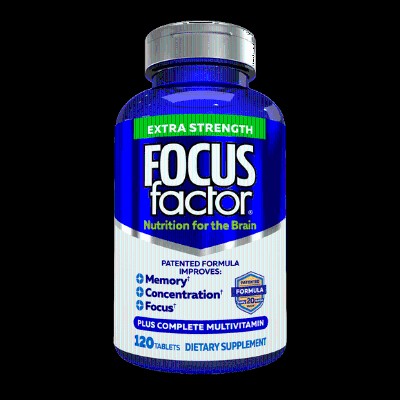

$39.99 $1.33 per serving

Product analysis
Focus Factor Extra Strength offers broad vitamin and mineral support for normal energy use and immune function. The undisclosed contents of its proprietary blend make it difficult to judge what the extra ingredients add.
AI assessment of the formula, label and price. How scoring works
Nutrient Quality45
Several nutrients have clearly identified forms, including vitamin B6 and niacin. Missing forms and an unidentified blend limit a complete picture of ingredient quality.
Ingredient Transparency76
All declared ingredient amounts are stated, but some forms and most mixture proportions are omitted. Those gaps make it difficult to compare the blend and mixed nutrient sources in detail.
Value For Money34
Several of the individually compared nutrients offer limited value at the full formula price. Biotin is more reasonably priced in context, while a reliable comparison is unavailable for many other nutrients.
Customer Satisfaction74
Customer feedback is generally favorable across hundreds of ratings. That gives a useful indication of satisfaction without establishing an effect on focus or health.
Product Focus10
The clearest supported uses are everyday nutrition and immune function. Its extensive mixture and undisclosed blend make a distinct focus benefit difficult to establish.
- Format
Tablet - Container
- 120 Tablet(s)
- Per serving
- $1.33
- Customer rating
- 4.4 · 848 ratings
Goals

Impact
Highest effect
Magnesium · 100 mgVitamin C · 300 mgZinc · 10 mgVitamin A · 1200 mcgVitamin D · 25 mcgSelenium · 70 mcg
Vitamin A supports protective barriers, and zinc, vitamin D and selenium contribute to normal immune function. Vitamin C has modest support for shorter colds with regular use; the amount receives a partial allowance. Iron, copper, folate, B6 and B12 help when low intake impairs immune function. Magnesium and vitamin E have limited routine immunity evidence, and glutamine presence remains unresolved.
How this product is rated for Immunity
Ingredient fit61
The relevant nutrients receive the main ingredient allowances. Amounts vary in how fully they meet the saved comparison ranges.
Goal fit
The relevant nutrients supply the main saved ingredient focus; other actives and the product’s wider purposes affect specificity.
Dose adequacy
The declared amounts receive partial or mixed allowances, limiting the saved contribution without proving the ingredients ineffective.
Pathways97
The strongest saved contribution concerns lymphocyte function and immune regulation. The saved findings span the target range of immune functions.
Depth
The strongest saved contribution concerns lymphocyte function and immune regulation.
Breadth
The saved findings identify meaningful coverage of barrier and antimicrobial defense, lymphocyte function and immune regulation, oxidative and inflammatory balance.
Evidence100
The strongest relevant support concerns normal nutrient function or regular vitamin C use, rather than general infection prevention.
Evidence strength
The strongest relevant support concerns normal nutrient function or regular vitamin C use, rather than general infection prevention.
Studied preparation
The relevant preparations receive the saved comparison allowance, without establishing clinical superiority over alternative forms.
Formulation logic100
The counted ingredients meet the minimum amount criterion and have no missing required partner or identified configured conflict.
Partner coverage
No required partner is missing for the ingredients counted in the saved findings.
Conflicts
No configured ingredient conflict was identified; this does not establish individual suitability.
Effective doses
The ingredients counted here meet the saved minimum amount criterion; this comparison threshold does not prove clinical effectiveness.

Impact
Highest effect
Folate · 665 mcg DFEVitamin B12 · 20 mcgVitamin D · 25 mcgMagnesium · 100 mgSelenium · 70 mcgZinc · 10 mgVitamin C · 300 mg
B vitamins provide nutrients used in normal energy metabolism, with folate and B12 contributing to blood formation where present. Magnesium provides a nutritional contribution to energy and mineral metabolism. Vitamin D contributes to nutritional adequacy for bone and mineral function. Vitamin C and zinc contribute nutrients involved in normal antioxidant or immune processes.
How this product is rated for Everyday Health
Ingredient fit82
Several declared amounts provide only partial coverage of the saved comparisons, limiting their attributed contribution.
Goal fit
The identified ingredients are concentrated in the roles considered relevant to general health.
Dose adequacy
Several declared amounts provide only partial coverage of the saved comparisons, limiting their attributed contribution.
Pathways100
The strongest identified connection concerns nutrients used in energy metabolism.
Depth
The strongest identified connection concerns nutrients used in energy metabolism.
Breadth
The identified connections cover nutrients used in energy metabolism, folate-related processes and blood formation, bone and mineral function, normal antioxidant and immune processes.
Evidence86
Magnesium leads the saved evidence findings, while the supplied context limits what can be claimed for general health.
Evidence strength
Magnesium leads the saved evidence findings, while the supplied context limits what can be claimed for general health.
Studied preparation
The evaluated preparations meet the supplied preparation comparison; study population and outcome limitations still apply.
Formulation logic100
The evaluated ingredients have no unmet partner requirement in the supplied findings.
Partner coverage
The evaluated ingredients have no unmet partner requirement in the supplied findings.
Conflicts
No configured ingredient conflict was identified.
Effective doses
The evaluated ingredients meet the saved minimum amount comparison; this is not a proven threshold for health benefit.

Impact
High effect
Biotin · 300 mcgVitamin D · 25 mcgZinc · 10 mgIron · 5 mgVitamin C · 300 mg
Zinc can help address shedding associated with low zinc intake. Vitamin C supports normal collagen formation and iron absorption, while folate supports cell division; these functions do not establish extra hair growth when nutrition is adequate. The small iron amount receives no contribution in the saved findings, and the formula does not establish a broader hair-loss treatment.
How this product is rated for Hair Health
Ingredient fit67
The contributing amounts cover part of the saved comparison range; this does not establish a measured hair-growth response.
Goal fit
The formula includes ingredients connected to hair health, alongside broader nutritional or other uses that reduce its specific focus.
Dose adequacy
The contributing amounts cover part of the saved comparison range; this does not establish a measured hair-growth response.
Pathways56
The strongest saved connection is to follicle antioxidant protection; normal nutrient functions do not establish improved hair growth.
Depth
The strongest saved connection is to follicle antioxidant protection; normal nutrient functions do not establish improved hair growth.
Breadth
Antioxidant protection is the only area reaching the saved coverage threshold; broader hair-loss mechanisms remain unsupported.
Evidence97
Zinc provides the strongest contributing evidence, with benefit tied to correcting low intake rather than routine regrowth.
Evidence strength
Zinc provides the strongest contributing evidence, with benefit tied to correcting low intake rather than routine regrowth.
Studied preparation
Most contributing forms match the saved preparation criteria; iodine does not, and this does not establish equivalent hair outcomes.
Formulation logic100
The contributing ingredients have no missing required partners or configured conflicts. Their amounts meet the saved minimum comparison threshold.
Partner coverage
No required ingredient partner is missing among the contributing ingredients; this does not establish an added combination benefit.
Conflicts
No configured ingredient conflict was identified in the supplied calculation.
Effective doses
All contributing ingredients meet the saved minimum amount threshold; this is a comparison finding, not proof of clinical effectiveness.
Ingredients
| Ingredient | Amount per serving | Score |
|---|---|---|
Vitamin A (Beta-Carotene, Mixed Carotenoids) | 1200 mcg | |
Vitamin C (Ascorbic Acid, Ascorbyl Palmitate, Calcium Ascorbate, Potassium Ascorbate, Sodium Ascorbate, Zinc Ascorbate) | 300 mg | |
Vitamin D (Cholecalciferol) | 25 mcg | |
Vitamin E (D-Alpha-Tocopheryl Succinate) | 20.1 mg | |
Thiamine (Thiamine Mononitrate) | 4.5 mg | |
Riboflavin | 5.1 mg | |
Niacin (Inositol Hexanicotinate, Niacinamide) | 25 mg | |
Vitamin B6 (Pyridoxal 5-Phosphate, Pyridoxal-Alpha-Ketoglutarate) | 15 mg | |
Folate | 665 mcg DFE | |
Vitamin B12 | 20 mcg | |
Biotin | 300 mcg | |
Pantothenic Acid (D-Calcium Pantothenate) | 12 mg | |
Choline (Choline Bitartrate) | 30 mg | |
Calcium (Calcium Ascorbate, Calcium Citrate, Calcium Succinate) | 50 mg | |
Iron (Carbonyl Iron) | 5 mg | |
Iodine (Kelp) | 75 mcg | |
Magnesium (Magnesium Citrate, Magnesium Malate, Magnesium Taurinate) | 100 mg | |
Zinc (Zinc Ascorbate, Zinc Citrate) | 10 mg | |
Selenium (Selenomethionine) | 70 mcg | |
Copper (Copper Citrate, Copper Glycinate Chelate) | 0.4 mg | |
Manganese (Manganese Citrate) | 2 mg | |
Chromium (Chromium Polynicotinate) | 100 mcg | |
Molybdenum (Molybdenum Amino Acid Chelate) | 30 mcg | |
Potassium (Potassium Ascorbate, Potassium Aspartate, Potassium Citrate) | 50 mg | |
Synergistic and Proprietary Formulation | 798 mg |
One serving provides 15 mg of vitamin B6, exceeding the European adult daily upper limit. The B6 comes from pyridoxal 5-phosphate and pyridoxal alpha-ketoglutarate; their individual proportions are not disclosed.
How this ingredient is rated
Ingredient Form & Label Quality94
The B6 comes from pyridoxal 5-phosphate and pyridoxal alpha-ketoglutarate. The evaluation flags talc.
Vitamin B6 Form Identification
The identified B6 sources are pyridoxal 5-phosphate and pyridoxal alpha-ketoglutarate; their individual proportions are not disclosed.
Clean Label and Excipient Purity
The evaluation flags talc among the additives.
Dose, Safety & Label Transparency69
The 15 mg of vitamin B6 in one serving exceeds the European adult daily upper limit; food and other supplements add to total intake.
Vitamin B6 Dose & Safety Policy
One serving provides 15 mg of vitamin B6, exceeding the European adult daily upper limit before other sources are counted.
Label Transparency
The total B6 amount and both chemical sources are identified.
Value18
The whole-product price works out to about $0.089 per mg of vitamin B6.
Vitamin B6 Price Efficiency
The whole-product price works out to about $0.089 per mg of vitamin B6.
Niacin (Inositol Hexanicotinate, Niacinamide) · 25 mg OverallScore59
A four-tablet serving provides 25 mg of niacin from niacinamide and inositol hexanicotinate in equal disclosed proportions. Both forms are generally considered non-flushing.
How this ingredient is rated
Active Ingredient Quality & Bioavailability71
Niacinamide and inositol hexanicotinate contribute equally to the recorded niacin, and both are generally considered non-flushing.
Niacin Form & Goal Alignment
The recorded niacin sources are niacinamide and inositol hexanicotinate in equal disclosed proportions.
Precursor Source Quality
Niacinamide and inositol hexanicotinate are the recorded sources; no NR or NMN precursor is identified in the saved facts.
Dose, Safety & Label Transparency67
A serving provides 25 mg of niacin. The two forms and their equal proportions are recorded.
Clarity of Chemical Form
Both niacinamide and inositol hexanicotinate are identified, with equal source proportions disclosed.
Form-Specific Dosage Efficacy
A serving provides 25 mg of niacin.
Flush Risk & Safety Labeling
Both forms are generally considered non-flushing; no explicit no-flush claim is recorded.
Value20
The whole product costs about $1.33 per serving.
Price Per Effective Serving
The whole product costs about $1.33 per serving.
Manganese (Manganese Citrate) · 2 mg OverallScore70
Each serving provides 2 mg of manganese as manganese citrate. The whole-product serving costs about $1.33.
How this ingredient is rated
Active Ingredient Quality & Bioavailability80
The stated form is manganese citrate.
Manganese Chemical Form
The stated form is manganese citrate.
Dose, Safety & Label Transparency86
The manganese amount is recorded as 2 mg per serving.
Manganese Dosage Efficacy & Safety
The serving provides 2 mg of manganese.
Elemental Weight Disclosure
The elemental manganese amount is recorded as 2 mg per serving.
Value20
The whole-product price is about $1.33 per serving.
Price per Serving vs. Median
The whole-product price is about $1.33 per serving.
Alternative products
Report alternatives
Sources
Published studies used for the product analysis and the top-ranked studies for each ingredient and goal.
- Intakes of Folate, Vitamin B6, and Vitamin B12 in Relation to All-Cause and Cause-Specific Mortality: A National Population-Based Cohort.
- The responsiveness of plasma homocysteine to small increases in dietary folic acid: a primary care study.
- Associations of Serum Folate and Homocysteine Concentrations with All-Cause, Cardiovascular Disease, and Cancer Mortality in Men and Women in Korea: the Cardiovascular Disease Association Study.
- The concept of folic acid supplementation and its role in prevention of neural tube defect among pregnant women: PRISMA.
- Systematic review of adverse health outcomes associated with high serum or red blood cell folate concentrations.
- Perioperative systemic magnesium to minimize postoperative pain: a meta-analysis of randomized controlled trials.
- Long-term outcome after intravenous magnesium sulphate in suspected acute myocardial infarction: the second Leicester Intravenous Magnesium Intervention Trial (LIMIT-2).
- Association of magnesium sulfate use with mortality in critically ill patients with sepsis: a retrospective propensity score-matched cohort study.
- Hypomagnesemia and Mortality in Incident Hemodialysis Patients.
- The effects of magnesium supplementation on abnormal uterine bleeding, alopecia, quality of life, and acne in women with polycystic ovary syndrome: a randomized clinical trial.
- Associations of selenium status with all-cause and cause-specific mortality: a systematic review and meta-analysis of cohort studies.
- Dietary Antioxidants, Circulating Antioxidant Concentrations, Total Antioxidant Capacity, and Risk of All-Cause Mortality: A Systematic Review and Dose-Response Meta-Analysis of Prospective Observational Studies.
- The efficacy and safety of selenium supplementation versus placebo in the treatment of Graves' orbitopathy: A systematic review and meta-analysis of randomised controlled trials.
- Associations of plasma metal concentrations with the risks of all-cause and cardiovascular disease mortality in Chinese adults.
- Updates on clinical studies of selenium supplementation in radiotherapy.
- Oral Vitamin B12 versus Placebo for the Prevention of Chemotherapy-Induced Peripheral Neuropathy in Gynecological Cancer Patients: A Randomized, Double-Blind, Placebo-Controlled Trial.
- Vitamin B12 Supplementation in Diabetic Neuropathy: A 1-Year, Randomized, Double-Blind, Placebo-Controlled Trial.
- A single-center randomized controlled trial of local methylcobalamin injection for subacute herpetic neuralgia.
- Local Injection of Methylcobalamin Combined with Lidocaine for Acute Herpetic Neuralgia.
- The Effect of Vitamin B12 and Folic Acid Supplementation on Serum Homocysteine, Anemia Status and Quality of Life of Patients with Multiple Sclerosis.