
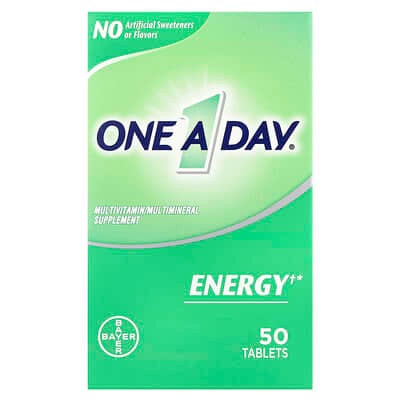

$10.90 $0.21 per serving


Product analysis
Energy brings vitamins and minerals together with caffeine in one supplement. Most nutrient forms are not specified, making exact ingredient comparisons harder.
AI assessment of the formula, label and price. How scoring works
Nutrient Quality23
Most nutrient forms are unspecified, leaving their quality uncertain. Some forms are identified elsewhere in the ingredient list, but the proportions of several mineral sources remain unclear.
Ingredient Transparency67
Ingredient amounts are clearly listed, helping you compare servings. Some ingredient forms are named, while others remain unclear.
Value For Money54
Several minerals offer favorable value, while niacin and biotin offer more moderate value. Value for many other nutrients and caffeine remains uncertain, and the calcium and copper comparisons are older.
Customer Satisfaction72
Customer feedback is very positive. The number of reviews gives more context to satisfaction but does not establish effectiveness or safety.
Product Focus42
The ingredient mix has support across several intended goals, though benefits remain uncertain. None of the ingredients is confirmed to be unnecessary.
- Format
Tablet - Container
- 50 Tablet(s)
- Per serving
- $0.21
- Customer rating
- 4.7 · 125 ratings
Goals

Impact
High effect
Iodine · 150 mcgVitamin D · 10 mcgVitamin B5 · 10 mgMagnesium · 40 mgRiboflavin · 3.4 mgThiamin · 3 mgVitamin B12 · 12 mcgIron · 9 mgCaffeine · 90 mg
Caffeine supports acute alertness and reduced sleepiness, with 90 mg per serving. Iron, folate and several B vitamins also have roles in addressing fatigue associated with low nutrient intake, alongside vitamin C. These nutritional roles do not establish extra energy when intake is adequate. The low magnesium amount and the supplied B12 and vitamin D amounts did not contribute to the saved result.
How this product is rated for Energy
Ingredient fit63
Several nutrients contribute through their nutritional roles, with varying amounts and additional ingredients outside those roles.
Goal fit
The relevant nutrients share the formula with other actives, so the product's focus extends beyond energy.
Dose adequacy
Amounts vary across the contributing nutrients; excluded low amounts do not establish a lack of nutritional value.
Pathways45
Alertness is the only supported route among those evaluated. Broader exercise and cellular-energy coverage is absent.
Depth
Caffeine provides the strongest contribution through alertness.
Breadth
Alertness is the only route meeting the saved coverage threshold.
Evidence99
Caffeine supplies the strongest relevant evidence for acute alertness. The qualifying ingredients meet the saved preparation criteria.
Evidence strength
Caffeine provides the strongest relevant evidence, specifically for acute alertness and reduced sleepiness.
Studied preparation
Most qualifying nutrient declarations meet the saved preparation criteria; iodine does not.
Formulation logic100
The contributing ingredients meet the saved minimum amount and partner conditions. No configured conflict was identified.
Partner coverage
The contributing ingredients do not require an additional partner under the supplied findings.
Conflicts
No configured ingredient conflict was identified in the supplied facts.
Effective doses
All ingredients counted in the saved result meet its minimum amount criterion; that criterion does not guarantee a noticeable benefit.
Vitamin B5 Not classified
No linked studies yet.

Impact
High effect
Folate · 665 mcg DFEVitamin B6 · 4 mgVitamin D · 10 mcgVitamin B12 · 12 mcgMagnesium · 40 mgCaffeine · 90 mg
Caffeine supplies the most direct support for alertness and sustained attention. Folate, iron, vitamin B12, thiamin and niacin can help concentration when low intake or deficiency impairs it. These nutritional roles are separate from an immediate stimulant effect and do not establish extra focus when intake is adequate.
How this product is rated for Mental Focus
Ingredient fit72
Caffeine contributes immediate alertness alongside nutrients relevant to deficiency-related concentration problems. The declared amounts provide uneven coverage of the saved amount ranges; some contributions remain partial.
Goal fit
Caffeine contributes immediate alertness alongside nutrients relevant to deficiency-related concentration problems.
Dose adequacy
The declared amounts provide uneven coverage of the saved amount ranges; some contributions remain partial.
Pathways56
Caffeine dominates the immediate alertness finding.
Depth
Caffeine dominates the immediate alertness finding.
Breadth
Only the alertness route reaches the saved coverage threshold.
Evidence79
Caffeine provides the clearest direct acute attention evidence.
Evidence strength
Caffeine provides the clearest direct acute attention evidence.
Studied preparation
The saved preparation match is complete for the ingredients that meet its amount criterion; this does not establish consistent focus benefit.
Formulation logic100
The represented ingredients have no missing required partner in the saved finding. No specified ingredient conflict was identified in the saved findings.
Partner coverage
The represented ingredients have no missing required partner in the saved finding.
Conflicts
No specified ingredient conflict was identified in the saved findings.
Effective doses
All ingredients counted by this rule reach its minimum amount criterion; that threshold is not a clinically proven effective dose.

Impact
High effect
Biotin · 300 mcgVitamin D · 10 mcgZinc · 15 mgIron · 9 mgVitamin C · 60 mg
Zinc and iron can contribute to hair health when inadequate intake is associated with shedding. Copper supports normal pigmentation and connective tissue, while selenium supports antioxidant functions; these roles do not establish routine regrowth. Biotin is present but received no meaningful amount recognition in the saved findings. The broader vitamin mixture does not establish additional hair benefit from combining these ingredients.
How this product is rated for Hair Health
Ingredient fit66
The formula includes hair-relevant nutrients, alongside broader nutritional ingredients. Several contributions depend on intake, amount or preparation rather than establishing routine regrowth.
Goal fit
Relevant nutrients share the formula with ingredients aimed at other goals, making its hair focus less concentrated.
Dose adequacy
The amounts provide partial coverage of the saved comparisons rather than uniformly matching their reference exposures.
Pathways14
The strongest coverage concerns antioxidant functions, with limited breadth across the other assessed hair mechanisms.
Depth
Antioxidant-related nutrients provide the strongest coverage; normal antioxidant functions do not by themselves establish hair regrowth.
Breadth
The formula does not reach the saved coverage level in any assessed hair mechanism.
Evidence97
The leading ingredient findings must be read alongside their nutritional and preparation limits. Recognition in the saved comparisons does not establish routine regrowth from this product.
Evidence strength
Zinc leads the ingredient findings, with hair benefits most relevant when intake is inadequate.
Studied preparation
Most recognized preparations match the saved comparison, while iodine lacks a studied hair preparation.
Formulation logic100
Required partners are accounted for and no configured conflicts were found. The amount findings describe comparison coverage, without proving combined hair benefit.
Partner coverage
No required ingredient partner is missing from the saved findings; this does not imply added benefit from combining ingredients.
Conflicts
No configured ingredient conflict was identified; unassessed interactions and suitability remain unresolved.
Effective doses
All ingredients included in this amount check reach its minimum comparison level; that level is not a proven effective hair dose.

Impact
High effect
Vitamin K · 25 mcgMagnesium · 40 mgCalcium · 250 mgVitamin D · 10 mcgCopper · 2 mgManganese · 2 mgZinc · 15 mgVitamin C · 60 mg
Calcium supplies bone mineral; its 250 mg per serving can help fill a dietary gap, without establishing extra benefit when intake is already adequate. Vitamin D supports calcium absorption and deficiency-related mineralization; routine extra supplementation has not established fracture prevention in generally healthy adults. Magnesium supports normal bone metabolism when intake is low, although routine fracture prevention is unproven. Vitamin C supports collagen formation and copper helps cross-link it, with the clearest skeletal benefit from correcting deficiency.
How this product is rated for Bone Health
Ingredient fit63
Minerals provide a nutritional route to supporting bones, with the contribution depending on the declared amount and dietary need.
Goal fit
Bone-related nutrients sit within a broader formula containing ingredients aimed at other needs.
Dose adequacy
The declared amounts provide partial or mixed coverage of the nutritional and preparation references; lower amounts limit the contribution.
Pathways60
The main represented roles are collagen matrix formation. Other bone-related roles receive less or no coverage.
Depth
The strongest represented role is collagen matrix formation. This describes ingredient coverage, not a demonstrated change in bone health.
Breadth
The main represented roles are collagen matrix formation. Other bone-related roles receive less or no coverage.
Evidence100
Calcium supports mineralization when dietary intake is insufficient; fracture outcomes remain mixed.
Evidence strength
Calcium supports mineralization when dietary intake is insufficient; fracture outcomes remain mixed.
Studied preparation
The saved findings identify the counted preparations as matching study preparations; that match does not establish fracture prevention.
Formulation logic100
The counted ingredients either have their specified nutritional partner or can contribute independently. No configured ingredient conflict was identified in the supplied findings.
Partner coverage
The counted ingredients either have their specified nutritional partner or can contribute independently.
Conflicts
No configured ingredient conflict was identified in the supplied findings.
Effective doses
The counted ingredients meet the saved minimum amount comparison; this does not make those amounts proven effective doses for preventing fractures.
Ingredients
| Ingredient | Amount per serving | Score |
|---|---|---|
Vitamin A (Beta-Carotene) | 1050 mcg | |
Vitamin C | 60 mg | |
Vitamin D | 10 mcg | |
Vitamin E | 10.1 mg | |
Vitamin K | 25 mcg | |
Thiamine | 3 mg | |
Riboflavin | 3.4 mg | |
Niacin | 40 mg | |
Vitamin B6 | 4 mg | |
Folate | 665 mcg DFE | |
Vitamin B12 | 12 mcg | |
Biotin | 300 mcg | |
Pantothenic Acid | 10 mg | |
Calcium | 250 mg | |
Iron | 9 mg | |
Iodine | 150 mcg | |
Magnesium | 40 mg | |
Zinc | 15 mg | |
Selenium | 45 mcg | |
Copper | 2 mg | |
Manganese | 2 mg | |
Chromium | 100 mcg | |
Molybdenum | 25 mcg | |
Caffeine | 90 mg |
Iodine · 150 mcg OverallScore88
Caffeine · 90 mg OverallScore73
Each serving lists 90 mg of caffeine. The whole-product serving costs about $0.22.
How this ingredient is rated
Active Ingredient Quality & Bioavailability40
Caffeine is identified, but the available form data do not specify a distinct preparation or establish a release advantage.
Advanced Bioavailability and Release Profiles
Caffeine is identified, but the available form data do not specify a distinct preparation or establish a release advantage.
Dose, Safety & Label Transparency92
The stated 90 mg of caffeine per serving is a mild amount. The evaluated ingredient panel lists no secondary stimulants.
Caffeine Dose Transparency
The label states 90 mg of caffeine per serving.
Dosage Efficacy and Safety Margin
The stated 90 mg of caffeine per serving is a mild amount.
Secondary Stimulant Disclosure and Risk
The evaluated ingredient panel lists no secondary stimulants.
Value100
The whole-product serving costs about $0.22, on the lower end of the evaluated prices.
Price Per Serving vs. Collection Median
The whole-product serving costs about $0.22, on the lower end of the evaluated prices.
Calcium · 250 mg OverallScore52
Each serving provides 250 mg of calcium, but the source of that amount is uncertain. Several calcium compounds appear in the other ingredients, and an artificial additive is flagged.
How this ingredient is rated
Active Ingredient Quality & Bioavailability37
Calcium carbonate, dicalcium phosphate, and calcium D-pantothenate appear in the other ingredients, but the source of the listed calcium remains uncertain.
Calcium Form & Absorption Potential
Calcium carbonate, dicalcium phosphate, and calcium D-pantothenate appear in the other ingredients; the source of the stated calcium amount is not fully known.
Elemental Calcium Transparency
The label specifies 250 mg of elemental calcium per serving.
Dose, Safety & Label Transparency42
A serving supplies 250 mg of calcium. The evaluation flags an artificial additive in the ingredients.
Absorption-Optimized Serving Dose
A serving supplies 250 mg of calcium.
Formulation Purity & Additives
The evaluation flags an artificial additive in the ingredients.
Value100
At about $0.22 per whole-product serving, the price covers the entire product.
Price Per Serving Efficiency
A whole-product serving costs about $0.22.
Alternative products
Report alternatives
Sources
Published studies used for the product analysis and the top-ranked studies for each ingredient and goal.
- What is the impact of daily oral supplementation of vitamin D3 (cholecalciferol) plus calcium on the incidence of hip fracture in older people? A systematic review and meta-analysis.
- Calcium supplementation prevents seasonal bone loss and changes in biochemical markers of bone turnover in elderly New England women: a randomized placebo-controlled trial.
- The effects of calcium supplementation (milk powder or tablets) and exercise on bone density in postmenopausal women.
- The efficacy of calcium supplementation alone in elderly Thai women over a 2-year period: a randomized controlled trial.
- Calcium-enriched foods and bone mass growth in prepubertal girls: a randomized, double-blind, placebo-controlled trial.
- The Association between Dietary and Circulating Copper Levels and Osteoporosis: a Scoping Review.
- Association between dietary copper, iron, zinc, selenium intake and osteopenia or osteoporosis in elderly hypertensive patients: a retrospective cohort study.
- Associations of dietary copper intake with total bone mineral density and lumbar spine bone mineral density in American adults.
- The association between dietary mineral intake and bone mineral density: a cross-sectional study.
- Association between dietary copper intake and bone mineral density in children and adolescents aged 8-19 years: A cross-sectional study.
- Association between RBC folate and lumbar bone mineral density in postmenopausal women, a cross-sectional study from NHANES 2009-2018.
- Genetic variants modify the associations of concentrations of methylmalonic acid, vitamin B-12, vitamin B-6, and folate with bone mineral density.
- Adequate Intake and Supplementation of B Vitamins, in Particular Folic Acid, can Play a Protective Role in Bone Health.
- Relation of homocysteine, folate, and vitamin B12 to bone mineral density of postmenopausal women.
- Dietary intake of folate, but not vitamin B2 or B12, is associated with increased bone mineral density 5 years after the menopause: results from a 10-year follow-up study in early postmenopausal women.
- Association between Serum Magnesium and Fractures: A Systematic Review and Meta-Analysis of Observational Studies.
- Bioabsorbable Magnesium-Based Materials Potential and Safety in Bone Surgery: A Systematic Review.
- Vascularized bone grafting fixed by biodegradable magnesium screw for treating osteonecrosis of the femoral head.
- An update on magnesium and bone health.
- Sex-specific differences in the association of magnesium intake with femoral neck bone mineral density among older adults.