
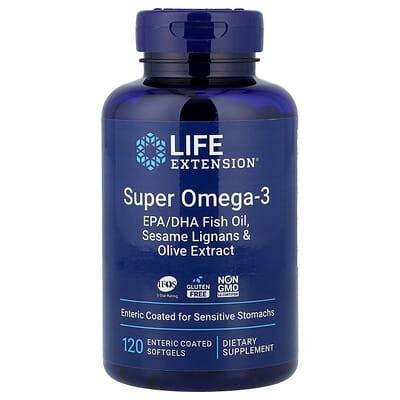

$24.00 $0.40 per serving


Product analysis
Super Omega-3 supplies EPA and DHA, omega-3 fats linked most closely to support for blood-fat levels. Its undisclosed oil forms and blend contents make a detailed quality comparison harder.
AI assessment of the formula, label and price. How scoring works
Nutrient Quality20
The oil forms are not disclosed, preventing a confident comparison of absorption quality. The unnamed blend components also leave part of the formula unclear.
Ingredient Transparency65
EPA and DHA amounts are declared separately, making the active fats easier to compare than total fish-oil weight. The oil forms and one blend’s contents remain undisclosed.
Value For Money92
The declared EPA and DHA generally offer favourable value in their unit-cost comparisons. Their prices do not establish the benefits of higher-exposure or prescription preparations.
Customer Satisfaction91
Customer ratings are generally positive. The size of the review base helps show how widely those experiences are represented.
Product Focus38
The clearest connection is to blood-fat levels, with limited support for longer-term brain nutrition. Immediate focus improvements and felt relief from inflammation remain uncertain.
- Format
Softgel - Container
- 120 Softgel(s)
- Per serving
- $0.40
- Also available
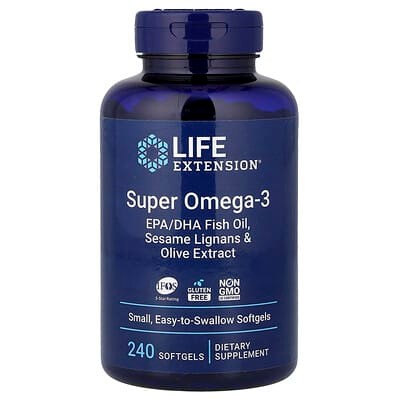 Super Omega-3$24.00
- Customer rating
- 4.8 · 5,471 ratings
Goals

Impact
Moderate effect
Fish Oil · 2000 mg
EPA and DHA may lower some markers of inflammation in the blood. These omega-3 fats are relevant to inflammatory processes, but changes in blood markers do not necessarily mean you will feel less pain or experience relief from an inflammatory condition. Their declared amounts matter more for this purpose than the total weight of fish oil.
How this product is rated for Inflammation
Ingredient fit55
EPA and DHA may reduce some blood markers of inflammation; symptom relief does not automatically follow.
Goal fit
EPA and DHA may reduce some blood markers of inflammation; symptom relief does not automatically follow.
Dose adequacy
The serving declares EPA 700 mg and DHA 500 mg; these are separate from total fish-oil weight.
Pathways19
EPA and DHA may reduce some blood markers of inflammation; symptom relief does not automatically follow.
Depth
EPA and DHA may reduce some blood markers of inflammation; symptom relief does not automatically follow.
Breadth
Effects on individual inflammation-related processes do not demonstrate broad symptom relief.
Evidence70
EPA and DHA are explicitly identified; total fish-oil mass is not interchangeable with their amounts.
Evidence strength
EPA and DHA may reduce some blood markers of inflammation; symptom relief does not automatically follow.
Studied preparation
EPA and DHA are explicitly identified; total fish-oil mass is not interchangeable with their amounts.
Formulation logic100
No particular ingredient conflict or missing required partner is identified.
Partner coverage
No missing required ingredient partner is identified.
Conflicts
No particular ingredient conflict is identified.
Effective doses
The serving declares EPA 700 mg and DHA 500 mg; these are separate from total fish-oil weight.

Impact
High effect
EPA (Eicosapentaenoic Acid) · 700 mg
EPA contributes to triglyceride-related support, while DHA has limited evidence for selected blood-pressure and vascular effects. Their declared amounts provide a clearer comparison than the total fish-oil weight, and the two DHA entries describe the same ingredient. These findings do not establish prevention of heart attacks or other major cardiovascular events, and one serving does not establish the daily exposure used in trials.
How this product is rated for Heart Health
Ingredient fit70
EPA and DHA provide the principal connection to heart health. Their declared amounts provide differing levels of coverage of the supplied comparison ranges.
Goal fit
EPA and DHA provide the relevant connection, while the formula also covers other purposes.
Dose adequacy
DHA reaches its comparison range, while EPA makes a smaller amount-based contribution.
Pathways60
The findings center on triglyceride handling. This is a concentrated contribution rather than coverage of several heart-related routes.
Depth
EPA and DHA concentrate the findings on triglyceride handling.
Breadth
The findings cover triglyceride handling, with no comparable coverage of the other assessed routes.
Evidence100
EPA has the strongest evidence contribution for triglyceride-related support, with more limited DHA vascular findings.
Evidence strength
EPA supplies the strongest evidence contribution here, chiefly for triglyceride-related effects.
Studied preparation
Declared EPA and DHA fit the supplied preparation comparison; the carrier oil does not add an independent active dose.
Formulation logic100
No unmet partner requirement or listed stimulant or high-sodium conflict was identified. The ingredients counted for amount coverage reach the supplied comparison threshold.
Partner coverage
The contributing ingredients have no unmet partner requirement in the supplied findings.
Conflicts
No listed caffeine, stimulant or high-sodium conflict was identified in the supplied facts.
Effective doses
The counted ingredients meet the saved amount-comparison threshold; this is not proof of clinical effectiveness.
DHA (Docosahexaenoic Acid) Not classified
No linked studies yet.

Impact
High effect
Fish Oil · 2000 mg
EPA and DHA can lower triglycerides, a blood-fat marker, in the studied populations. This serving declares 700 mg EPA and 500 mg DHA separately; those declarations support their individual recognition, while no combined EPA+DHA amount is inferred from fish-oil mass. Their study-linked marker role does not establish prevention of heart attacks or rhythm problems, and one serving does not establish a daily regimen.
How this product is rated for Cardiovascular Support
Ingredient fit76
The relevant ingredients provide a cardiovascular connection, with their declared amounts determining how closely study exposures can be compared.
Goal fit
Cardiovascular ingredients share the formula with other aims, so its focus is less concentrated.
Dose adequacy
The recognized amounts reach the comparison anchors; those anchors do not establish a clinical benefit or a daily regimen.
Pathways60
The findings concentrate on triglyceride metabolism, rather than establishing broad clinical protection.
Depth
The strongest recorded area is triglyceride metabolism, with the clinical limits described for the relevant ingredients.
Breadth
The findings concentrate on one selected cardiovascular pathway, leaving broader coverage limited.
Evidence83
Evidence recognition concerns the supplied ingredients and preparations; the scientific context preserves distinctions between marker changes and clinical events.
Evidence strength
EPA declared active leads the recognized evidence findings; marker changes and population limits constrain what that means for cardiovascular outcomes.
Studied preparation
The recognized preparation declarations receive a study match in the saved findings; this does not extend their results beyond the studied outcomes and populations.
Formulation logic100
No missing required partner or ingredient conflict is recorded; amount limitations still affect interpretation.
Partner coverage
No required partner is missing for the recognized ingredients; this does not establish extra benefit from combining them.
Conflicts
No ingredient conflict was recorded in the supplied findings.
Effective doses
All recognized ingredients meet the saved minimum amount threshold; this is not a proven clinical-effect threshold.

Impact
High effect
DHA and EPA are relevant to longer-term brain nutrition, but the supplied cognitive findings concern repeated intake and selected populations. Those findings do not establish an immediate improvement in focus from this serving, and fish-oil quantity cannot substitute for the separately declared fatty acids.
How this product is rated for Mental Focus
Ingredient fit65
The saved finding includes epa (eicosapentaenoic acid) among its relevant ingredients. Amounts make uneven contributions to the saved comparison; smaller or preparation-limited contributions reduce the overall match.
Goal fit
The relevant ingredients share the formula with actives serving other goals, limiting its focus.
Dose adequacy
Amounts make uneven contributions to the saved comparison; smaller or preparation-limited contributions reduce the overall match.
Pathways56
The strongest saved connection is synaptic plasticity and neuroprotection. One pathway reaches the configured coverage threshold.
Depth
The strongest saved connection is synaptic plasticity and neuroprotection.
Breadth
One pathway reaches the configured coverage threshold.
Evidence56
EPA (Eicosapentaenoic Acid) leads the saved evidence finding. Long-term cognitive findings do not establish acute focus benefits.
Evidence strength
EPA (Eicosapentaenoic Acid) leads the saved evidence finding, while the supplied scientific context limits claims of acute focus enhancement.
Studied preparation
Some counted material does not fully match reviewed preparations, limiting preparation-specific confidence.
Formulation logic100
The counted ingredients work alone or have the partner required by the configuration. No configured ingredient conflict was found.
Partner coverage
The counted ingredients work alone or have the partner required by the configuration.
Conflicts
No configured ingredient conflict was found.
Effective doses
All counted ingredients pass the configured amount threshold; it is not a proven effective dose.
DHA (Docosahexaenoic Acid) Not classified
No linked studies yet.
Ingredients
| Ingredient | Amount per serving | Score |
|---|---|---|
Calories | 25 Calorie(s) | |
Total Fat | 2.5 Gram(s) | |
Cholesterol | 5 mg | |
Pure+ Wild Fish Oil concentrate | 2000 mg | |
Eicosapentaenoic Acid | 700 mg | |
Docosahexaenoic Acid | 500 mg | |
Polyphen-Oil Olive extract | 300 mg | |
Polyphenols | 19.5 mg | |
Hydroxytyrosol/Tyrosol | 5.2 mg | |
Verbascoside/Oleuropein | 4.4 mg | |
Sesame seed Lignan extract | 10 mg |
EPA (Eicosapentaenoic Acid) · 700 mg OverallScore76
Each serving provides 700 mg of EPA and 500 mg of DHA, making it EPA-forward. The whole-product price works out to about $0.57 per gram of EPA.
How this ingredient is rated
Active Ingredient Quality & Bioavailability60
EPA makes up about 35.0% of the fish oil, but its molecular form is unknown in the saved facts.
Molecular Form and Bioavailability
The saved facts do not identify EPA’s molecular form.
EPA Concentration Density
EPA makes up about 35.0% of the fish oil (700 mg EPA in 2000 mg fish oil per serving).
Oxidation Protection
Tocopherol and a second recognized antioxidant are recorded; their presence does not establish measured oxidation protection.
Dose, Safety & Label Transparency81
EPA exceeds DHA: each serving contains 700 mg EPA and 500 mg DHA. A qualifying testing or certification claim is recorded.
Absolute EPA Dose per Serving
Each serving supplies 700 mg of EPA.
EPA-Centric Ratio
EPA exceeds DHA: a serving has 700 mg EPA and 500 mg DHA.
Purity and Contaminant Testing
A qualifying product testing or certification claim is recorded; it has not been independently verified.
Value100
The whole-product price works out to about $0.57 per gram of EPA.
Price per Gram of EPA
A whole-product serving costs about $0.40 and supplies 700 mg of EPA.
DHA · 500 mg OverallScore71
Fish Oil · 2000 mg OverallScore69
Alternative products
Report alternatives
Sources
Published studies used for the product analysis and the top-ranked studies for each ingredient and goal.
- Marine Omega-3 Supplementation and Cardiovascular Disease: An Updated Meta-Analysis of 13 Randomized Controlled Trials Involving 127 477 Participants.
- Impact of omega-3 fatty acids on hypertriglyceridemia, lipidomics, and gut microbiome in patients with type 2 diabetes.
- A systematic review of fish-oil supplements for the prevention and treatment of hypertension.
- Effects of fish oil-derived fatty acids on suboptimal cardiovascular health: A multicenter, randomized, double-blind, placebo-controlled trial.
- Effect of High-Dose Marine Omega-3 Fatty Acids on Atherosclerosis: A Systematic Review and Meta-Analysis of Randomized Clinical Trials.
- Effects of eicosapentaenoic acid on major coronary events in hypercholesterolaemic patients (JELIS): a randomised open-label, blinded endpoint analysis.
- Effects of EPA on coronary artery disease in hypercholesterolemic patients with multiple risk factors: sub-analysis of primary prevention cases from the Japan EPA Lipid Intervention Study (JELIS).
- Effects of omega-3 fatty acids on coronary revascularization and cardiovascular events: a meta-analysis.
- Incremental effects of eicosapentaenoic acid on cardiovascular events in statin-treated patients with coronary artery disease.
- Omega-3 Fatty Acids for the Management of Hypertriglyceridemia: A Science Advisory From the American Heart Association.
- Dose-dependent effects of fish oil on cardio-metabolic biomarkers in healthy middle-aged and elderly Chinese people: a double-blind randomized controlled trial.
- Eicosapentaenoic acid supplementation alleviates pruritus, enhances skin moisture, and mitigates depression in maintenance hemodialysis patients.
- Lowering effects of fish oil supplementation on proinflammatory markers in hypertension: results from a randomized controlled trial.
- The effects of ω-3 fish oil emulsion-based parenteral nutrition plus combination treatment for acute paraquat poisoning.
- Effects of Omega-3 Fatty Acid Intake in Patients Undergoing Dialysis: A Systematic Review and Meta-Analysis of Randomized Controlled Trials.
- The influence of n-3 polyunsaturated fatty acids on cognitive function in individuals without dementia: a systematic review and dose-response meta-analysis.
- EPA supplementation improves teacher-rated behaviour and oppositional symptoms in children with ADHD.
- Docosahexaenoic Acid (DHA) and Eicosapentaenoic Acid (EPA)-Should They Be Mandatory Supplements in Pregnancy?
- Supplementation with oil rich in eicosapentaenoic acid, but not in docosahexaenoic acid, improves global cognitive function in healthy, young adults: results from randomized controlled trials.