
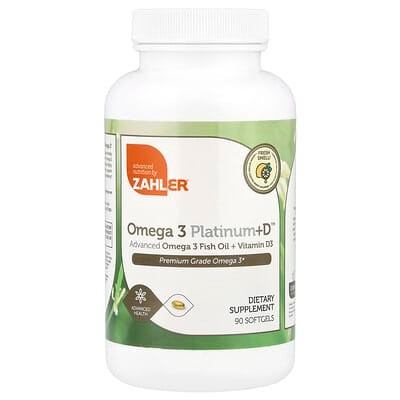
Omega 3 Platinum + D 2000 mg

Goals
$30.52 $0.67 per serving


Product analysis
Omega 3 Platinum + D 2000 mg offers omega-3 fats for triglyceride-related support. Incomplete identification and amount details make parts of the formula harder to compare.
AI assessment of the formula, label and price. How scoring works
Nutrient Quality27
The mixed ingredient is not clearly identified, leaving its quality uncertain. The other components also lack specific form details, limiting a confident preparation comparison.
Ingredient Transparency51
Some amounts and form details are stated, but the mixed ingredient lacks a clear identity and amount. Its composition remains uncertain, limiting comparison of the full serving.
Value For Money40
Value for the active content remains uncertain. There is not enough information for a confident comparison of cost and contribution.
Customer Satisfaction77
Customer ratings indicate strong satisfaction. A few hundred ratings provide some breadth of feedback, though the pool remains moderate.
Product Focus72
The clearest role involves omega-3 support for triglyceride-related markers. Joint-comfort findings are mixed, and adding vitamin D does not establish extra cardiovascular protection.
- Format
Softgel - Container
- 90 Softgel(s)
- Per serving
- $0.67
- Customer rating
- 4.8 · 328 ratings
Goals

Impact
High effect
Vitamin D · 50 mcgFish Oil · 2000 mg
EPA and DHA contribute to fatty-acid signals involved in inflammation, with human studies reporting reductions in inflammation markers but inconsistent results across settings. The serving declares EPA and DHA separately; fish-oil mass is not the active omega-3 amount. Vitamin D has shown a temporary reduction in one inflammation marker in older adults, while other markers and longer follow-up were unchanged. Routine anti-inflammatory clinical benefit remains unestablished.
How this product is rated for Inflammation
Ingredient fit74
Relevant ingredients sit within a formula also intended for other goals. Amounts provide uneven support in the saved comparison; a qualifying amount does not guarantee clinical benefit.
Goal fit
Relevant ingredients sit within a formula also intended for other goals.
Dose adequacy
Amounts provide uneven support in the saved comparison; a qualifying amount does not guarantee clinical benefit.
Pathways60
The saved findings are strongest for inflammatory gene signalling. Coverage remains concentrated rather than broad.
Depth
The strongest saved connection is to inflammatory gene signalling; pathway coverage does not establish a clinical effect.
Breadth
Only one pathway reaches the saved coverage threshold.
Evidence93
Vitamin D leads the saved evidence finding. The saved finding accepts the relevant preparations; this does not remove the population and outcome limitations.
Evidence strength
Vitamin D leads the saved evidence finding, although its supplied clinical evidence remains qualified by population, outcome or amount.
Studied preparation
The saved finding accepts the relevant preparations; this does not remove the population and outcome limitations.
Formulation logic100
The counted ingredients have no unmet partner requirement or matched conflict in the supplied findings. Their qualifying amounts do not establish synergy.
Partner coverage
No counted ingredient has an unmet partner requirement.
Conflicts
No configured conflict was matched; this is a limited finding about the supplied combination.
Effective doses
All counted ingredients reach the saved amount threshold; ingredients below it do not contribute to this finding.

Impact
Highest effect
Vitamin D · 50 mcgFish Oil · 2000 mg
EPA and DHA provide the main connection through triglyceride metabolism. Their declared active amounts contribute separately; total oil weight does not establish the same exposure. Supporting studies concern blood markers in specific populations and do not establish prevention of cardiovascular events.
How this product is rated for Cardiovascular Support
Ingredient fit84
EPA declared active gives the formula a clear connection to cardiovascular support. The declared amounts provide partial support, with smaller or unresolved amounts limiting the contribution.
Goal fit
EPA declared active gives the formula a clear connection to cardiovascular support.
Dose adequacy
The declared amounts provide partial support, with smaller or unresolved amounts limiting the contribution.
Pathways60
The strongest saved connection is triglyceride metabolism. One aspect reaches substantial coverage; support across other aspects is limited or absent.
Depth
The strongest saved connection is triglyceride metabolism.
Breadth
One aspect reaches substantial coverage; support across other aspects is limited or absent.
Evidence83
The supplied studies support specific marker or nutrient roles, with the limitations described for the relevant ingredients.
Evidence strength
EPA declared active provides the strongest amount-qualified evidence connection, subject to its population and outcome limitations.
Studied preparation
The preparations that qualify by amount match those accepted in the supplied evidence; this does not establish superiority over other forms.
Formulation logic100
The contributing ingredients work independently or have the partners required by the supplied findings. No listed formulation conflict was identified in the supplied facts.
Partner coverage
The contributing ingredients work independently or have the partners required by the supplied findings.
Conflicts
No listed formulation conflict was identified in the supplied facts.
Effective doses
All contributing ingredients meet the saved minimum amount check; this is not a guarantee of clinical benefit.

Impact
Highest effect
EPA (Eicosapentaenoic Acid) · 600 mgVitamin D · 50 mcg
EPA has limited support for triglyceride-related effects, distinct from prevention of major cardiovascular events. An active-catalogue DHA declaration is present, while the separate linked DHA identity remains unresolved and was not credited in the saved findings. Vitamin D does not establish cardiovascular prevention from this serving. Fish-oil mass and the combination do not add independent benefit.
How this product is rated for Heart Health
Ingredient fit82
The relevant ingredients provide a focused heart-health connection. Declared amounts partly meet the saved amount references.
Goal fit
Relevant ingredients dominate the heart-health fit; links to other goals broaden the product's focus.
Dose adequacy
The declared amounts provide partial coverage of the saved references; these are exposure comparisons rather than proven treatment doses.
Pathways44
The strongest saved connection is triglyceride metabolism. Only this pathway reaches the breadth threshold.
Depth
The strongest saved connection concerns triglyceride metabolism, without establishing a corresponding clinical outcome.
Breadth
Only one assessed pathway reaches the breadth threshold.
Evidence100
EPA (Eicosapentaenoic Acid) provides the leading evidence contribution in the saved findings. The preparation check is satisfied for included ingredients, without establishing prevention of heart attacks or strokes.
Evidence strength
EPA (Eicosapentaenoic Acid) supplies the leading evidence contribution, subject to the ingredient's population and outcome limitations.
Studied preparation
Included ingredients satisfy the saved preparation check; this does not establish efficacy of the finished product.
Formulation logic100
No required partner is missing, and no configured conflict was matched. Included amounts clear the saved minimum comparison threshold.
Partner coverage
No required partner is missing from the included contributions.
Conflicts
No configured ingredient conflict was matched.
Effective doses
All included ingredients clear the saved minimum amount threshold; this cutoff does not establish effective cardiovascular treatment.

Impact
High effect
Omega-3 · 1100 mgVitamin D · 50 mcg
Omega-3 studies found differing resting-metabolic-rate effects in older women and young men, so a general increase cannot be assumed. The supplied findings do not establish a sustained rise in metabolic rate or weight loss from this serving.
How this product is rated for Metabolism Support
Ingredient fit65
Several nutrients relate to normal metabolism, with varying serving amounts and a broader formulation focus.
Goal fit
The formula contains nutrients linked to normal metabolism alongside ingredients serving other purposes, so it is not narrowly focused on increasing energy expenditure.
Dose adequacy
Retained amounts vary relative to their saved references; amount coverage does not demonstrate a rise in energy expenditure.
Pathways20
The saved findings identify limited coverage of insulin sensitivity and metabolic hormones; these findings do not demonstrate thermogenesis.
Depth
The saved findings identify limited coverage of insulin sensitivity and metabolic hormones; these findings do not demonstrate thermogenesis.
Breadth
No pathway reaches the saved coverage threshold.
Evidence89
Omega-3 provides the strongest saved evidence finding, with inconsistent metabolic-rate results between studied populations.
Evidence strength
Omega-3 leads the saved evidence finding, but differing age- and sex-specific results limit expectations for general users.
Studied preparation
The retained ingredients meeting the amount threshold match recognized preparation categories in the saved findings; this does not establish increased energy expenditure.
Formulation logic100
No configured partner gap or conflict was found, and retained ingredients meet the saved amount threshold.
Partner coverage
No required ingredient partner is missing in the saved findings.
Conflicts
No configured ingredient conflict was matched in the supplied serving.
Effective doses
All retained ingredients meet the saved inclusion threshold; this threshold does not establish a clinically effective dose for increasing metabolic rate.

Impact
High effect
Omega-3 · 1100 mg
Omega-3 fatty acids, including EPA and DHA, may provide small improvements in joint pain, stiffness or function in some inflammatory-joint and osteoarthritis settings. Findings are mixed, with important large trials showing no benefit. The evidence concerns sustained study regimens, so a label serving does not establish the same exposure or outcome, and it does not show cartilage repair or prevention. Vitamin D receives a saved contribution, but the supplied OA trial does not establish knee-pain or cartilage-volume benefit.
How this product is rated for Joint Health
Ingredient fit78
Omega-3 fatty acids and vitamin D receive contributions in a focused formula.
Goal fit
Omega-3 fatty acids and vitamin D receive contributions in a focused formula.
Dose adequacy
The fatty-acid amounts contribute partially, while vitamin D reaches its saved comparison range.
Pathways18
Inflammation control receives the strongest saved coverage. Inflammation control has limited coverage below the saved breadth criterion.
Depth
Inflammation control receives the strongest saved coverage; this does not establish structural repair.
Breadth
Inflammation control has limited coverage below the saved breadth criterion.
Evidence69
Omega-3 anchors the saved evidence finding, with population, regimen and preparation limits on expected symptom benefit.
Evidence strength
Omega-3 anchors the saved evidence finding; the supplied clinical limitations remain relevant.
Studied preparation
The counted preparations are accepted in the saved finding; this does not establish identical clinical effects across products.
Formulation logic100
The counted ingredients work independently or have their required partner; no configured conflict was found.
Partner coverage
The counted ingredients work independently or have their required partner; no extra combination benefit is established.
Conflicts
No configured ingredient conflict was found.
Effective doses
All 4 counted ingredients provide meaningful amounts under the saved criteria.

Impact
High effect
Vitamin D · 50 mcg
DHA and EPA are relevant to longer-term brain nutrition, but the supplied cognitive findings concern repeated intake and selected populations. Those findings do not establish an immediate improvement in focus from this serving, and fish-oil quantity cannot substitute for the separately declared fatty acids.
How this product is rated for Mental Focus
Ingredient fit74
The saved finding includes vitamin d among its relevant ingredients. Amounts make uneven contributions to the saved comparison; smaller or preparation-limited contributions reduce the overall match.
Goal fit
The relevant ingredients share the formula with actives serving other goals, limiting its focus.
Dose adequacy
Amounts make uneven contributions to the saved comparison; smaller or preparation-limited contributions reduce the overall match.
Pathways50
The strongest saved connection is synaptic plasticity and neuroprotection. One pathway reaches the configured coverage threshold.
Depth
The strongest saved connection is synaptic plasticity and neuroprotection.
Breadth
One pathway reaches the configured coverage threshold.
Evidence64
Vitamin D leads the saved evidence finding. Long-term cognitive findings do not establish acute focus benefits.
Evidence strength
Vitamin D leads the saved evidence finding, while the supplied scientific context limits claims of acute focus enhancement.
Studied preparation
Some counted material does not fully match reviewed preparations, limiting preparation-specific confidence.
Formulation logic100
The counted ingredients work alone or have the partner required by the configuration. No configured ingredient conflict was found.
Partner coverage
The counted ingredients work alone or have the partner required by the configuration.
Conflicts
No configured ingredient conflict was found.
Effective doses
All counted ingredients pass the configured amount threshold; it is not a proven effective dose.
DHA (Docosahexaenoic Acid) Not classified
No linked studies yet.

Impact
High effect
Omega-3 · 1100 mg
Omega-3 has some human evidence involving responses to UV exposure, but it concerns a specific purified EPA preparation. That evidence does not establish equivalent skin benefits from this product’s generic omega-3 or total oil amounts. Although the saved findings emphasize the skin barrier, routine improvements in hydration or barrier function cannot be inferred for this preparation.
How this product is rated for Skin Health
Ingredient fit78
Omega-3 drives the saved skin-related finding. The credited amounts meet the saved criteria.
Goal fit
Omega-3 is the principal ingredient receiving a skin-related contribution; the product’s other uses also affect its focus.
Dose adequacy
The credited ingredients meet the saved amount criteria; this does not establish additional benefit above nutritional needs.
Pathways50
Coverage is strongest for barrier lipids, with limited breadth beyond the breadth criterion.
Depth
The strongest saved contribution concerns barrier lipids; this describes coverage, not a proven clinical effect.
Breadth
Only barrier lipids reaches the breadth criterion; support across other skin functions is limited.
Evidence78
The human UV evidence concerns purified EPA and does not establish equivalent effects for generic omega-3.
Evidence strength
The human UV evidence concerns purified EPA and does not establish equivalent effects for generic omega-3.
Studied preparation
The saved preparation finding is favorable, but the supplied research does not establish equivalent routine skin benefits for this preparation.
Formulation logic100
No unmet partner requirement or evaluated conflict was identified. The credited ingredients meet the saved minimum amount criterion.
Partner coverage
The credited ingredients have no unmet partner requirement in the supplied findings; this does not establish added benefits from combining them.
Conflicts
No ingredient conflict was identified by the evaluated rules.
Effective doses
All credited ingredients meet the saved minimum amount criterion; that threshold is not a proven effective skin dose.
Ingredients
| Ingredient | Amount per serving | Score |
|---|---|---|
Calories | 20 Calorie(s) | |
Total Fat | 2 Gram(s) | |
Vitamin D3 (Cholecalciferol) | 50 mcg | |
Fish Oil | 2000 mg | |
EPA (TG) | 600 mg | |
DHA (TG) | 400 mg | |
Total Omega-3 (Triglycerides) | 1100 mg |
Omega-3 (Triglycerides) · 1100 mg OverallScore67
A serving provides 1,000 mg of EPA and DHA combined, within 1,100 mg of total omega-3. The whole-product price is about $0.68 per gram of combined EPA and DHA.
How this ingredient is rated
Active Ingredient Quality & Bioavailability72
The saved facts identify a triglyceride form. The saved facts do not establish the evaluated source-and-antioxidant combination; the oil’s freshness remains unknown.
Molecular Form & Absorption Potential
The saved facts identify a triglyceride form.
Source Purity & Oxidative Protection
The saved facts do not establish the evaluated source-and-antioxidant combination; the oil’s freshness remains unknown.
Dose, Safety & Label Transparency55
The serving lists 600 mg of EPA and 400 mg of DHA separately, totaling 1,000 mg. EPA and DHA together account for 50% of the 2,000 mg of source oil per serving.
EPA & DHA Label Specificity
The serving lists 600 mg of EPA and 400 mg of DHA separately, totaling 1,000 mg.
Active Ingredient Concentration
EPA and DHA together account for 50% of the 2,000 mg of source oil per serving.
Third-Party Purity Verification
The saved facts do not establish a qualifying third-party testing or certification claim.
Value80
The whole-product price is about $0.68 per gram of combined EPA and DHA.
Price per 1000mg of EPA+DHA
The whole-product price is about $0.68 per gram of combined EPA and DHA.
EPA (Eicosapentaenoic Acid) (TG) · 600 mg OverallScore64
A serving provides 600 mg of EPA, about 30% of the fish oil. It is in triglyceride form, and the whole-product serving price works out to about $1.13 per gram of EPA.
How this ingredient is rated
Active Ingredient Quality & Bioavailability65
The EPA is in triglyceride form. EPA makes up about 30% of the 2000 mg of fish oil per serving. The saved information does not confirm an antioxidant for the oil.
Molecular Form and Bioavailability
The EPA is in triglyceride form.
EPA Concentration Density
EPA makes up about 30% of the 2000 mg of fish oil per serving.
Oxidation Protection
The saved information does not confirm an antioxidant for the oil.
Dose, Safety & Label Transparency70
Each serving has 600 mg of EPA and 400 mg of DHA. The saved information does not confirm a purification or qualifying contaminant-testing claim.
Absolute EPA Dose per Serving
Each serving provides 600 mg of EPA, a higher amount.
EPA-Centric Ratio
Each serving has 600 mg of EPA and 400 mg of DHA, so EPA is higher.
Purity and Contaminant Testing
The saved information does not confirm a purification or qualifying contaminant-testing claim.
Value50
Based on the whole-product serving price, the cost works out to about $1.13 per gram of EPA.
Price per Gram of EPA
Based on the whole-product serving price, the cost works out to about $1.13 per gram of EPA.
Fish Oil · 2000 mg OverallScore55
Each serving provides 600 mg of EPA and 400 mg of DHA from 2,000 mg of fish oil. The oil is identified as triglyceride, and EPA and DHA together make up about 50% of the oil.
How this ingredient is rated
Active Ingredient Quality & Bioavailability44
The evaluation records a triglyceride-form claim. The saved facts do not establish a purification claim or method.
Omega-3 Molecular Form
The evaluation records a triglyceride-form claim.
Purification & Filtration Method
The saved facts do not establish a purification claim or method.
Third-Party Purity & Potency Verification
The saved facts do not record an independent-testing claim.
Source & Sustainability
The evaluation does not identify a qualifying fish-source or sustainability claim.
Dose, Safety & Label Transparency69
A serving provides 1,000 mg of EPA and DHA combined. EPA and DHA together account for about 50% of the 2,000 mg of fish oil per serving. No qualifying antioxidant is recorded in the saved facts.
Total Active Omega-3 Dose (EPA + DHA)
A serving provides 1,000 mg of EPA and DHA combined.
Omega-3 Potency & Concentration
EPA and DHA together account for about 50% of the 2,000 mg of fish oil per serving.
EPA & DHA Individual Disclosure
EPA and DHA are listed separately at 600 mg and 400 mg per serving, respectively.
Oxidation Protection (Stabilizers)
No qualifying antioxidant is recorded in the saved facts.
Value50
The whole-product serving price works out to about $0.68 per gram of EPA and DHA combined.
Cost Per Gram of Active EPA + DHA
The whole-product serving price works out to about $0.68 per gram of EPA and DHA combined.
Alternative products
Report alternatives
Sources
Published studies used for the product analysis and the top-ranked studies for each ingredient and goal.
- Marine Omega-3 Supplementation and Cardiovascular Disease: An Updated Meta-Analysis of 13 Randomized Controlled Trials Involving 127 477 Participants.
- Impact of omega-3 fatty acids on hypertriglyceridemia, lipidomics, and gut microbiome in patients with type 2 diabetes.
- A systematic review of fish-oil supplements for the prevention and treatment of hypertension.
- Effects of fish oil-derived fatty acids on suboptimal cardiovascular health: A multicenter, randomized, double-blind, placebo-controlled trial.
- Effect of High-Dose Marine Omega-3 Fatty Acids on Atherosclerosis: A Systematic Review and Meta-Analysis of Randomized Clinical Trials.
- Comparative Efficacy of Nutraceuticals on Endothelial Function: A Systematic Review and Network Meta-Analysis.
- A Randomized Trial of Vitamin D Supplementation on Vascular Function in CKD.
- Randomized, placebo-controlled, double-blind clinical trial on the contributions of vitamin D in the control of cardiovascular risk factors, depressive symptoms and suicide risk.
- Dose responses of vitamin D3 supplementation on arterial stiffness in overweight African Americans with vitamin D deficiency: A placebo controlled randomized trial.
- Paricalcitol and endothelial function in chronic kidney disease trial.
- Effects of eicosapentaenoic acid on major coronary events in hypercholesterolaemic patients (JELIS): a randomised open-label, blinded endpoint analysis.
- Effects of EPA on coronary artery disease in hypercholesterolemic patients with multiple risk factors: sub-analysis of primary prevention cases from the Japan EPA Lipid Intervention Study (JELIS).
- Effects of omega-3 fatty acids on coronary revascularization and cardiovascular events: a meta-analysis.
- Incremental effects of eicosapentaenoic acid on cardiovascular events in statin-treated patients with coronary artery disease.
- Omega-3 Fatty Acids for the Management of Hypertriglyceridemia: A Science Advisory From the American Heart Association.
- Vitamin D supplementation for cardiometabolic risk markers in pregnant women based on the gestational diabetes mellitus or obesity status : a randomized clinical trial.
- Vitamin D Supplementation, Serum 25(OH)D Concentrations and Cardiovascular Disease Risk Factors: A Systematic Review and Meta-Analysis.
- Does vitamin D supplementation modulate metabolic risk factors of cardiovascular disease? A systematic review and meta-analysis of clinical trials.
- Dose-dependent effects of fish oil on cardio-metabolic biomarkers in healthy middle-aged and elderly Chinese people: a double-blind randomized controlled trial.
- Eicosapentaenoic acid supplementation alleviates pruritus, enhances skin moisture, and mitigates depression in maintenance hemodialysis patients.