
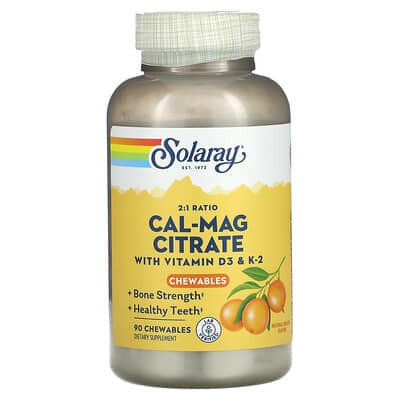
Cal-Mag Citrate Chewable Natural Orange Flavor

Goals
$28.89 $0.96 per serving


Product analysis
Cal-Mag Citrate Chewable Natural Orange Flavor offers calcium and magnesium to help fill dietary gaps relevant to normal bone health. The chewable format comes with a relatively high cost for the minerals supplied.
AI assessment of the formula, label and price. How scoring works
Nutrient Quality51
The MK-7 form of vitamin K is a quality strength. The mineral blends contain different forms in unknown proportions, leaving their absorption quality less clear.
Ingredient Transparency80
All amounts and forms are stated, helping you compare the one-chewable serving. The proportions within the four nutrient mixes are missing, limiting exact composition comparisons.
Value For Money23
The cost is high for calcium and vitamin K and particularly unfavorable for the magnesium blend. Vitamin D value remains uncertain, so it does not establish an offsetting advantage.
Customer Satisfaction71
Customer ratings are generally positive. Feedback from 962 ratings gives a moderate picture of satisfaction.
Product Focus55
Mineral intake is the clearest benefit for normal bone health when diet falls short. The amounts describe one chewable, while the label's daily directions mention three tablets.
- Format
Tablet - Container
- 90 Tablet(s)
- Per serving
- $0.96
- Customer rating
- 4.3 · 962 ratings
Goals

Impact
High effect
Vitamin K · 50 mcgMagnesium · 500 mgCalcium · 1000 mgVitamin D · 25 mcg

Impact
High effect
Vitamin D · 25 mcgMagnesium · 500 mgVitamin K · 50 mcg

Impact
Moderate effect
Vitamin K · 50 mcgMagnesium · 500 mgVitamin D · 25 mcg


Impact
Moderate effect
Vitamin K · 50 mcgMagnesium · 500 mgVitamin D · 25 mcg

Impact
Moderate effect
Magnesium · 500 mgVitamin D · 25 mcg
Ingredients
| Ingredient | Amount per serving | Score |
|---|---|---|
Vitamin D (Cholecalciferol, Vitamin D3) | 25 mcg | |
Vitamin K (Chickpea, Menaquinone-7, Vitamin K2) | 50 mcg | |
Calcium (Calcium Carbonate, Calcium Citrate) | 1000 mg | |
Magnesium (Magnesium Citrate, Magnesium Oxide) | 500 mg |
Magnesium (Magnesium Citrate, Magnesium Oxide) · 500 mg OverallScore46
500 mg of magnesium per serving offers a stated amount; the serving cost is less favorable for the stated magnesium source. It uses Magnesium Citrate and Magnesium Oxide; the proportions are unknown.
How this ingredient is rated
Active Ingredient Quality & Bioavailability21
It uses Magnesium Citrate and Magnesium Oxide; the proportions are unknown. The chelation standard is unspecified.
Magnesium Form & Absorption Potential
It uses Magnesium Citrate and Magnesium Oxide; the proportions are unknown.
Patented Materials & Chelation Quality
The chelation standard is unspecified.
Dose, Safety & Label Transparency88
Each serving provides 500 mg of elemental magnesium. The serving also contains 1000 mg calcium.
Elemental Yield Transparency
The label states 500 mg of elemental magnesium per serving.
Therapeutic Dosage Alignment
Each serving provides 500 mg of elemental magnesium.
Synergistic Formulation Logic
The serving also contains 1000 mg calcium.
Value14
The serving cost is less favorable for the stated magnesium source.
Price Per Elemental Quality
The serving cost is less favorable for the stated magnesium source.
Alternative products
Report alternatives
Sources
Published studies used for the product analysis and the top-ranked studies for each ingredient and goal.
- What is the impact of daily oral supplementation of vitamin D3 (cholecalciferol) plus calcium on the incidence of hip fracture in older people? A systematic review and meta-analysis.
- Calcium supplementation prevents seasonal bone loss and changes in biochemical markers of bone turnover in elderly New England women: a randomized placebo-controlled trial.
- The effects of calcium supplementation (milk powder or tablets) and exercise on bone density in postmenopausal women.
- The efficacy of calcium supplementation alone in elderly Thai women over a 2-year period: a randomized controlled trial.
- Calcium-enriched foods and bone mass growth in prepubertal girls: a randomized, double-blind, placebo-controlled trial.
- Association between Serum Magnesium and Fractures: A Systematic Review and Meta-Analysis of Observational Studies.
- Bioabsorbable Magnesium-Based Materials Potential and Safety in Bone Surgery: A Systematic Review.
- Vascularized bone grafting fixed by biodegradable magnesium screw for treating osteonecrosis of the femoral head.
- An update on magnesium and bone health.
- Sex-specific differences in the association of magnesium intake with femoral neck bone mineral density among older adults.
- Pregnancy vitamin D supplementation and offspring bone mineral density in childhood follow-up of a randomized controlled trial.
- Vitamin D analogs and bone: preclinical and clinical studies with eldecalcitol.
- Efficacy of vitamin D fortified foods on bone mineral density and serum bone biomarkers: A systematic review and meta-analysis of interventional studies.
- Cholecalciferol Supplementation Attenuates Bone Loss in Incident Kidney Transplant Recipients: A Prespecified Secondary Endpoint Analysis of a Randomized Controlled Trial.
- Vitamin D supplementation and bone health in post-menopausal women: a 24-month randomized controlled intervention with enhanced bioavailability formulations.
- Vitamin K and the prevention of fractures: systematic review and meta-analysis of randomized controlled trials.
- Three-year low-dose menaquinone-7 supplementation helps decrease bone loss in healthy postmenopausal women.
- Effect of combined administration of vitamin D3 and vitamin K2 on bone mineral density of the lumbar spine in postmenopausal women with osteoporosis.
- Efficacy and safety of vitamin K2 for postmenopausal women with osteoporosis at a long-term follow-up: meta-analysis and systematic review.
- Low-dose vitamin K2 (MK-4) supplementation for 12 months improves bone metabolism and prevents forearm bone loss in postmenopausal Japanese women.