
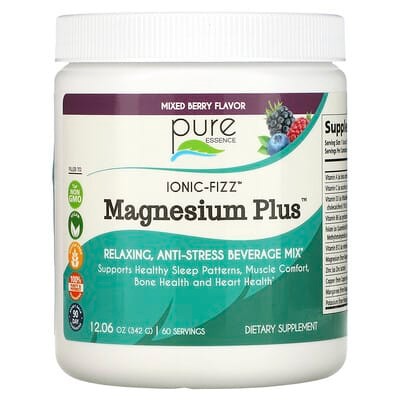
Magnesium Plus Mixed Berry Flavor

Goals
$40.58 $0.67 per serving


Product analysis
Magnesium Plus Mixed Berry Flavor may help fill a magnesium gap and support normal muscle function and energy use. The magnesium form is a less favourable choice for absorption, which matters when comparing similar supplements.
AI assessment of the formula, label and price. How scoring works
Nutrient Quality42
Methylfolate and potassium bicarbonate have favourable form characteristics. Magnesium carbonate is a weaker choice for absorption, while many other ingredients remain uncertain.
Ingredient Transparency71
All listed amounts are disclosed, helping with serving comparisons. Several forms and the mixture breakdown are missing, leaving the full preparation less clear.
Value For Money42
Potassium offers favourable value, but magnesium and folate are less competitive within the serving cost. Most other ingredient comparisons remain uncertain.
Customer Satisfaction79
Customer feedback is positive across close to a thousand ratings. That gives a substantial picture of satisfaction without establishing specific benefits.
Product Focus24
The clearest role is nutritional magnesium support when intake is low, with possible modest sleep or stress benefits. The wider ingredient mix does not establish added energy or reliable improvement across every health goal.
- Format
Powder - Container
- 12 Ounce(s)
- Per serving
- $0.67
- Also available
 Magnesium Plus Orange-Vanilla Flavor$37.01
- Customer rating
- 4.6 · 985 ratings
Goals

Impact
Moderate effect
Vitamin D · 2.5 mcgMagnesium · 300 mgVitamin B12 · 30 mcgPotassium · 100 mg

Impact
High effect
Folate · 50 mcgVitamin B12 · 30 mcgVitamin D · 2.5 mcgMagnesium · 300 mgBoron · 500 mcgZinc · 2 mgVitamin C · 250 mg

Impact
High effect
Magnesium · 300 mgVitamin B12 · 30 mcgVitamin B6 · 1 mgFolate · 50 mcgVitamin D · 2.5 mcg

Impact
High effect
Magnesium · 300 mgVitamin D · 2.5 mcgCopper · 0.25 mgManganese · 1 mgBoron · 500 mcgZinc · 2 mgVitamin C · 250 mg

Impact
High effect
Magnesium · 300 mg

Impact
Moderate effect
Vitamin D · 2.5 mcgMagnesium · 300 mgFolate · 50 mcgVitamin B12 · 30 mcgVitamin B6 · 1 mgVitamin C · 250 mg
Ingredients
| Ingredient | Amount per serving | Score |
|---|---|---|
Vitamin A (Beta-Carotene) | 150 mcg | |
Vitamin C (Ascorbic Acid) | 250 mg | |
Vitamin D3 | 2.5 mcg | |
Vitamin B6 (Pyridoxine Hydrochloride) | 1 mg | |
Folate (L-5-Methyltetrahydrofolate) | 50 mcg | |
Vitamin B12 (Methylcobalamin) | 30 mcg | |
Magnesium (Magnesium Carbonate) | 300 mg | |
Zinc (Zinc Lactate) | 2 mg | |
Copper (Copper Gluconate) | 0.25 mg | |
Manganese (Manganese Gluconate) | 1 mg | |
Potassium (Potassium Bicarbonate) | 100 mg | |
Bamboo extract | 60 mg | |
ionic Sea Minerals | 10 mg | |
Beet root powder | 8 mg | |
Grape skin extract | 7 mg | |
Boron (Boron Citrate) | 500 mcg |
Folate (L-5-Methyltetrahydrofolate) · 50 mcg OverallScore52
The serving provides 50 mcg folate at a higher cost per serving. It uses L-5-Methyltetrahydrofolate, an active form.
How this ingredient is rated
Active Ingredient Quality & Bioavailability91
L-5-Methyltetrahydrofolate is an active form that bypasses the MTHFR conversion step. The L prefix indicates the active isomer; no branded source is specified.
Folate Form Hierarchy
L-5-Methyltetrahydrofolate is an active form that bypasses the MTHFR conversion step.
Patented Sources & Isomeric Purity
The L prefix indicates the active isomer; no branded source is specified.
Dose, Safety & Label Transparency20
The serving provides 50 mcg folate.
Folate Dosage by Declared Basis
The serving provides 50 mcg folate.
Value40
The cost per serving is higher.
Price per Bioavailable Serving
The cost per serving is higher.
Potassium (Potassium Bicarbonate) · 100 mg OverallScore78
Each serving provides 100 mg of potassium at a low whole-product price. The potassium contribution is modest. The source is potassium bicarbonate.
How this ingredient is rated
Active Ingredient Quality & Bioavailability100
The source is potassium bicarbonate.
Potassium Form Quality
The source is potassium bicarbonate.
Dose, Safety & Label Transparency46
The potassium amount is listed as 100 mg per serving, without explicit elemental wording.
Potassium Dosage Potency
Each serving provides 100 mg of potassium.
Elemental Yield Transparency
The potassium amount is listed as 100 mg per serving, without explicit elemental wording.
Value100
The whole-product price per serving is low.
Potassium Value Efficiency
The whole-product price per serving is low.
Magnesium (Magnesium Carbonate) · 300 mg OverallScore50
A serving supplies 300 mg of magnesium. It uses Magnesium Carbonate. The serving cost is considered alongside Magnesium Carbonate.
How this ingredient is rated
Active Ingredient Quality & Bioavailability14
It uses Magnesium Carbonate. No specific chelation standard is stated.
Magnesium Form & Absorption Potential
It uses Magnesium Carbonate.
Patented Materials & Chelation Quality
No specific chelation standard is stated.
Dose, Safety & Label Transparency100
The label states 300 mg of elemental magnesium per serving. The serving also lists 0 mg of calcium.
Elemental Yield Transparency
The elemental magnesium amount per serving is stated.
Therapeutic Dosage Alignment
The label states 300 mg of elemental magnesium per serving.
Synergistic Formulation Logic
The serving also lists 0 mg of calcium.
Value20
The serving cost is considered alongside Magnesium Carbonate.
Price Per Elemental Quality
The serving cost is considered alongside Magnesium Carbonate.
Alternative products
Report alternatives
Sources
Published studies used for the product analysis and the top-ranked studies for each ingredient and goal.
- [Comparative study of the urinary excretion of boron, calcium, magnesium and phosphorus in postmenopausal women with and without osteoporosis].
- Effect of dietary boron on mineral, estrogen, and testosterone metabolism in postmenopausal women.
- The relationship between boron and magnesium status and bone mineral density in the human: a review.
- Effects of boron supplementation on bone mineral density and dietary, blood, and urinary calcium, phosphorus, magnesium, and boron in female athletes.
- Metabolic responses of postmenopausal women to supplemental dietary boron and aluminum during usual and low magnesium intake: boron, calcium, and magnesium absorption and retention and blood mineral concentrations
- The Association between Dietary and Circulating Copper Levels and Osteoporosis: a Scoping Review.
- Association between dietary copper, iron, zinc, selenium intake and osteopenia or osteoporosis in elderly hypertensive patients: a retrospective cohort study.
- Associations of dietary copper intake with total bone mineral density and lumbar spine bone mineral density in American adults.
- The association between dietary mineral intake and bone mineral density: a cross-sectional study.
- Association between dietary copper intake and bone mineral density in children and adolescents aged 8-19 years: A cross-sectional study.
- Association between RBC folate and lumbar bone mineral density in postmenopausal women, a cross-sectional study from NHANES 2009-2018.
- Genetic variants modify the associations of concentrations of methylmalonic acid, vitamin B-12, vitamin B-6, and folate with bone mineral density.
- Adequate Intake and Supplementation of B Vitamins, in Particular Folic Acid, can Play a Protective Role in Bone Health.
- Relation of homocysteine, folate, and vitamin B12 to bone mineral density of postmenopausal women.
- Dietary intake of folate, but not vitamin B2 or B12, is associated with increased bone mineral density 5 years after the menopause: results from a 10-year follow-up study in early postmenopausal women.
- Association between Serum Magnesium and Fractures: A Systematic Review and Meta-Analysis of Observational Studies.
- Bioabsorbable Magnesium-Based Materials Potential and Safety in Bone Surgery: A Systematic Review.
- Vascularized bone grafting fixed by biodegradable magnesium screw for treating osteonecrosis of the femoral head.
- An update on magnesium and bone health.
- Sex-specific differences in the association of magnesium intake with femoral neck bone mineral density among older adults.