
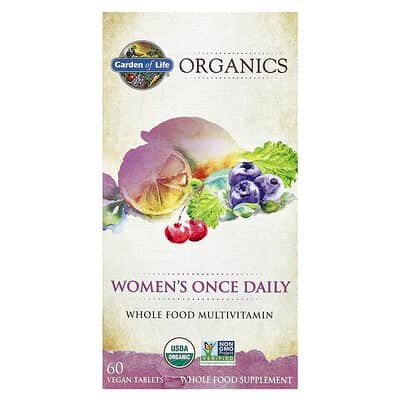
Women's Once Daily

Goals
$33.00 $0.55 per serving


Product analysis
Women’s Once Daily supplies nutrients for normal energy use, immune function and bone health when intake is low. An unidentified blend makes the complete formula harder to assess.
AI assessment of the formula, label and price. How scoring works
Nutrient Quality34
The broad food-source descriptions leave most nutrients difficult to compare for absorption. Vitamin K and selenium are not identified precisely enough to establish their form quality.
Ingredient Transparency78
Amounts are stated throughout, and most ingredients have a named source or form. The combination blend’s contents are not identified, so you cannot fully check what it adds.
Value For Money39
The serving cost looks favorable for the vitamin K contribution, while iron and selenium are relatively expensive for their contributions. Value for most other nutrients remains uncertain without usable comparisons.
Customer Satisfaction91
Customer ratings are very positive across a large review base. No specific experiences explain which features buyers found helpful.
Product Focus20
The formula supports several everyday nutritional needs, with the clearest usefulness when intake is low. Unidentified blend contents prevent a complete assessment of the active ingredients.
- Format
Tablet - Container
- 60 Tablet(s)
- Per serving
- $0.55
- Also available
 Women's Once Daily$21.99
- Customer rating
- 4.8 · 5,553 ratings
Goals

Impact
Highest effect
Folate · 400 mcg DFEVitamin B12 · 5 mcgVitamin D · 25 mcgVitamin K · 120 mcgSelenium · 55 mcgZinc · 3.9 mgVitamin C · 90 mg

Impact
High effect
Vitamin C · 90 mgZinc · 3.9 mgVitamin A · 900 mcgVitamin D · 25 mcgSelenium · 55 mcg

Impact
High effect
Folate · 400 mcg DFEVitamin B12 · 5 mcgVitamin K · 120 mcgVitamin D · 25 mcg

Impact
High effect
Vitamin K · 120 mcgVitamin B12 · 5 mcgVitamin B6 · 8.5 mgFolate · 400 mcg DFEVitamin D · 25 mcg

Impact
Moderate effect
Vitamin K · 120 mcgVitamin D · 25 mcgSelenium · 55 mcgVitamin B12 · 5 mcgVitamin B6 · 8.5 mgVitamin E · 16 mgFolate · 400 mcg DFENiacin · 18.4 mgVitamin C · 90 mg

Impact
High effect
Vitamin K · 120 mcgVitamin D · 25 mcgManganese · 0.8 mgZinc · 3.9 mgVitamin C · 90 mg
Ingredients
| Ingredient | Amount per serving | Score |
|---|---|---|
Vitamin A (Beta Carotene) | 900 mcg | |
Vitamin C (Organic Food Blend) | 90 mg | |
Vitamin D (D3) | 25 mcg | |
Vitamin E (Organic Food Blend) | 16 mg | |
Vitamin K (Saccharomyces cerevisae) | 120 mcg | |
Thiamin (Organic Food Blend) | 1.38 mg | |
Riboflavin (Organic Food Blend) | 1.5 mg | |
Niacin (Organic Food Blend) | 18.4 mg | |
Vitamin B6 (Organic Food Blend) | 8.5 mg | |
Folate (Organic Food Blend) | 400 mcg DFE | |
Vitamin B12 (Methylcobalamin) | 5 mcg | |
Biotin (Organic Food Blend) | 120 mcg | |
Pantothenic Acid (Organic Food Blend) | 5 mg | |
Iron (Organic Food Blend) | 2.5 mg | |
Zinc (Organic Food Blend) | 3.9 mg | |
Selenium (Organic Food Blend) | 55 mcg | |
Manganese (Organic Food Blend) | 0.8 mg | |
Chromium (Organic Food Blend) | 35 mcg | |
Organic Food Blend | 646 mg |
Selenium (Organic Food Blend) · 55 mcg OverallScore30
55 mcg of selenium per serving contributes to daily intake. The cost is high relative to the selenium supplied. The selenium form is unspecified.
How this ingredient is rated
Active Ingredient Quality & Bioavailability0
The selenium form is unspecified. Its absorption cannot be determined from the form.
Selenium Chemical Form
The selenium form is unspecified.
Form Transparency & Isomer Specificity
Without the chemical form, its identity and absorption are unclear.
Dose, Safety & Label Transparency70
55 mcg of selenium per serving contributes to daily intake. The 55 mcg serving is below the 400 mcg adult upper limit, leaving room for selenium from food.
Dosage Efficacy Sweet Spot
55 mcg of selenium per serving contributes to daily intake.
Safety Margin & UL Adherence
The 55 mcg serving is below the 400 mcg adult upper limit, leaving room for selenium from food.
Value10
The cost is high relative to the selenium supplied.
Price per 200 mcg Serving
The cost is high relative to the selenium supplied.
Iron (Organic Food Blend) · 2.5 mg OverallScore32
Vitamin K (Saccharomyces cerevisae) · 120 mcg OverallScore20
Alternative products
Report alternatives
Sources
Published studies used for the product analysis and the top-ranked studies for each ingredient and goal.
- Association between RBC folate and lumbar bone mineral density in postmenopausal women, a cross-sectional study from NHANES 2009-2018.
- Genetic variants modify the associations of concentrations of methylmalonic acid, vitamin B-12, vitamin B-6, and folate with bone mineral density.
- Adequate Intake and Supplementation of B Vitamins, in Particular Folic Acid, can Play a Protective Role in Bone Health.
- Relation of homocysteine, folate, and vitamin B12 to bone mineral density of postmenopausal women.
- Dietary intake of folate, but not vitamin B2 or B12, is associated with increased bone mineral density 5 years after the menopause: results from a 10-year follow-up study in early postmenopausal women.
- Risk of Environmental Chemicals on Bone Fractures Is Independent of Low Bone Mass in US Adults: Insights from 2017 to 2018 NHANES.
- The Manganese-Bone Connection: Investigating the Role of Manganese in Bone Health.
- Associations of multiple metals with bone mineral density: A population-based study in US adults.
- Sex-specific associations of urinary mixed-metal concentrations with femoral bone mineral density among older people: an NHANES (2017-2020) analysis.
- Relationship between blood manganese and bone mineral density and bone mineral content in adults: A population-based cross-sectional study.
- Evaluating the Protective Role of Vitamin A Supplementation in Periodontal Health: A Comprehensive Systematic Review and Meta-Analysis.
- Dietary vitamin A intake and bone health in the elderly: the Rotterdam Study.
- Vitamin A and its dervatives effect on bone mineral density, a systematic review.
- Association of vitamins with bone mineral density and osteoporosis measured by dual-energy x-ray absorptiometry: a cross-sectional study.
- Association of dietary consumption and serum levels of vitamin A and β-carotene with bone mineral density in Chinese adults.
- Effect of Vitamin B12 and Folic Acid Supplementation on Bone Mineral Density and Quantitative Ultrasound Parameters in Older People with an Elevated Plasma Homocysteine Level: B-PROOF, a Randomized Controlled Trial.
- Plasma B vitamins, homocysteine, and their relation with bone loss and hip fracture in elderly men and women.
- Relation between homocysteine and B-vitamin status indicators and bone mineral density in older Americans.
- The role of B-vitamin intake, B-vitamin-rich dietary patterns, the B-vitamin deficiency index in bone mineral density among school-aged children.
- Hyperhomocysteinemia is Associated with Inflammation, Bone Resorption, Vitamin B12 and Folate Deficiency and MTHFR C677T Polymorphism in Postmenopausal Women with Decreased Bone Mineral Density.