
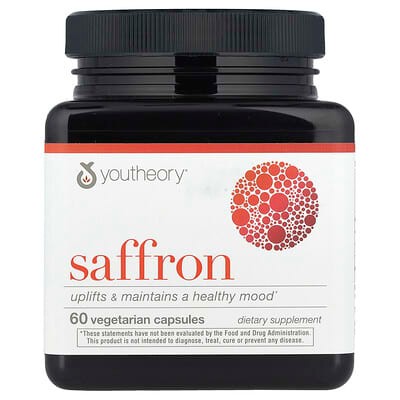

$28.72 $0.95 per serving


Product analysis
Saffron combines ingredients with some evidence for low mood and stress-related fatigue. Unspecified preparations limit confidence that the results from particular extracts apply to the whole formula.
AI assessment of the formula, label and price. How scoring works
Nutrient Quality20
The main entries do not identify the specific botanical preparations. That limits comparison with the extracts used for particular effects.
Ingredient Transparency63
All three ingredient amounts are disclosed. The main entries omit preparation details, making it harder to match the formula with other extracts.
Value For Money40
Rhodiola offers limited value for the serving cost. Value for the ashwagandha and saffron remains uncertain.
Customer Satisfaction76
Customer feedback is generally positive across a sizable review base. That offers a useful satisfaction picture without establishing mood or stress effects.
Product Focus70
The main connections are to low mood and fatigue associated with stress, with findings depending on the preparation and population. The amounts do not establish added benefit from combining the three ingredients or reliable improvements in daily work output.
- Format
Capsule - Container
- 60 Capsule(s)
- Per serving
- $0.95
- Customer rating
- 4.5 · 1,011 ratings
Goals

Impact
Moderate effect
Rhodiola relates to mental fatigue under stress, with small trials using specific extracts. Ashwagandha has limited short-term cognitive findings from a particular preparation. These findings do not establish sustained work benefits for every extract; saffron has no independent contribution in the saved assessment.
How this product is rated for Productivity Boost
Ingredient fit66
The saved assessment finds a reasonably focused contribution to the goal, while accounting for other ingredients and uses. The assessed amounts provide partial support against the saved dose references (55.9 out of 100).
Goal fit
The saved assessment finds a reasonably focused contribution to the goal, while accounting for other ingredients and uses.
Dose adequacy
The assessed amounts provide partial support against the saved dose references (55.9 out of 100).
Pathways42
The strongest saved coverage concerns stress-fatigue resilience, with partial coverage. One mechanism reaches the saved coverage threshold, so support is concentrated rather than broad.
Depth
The strongest saved coverage concerns stress-fatigue resilience, with partial coverage.
Breadth
One mechanism reaches the saved coverage threshold, so support is concentrated rather than broad.
Evidence52
Ashwagandha leads the saved evidence comparison at an assessed amount; this is not a prediction of improved work output. Only part of the qualifying formula matches the saved studied-preparation category; rhodiola does not.
Evidence strength
Ashwagandha leads the saved evidence comparison at an assessed amount; this is not a prediction of improved work output.
Studied preparation
Only part of the qualifying formula matches the saved studied-preparation category; rhodiola does not.
Formulation logic100
The assessed ingredients work independently or have their listed partner. No ingredient conflict is recorded in the saved assessment.
Partner coverage
The assessed ingredients work independently or have their listed partner.
Conflicts
No ingredient conflict is recorded in the saved assessment.
Effective doses
All assessed ingredients reach the saved minimum dose threshold.
Impact
Highest effect
Ashwagandha · 150 mg
Rhodiola is the main ingredient connected with stress-related mental fatigue, but the supplied research concerns a specific extract in adults with diagnosed stress-related fatigue. Generic rhodiola at 350 mg per serving does not establish the same effect. Sensoril ashwagandha is present at 150 mg, below the amount supported by its small cognitive-task study, so its contribution is limited.
How this product is rated for Brain Health
Ingredient fit87
Rhodiola receives substantial partial amount recognition; the Sensoril amount is too small to contribute under the saved rule.
Goal fit
The saved focus reflects the relevant ingredients and the formula's other uses; presence alone does not establish cognitive benefit.
Dose adequacy
Rhodiola receives substantial partial amount recognition; the Sensoril amount is too small to contribute under the saved rule.
Pathways47
Stress and arousal regulation is the main recorded connection, driven by rhodiola. The saved findings are concentrated in stress regulation, with no comparable breadth across other brain functions.
Depth
Stress and arousal regulation is the main recorded connection, driven by rhodiola.
Breadth
The saved findings are concentrated in stress regulation, with no comparable breadth across other brain functions.
Evidence82
Rhodiola's connection is limited by research in stress-related fatigue using a specific preparation.
Evidence strength
Rhodiola's connection is limited by research in stress-related fatigue using a specific preparation.
Studied preparation
The saved rule recognizes the credited preparations; that recognition does not resolve the population and outcome limits of their evidence.
Formulation logic100
The credited ingredients have no missing required partner or recorded conflict. Their amounts pass the saved minimum contribution rule, which does not prove clinical efficacy.
Partner coverage
No required partner is missing for the credited ingredients; this does not establish an added benefit from combining them.
Conflicts
No configured conflict was recorded; this finding does not establish the absence of all possible interactions.
Effective doses
All credited ingredients pass the saved minimum amount rule; ingredients excluded for smaller amounts are not counted in this finding.

Impact
Moderate effect
Ashwagandha · 150 mg
Rhodiola at 350 mg is the main relevant ingredient for mental performance under stress or fatigue, although its unidentified preparation limits confidence in applying extract-specific findings. Ashwagandha at 150 mg makes only a small exposure contribution. Saffron's supplied cognitive evidence concerns a disease cohort and does not support a routine benefit for the unspecified amount here.
How this product is rated for Cognitive Support
Ingredient fit90
Rhodiola drives the assessed contribution; ashwagandha and saffron provide limited additional support.
Goal fit
The relevant ingredients are closely focused on cognitive support.
Dose adequacy
Most assessed ingredients have substantial exposure matches, with some smaller contributions.
Pathways19
The strongest contribution relates to stress and arousal, with limited overall coverage. No assessed pathway reaches the saved substantial-coverage threshold.
Depth
The strongest contribution relates to stress and arousal, with limited overall coverage.
Breadth
No assessed pathway reaches the saved substantial-coverage threshold.
Evidence33
Rhodiola provides the strongest assessed evidence at an eligible amount. The evidence remains specific to the supplied outcomes and populations. The rhodiola preparation is unidentified and is not a confirmed match to a studied extract.
Evidence strength
Rhodiola provides the strongest assessed evidence at an eligible amount. The evidence remains specific to the supplied outcomes and populations.
Studied preparation
The rhodiola preparation is unidentified and is not a confirmed match to a studied extract.
Formulation logic100
Required partners are covered, no configured conflict was found, and the included ingredients meet the saved minimum exposure threshold.
Partner coverage
The assessed ingredients can contribute alone or have their required partner.
Conflicts
No configured ingredient conflict was identified in the supplied facts.
Effective doses
1 of 1 assessed ingredients meet the saved minimum exposure threshold. Meeting that threshold does not guarantee a cognitive benefit.

Impact
Highest effect
Ashwagandha · 150 mg
Saffron has direct findings for low mood, although small trials and publication bias limit confidence. Its 28 mg per serving is close to the daily exposures studied. Ashwagandha may support stress-associated emotional well-being, but the unidentified root-and-leaf extract cannot be assumed equivalent to named trial extracts. Rhodiola findings mainly concern fatigue or diagnosed depression and do not establish the same mood benefit for healthy adults.
How this product is rated for Mood Support
Ingredient fit85
The mood-related contribution comes from the relevant ingredients at their declared serving amounts, with the ingredient-specific limits described above.
Goal fit
The contributing ingredients are focused on mood-related roles, though the product may also serve other goals.
Dose adequacy
Declared serving amounts contribute to different extents; meeting the amount comparison does not establish an individual mood effect.
Pathways75
The ingredients represent the areas described below; these are ingredient relationships rather than proof that every mechanism produces a mood benefit.
Depth
The strongest represented area is monoamine signalling, reflecting the ingredients and amounts retained in the saved findings.
Breadth
The saved findings cover stress-hormone regulation, monoamine signalling.
Evidence85
The retained evidence and preparation findings below must be interpreted alongside each ingredient’s direct mood outcomes and the populations studied.
Evidence strength
Saffron provides the strongest retained evidence contribution, with the population and outcome limits described for that ingredient.
Studied preparation
Preparation matching is incomplete for Ashwagandha. Other retained preparations meet the saved matching check.
Formulation logic100
The supplied partner, conflict and minimum-amount checks are satisfied for the retained contributors, without establishing synergy or medication suitability.
Partner coverage
No contributing ingredient is missing a required partner in the supplied checks; this does not establish added benefit from combining ingredients.
Conflicts
No listed ingredient conflict was triggered by the supplied product facts; this check does not establish general medication compatibility.
Effective doses
All retained contributors meet the saved minimum amount threshold; that threshold is not a proven effective dose for improving mood.

Impact
Highest effect
Ashwagandha · 150 mg
Ashwagandha has the clearest connection to perceived stress here, with Sensoril identified in the supplied facts. At 150 mg per serving, its sleep-related relevance is qualified: subjective sleep findings extend to lower amounts, while stronger adjusted sleep findings came from higher amounts. Rhodiola may help stress-related fatigue, but its extract is unidentified and findings are preparation-specific. The two ingredients meet their quantity references without establishing added benefit from combining them.
How this product is rated for Stress Relief
Ingredient fit84
Ashwagandha and rhodiola provide the relevant stress connection. Both meet their preparation-specific quantity references, while saffron has no assigned contribution in the supplied assessment.
Goal fit
Ashwagandha and rhodiola provide the relevant connection; the additional saffron makes the formula less exclusively focused on those contributions.
Dose adequacy
Both extracts meet the quantity references used for their respective preparations; this does not establish an equivalent daily regimen.
Pathways80
The strongest findings concern stress-hormone regulation, with sleep recovery also represented; calming and mood-related coverage are smaller.
Depth
Stress-hormone regulation is the strongest represented aspect, led by ashwagandha.
Breadth
Stress-hormone regulation and sleep recovery reach the coverage threshold; calming and mood-related coverage remain smaller.
Evidence87
Ashwagandha carries the stronger support here. Sensoril is identified, while rhodiola does not identify the extract needed to match preparation-specific findings.
Evidence strength
Ashwagandha provides the strongest direct connection to perceived psychological stress among this product's relevant ingredients.
Studied preparation
Sensoril is identified, but the rhodiola declaration does not identify a studied extract.
Formulation logic100
Ashwagandha and rhodiola can contribute without a required additional partner. No checked conflict was matched, and the relevant ingredients reach the amount threshold for inclusion.
Partner coverage
Ashwagandha and rhodiola do not require an additional partner for the contribution retained here.
Conflicts
None of the specific ingredient conflicts checked in the supplied comparison was matched.
Effective doses
Both relevant extracts reach the comparison's amount threshold for inclusion; this is not a proven effective-dose boundary.

Impact
Moderate effect
Rhodiola and ashwagandha relate mainly to fatigue in stressful settings. Their evidence depends on the specific preparation and circumstances, so the supplied 350 mg of rhodiola and 150 mg of ashwagandha should be viewed as a qualified contribution rather than a reliable general energy boost.
How this product is rated for Energy
Ingredient fit64
The relevant ingredients focus mainly on fatigue associated with stress. The saved amount findings indicate a partial contribution from both herbs.
Goal fit
The relevant ingredients focus mainly on fatigue associated with stress.
Dose adequacy
The saved amount findings indicate a partial contribution from both herbs.
Pathways44
Stress-related fatigue is the strongest saved connection. The saved findings identify one main area of support: stress-related fatigue.
Depth
Stress-related fatigue is the strongest saved connection.
Breadth
The saved findings identify one main area of support: stress-related fatigue.
Evidence61
Ashwagandha provides the strongest saved evidence contribution; its usefulness still depends on the nutritional or fatigue context. The saved preparation findings are mostly supportive, with uncertainty for Rhodiola.
Evidence strength
Ashwagandha provides the strongest saved evidence contribution; its usefulness still depends on the nutritional or fatigue context.
Studied preparation
The saved preparation findings are mostly supportive, with uncertainty for Rhodiola.
Formulation logic100
The counted ingredients can contribute without an additional required partner. No configured ingredient conflict was identified in the saved findings; undisclosed amounts remain uncertain. All counted ingredients reach the saved minimum contribution level.
Partner coverage
The counted ingredients can contribute without an additional required partner.
Conflicts
No configured ingredient conflict was identified in the saved findings; undisclosed amounts remain uncertain.
Effective doses
All counted ingredients reach the saved minimum contribution level.

Impact
Moderate effect
Rhodiola at 350 mg provides a tentative connection to focus under stress or fatigue. The relevant acute findings used a specific SHR-5 extract in stressed, fatigued participants; the material here is not matched to that preparation. Ashwagandha evidence is also extract specific and does not establish an immediate benefit from any generic material.
How this product is rated for Mental Focus
Ingredient fit78
The relevant ingredients provide a reasonable connection to the goal within a broader formula. The counted amounts align well with the saved dose comparison ranges.
Goal fit
The relevant ingredients provide a reasonable connection to the goal within a broader formula.
Dose adequacy
The counted amounts align well with the saved dose comparison ranges.
Pathways40
The strongest assessed connection is stress and fatigue resilience, with moderate coverage. Stress and fatigue resilience reaches the saved coverage threshold; the overall contribution remains concentrated.
Depth
The strongest assessed connection is stress and fatigue resilience, with moderate coverage.
Breadth
Stress and fatigue resilience reaches the saved coverage threshold; the overall contribution remains concentrated.
Evidence23
Rhodiola provides the strongest relevant evidence among ingredients counted at meaningful amounts. The findings remain specific to the reviewed context. The assessed botanical material is not matched to the specific extract used in the reviewed trials.
Evidence strength
Rhodiola provides the strongest relevant evidence among ingredients counted at meaningful amounts. The findings remain specific to the reviewed context.
Studied preparation
The assessed botanical material is not matched to the specific extract used in the reviewed trials.
Formulation logic100
The counted ingredients can contribute independently or have their required partner. No ingredient conflict was identified in the saved assessment. 1 of 1 counted ingredients reach the saved meaningful-amount threshold.
Partner coverage
The counted ingredients can contribute independently or have their required partner.
Conflicts
No ingredient conflict was identified in the saved assessment.
Effective doses
1 of 1 counted ingredients reach the saved meaningful-amount threshold.
Ingredients
| Ingredient | Amount per serving | Score |
|---|---|---|
Rhodiola (root) extract | 350 mg | |
Ashwagandha (root, leaf) extract | 150 mg | |
Saffron (stigma) extract | 28 mg |
Ashwagandha · 150 mg OverallScore65
Each serving provides 150 mg of ashwagandha leaf and root extract. The withanolide percentage is not available in the saved facts, so its concentration cannot be compared on that measure.
How this ingredient is rated
Composition and Label Disclosure30
The preparation is ashwagandha leaf and root extract; its withanolide percentage is not available in the saved facts.
Withanolide and Preparation Disclosure
The saved facts identify ashwagandha leaf and root extract, but do not provide a withanolide percentage.
Composition and Label Disclosure100
The disclosed serving amount identifies 150 mg of ashwagandha leaf and root extract.
Individual Preparation Amount Disclosure
The serving lists 150 mg of ashwagandha leaf and root extract.
Commercial Price and Usability
A whole-product serving costs about $0.96; no ashwagandha-specific value rule was evaluated.
Rhodiola · 350 mg OverallScore46
Each serving contains 350 mg of rhodiola root extract. The supplied facts do not identify its species or rosavin and salidroside percentages.
How this ingredient is rated
Composition and Label Disclosure9
The supplied facts do not identify the rhodiola species. The supplied facts do not show rosavin or salidroside percentages.
Declared Rhodiola Marker Profile
The supplied facts do not show rosavin or salidroside percentages.
Rhodiola Species Detail
The supplied facts do not identify the rhodiola species.
Composition and Label Disclosure85
The selected serving declares 350 mg of rhodiola root extract. The other-ingredient evaluation flags a flow agent, but the supplied facts do not identify it.
Rhodiola Amount Disclosure
The selected serving declares 350 mg of rhodiola root extract.
Other Ingredients Disclosure
The other-ingredient evaluation flags a flow agent, but the supplied facts do not identify it.
Commercial Price and Usability40
Based on the whole-product price, 200 mg of rhodiola corresponds to about $0.55.
Cost per 200 mg Declared Rhodiola
Based on the whole-product price, 200 mg of rhodiola corresponds to about $0.55.
Alternative products
Report alternatives
Sources
Published studies used for the product analysis and the top-ranked studies for each ingredient and goal.
- Acute and Repeated Ashwagandha Supplementation Improves Markers of Cognitive Function and Mood.
- Effect of ashwagandha (Withania somnifera) extract with Sominone (Somin-On™) to improve memory in adults with mild cognitive impairment: A randomized, double-blind, placebo-controlled study.
- Efficacy of Withania somnifera supplementation on adult's cognition and mood.
- A clinical assessment of the therapeutic effects of Ashwagandha root extract on cognitive performance, sleep, and fatigue in children aged 6-12 years.
- Efficacy and Safety of Ashwagandha Root Extract on Cognitive Functions in Healthy, Stressed Adults: A Randomized, Double-Blind, Placebo-Controlled Study.
- Dose-Response Effects of Short-Term Rhodiola rosea (Golden Root Extract) Supplementation on Anaerobic Exercise Performance and Cognitive Function in Resistance-Trained Athletes: A Randomized, Crossover, Double-Blind, and Placebo-Controlled Study.
- A combination of green tea, rhodiola, magnesium and B vitamins modulates brain activity and protects against the effects of induced social stress in healthy volunteers.
- Rosenroot (Rhodiola rosea): traditional use, chemical composition, pharmacology and clinical efficacy.
- Rhodiola rosea in stress induced fatigue--a double blind cross-over study of a standardized extract SHR-5 with a repeated low-dose regimen on the mental performance of healthy physicians during night duty.
- Effects of a Rhodiola rosea extract on mental resource allocation and attention: An event-related potential dual task study.
- A standardized Ashwagandha root extract alleviates stress, anxiety, and improves quality of life in healthy adults by modulating stress hormones: Results from a randomized, double-blind, placebo-controlled study.
- Efficacy and safety of ashwagandha root extract in children and adolescents with mild attention-deficit/hyperactivity disorder: a randomized, double-blind, placebo-controlled trial.
- Evidence-based efficacy of adaptogens in fatigue, and molecular mechanisms related to their stress-protective activity.
- Central additive effect of Ginkgo biloba and Rhodiola rosea on psychomotor vigilance task and short-term working memory accuracy.
- Clinical evidence for the adaptogenic effects of Withania somnifera and Rhodiola rosea - A systematic review with molecular interpretation of psychometric outcomes.
- A randomised, double-blind, placebo-controlled, parallel-group study of the standardised extract shr-5 of the roots of Rhodiola rosea in the treatment of subjects with stress-related fatigue.
- Effects of multi-herb and ashwagandha root formulas on stress modulation: a randomized, double-blind, placebo-controlled clinical study.
- Efficacy and Safety of Low-Dose Ashwagandha Supplementation on Exercise Endurance: A Randomized, Placebo-Controlled, Double-Blind, Clinical Trial.
- Enhancing healthspan with Ashwagandha (Withania somnifera): a comprehensive review of its multifaceted geroprotective benefits.
- Safety and Efficacy of Ashwagandha Root Extract on Cognition, Energy and Mood Problems in Adults: Prospective, Randomized, Placebo-Controlled Study.