
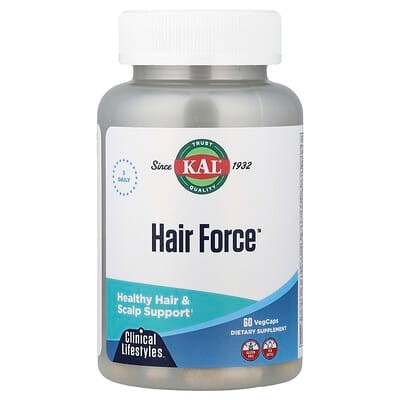

$19.39 $0.96 per serving


Product analysis
Hair Force provides nutrients that may help when low intake contributes to hair shedding. Its many extra ingredients and unclear blend details make the full combination harder to judge.
AI assessment of the formula, label and price. How scoring works
Nutrient Quality37
Natural-form vitamin E and clearly identified B6 and B5 are favorable features. Many other forms are omitted or too broadly described for a confident comparison.
Ingredient Transparency64
Every ingredient amount is listed, but fewer than half the forms are identified. Missing blend details leave part of the formula unclear.
Value For Money35
Value is weak across many vitamins and minerals at the serving cost. Cysteine compares favorably, while several other ingredients lack a reliable price comparison.
Customer Satisfaction71
Customer ratings are very positive. The relatively small review count leaves buyer opinion less settled than for extensively reviewed alternatives.
Product Focus6
The long ingredient list spreads across many health goals. Its clearest practical role is helping fill nutrient gaps, with less certainty about the added herbs.
- Format
Capsule - Container
- 60 Capsule(s)
- Per serving
- $0.96
- Customer rating
- 4.5 · 287 ratings
Goals

Impact
High effect
Silicon · 100 mgBiotin · 1200 mcgMethionine · 50 mg
Biotin supports processes involved in nail formation, with limited evidence of improved brittle nails from small studies using 2500 mcg daily over months. The 1200 mcg serving is below that study amount, so the reported brittle-nail findings do not directly establish the same benefit here. Zinc and iron can help fill dietary gaps when intake is low, since their deficiencies can affect nails.
How this product is rated for Nail Health
Ingredient fit49
Biotin and other counted nutrients contribute to the nail comparison within a broader formula. Biotin is below the amount used in the small nail studies, limiting direct transfer of their findings.
Goal fit
Biotin and other counted nutrients contribute to the nail comparison within a broader formula.
Dose adequacy
Biotin is below the amount used in the small nail studies, limiting direct transfer of their findings.
Pathways60
The saved coverage concentrates on silicon and matrix cross-linking, leaving broader coverage limited.
Depth
The strongest represented area is silicon and matrix cross-linking. This describes the saved ingredient coverage, not a measured nail outcome.
Breadth
The saved coverage concentrates on silicon and matrix cross-linking, leaving broader coverage limited.
Evidence98
Biotin leads the saved comparison, but the small studies leave routine and lasting nail benefits uncertain. Preparation matching is incomplete for L-Cysteine, limiting transfer of study findings.
Evidence strength
Biotin leads the saved comparison, but the small studies leave routine and lasting nail benefits uncertain.
Studied preparation
Preparation matching is incomplete for L-Cysteine, limiting transfer of study findings.
Formulation logic96
Vitamin E lacks an assessable amount and does not meet the saved minimum amount check; the other counted ingredients meet it.
Partner coverage
No required ingredient partner is missing in the saved comparison; this does not establish added benefit from combining the ingredients.
Conflicts
No configured ingredient conflict was identified from the supplied serving facts.
Effective doses
Vitamin E lacks an assessable amount and does not meet the saved minimum amount check; the other counted ingredients meet it.
L-Cysteine Not classified
No linked studies yet.
Methionine Not classified
No linked studies yet.

Impact
High effect
Biotin · 1200 mcgZinc · 15 mgIron · 18 mgMethionine · 50 mgVitamin C · 500 mg
Zinc, iron and biotin can help address low intake that contributes to diffuse hair shedding. This role concerns nutrient sufficiency, with no established extra regrowth benefit when intake is adequate. Saw palmetto has limited findings for particular thinning-hair preparations, but this generic material cannot be assumed equivalent to those studied extracts.
How this product is rated for Hair Health
Ingredient fit61
Zinc, iron and biotin are relevant to nutrient-related shedding within a broader formula. The useful role depends on the cause of shedding and nutrient intake.
Goal fit
Zinc, iron and biotin are relevant to nutrient-related shedding within a broader formula.
Dose adequacy
The serving provides varying nutrient amounts; larger quantities do not establish proportionally greater hair regrowth.
Pathways60
The strongest saved connection concerns antioxidant protection around follicles; normal antioxidant roles do not establish hair regrowth. Coverage remains concentrated in this area.
Depth
The strongest saved connection concerns antioxidant protection around follicles; normal antioxidant roles do not establish hair regrowth.
Breadth
The findings concentrate on follicle antioxidant protection, with limited support across the other examined aspects of hair health.
Evidence96
Zinc leads the saved findings, while its useful hair role centers on correcting low intake associated with shedding. Saw palmetto’s generic preparation limits transfer of trial findings.
Evidence strength
Zinc leads the saved findings, while its useful hair role centers on correcting low intake associated with shedding.
Studied preparation
Saw Palmetto does not meet the reviewed preparation criteria; other counted ingredients meet those criteria without proving regrowth.
Formulation logic97
The counted ingredients have their required partners and no evaluated conflict was identified. Small or unresolved amounts limit some contributions.
Partner coverage
The counted ingredients do not lack a required partner; this does not demonstrate additional hair benefit from combining them.
Conflicts
No evaluated ingredient conflict was identified in the supplied facts.
Effective doses
Vitamin B12 falls below the comparison’s amount threshold, limiting the contribution despite the other counted ingredients meeting it.
Methionine Not classified
No linked studies yet.

Impact
High effect
Vitamin C · 500 mgZinc · 15 mg
Vitamin C supports immune-cell function and may modestly shorten colds with regular use. Zinc and B vitamins supply nutrients for normal immune function, while iron and copper can fill deficiencies that impair immune cells; these roles do not establish routine infection prevention. L-cysteine receives a smaller saved contribution, but NAC findings cannot be transferred to it. Vitamin E is unquantified and ginger's presence is unresolved.
How this product is rated for Immunity
Ingredient fit51
Eight ingredients provide known contributions within a broader formula; vitamin E remains unquantified.
Goal fit
Eight ingredients provide known contributions within a broader formula; vitamin E remains unquantified.
Dose adequacy
Known amounts provide mixed contributions; vitamin E cannot be assessed by amount.
Pathways65
Innate immune-cell activity receives the strongest saved coverage. Innate immune cells and lymphocyte regulation are covered.
Depth
Innate immune-cell activity receives the strongest saved coverage.
Breadth
Innate immune cells and lymphocyte regulation are covered.
Evidence98
Vitamin C anchors the saved evidence finding; clinical context limits the expected benefits.
Evidence strength
Vitamin C anchors the saved evidence finding, without establishing broad infection prevention.
Studied preparation
Most counted preparations are accepted, but L-cysteine lacks a studied-preparation match.
Formulation logic97
The counted ingredients work independently or have their required partner; no configured conflict was found.
Partner coverage
The counted ingredients work independently or have their required partner.
Conflicts
No configured ingredient conflict was found.
Effective doses
Eight known amounts contribute meaningfully; vitamin E remains unquantified.
L-Cysteine Not classified
No linked studies yet.

Impact
High effect
Zinc · 15 mgVitamin C · 500 mgCopper · 2 mgGluthathione · 2 mgSilicon · 100 mgVitamin E · 13 IU
Vitamin C and zinc matter when deficiency impairs healing, while B6 and riboflavin support correction of deficiency-related dermatitis. Extra intake has no established benefit when these nutrients are adequate. Copper’s connective-tissue role does not prove added skin improvement, and B5 acne-formulation findings do not establish routine hydration benefit. MSM and glutathione amounts are small, while silicon and vitamin E amounts remain unresolved.
How this product is rated for Skin Health
Ingredient fit57
The relevant ingredients receive partial amount recognition because of smaller or unresolved amounts. Other actives and links to additional goals also affect focus.
Goal fit
The relevant ingredients provide the recognized connection; other actives and links to additional goals reduce the product’s focus here.
Dose adequacy
Smaller or unresolved included amounts limit the serving comparison, without establishing lack of all biological activity.
Pathways56
The strongest recognized connection is to connective-tissue support. Coverage remains concentrated on this route.
Depth
The strongest recognized connection is to connective-tissue support.
Breadth
Coverage is concentrated on connective-tissue support; other routes do not reach the supplied threshold.
Evidence100
Vitamin C leads the saved evidence finding; its supported skin role is deficiency correction, without established extra benefit when intake is adequate.
Evidence strength
Vitamin C leads the saved evidence finding; its supported skin role is deficiency correction, without established extra benefit when intake is adequate.
Studied preparation
The saved finding recognizes the included preparation as studied; that recognition does not resolve ingredient-specific applicability limitations.
Formulation logic94
No unmet partner or configured conflict was identified. Some included amounts are too small or unresolved.
Partner coverage
No unmet required partner is identified for the included ingredients; this does not establish synergy.
Conflicts
No configured ingredient conflict was matched in the supplied findings.
Effective doses
Some included amounts are smaller than the saved threshold or unresolved, limiting the amount finding.

Impact
Moderate effect
Vitamin B5 · 150 mgRiboflavin · 2 mgThiamin · 5 mgVitamin B12 · 100 mcgIron · 18 mg
Iron, folate and B vitamins provide nutritional support relevant to normal energy metabolism and deficiency-related tiredness. Vitamin C adds to this nutritional contribution. High B-vitamin amounts do not imply extra energy in adequately nourished adults, and B12 contributes little in the saved findings.
How this product is rated for Energy
Ingredient fit55
Only part of the broad formula directly supports the assessed energy goal. Relevant quantities provide partial support, with smaller or unresolved amounts limiting the finding.
Goal fit
Only part of the broad formula directly supports the assessed energy goal.
Dose adequacy
Relevant quantities provide partial support, with smaller or unresolved amounts limiting the finding.
Pathways0
The saved findings show nutritional support without a separately covered direct energy pathway. The findings do not show substantial coverage across several distinct energy-related processes.
Depth
The saved findings show nutritional support without a separately covered direct energy pathway.
Breadth
The findings do not show substantial coverage across several distinct energy-related processes.
Evidence98
Iron supplies the strongest evidence contribution in the saved findings, subject to the supplied nutritional or fatigue-specific limitations. The saved findings recognize the relevant preparations at their assessed amounts.
Evidence strength
Iron supplies the strongest evidence contribution in the saved findings, subject to the supplied nutritional or fatigue-specific limitations.
Studied preparation
The saved findings recognize the relevant preparations at their assessed amounts.
Formulation logic100
No listed formulation conflict was matched in the saved findings. All ingredients counted in this finding meet the saved minimum amount benchmark.
Partner coverage
The relevant ingredients have no missing required partner in the saved findings.
Conflicts
No listed formulation conflict was matched in the saved findings.
Effective doses
All ingredients counted in this finding meet the saved minimum amount benchmark.
Vitamin B5 Not classified
No linked studies yet.

Impact
Lower effect
Vitamin E · 13 IUVitamin C · 500 mg
Ingredients
| Ingredient | Amount per serving | Score |
|---|---|---|
Vitamin C | 500 mg | |
Vitamin E (D-Alpha-Tocopherol Succinate) | 13 IU | |
Thiamine (Thiamine Hydrochloride) | 5 mg | |
Riboflavin | 2 mg | |
Niacin | 80 mg | |
Vitamin B6 (Pyridoxine Hydrochloride) | 20 mg | |
Folic Acid | 400 mcg | |
Vitamin B-12 (natural Cyanocobalamin) | 100 mcg | |
Biotin | 1200 mcg | |
Pantothenic Acid (D-Calcium Pantothenate) | 150 mg | |
Iron (Iron Glycinate) | 18 mg | |
Zinc (Zinc Amino Acid Chelate) | 15 mg | |
Copper (Copper Amino Acid Chelate) | 2 mg | |
Manganese (Manganese Amino Acid Chelate) | 2 mg | |
L-Cysteine | 500 mg | |
MSM | 250 mg | |
GP Saw Palmetto berry extract (Fatty Acids, Sterols) | 100 mg | |
Silica | 100 mg | |
L-Methionine | 50 mg | |
Choline (Choline Bitartrate) | 50 mg | |
Inositol | 50 mg | |
PABA | 40 mg | |
GP Gotu Kola aerial extract (Triterpenes) | 25 mg | |
Peppermint leaves | 10 mg | |
L-Glutathione | 2 mg | |
ActiSorb Base | 10 mg |
Copper (Copper Amino Acid Chelate) · 2 mg OverallScore63
Each serving provides 2 mg of copper as copper amino acid chelate, matching the evaluation’s per-serving target. Its zinc-to-copper ratio of 7.5:1 falls outside the evaluation’s preferred balance criterion.
How this ingredient is rated
Active Ingredient Quality & Bioavailability58
The amount and copper amino acid chelate source are named, but the generic name does not establish a specific chelate.
Copper Form Bioavailability
Copper amino acid chelate is named, but the specific amino acid chelate is not established.
Elemental Copper Labeling Clarity
The copper row identifies both 2 mg of copper and its amino acid chelate source.
Dose, Safety & Label Transparency85
Each serving contains 2 mg of copper, matching the evaluation’s target. Its zinc-to-copper ratio is 7.5:1, outside the evaluation’s preferred balance criterion.
Copper Dosage Safety & Efficacy
The serving provides 2 mg of copper, matching the evaluation’s per-serving target.
Zinc-to-Copper Balance
The recorded zinc-to-copper ratio is 7.5:1, outside the evaluation’s preferred balance criterion. That does not by itself establish a health problem.
Value30
A whole-product serving costs about $0.97.
Price Per Serving Efficiency
The price is about $0.97 per whole-product serving.
PABA · 40 mg OverallScore78
Each serving supplies 40 mg of PABA, a moderate amount in the evaluation. The whole-product price is about $2.42 per 100 mg of PABA, a high cost for the quantity.
How this ingredient is rated
Active Ingredient Quality & Bioavailability80
PABA is identified in the saved facts, with no specific source or grade recorded.
PABA Source & Grade
The ingredient is named as PABA; the saved facts do not specify a quality grade or establish purity.
Dose, Safety & Label Transparency95
The PABA amount is individually disclosed.
PABA Dosage Alignment
The 40 mg per serving is a moderate amount in the evaluation.
Label Disclosure Clarity
PABA is individually listed at 40 mg per serving.
Additive and Excipient Quality
No artificial dyes, titanium dioxide, or hydrogenated oils were identified in the recorded other ingredients.
Value40
The whole-product cost is high when compared by PABA quantity.
Price per 100mg PABA
The whole-product price works out to about $2.42 per 100 mg of PABA.
Vitamin B6 (Pyridoxine Hydrochloride) · 20 mg OverallScore74
A serving provides 20 mg of B6; the cost per mg is relatively high. That serving exceeds the European adult upper limit of 12 mg per day. It uses Pyridoxine Hydrochloride.
How this ingredient is rated
Ingredient Form & Label Quality100
The B6 source is Pyridoxine Hydrochloride. The listed ingredients do not flag artificial colors, titanium dioxide or talc.
Vitamin B6 Form Identification
The B6 source is Pyridoxine Hydrochloride.
Clean Label and Excipient Purity
The listed ingredients do not flag artificial colors, titanium dioxide or talc.
Dose, Safety & Label Transparency65
The 20 mg per serving exceeds the European adult upper limit of 12 mg per day; total intake can include other sources.
Vitamin B6 Dose & Safety Policy
The 20 mg per serving exceeds the European adult upper limit of 12 mg per day; total intake can include other sources.
Label Transparency
The chemical source is stated.
Value39
The cost per mg of B6 is relatively high.
Vitamin B6 Price Efficiency
The cost per mg of B6 is relatively high.
Sources
Published studies used for the product analysis and the top-ranked studies for each ingredient and goal.
- Large-dose intravenous ferric carboxymaltose injection for iron deficiency anemia in heavy uterine bleeding: a randomized, controlled trial.
- The Effect of Parenteral or Oral Iron Supplementation on Fatigue, Sleep, Quality of Life and Restless Legs Syndrome in Iron-Deficient Blood Donors: A Secondary Analysis of the IronWoMan RCT.
- Ferric carboxymaltose vs. oral iron in the treatment of pregnant women with iron deficiency anemia: an international, open-label, randomized controlled trial (FER-ASAP).
- Effect of iron therapy on fatigue symptoms in non-anaemic iron deficient women of reproductive age- A Randomized Controlled Trial.
- Intravenous iron isomaltoside treatment of women suffering from severe fatigue after postpartum hemorrhage.
- Physicochemical properties of and volatile compounds in riboflavin fortified cloudy apple juice; study of its effect on job fatigue among Egyptian construction workers.
- Vitamin B status in patients with chronic fatigue syndrome.
- B-vitamins, related vitamers, and metabolites in patients with quiescent inflammatory bowel disease and chronic fatigue treated with high dose oral thiamine.
- Metabolic features of chronic fatigue syndrome.
- Effectiveness of Riboflavin in Inherited Metabolic Diseases: A Systematic Review
- Influence of thiamin supplementation on the health and general well-being of an elderly Irish population with marginal thiamin deficiency.
- Randomised clinical trial: high-dose oral thiamine versus placebo for chronic fatigue in patients with quiescent inflammatory bowel disease.
- Dietary reference values for thiamin.
- Effects of thiamine supplementation on exercise-induced fatigue.
- Long-term maintenance treatment with 300 mg thiamine for fatigue in patients with inflammatory bowel disease: results from an open-label extension of the TARIF study.
- A new perspective on vitamin B12 deficiency in rheumatology: a case-based review.
- Effects of Vitamin B12 Supplementation on Cognitive Function, Depressive Symptoms, and Fatigue: A Systematic Review, Meta-Analysis, and Meta-Regression.
- Patients' experiences with methylcobalamin injections in amyotrophic lateral sclerosis.
- Cobalamin deficiency: clinical picture and radiological findings.
- Vitamin B12 Deficiency: Common Questions and Answers.