
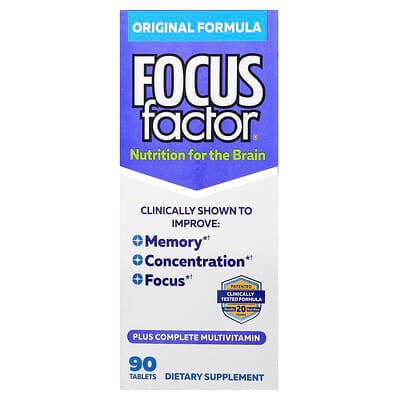

$29.91 $1.35 per serving


Product analysis
FOCUSfactor supplies a wide range of nutrients that may help fill dietary gaps and support normal body functions. Its proprietary blend lacks a component breakdown, making the additional ingredients harder to judge.
AI assessment of the formula, label and price. How scoring works
Nutrient Quality48
Several clearly identified forms, including vitamin D3 and natural vitamin E, receive favorable quality assessments. Quality remains uncertain for much of the formula, and the folate form is less favored in the available comparison.
Ingredient Transparency75
All listed ingredient amounts and most forms are disclosed. Missing mixture proportions and the undisclosed proprietary blend contents make it difficult to see how much each component contributes.
Value For Money34
Several vitamins and minerals are expensive relative to the amounts provided. Some ingredient values remain uncertain, so the broad formula does not establish good value.
Customer Satisfaction73
Customers give generally positive feedback. The relatively modest review count limits how broadly that feedback can be applied.
Product Focus10
The clearest supported use is filling nutrient gaps that affect everyday health, hair or skin. The long formula and unidentified blend do not establish improved focus in someone whose intake is already adequate.
- Format
Tablet - Container
- 90 Tablet(s)
- Per serving
- $1.35
- Customer rating
- 4.7 · 211 ratings
Goals

Impact
Moderate effect
Zinc · 10 mgVitamin C · 250 mgCopper · 0.4 mgSelenium · 50 mcgVitamin E · 30 IU
Ingredients
| Ingredient | Amount per serving | Score |
|---|---|---|
Vitamin A (Betatene Mixed Carotenoids, CaroCare natural Beta-Carotene) | 4000 IU | |
Vitamin C (Ascorbic Acid, Ascorbyl Palmitate, Calcium Ascorbate, Potassium Ascorbate, Sodium Ascorbate, Zinc Ascorbate) | 250 mg | |
Vitamin D (Cholecalciferol) | 100 IU | |
Vitamin E (D-Alpha-Tocopheryl Succinate) | 30 IU | |
Thiamine (Thiamine Mononitrate) | 3 mg | |
Riboflavin | 1.7 mg | |
Niacin (Inositol Hexanicotinate, Niacinamide) | 25 mg | |
Vitamin B6 (Pyridoxal 5-Phosphate, Pyridoxal-Alpha-Ketoglutarate) | 15 mg | |
Folate (Folic Acid) | 400 mcg | |
Vitamin B12 | 20 mcg | |
Biotin | 300 mcg | |
Pantothenic Acid (D-Calcium Pantothenate) | 12 mg | |
Calcium (Calcium Succinate, Calcium Ascorbate, Calcium Citrate) | 50 mg | |
Iron (Ferronyl Carbonyl Iron) | 5 mg | |
Iodine (Kelp) | 15 mcg | |
Magnesium (Magnesium Citrate, Magnesium Malate, Magnesium Taurinate) | 100 mg | |
Zinc (Zinc Ascorbate, Zinc Citrate) | 10 mg | |
Selenium (Selenomethionine) | 50 mcg | |
Copper (Copper Citrate, TRAACS Copper Glycinate Chelate) | 0.4 mg | |
Manganese (Manganese Citrate) | 2 mg | |
Chromium (Chromium Polynicotinate) | 100 mcg | |
Molybdenum (Molybdenum Amino Acid Chelate) | 10 mcg | |
Potassium (Potassium Ascorbate, Potassium Aspartate, Potassium Citrate) | 50 mg | |
Synergistic and Proprietary Formulation | 692 mg |
Each serving provides 15 mg of B6, with a high cost per amount. The sources are Pyridoxal 5-Phosphate and Pyridoxal Alpha-ketoglutarate; their proportions are unknown. That serving exceeds the European adult upper limit of 12 mg per day.
How this ingredient is rated
Ingredient Form & Label Quality100
The sources are Pyridoxal 5-Phosphate and Pyridoxal Alpha-ketoglutarate; their proportions are unknown. No artificial colors, titanium dioxide, hydrogenated oils or talc are indicated; other excipients may still be present.
Vitamin B6 Form Identification
The sources are Pyridoxal 5-Phosphate and Pyridoxal Alpha-ketoglutarate; their proportions are unknown.
Clean Label and Excipient Purity
No artificial colors, titanium dioxide, hydrogenated oils or talc are indicated; other excipients may still be present.
Dose, Safety & Label Transparency69
Each serving provides 15 mg of vitamin B6. That single serving exceeds the European adult upper limit of 12 mg per day; total intake may be higher. The label names the B6 source.
Vitamin B6 Dose & Safety Policy
Each serving provides 15 mg of vitamin B6. That single serving exceeds the European adult upper limit of 12 mg per day; total intake may be higher.
Label Transparency
The label names the B6 source.
Value18
The cost per amount of B6 is high; the whole-product price may overstate the cost of B6 alone.
Vitamin B6 Price Efficiency
The cost per amount of B6 is high; the whole-product price may overstate the cost of B6 alone.
Manganese (Manganese Citrate) · 2 mg OverallScore70
A serving provides 2 mg manganese at a high cost per serving. It uses manganese citrate.
How this ingredient is rated
Active Ingredient Quality & Bioavailability80
It uses manganese citrate.
Manganese Chemical Form
It uses manganese citrate.
Dose, Safety & Label Transparency86
A serving provides 2 mg manganese.
Manganese Dosage Efficacy & Safety
A serving provides 2 mg manganese.
Elemental Weight Disclosure
The manganese amount and source are stated.
Value20
The cost per serving is high.
Price per Serving vs. Median
The cost per serving is high.
A serving supplies 4,000 IU of vitamin A at a high cost per 5,000 IU. The vitamin A form is unknown.
How this ingredient is rated
Active Ingredient Quality & Bioavailability0
The vitamin A form is not specified.
Vitamin A Chemical Form & Source
The vitamin A form is not specified.
Dose, Safety & Label Transparency56
A serving supplies 4,000 IU of vitamin A. The vitamin A form is not specified.
Dosage Efficacy & Safety Thresholds
A serving supplies 4,000 IU of vitamin A.
Label Transparency of Specific Forms
The vitamin A form is not specified.
Value20
The cost per 5,000 IU is high.
Price per 5,000 IU Dose
The cost per 5,000 IU is high.
Alternative products
Report alternatives
Sources
Published studies used for the product analysis and the top-ranked studies for each ingredient and goal.
- Low serum biotinidase activity in children with valproic acid monotherapy.
- Evaluation of biophysical skin parameters and hair changes in patients with acne vulgaris treated with isotretinoin, and the effect of biotin use on these parameters.
- The Role of Sesbania grandiflora-Derived Biotin and Bambusa arundinacea-Derived Silica Extracts in Promoting Hair, Skin, and Nail Health: A Randomized, Double-Blind, Placebo-Controlled Clinical Study.
- Generalized seborrhoeic dermatitis. Clinical and therapeutic data of 25 patients.
- Holocarboxylase synthetase deficiency: novel clinical and molecular findings.
- Noninferiority of Copper Dressings Than Negative Pressure Wound Therapy in Healing Diabetic Wounds: A Randomized Clinical Trial.
- Improvement of facial skin characteristics using copper oxide containing pillowcases: a double-blind, placebo-controlled, parallel, randomized study.
- Radially Electrospun Fibrous Membrane Incorporated with Copper Peroxide Nanodots Capable of Self-Catalyzed Chemodynamic Therapy for Angiogenesis and Healing Acceleration of Diabetic Wounds.
- Engineering copper nanoparticle/polysaccharide-immobilized cotton gauze for accelerated healing of Staphylococcus aureus-infected dermal wounds.
- Stimulation of Healing of Non-Infected Stagnated Diabetic Wounds by Copper Oxide-Impregnated Wound Dressings.
- The effect of niacinamide on reducing cutaneous pigmentation and suppression of melanosome transfer.
- Niacinamide: A B vitamin that improves aging facial skin appearance.
- The clinical anti-aging effects of topical kinetin and niacinamide in Asians: a randomized, double-blind, placebo-controlled, split-face comparative trial.
- A Phase 3 Randomized Trial of Nicotinamide for Skin-Cancer Chemoprevention.
- Nicotinamide for Skin Cancer Chemoprevention.
- Protective effects of B vitamins and antioxidants on the risk of arsenic-related skin lesions in Bangladesh.
- Effect of intake of selected nutrients on skin firmness and elasticity in women.
- Comparative clinical trial of bifonazole solution versus selenium sulphide shampoo in the treatment of pityriasis versicolor.
- Selenium supplementation and secondary prevention of nonmelanoma skin cancer in a randomized trial.
- Evidence-Based Nutritional Interventions in Wound Care.