
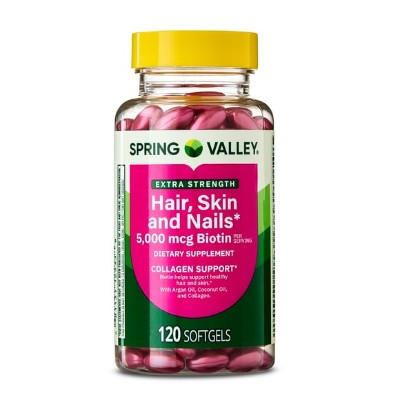
Extra Strength Hair Skin & Nails

Goals
$6.88 $0.17 per serving

Product analysis
Extra Strength Hair Skin & Nails may help fill nutrient gaps and offers limited potential support for brittle nails.
AI assessment of the formula, label and price. How scoring works
Nutrient Quality47
Ingredient quality is mixed, with favorable vitamin D and biotin forms alongside less favored vitamin E and silicon forms. Several other preparations remain unclear, including the collagen form.
Ingredient Transparency89
The listed amounts and most forms are disclosed. Several preparation details remain missing, limiting a complete comparison of the added ingredients.
Value For Money45
Biotin and vitamin A offer favorable value, while the collagen content and synthetic vitamin E form offer weak value. Several other nutrient comparisons remain uncertain.
Customer Satisfaction88
Feedback is favorable across thousands of ratings. The large number of opinions gives a broader picture of buyer satisfaction.
Product Focus39
The clearest contribution is nutritional support, with limited evidence for brittle-nail benefits. Hair benefits mainly relate to correcting low zinc rather than improving growth when nutrient needs are already met.
- Format
Softgel - Container
- 120 Softgel(s)
- Per serving
- $0.17
- Customer rating
- 4.6 · 8,447 ratings
Goals

Impact
High effect
Silicon · 30 mgCollagen · 60 mgBiotin · 5000 mcgHorsetail · 3 mg
Biotin has limited nail-specific findings from small, mostly uncontrolled studies of brittle nails using 2500 mcg daily over months. These suggest possible changes in brittleness or growth but do not establish reliable routine improvement. Higher amounts have no established extra nail benefit, and one serving does not establish sustained daily use. The 60 mg generic collagen serving is far below the studied collagen exposure and lacks preparation equivalence. Silica and horsetail do not establish the elemental silicon preparation used in the nail study; zinc is relevant when deficiency affects nails.
How this product is rated for Nail Health
Ingredient fit56
Vitamin B7 (Biotin) leads the ingredient finding. The wider formula and amount alignment influence how closely it relates to nail health.
Goal fit
Nail-related ingredients sit within a formula also directed at broader nutritional purposes.
Dose adequacy
The amounts partly align with the saved reference ranges, with some below the relevant research exposures.
Pathways70
The strongest recorded connection concerns keratinization cofactors. Coverage is concentrated in keratinization cofactors.
Depth
The strongest recorded connection concerns keratinization cofactors.
Breadth
Coverage is concentrated in keratinization cofactors.
Evidence100
Vitamin B7 (Biotin) leads the saved evidence finding. The supporting clinical findings remain limited in size or applicability.
Evidence strength
Vitamin B7 (Biotin) leads the saved evidence finding; its assigned standing does not establish reliable improvement in nail quality.
Studied preparation
The counted preparation matches the saved material finding; this does not establish the same duration or individual response.
Formulation logic95
No unmet partner requirement or configured conflict was recorded. Vitamin E has an unresolved applicable amount.
Partner coverage
No unmet partner requirement is recorded; the presence of supporting nutrients does not establish added benefit.
Conflicts
No configured ingredient conflict was identified in the supplied findings.
Effective doses
Vitamin E falls below the saved amount threshold because its applicable amount remains unresolved; its presence is still recorded.
Horsetail Not classified
No linked studies yet.

Impact
High effect
Vitamin C · 90 mgZinc · 7.5 mgVitamin A · 5000 IUVitamin D · 2000 IUSelenium · 12.5 mcg
Vitamin D and zinc supply nutrients involved in normal immune regulation, while folate, B6 and B12 can fill deficiencies that impair immune-cell function. These roles do not establish infection prevention when intake is adequate. Vitamin A and E have unknown amounts, while vitamin C and selenium are below the saved contribution thresholds. The unknown amounts limit how completely the formulation can be described.
How this product is rated for Immunity
Ingredient fit49
Five nutrients provide known contributions; vitamins A and E remain unquantified.
Goal fit
Five nutrients provide known contributions; vitamins A and E remain unquantified.
Dose adequacy
Known amounts contribute unevenly; vitamins A and E cannot be assessed by amount.
Pathways60
Lymphocyte function and immune regulation receives the strongest saved coverage. Lymphocyte regulation is the main covered area.
Depth
Lymphocyte function and immune regulation receives the strongest saved coverage.
Breadth
Lymphocyte regulation is the main covered area.
Evidence100
Zinc anchors the saved evidence finding; the supplied scientific limits determine what immune benefits can be expected.
Evidence strength
Zinc anchors the saved evidence finding, without establishing broad infection prevention.
Studied preparation
The counted preparations with substantial known amounts are accepted; no additional form advantage is established.
Formulation logic93
The counted nutrients work independently or have their required partner; no configured conflict was found.
Partner coverage
The counted nutrients work independently or have their required partner.
Conflicts
No configured ingredient conflict was found.
Effective doses
Five counted nutrients provide meaningful known amounts; vitamins A and E remain unquantified.

Impact
Moderate effect
Biotin · 5000 mcgVitamin D · 2000 IUZinc · 7.5 mgVitamin C · 90 mgCollagen · 60 mg
Zinc may help with shedding caused by low zinc levels. That benefit concerns correcting a nutrient shortage; taking extra zinc when you already get enough isn't known to regrow hair. Vitamin C also helps normal collagen synthesis and iron absorption, without a clear independent hair-regrowth benefit.
How this product is rated for Hair Health
Ingredient fit57
Collagen, Vitamin B7 (Biotin), Vitamin B9 (Folate) provide the relevant ingredient connection; other actives have no clear independent hair benefit here.
Goal fit
Collagen, Vitamin B7 (Biotin), Vitamin B9 (Folate) provide the relevant ingredient connection; other actives have no clear independent hair benefit here.
Dose adequacy
Collagen 60 mg, Vitamin B7 (Biotin) 5000 mcg, Vitamin B9 (Folate) 400 mcg DFE per selected serving. Some nutrient amounts remain unresolved.
Pathways0
The relevant contribution concerns nutrient adequacy rather than a defined hair-growth mechanism.
Depth
The relevant contribution concerns nutrient adequacy rather than a defined hair-growth mechanism.
Breadth
A broad effect across hair-related mechanisms isn't demonstrated by these ingredient facts.
Evidence98
Zinc's useful hair benefit concerns correcting a deficiency, rather than routine regrowth when intake is adequate.
Evidence strength
Zinc's useful hair benefit concerns correcting a deficiency, rather than routine regrowth when intake is adequate.
Studied preparation
The relevant nutrient forms fit the available ingredient context; that doesn't make their hair benefit unconditional.
Formulation logic92
The relevant ingredients can act without an extra partner, and no particular conflict is identified.
Partner coverage
The relevant ingredients don't require an additional missing partner for their described role.
Conflicts
No particular ingredient conflict is identified for this combination.
Effective doses
Vitamin A, Vitamin D have an unresolved or low amount relative to the ingredient comparison amounts.
Horsetail Not classified
No linked studies yet.

Impact
Moderate effect
Vitamin D · 2000 IUVitamin B5 · 15 mgRiboflavin · 5 mgThiamin · 5 mgVitamin B12 · 8 mcg
Riboflavin, niacin, B5, B6, folate and B12 relate to normal metabolism and may help with tiredness when they fill a dietary gap. Vitamin C adds nutritional support, while the large biotin amount has no independent fatigue benefit established in the supplied evidence.
How this product is rated for Energy
Ingredient fit65
The saved assessment identifies 8 relevant ingredients and 11 other active ingredients (Argan nut oil, Collagen, Horsetail, Hyaluronic acid, PABA, Selenium, Silicon, Vitamin A, Vitamin E, Zinc, coconut oil). Other linked uses also affect focus. The evaluated amounts largely meet the saved dose benchmarks.
Goal fit
The saved assessment identifies 8 relevant ingredients and 11 other active ingredients (Argan nut oil, Collagen, Horsetail, Hyaluronic acid, PABA, Selenium, Silicon, Vitamin A, Vitamin E, Zinc, coconut oil). Other linked uses also affect focus.
Dose adequacy
The evaluated amounts largely meet the saved dose benchmarks.
Pathways0
No contribution to the listed energy processes was recorded. None of the listed processes reaches the saved coverage threshold.
Depth
No contribution to the listed energy processes was recorded.
Breadth
None of the listed processes reaches the saved coverage threshold.
Evidence95
Vitamin D supplies the strongest recorded evidence contribution; its practical relevance depends on the studied population and outcome. The saved assessment treats the evaluated preparations as matching those used in research.
Evidence strength
Vitamin D supplies the strongest recorded evidence contribution; its practical relevance depends on the studied population and outcome.
Studied preparation
The saved assessment treats the evaluated preparations as matching those used in research.
Formulation logic100
The evaluated ingredients work alone or have their relevant partners present. All evaluated ingredients reach the saved minimum dose threshold.
Partner coverage
The evaluated ingredients work alone or have their relevant partners present.
Conflicts
No ingredient conflicts were recorded.
Effective doses
All evaluated ingredients reach the saved minimum dose threshold.
Vitamin B5 Not classified
No linked studies yet.

Impact
Highest effect
Folate · 400 mcgVitamin B12 · 8 mcgVitamin D · 2000 IUCollagen · 60 mgSelenium · 12.5 mcgZinc · 7.5 mgVitamin C · 90 mg
B vitamins contribute nutrients used in normal energy metabolism; folate contributes to blood formation and one-carbon metabolism. Vitamin D contributes to normal bone and mineral metabolism. Zinc provides a nutrient involved in normal antioxidant or immune functions. These nutritional contributions matter most when intake falls short; extra benefit with adequate intake is not established.
How this product is rated for Everyday Health
Ingredient fit75
The main relevant ingredients are Vitamin B1 (Thiamin), Vitamin B2 (Riboflavin), Vitamin B3 (Niacin), Vitamin B5 (Pantothenic Acid), Vitamin B9 (Folate), Vitamin B6, Vitamin D and Zinc. Their value is nutritional, rather than a demonstrated broad health improvement.
Goal fit
The nutrient core fits several routine nutritional needs, while additional actives and links to other goals make the formula less focused.
Dose adequacy
The selected serving provides several meaningful nutrient amounts, although contributions vary across ingredients.
Pathways100
The main areas represented are energy metabolism cofactors, one-carbon metabolism and blood formation, bone and mineral metabolism, antioxidant and immune defence.
Depth
The strongest supported area is energy metabolism cofactors, through the relevant nutrients.
Breadth
The main areas represented are energy metabolism cofactors, one-carbon metabolism and blood formation, bone and mineral metabolism, antioxidant and immune defence.
Evidence82
Vitamin B9 (Folate) supports a nutritional role, chiefly when intake is low; this does not establish extra benefit with adequate intake.
Evidence strength
Vitamin B9 (Folate) supports a nutritional role, chiefly when intake is low; this does not establish extra benefit with adequate intake.
Studied preparation
The relevant nutrient preparations were accepted in the saved comparison; no superior form or delivery benefit is established.
Formulation logic100
The relevant ingredients can contribute independently or have their required partner; their combination does not establish added benefit. No conflict was identified by the evaluated checks.
Partner coverage
The relevant ingredients can contribute independently or have their required partner; their combination does not establish added benefit.
Conflicts
No conflict was identified by the evaluated checks.
Effective doses
The counted ingredients reach the comparison’s minimum amount criterion; this is not proof of a clinical benefit.

Impact
Moderate effect
Vitamin D · 2000 IUCollagen · 60 mgVitamin E · 30 IUVitamin C · 90 mg
Zinc may help when low zinc contributes to ongoing low-level inflammation. Getting enough supports normal immune function, but extra zinc isn't known to provide the same benefit when your intake is already adequate. The other ingredients don't turn this conditional nutrient benefit into a predictable reduction in inflammation or joint symptoms.
How this product is rated for Inflammation
Ingredient fit39
Zinc relates to inflammation mainly when zinc levels are low.
Goal fit
Zinc relates to inflammation mainly when zinc levels are low.
Dose adequacy
The selected serving supplies Zinc 7.5 mg, Collagen 0.06 g, Selenium 12.5 mcg, Vitamin D 50 mcg, Vitamin C 90 mg. These amounts are comparisons, not guarantees of symptom relief.
Pathways57
The connection concerns processes involved in inflammation; it does not predict a noticeable reduction in pain or other symptoms.
Depth
The strongest connection concerns inflammatory gene signalling (nf-kb), a process involved in inflammation rather than a prediction of symptom relief.
Breadth
The connection is concentrated in one inflammation process rather than spread broadly across several.
Evidence93
Zinc may help when low zinc contributes to ongoing low-level inflammation. Getting enough supports normal immune function, but extra zinc isn't known to provide the same benefit when your intake is already adequate.
Evidence strength
Zinc may help with inflammation related to low zinc; benefits when zinc intake is adequate are unclear.
Studied preparation
The named ingredient forms match the preparation context used here; that does not guarantee the same practical benefit.
Formulation logic92
No particular ingredient conflict is identified. A required extra partner is not identified for the ingredients with a contribution.
Partner coverage
No required additional ingredient partner is identified for the ingredients with a contribution.
Conflicts
No particular conflict between the ingredients is identified.
Effective doses
Some relevant amounts are low or unresolved, so the ingredients do not all have comparable dose information.

Impact
Moderate effect
Zinc · 7.5 mgVitamin D · 2000 IU
Zinc may help restore testosterone when low zinc is contributing to low levels. Severe or moderate zinc deficiency can disrupt male hormone function, so getting enough matters. Taking extra zinc hasn't been shown to raise testosterone when you're already getting enough, and the amount in a serving doesn't tell you whether you need more.
How this product is rated for Testosterone Support
Ingredient fit40
Zinc supplies the main nutrient connection to testosterone. Its practical value depends on the limits of that connection.
Goal fit
Zinc provides a relevant nutrient connection, while the other ingredients don't imply an added testosterone benefit.
Dose adequacy
Zinc 7.5 mg, Selenium 12.5 mcg, Vitamin B6 5 mg, plus other declared nutrients per serving; these amounts do not predict a testosterone increase.
Pathways2
Zinc relates to hormone function through nutrient sufficiency. This is different from reliably increasing testosterone in someone who gets enough.
Depth
Zinc relates to normal hormone function when deficiency is present; this does not imply extra testosterone above adequate intake.
Breadth
The ingredients do not provide reliable grounds to expect several distinct testosterone effects.
Evidence91
The useful distinction is zinc deficiency: correcting it may help hormone levels. Extra zinc has no clear testosterone benefit when intake is adequate.
Evidence strength
Zinc has a specific role in correcting deficiency-related hormone problems; a benefit beyond adequate intake is unclear.
Studied preparation
Vitamin B6 adds uncertainty: its preparation does not provide a reliable basis for expecting higher testosterone.
Formulation logic94
No missing partner or particular ingredient conflict is identified. Combining the ingredients does not itself show an added hormone benefit.
Partner coverage
No missing ingredient partner is identified for the relevant ingredients.
Conflicts
No particular ingredient conflict is identified.
Effective doses
Some nutrient amounts are low or unclear; their presence alone cannot show a meaningful testosterone effect.
Vitamin B6 Not classified
No linked studies yet.
Ingredients
| Ingredient | Amount per serving | Score |
|---|---|---|
Vitamin A (Retinyl Palmitate) | 5000 IU | |
Vitamin C (Ascorbic Acid) | 90 mg | |
Vitamin D3 (Cholecalciferol) | 2000 IU | |
Vitamin E (DL-Alpha-Tocopheryl Acetate) | 30 IU | |
Thiamine (Thiamine Mononitrate) | 5 mg | |
Riboflavin | 5 mg | |
Niacin (Niacinamide) | 25 mg | |
Vitamin B6 (Pyridoxine Hydrochloride) | 5 mg | |
Folic Acid | 400 mcg | |
Vitamin B12 (Cyanocobalamin) | 8 mcg | |
Biotin (D-Biotin) | 5000 mcg | |
Pantothenic Acid (D-Calcium Pantothenate) | 15 mg | |
Zinc (Zinc Gluconate) | 7.5 mg | |
Selenium (Selenium Yeast) | 12.5 mcg | |
Argan Oil | 25 mg | |
PABA | 10 mg | |
Horsetail | 3 mg | |
hydrolyzed Collagen | 60 mg | |
Hyaluronic Acid (Sodium Hyaluronate) | 1 mg | |
Silica (Silicon Dioxide) | 30 mg | |
extra virgin organic Coconut Oil | 50 mg |
Biotin (D-Biotin) · 5000 mcg OverallScore93
Each serving supplies 5,000 mcg of biotin, a relatively high amount. It uses biologically active D-biotin and costs about $0.17 per whole-product serving.
How this ingredient is rated
Active Ingredient Quality & Bioavailability92
The label specifies biologically active D-biotin; the evaluation also identifies an artificial color.
Biologically Active d-Biotin Isomer
The label specifies D-biotin, the biologically active isomer.
Excipient Purity
The evaluation identifies an artificial color and no checked artificial sweeteners.
Dose, Safety & Label Transparency100
A serving supplies 5,000 mcg of biotin, a relatively high amount, and the quantity is explicitly disclosed.
Biotin Potency for Health Goals
A serving supplies 5,000 mcg of biotin, an amount favored by the evaluation.
Label Transparency & Exact Disclosure
The label gives the exact biotin amount: 5,000 mcg per serving.
Value80
A whole-product serving costs about $0.17 and supplies 5,000 mcg of biotin, a relatively low cost for that quantity in the evaluation.
Price per 5,000 mcg Biotin
A whole-product serving costs about $0.17 and supplies 5,000 mcg of biotin, a relatively low cost for that quantity in the evaluation.
Vitamin A (Retinyl Palmitate) · 5000 IU OverallScore61
The serving provides 5,000 IU of vitamin A as preformed retinyl palmitate. The whole-product serving costs about $0.17.
How this ingredient is rated
Active Ingredient Quality & Bioavailability30
Retinyl palmitate is preformed vitamin A, which the body regulates less tightly than carotenoid sources.
Vitamin A Chemical Form & Source
The recorded vitamin A form is retinyl palmitate, a preformed form.
Dose, Safety & Label Transparency82
The recorded serving provides 5,000 IU of vitamin A. The form is identified as retinyl palmitate, but an explicit source percentage is not recorded.
Dosage Efficacy & Safety Thresholds
The recorded serving provides 5,000 IU of vitamin A.
Label Transparency of Specific Forms
The form is identified as retinyl palmitate, but an explicit source percentage is not recorded.
Value80
At the whole-product price, an equivalent 5,000 IU of vitamin A costs about $0.17.
Price per 5,000 IU Dose
At the whole-product price, an equivalent 5,000 IU of vitamin A costs about $0.17.
Vitamin D (Cholecalciferol) · 2000 IU OverallScore71
Each serving provides 2000 IU of vitamin D3. The ingredient details also identify titanium dioxide.
How this ingredient is rated
Active Ingredient Quality & Bioavailability87
The identified form is vitamin D3 (cholecalciferol).
Vitamin D3 vs. D2 Superiority
The identified form is vitamin D3 (cholecalciferol), which is more effective at raising and maintaining blood levels than D2.
Sourcing and Active Marker Disclosure
The saved facts do not establish the raw material source.
Dose, Safety & Label Transparency61
The serving provides 2000 IU of vitamin D3, and titanium dioxide is identified in the ingredient details.
Daily Dosage Appropriateness
The serving provides 2000 IU of vitamin D.
Excipient and Additive Purity
The available ingredient details identify titanium dioxide; artificial colors and hydrogenated oils are not identified.
Purity and Quality Certification
The saved facts do not establish a qualifying independent verification, batch-specific certificate or GMP claim.
Value60
A whole-product serving costs about $0.17.
Price per 1,000 IU Efficiency
The cost is about $0.09 per 1,000 IU of vitamin D, based on a whole-product serving.
Alternative products
Report alternatives
Sources
Published studies used for the product analysis and the top-ranked studies for each ingredient and goal.
- Physicochemical properties of and volatile compounds in riboflavin fortified cloudy apple juice; study of its effect on job fatigue among Egyptian construction workers.
- Vitamin B status in patients with chronic fatigue syndrome.
- B-vitamins, related vitamers, and metabolites in patients with quiescent inflammatory bowel disease and chronic fatigue treated with high dose oral thiamine.
- Metabolic features of chronic fatigue syndrome.
- Effectiveness of Riboflavin in Inherited Metabolic Diseases: A Systematic Review
- Influence of thiamin supplementation on the health and general well-being of an elderly Irish population with marginal thiamin deficiency.
- Randomised clinical trial: high-dose oral thiamine versus placebo for chronic fatigue in patients with quiescent inflammatory bowel disease.
- Dietary reference values for thiamin.
- Effects of thiamine supplementation on exercise-induced fatigue.
- Long-term maintenance treatment with 300 mg thiamine for fatigue in patients with inflammatory bowel disease: results from an open-label extension of the TARIF study.
- A new perspective on vitamin B12 deficiency in rheumatology: a case-based review.
- Effects of Vitamin B12 Supplementation on Cognitive Function, Depressive Symptoms, and Fatigue: A Systematic Review, Meta-Analysis, and Meta-Regression.
- Patients' experiences with methylcobalamin injections in amyotrophic lateral sclerosis.
- Cobalamin deficiency: clinical picture and radiological findings.
- Vitamin B12 Deficiency: Common Questions and Answers.
- Effect of Vitamin D Supplementation on Fatigue in Multiple Sclerosis: A Systematic Review and Meta-Analysis.
- Vitamin D Supplementation in Adolescents and Young Adults With Juvenile Systemic Lupus Erythematosus for Improvement in Disease Activity and Fatigue Scores: A Randomized, Double-Blind, Placebo-Controlled Trial.
- Vitamin D in Myalgic Encephalomyelitis/Chronic Fatigue Syndrome After COVID-19 or Vaccination: A Randomized Controlled Trial.
- The effects of vitamin D supplementation on disease activity and fatigue in Libyan rheumatoid arthritis patients.
- The effect of home-based aerobic training and vitamin D supplementation on fatigue and quality of life in patients with multiple sclerosis during COVID-19 outbreak.