
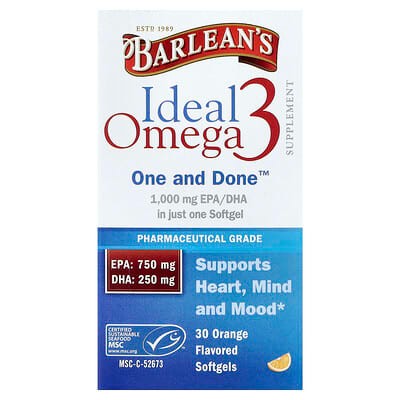
Ideal Omega 3 Orange Flavored

Goals
$28.99 $0.96 per serving


Product analysis
Ideal Omega 3 Orange Flavored supplies omega-3 fats, with EPA offering support for triglyceride levels. The precise oil forms are unspecified, which makes close comparison with other omega-3 supplements harder.
AI assessment of the formula, label and price. How scoring works
Nutrient Quality20
The precise forms of the omega-3 fats are unspecified. That makes it hard to compare their quality with clearly described oil preparations.
Ingredient Transparency50
Most listed amounts are disclosed, giving a basis for serving comparisons. The precise fat forms are unspecified, which limits comparison between oil preparations.
Value For Money47
EPA and the combined omega-3 amount offer middle-of-the-range value. A separate value judgment for DHA remains uncertain.
Customer Satisfaction74
Customer ratings are strongly favorable. The relatively small review pool leaves a narrower view of buyer satisfaction.
Product Focus76
The clearest role is omega-3 nutrition, with EPA relevant to triglyceride levels. The wider eye and focus uses do not establish improved routine vision or immediate attention.
- Format
Softgel - Container
- 30 Softgel(s)
- Per serving
- $0.96
- Customer rating
- 4.8 · 113 ratings
Goals

Impact
Highest effect
EPA (Eicosapentaenoic Acid) · 750 mg
EPA provides triglyceride-related support, but routine supplementation does not establish a general reduction in major cardiovascular events. The saved findings include EPA while the DHA declarations remain unresolved across the supplied facts, so no additional DHA benefit can be confidently assigned. The serving is not equivalent to prescription omega-3 therapy or its selected patient populations.
How this product is rated for Heart Health
Ingredient fit86
EPA (Eicosapentaenoic Acid) provide the included contribution, with partial coverage of the comparison amounts.
Goal fit
EPA (Eicosapentaenoic Acid) provide the relevant ingredient focus; the product is also linked to other goals.
Dose adequacy
The included amounts partly cover the saved comparison ranges, which compare exposure rather than establish treatment doses.
Pathways50
The strongest recorded connection is triglyceride metabolism, with partial comparison-range coverage.
Depth
The strongest recorded connection is triglyceride metabolism, with partial comparison-range coverage.
Breadth
One configured pathway reached the coverage threshold, so the contribution remains focused.
Evidence100
EPA (Eicosapentaenoic Acid) provides the strongest included evidence; its clinical meaning remains limited by the outcomes and populations studied.
Evidence strength
EPA (Eicosapentaenoic Acid) provides the strongest included evidence; its clinical meaning remains limited by the outcomes and populations studied.
Studied preparation
The included preparations were matched to studied material, without establishing benefit outside the studied outcomes or populations.
Formulation logic100
The included ingredients have no recorded partner gap or configured conflict and clear the minimum amount threshold.
Partner coverage
The included ingredients can stand alone or have their required partner present.
Conflicts
No configured ingredient conflict was identified.
Effective doses
All included ingredients clear the saved minimum amount threshold; this does not guarantee a clinical benefit.

Impact
High effect
EPA (Eicosapentaenoic Acid) · 750 mg
DHA is a structural component of the retina, and EPA has anti-inflammatory roles. Those functions do not establish improved routine vision from these supplements. The supplied trials found no overall benefit from adding omega-3s for age-related macular degeneration, and EPA/DHA did not outperform placebo for moderate-to-severe dry eye. The saved amount recognition does not change those limits.
How this product is rated for Eye Health
Ingredient fit81
Relevant ingredients sit within a broader formula, giving it a less concentrated vision focus. The declared amounts meet the saved comparison only partly; unresolved amounts do not receive amount recognition.
Goal fit
Relevant ingredients sit within a broader formula, giving it a less concentrated vision focus.
Dose adequacy
The declared amounts meet the saved comparison only partly; unresolved amounts do not receive amount recognition.
Pathways60
The main assigned contribution concerns retinal and lens antioxidant defense, without establishing a clinical improvement. Coverage was concentrated in one specified mechanism.
Depth
The main assigned contribution concerns retinal and lens antioxidant defense, without establishing a clinical improvement.
Breadth
Only retinal and lens antioxidant defense reached the saved coverage requirement.
Evidence79
EPA (Eicosapentaenoic Acid) leads the saved comparison. Its recognized amount and preparation do not independently establish routine visual improvement.
Evidence strength
EPA (Eicosapentaenoic Acid) leads the saved evidence comparison; the supplied clinical population and combination limits still apply.
Studied preparation
DHA lacks matching studied-preparation recognition; EPA receives it in the saved comparison.
Formulation logic100
The included contributions meet the saved amount requirement, with no missing required partner or identified conflict.
Partner coverage
No required partner was missing under the supplied partner check; this does not establish a complete clinical eye-health regimen.
Conflicts
No ingredient conflict was identified by the supplied checks.
Effective doses
The included contributions met the saved minimum amount requirement, which is not proof of an effective routine vision dose.
DHA (Docosahexaenoic Acid) Not classified
No linked studies yet.

Impact
High effect
DHA and EPA are omega-3 fats relevant to brain function, but the supplied evidence concerns repeated use and does not establish immediate focus improvement. Positive DHA findings were in adults with low intake over months, while EPA findings do not establish acute attention benefits. The saved result recognizes their amounts without resolving that difference in scope.
How this product is rated for Mental Focus
Ingredient fit75
The saved findings recognize DHA and EPA, while their amounts do not establish immediate focus benefits.
Goal fit
DHA and EPA drive the saved fit, while other declared ingredients broaden the formula.
Dose adequacy
The disclosed amounts receive partial recognition against the saved benchmarks, without establishing a proven focus dose.
Pathways54
The saved pathway coverage is centered on synaptic function and protection.
Depth
The strongest saved pathway concerns synaptic function and protection; this does not establish an immediate attention effect.
Breadth
Only one focus pathway reached the saved coverage benchmark, limiting breadth.
Evidence56
The omega-3 evidence does not establish a one-serving attention benefit.
Evidence strength
EPA leads the saved evidence finding, but repeated-use studies do not establish acute focus benefits.
Studied preparation
DHA lacks the studied-preparation match recorded for EPA.
Formulation logic100
Recognized ingredients meet the recorded partner requirements, with no configured conflict matched.
Partner coverage
No required partner is missing among the ingredients recognized in the saved finding.
Conflicts
No configured conflict was matched in the supplied findings; this is not a general safety assessment.
Effective doses
All ingredients counted in this finding meet its minimum amount threshold; that threshold is not proof of efficacy.
DHA (Docosahexaenoic Acid) Not classified
No linked studies yet.
Ingredients
| Ingredient | Amount per serving | Score |
|---|---|---|
Calories | 15 Calorie(s) | |
Total Fat | 1 Gram(s) | |
Omega-3 Polyunsaturated Fat | 0 NP | |
Eicosapentaenoic Acid | 750 mg | |
Docosahexaenoic Acid | 250 mg | |
Other Omega-3 Fatty Acids | 60 mg |
EPA (Eicosapentaenoic Acid) · 750 mg OverallScore72
Each serving provides 750 mg EPA and 250 mg DHA. The saved evaluation also records a qualifying contaminant-testing or certification claim.
How this ingredient is rated
Active Ingredient Quality & Bioavailability65
The molecular form of EPA is not identified in the saved information. The 750 mg EPA is about 70.8% of the 1060 mg total omega-3s per serving.
Molecular Form and Bioavailability
The molecular form of EPA is not identified in the saved information.
EPA Concentration Density
The 750 mg EPA is about 70.8% of the 1060 mg total omega-3s per serving.
Oxidation Protection
Tocopherol is recorded as an antioxidant; actual oxidation protection was not measured by the evaluation.
Dose, Safety & Label Transparency90
Each serving provides 750 mg EPA and 250 mg DHA. The saved evaluation records a qualifying testing or certification claim.
Absolute EPA Dose per Serving
Each serving supplies 750 mg EPA.
EPA-Centric Ratio
Each serving has 750 mg EPA and 250 mg DHA, so EPA is the larger amount.
Purity and Contaminant Testing
The saved evaluation records a qualifying third-party contaminant-testing or certification claim; the claim is not independent verification.
Value50
Based on the whole-product serving price, the cost is about $1.29 per gram of EPA.
Price per Gram of EPA
Based on the whole-product serving price, the cost is about $1.29 per gram of EPA.
Omega-3 · 60 mg OverallScore48
DHA · 250 mg OverallScore37
Alternative products
Report alternatives
Sources
Published studies used for the product analysis and the top-ranked studies for each ingredient and goal.
- Dietary omega-3 LCPUFA intake in the prevention of neovascular age-related macular degeneration: a systematic review and meta-analysis.
- Dietary omega-3 polyunsaturated fatty acids and fish intake and risk of age-related macular degeneration.
- Dietary fatty acid intake, plasma fatty acid levels, and the risk of age-related macular degeneration (AMD): a dose-response meta-analysis of prospective cohort studies.
- Dietary ω-3 fatty acid and fish intake and incident age-related macular degeneration in women.
- Can Omega-3 Fatty Acids Serve as a Preventive Strategy for Age-Related Macular Degeneration? A Systematic Review and Meta-Analysis.
- Effects of eicosapentaenoic acid on major coronary events in hypercholesterolaemic patients (JELIS): a randomised open-label, blinded endpoint analysis.
- Effects of EPA on coronary artery disease in hypercholesterolemic patients with multiple risk factors: sub-analysis of primary prevention cases from the Japan EPA Lipid Intervention Study (JELIS).
- Effects of omega-3 fatty acids on coronary revascularization and cardiovascular events: a meta-analysis.
- Incremental effects of eicosapentaenoic acid on cardiovascular events in statin-treated patients with coronary artery disease.
- Omega-3 Fatty Acids for the Management of Hypertriglyceridemia: A Science Advisory From the American Heart Association.
- The influence of n-3 polyunsaturated fatty acids on cognitive function in individuals without dementia: a systematic review and dose-response meta-analysis.
- EPA supplementation improves teacher-rated behaviour and oppositional symptoms in children with ADHD.
- Docosahexaenoic Acid (DHA) and Eicosapentaenoic Acid (EPA)-Should They Be Mandatory Supplements in Pregnancy?
- Supplementation with oil rich in eicosapentaenoic acid, but not in docosahexaenoic acid, improves global cognitive function in healthy, young adults: results from randomized controlled trials.