
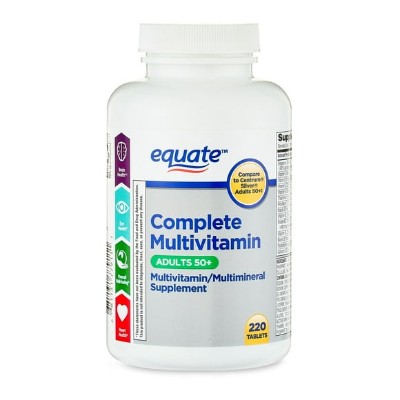

$8.84 $0.04 per serving

Product analysis
Complete Multivitamin offers broad nutritional support for everyday dietary gaps, including nutrients used in normal energy metabolism and immune function. Several less favored mineral and vitamin forms may matter to buyers comparing ingredient quality.
AI assessment of the formula, label and price. How scoring works
Nutrient Quality42
Ingredient quality varies across the formula. Favorable iodine and vitamin D choices sit alongside less favored vitamin E, copper and silicon forms.
Ingredient Transparency84
All ingredient amounts and most forms are stated, helping with serving comparisons. Some mixed-source proportions and forms remain undisclosed.
Value For Money59
Several core nutrients offer good value at the serving cost. The synthetic vitamin E contribution is less favorable, while other ingredients remain difficult to assess.
Customer Satisfaction90
Buyers give very positive feedback across a substantial review pool. That provides a broad view of satisfaction without establishing health effects.
Product Focus32
The formula is aimed at broad everyday nutritional coverage. Its long ingredient list makes it less targeted for a single dietary need.
- Format
Tablet - Container
- 220 Tablet(s)
- Per serving
- $0.04
- Also available
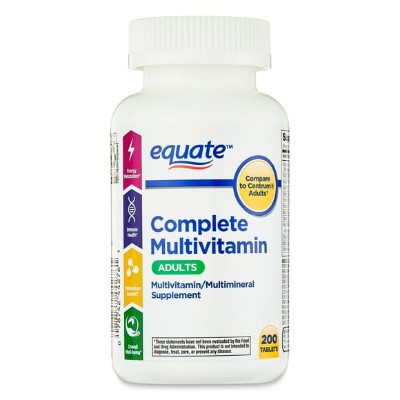 Complete Multivitamin$9.82
- Customer rating
- 4.8 · 3,557 ratings
Goals

Impact
Highest effect
Folate · 400 mcgVitamin B12 · 25 mcgVitamin D · 500 IUMagnesium · 50 mgVitamin K · 30 mcgBoron · 150 mcgSelenium · 55 mcgZinc · 11 mgVitamin C · 60 mg
The B vitamins provide nutrients used in everyday metabolism, while folate contributes to the nutrients involved in blood formation. Vitamin C adds to nutritional antioxidant support. These contributions are most useful when dietary intake falls short; larger amounts do not establish better energy or disease prevention, and the different forms receive no demonstrated superiority.
How this product is rated for Everyday Health
Ingredient fit74
The declared nutrients provide the product’s connection to general health. Amount coverage is partial in the saved finding.
Goal fit
The relevant nutrients share this formula with other actives, making its connection to general nutrition less focused.
Dose adequacy
The counted amounts provide partial coverage of the saved reference range; this does not measure clinical benefit or nutrient absorption.
Pathways100
The strongest connection is energy metabolism cofactors. The broader findings also reflect the functional areas identified by the individual rules.
Depth
The strongest recorded connection is energy metabolism cofactors, with full coverage in the saved findings.
Breadth
The recorded findings cover energy metabolism cofactors, one-carbon metabolism and blood formation, antioxidant and immune defence. Other general-health functions receive less or no coverage.
Evidence82
Vitamin B9 (Folate) leads the saved evidence finding. Nutritional availability when intake is low is distinct from proven improvement above adequacy.
Evidence strength
Vitamin B9 (Folate) leads the saved evidence finding; the supplied context supports conditional nutrient availability, rather than extra benefit above adequacy.
Studied preparation
The counted preparations receive full recognition in the saved finding, without establishing superiority for their chemical forms or delivery methods.
Formulation logic100
No missing partner or listed conflict reduced the counted contributions. The amount threshold applies only to the ingredients retained in the saved finding.
Partner coverage
No missing partner reduced the counted ingredients’ contributions; this finding does not establish synergy.
Conflicts
No listed formulation conflict was triggered.
Effective doses
All counted ingredients meet the saved amount threshold; smaller excluded amounts are distinct from proven ineffectiveness.

Impact
Moderate effect
Biotin · 30 mcgVitamin D · 500 IUZinc · 11 mgVitamin C · 60 mg
Zinc may help with diffuse shedding caused by low zinc levels. That gives it a useful role when a shortage is involved, but extra zinc isn't known to regrow hair when levels are already adequate. The particular zinc salt doesn't by itself predict a better hair outcome.
How this product is rated for Hair Health
Ingredient fit45
Zinc is most relevant when low levels contribute to diffuse shedding; the broader vitamin and mineral mix does not guarantee regrowth.
Goal fit
Zinc is most relevant when low levels contribute to diffuse shedding; the broader vitamin and mineral mix does not guarantee regrowth.
Dose adequacy
Zinc supplies 11 mg per serving; Folate supplies 400 mcg DFE per serving. These are serving amounts, not a confirmed daily regimen.
Pathways18
Antioxidant roles around hair follicles are the main mechanistic connection; those roles alone do not show regrowth.
Depth
Antioxidant roles around hair follicles are the main mechanistic connection; those roles alone do not show regrowth.
Breadth
Antioxidant roles around hair follicles are the main mechanistic connection; those roles alone do not show regrowth.
Evidence96
Zinc can matter when a shortage causes shedding; that does not predict regrowth with adequate levels.
Evidence strength
Zinc can matter when a shortage causes shedding; that does not predict regrowth with adequate levels.
Studied preparation
The iodine preparation has no matching preparation-specific hair outcome; ingredient identity alone cannot predict hair improvement.
Formulation logic94
No particular ingredient conflict or missing required partner is identified. A serving does not establish daily use or duration.
Partner coverage
No required ingredient partner is missing for the relevant ingredients.
Conflicts
No particular ingredient conflict is identified.
Effective doses
Vitamin A, Vitamin D amounts are unresolved, limiting their serving-amount comparison; this does not mean they are absent.

Impact
Moderate effect
Magnesium · 50 mgVitamin C · 60 mgZinc · 11 mgVitamin A · 2500 IUVitamin D · 500 IUSelenium · 55 mcg
Zinc at 11 mg, vitamin D at 12.5 mcg and selenium at 55 mcg support normal immune function. Copper, folate and vitamins B6 and B12 add nutritional support, while vitamin C contributes to antioxidant defenses. The practical benefit depends partly on whether intake is otherwise adequate.
How this product is rated for Immunity
Ingredient fit44
Relevant immune ingredients are present alongside ingredients serving other needs. Small or unresolved relevant amounts limit the contribution.
Goal fit
Relevant immune ingredients are present alongside ingredients serving other needs.
Dose adequacy
Small or unresolved relevant amounts limit the contribution.
Pathways43
Lymphocyte function and immune regulation is the strongest area of support in the saved findings. The saved findings show meaningful coverage of 1 aspect of immune support, with less coverage elsewhere.
Depth
Lymphocyte function and immune regulation is the strongest area of support in the saved findings.
Breadth
The saved findings show meaningful coverage of 1 aspect of immune support, with less coverage elsewhere.
Evidence100
Zinc provides the strongest relevant evidence at the assessed amount; normal nutritional function is distinct from preventing infections. The qualifying ingredients match preparations represented in the supplied evidence.
Evidence strength
Zinc provides the strongest relevant evidence at the assessed amount; normal nutritional function is distinct from preventing infections.
Studied preparation
The qualifying ingredients match preparations represented in the supplied evidence.
Formulation logic94
The assessed ingredients can contribute on their own or have their required partner present. No ingredient conflicts were identified in the saved assessment. Some ingredients had small or unresolved amounts, including Vitamin A, Vitamin E.
Partner coverage
The assessed ingredients can contribute on their own or have their required partner present.
Conflicts
No ingredient conflicts were identified in the saved assessment.
Effective doses
Some ingredients had small or unresolved amounts, including Vitamin A, Vitamin E.
Ingredients
| Ingredient | Amount per serving | Score |
|---|---|---|
Vitamin A (Beta-Carotene, Vitamin A Acetate) | 2500 IU | |
Vitamin C (Ascorbic Acid) | 60 mg | |
Vitamin D (Cholecalciferol) | 500 IU | |
Vitamin E (DL-Alpha-Tocopheryl Acetate) | 50 IU | |
Vitamin K (Phytonadione) | 30 mcg | |
Thiamine (Thiamine Mononitrate) | 1.5 mg | |
Riboflavin | 1.7 mg | |
Niacin (Niacinamide) | 20 mg | |
Vitamin B6 (Pyridoxine Hydrochloride) | 3 mg | |
Folic Acid | 400 mcg | |
Vitamin B12 (Cyanocobalamin) | 25 mcg | |
Biotin (D-Biotin) | 30 mcg | |
Pantothenic Acid (D-Calcium Pantothenate) | 10 mg | |
Calcium (Calcium Carbonate, Dicalcium Phosphate) | 220 mg | |
Phosphorus (Dicalcium Phosphate) | 20 mg | |
Iodine (Potassium Iodide) | 150 mcg | |
Magnesium (Magnesium Oxide) | 50 mg | |
Zinc (Zinc Oxide) | 11 mg | |
Selenium (Sodium Selenate) | 55 mcg | |
Copper (Cupric Sulfate) | 0.5 mg | |
Manganese (Manganese Sulfate) | 2.3 mg | |
Chromium (Chromium Picolinate) | 45 mcg | |
Molybdenum (Sodium Molybdate) | 45 mcg | |
Chloride (Potassium Chloride) | 72 mg | |
Potassium (Potassium Chloride) | 80 mg | |
Boron (Boric Acid, Sodium Borate) | 150 mcg | |
Nickel (Nickel Sulfate) | 5 mcg | |
Silicon (Silicon Dioxide) | 2 mg | |
Vanadium (Sodium Metavanadate) | 10 mcg | |
Lutein | 250 mcg | |
Lycopene | 300 mcg |
Iodine (Potassium Iodide) · 150 mcg OverallScore100
A serving provides 150 mcg iodine as potassium iodide, an amount the evaluation regards as suitable for maintenance. The whole-product serving costs about $0.04.
How this ingredient is rated
Active Ingredient Quality & Bioavailability100
The iodine is supplied as potassium iodide, a form favored in this evaluation.
Iodine Form & Bioavailability
Potassium iodide is the named iodine source and is favored in the form assessment.
Marine Source Purity & Sourcing
No marine source is recorded, so the seaweed-specific purity concern is not identified here.
Dose, Safety & Label Transparency100
The serving supplies 150 mcg iodine, an amount the evaluation regards as suitable for maintenance.
Dosage Efficacy for Daily Support
The evaluation regards 150 mcg iodine per serving as a maintenance-level amount.
Dosage Safety & Upper Limits
The 150 mcg per serving falls within the evaluation's safety reference; it does not account for iodine from other sources.
Elemental Iodine Transparency
The stated amount is 150 mcg of iodine per serving.
Value100
The whole-product serving costs about $0.04.
Price Per Effective Serving
A whole-product serving costs about $0.04.
Niacin (Niacinamide) · 20 mg OverallScore81
The serving provides 20 mg of niacin as niacinamide. Niacinamide generally does not cause the characteristic flush associated with nicotinic acid.
How this ingredient is rated
Active Ingredient Quality & Bioavailability86
Niacinamide is the identified vitamin B3 form.
Niacin Form & Goal Alignment
Niacinamide is a standard form of vitamin B3.
Precursor Source Quality
The identified source is niacinamide, a standard form of vitamin B3.
Dose, Safety & Label Transparency67
The evaluation uses 20 mg of niacin per serving, supplied as niacinamide. Niacinamide generally does not cause the characteristic flush associated with nicotinic acid.
Clarity of Chemical Form
The form is identified as niacinamide.
Form-Specific Dosage Efficacy
The evaluation uses 20 mg of niacin per serving as niacinamide.
Flush Risk & Safety Labeling
Niacinamide generally does not cause the characteristic flush associated with nicotinic acid.
Value100
The whole-product serving costs about $0.04.
Price Per Effective Serving
The whole-product serving costs about $0.04.
Calcium (Calcium Carbonate, Dicalcium Phosphate) · 220 mg OverallScore63
A serving provides 220 mg of elemental calcium. The calcium sources are calcium carbonate and dicalcium phosphate; their proportions are not established.
How this ingredient is rated
Active Ingredient Quality & Bioavailability65
The calcium sources are calcium carbonate and dicalcium phosphate; their proportions are not established. The saved facts specify 220 mg of elemental calcium per serving.
Calcium Form & Absorption Potential
The calcium sources are calcium carbonate and dicalcium phosphate; their proportions are not established.
Elemental Calcium Transparency
The saved facts specify 220 mg of elemental calcium per serving.
Dose, Safety & Label Transparency42
A serving provides 220 mg of elemental calcium. The evaluation flags an artificial additive.
Absorption-Optimized Serving Dose
A serving provides 220 mg of elemental calcium.
Formulation Purity & Additives
The evaluation flags an artificial additive.
Value100
The whole-product price is about $0.04 per serving.
Price Per Serving Efficiency
The whole-product price is about $0.04 per serving.
Alternative products
Report alternatives
Sources
Published studies used for the product analysis and the top-ranked studies for each ingredient and goal.
- Effects of boron supplementation on the severity and duration of pain in primary dysmenorrhea.
- Efficacy and safety of tavaborole topical solution, 5%, a novel boron-based antifungal agent, for the treatment of toenail onychomycosis: Results from 2 randomized phase-III studies.
- The efficacy and safety of tavaborole, a novel, boron-based pharmaceutical agent: phase 2 studies conducted for the topical treatment of toenail onychomycosis.
- Boron neutron capture therapy (BNCT) for glioblastoma multiforme: a phase II study evaluating a prolonged high-dose of boronophenylalanine (BPA).
- Effects of Calcium Fructoborate on Levels of C-Reactive Protein, Total Cholesterol, Low-Density Lipoprotein, Triglycerides, IL-1β, IL-6, and MCP-1: a Double-blind, Placebo-controlled Clinical Study
- Intakes of Folate, Vitamin B6, and Vitamin B12 in Relation to All-Cause and Cause-Specific Mortality: A National Population-Based Cohort.
- The responsiveness of plasma homocysteine to small increases in dietary folic acid: a primary care study.
- Associations of Serum Folate and Homocysteine Concentrations with All-Cause, Cardiovascular Disease, and Cancer Mortality in Men and Women in Korea: the Cardiovascular Disease Association Study.
- The concept of folic acid supplementation and its role in prevention of neural tube defect among pregnant women: PRISMA.
- Systematic review of adverse health outcomes associated with high serum or red blood cell folate concentrations.
- Perioperative systemic magnesium to minimize postoperative pain: a meta-analysis of randomized controlled trials.
- Long-term outcome after intravenous magnesium sulphate in suspected acute myocardial infarction: the second Leicester Intravenous Magnesium Intervention Trial (LIMIT-2).
- Association of magnesium sulfate use with mortality in critically ill patients with sepsis: a retrospective propensity score-matched cohort study.
- Hypomagnesemia and Mortality in Incident Hemodialysis Patients.
- The effects of magnesium supplementation on abnormal uterine bleeding, alopecia, quality of life, and acne in women with polycystic ovary syndrome: a randomized clinical trial.
- Associations of selenium status with all-cause and cause-specific mortality: a systematic review and meta-analysis of cohort studies.
- Dietary Antioxidants, Circulating Antioxidant Concentrations, Total Antioxidant Capacity, and Risk of All-Cause Mortality: A Systematic Review and Dose-Response Meta-Analysis of Prospective Observational Studies.
- The efficacy and safety of selenium supplementation versus placebo in the treatment of Graves' orbitopathy: A systematic review and meta-analysis of randomised controlled trials.
- Associations of plasma metal concentrations with the risks of all-cause and cardiovascular disease mortality in Chinese adults.
- Updates on clinical studies of selenium supplementation in radiotherapy.