
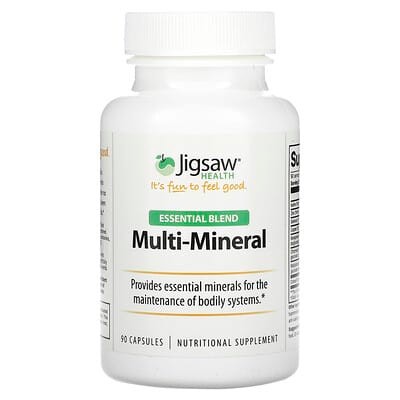

$29.97 $0.33 per serving


Product analysis
Essential Blend Multi Mineral may support normal immune and nutrient functions when mineral intake is low. An unidentified proprietary blend makes part of what you are taking difficult to judge.
AI assessment of the formula, label and price. How scoring works
Nutrient Quality77
Several minerals use favorable forms, including readily usable iodine and well-described copper and manganese preparations. The proprietary blend is not individually identified, leaving its quality unclear.
Ingredient Transparency76
The listed amounts and most mineral forms are disclosed, helping with serving comparisons. The proprietary blend lacks identified components and proportions, so its total weight does not reveal its contents.
Value For Money72
Several minerals offer favorable value, especially chromium and molybdenum. Selenium is more moderate, while zinc value remains uncertain.
Customer Satisfaction67
Customer feedback is positive. The modest review pool provides a limited view of how widely that satisfaction is shared.
Product Focus35
The named minerals mainly support normal nutrition and immune function when intake is low. The unidentified blend makes the full formula less clear, and broader weight-loss or detox purposes remain indirect.
- Format
Capsule - Container
- 90 Capsule(s)
- Per serving
- $0.33
- Customer rating
- 4.5 · 77 ratings
Goals

Impact
High effect
Zinc · 15 mgSelenium · 200 mcg
Zinc supports normal immune-cell function, while copper helps maintain immune-cell activity when intake is deficient. Selenium supports normal immune function and selenium-dependent antioxidant systems when intake is low. Higher amounts do not establish extra protection in adequately nourished adults, and the swallowed zinc serving does not reproduce a cold-treatment lozenge regimen.
How this product is rated for Immunity
Ingredient fit65
Relevant nutrient amounts contribute, with formula focus and serving quantities shaping the ingredient finding.
Goal fit
Relevant nutrients sit within a broader formula containing ingredients aimed at other goals.
Dose adequacy
Serving amounts provide a partial match to the saved comparisons; this does not mean a corresponding fraction of clinical benefit.
Pathways73
The strongest assigned area is oxidative and inflammatory balance. These ingredient associations do not establish clinical infection protection.
Depth
The strongest assigned area is oxidative and inflammatory balance; this ingredient association does not establish reduced infection risk.
Breadth
Coverage is concentrated in lymphocyte function and immune regulation, oxidative and inflammatory balance. Other areas have less support in the saved findings.
Evidence100
Zinc provides the leading evidence contribution. The supported roles remain bounded by nutritional status and the preparation or regimen studied.
Evidence strength
Zinc leads the saved evidence finding, supporting a bounded nutrient role rather than general infection prevention.
Studied preparation
The saved preparation finding is complete for the included ingredients; matching an ingredient does not establish a tested whole-product regimen.
Formulation logic100
No missing required partner or configured ingredient conflict was identified. The serving amounts meet the included minimum comparisons without establishing a combined clinical benefit.
Partner coverage
No missing required partner limits the included ingredients in the saved findings; this does not demonstrate an added benefit from combining them.
Conflicts
No configured ingredient conflict was identified. This finding does not establish overall safety or cover every possible interaction.
Effective doses
The included ingredients reach the saved minimum amount threshold, which is not a proven effective clinical immune dose.

Impact
High effect
Zinc · 15 mg
Iodine helps make thyroid hormones, and selenium helps activate them, supporting normal metabolism. Filling an iodine shortfall can correct impaired thyroid-related heat production, but extra iodine does not stimulate an already normal thyroid. Zinc supports normal enzymes; chromium-related glucose changes do not establish higher calorie expenditure. Together these functions do not prove a metabolism boost above adequate nutrition.
How this product is rated for Metabolism Support
Ingredient fit75
Zinc, iodine, selenium and chromium provide the included connections within a broader mineral formula. Included amounts make a mixed contribution against the saved comparisons.
Goal fit
Zinc, iodine, selenium and chromium provide the included connections within a broader mineral formula.
Dose adequacy
Included amounts make a mixed contribution against the saved comparisons.
Pathways13
The strongest saved connection concerns insulin sensitivity and metabolic hormones; this category does not establish extra calorie expenditure. No biological category meets the saved breadth comparison.
Depth
The strongest saved connection concerns insulin sensitivity and metabolic hormones; this category does not establish extra calorie expenditure.
Breadth
No biological category meets the saved breadth comparison.
Evidence100
Zinc leads the saved evidence finding, but normal nutrient function does not establish increased energy expenditure.
Evidence strength
Zinc leads the saved evidence finding, but normal nutrient function does not establish increased energy expenditure.
Studied preparation
Eligible included preparations match the saved comparison; this does not establish product-specific thermogenesis.
Formulation logic100
No missing required partner or configured ingredient conflict was found.
Partner coverage
The included ingredients do not lack a required partner; this does not establish an added metabolism benefit from combining them.
Conflicts
No configured ingredient conflict was identified.
Effective doses
All included ingredients meet the saved minimum amount comparison, which is not a proven effective metabolism-boosting dose.

Impact
Highest effect
Selenium · 200 mcgZinc · 15 mg
Zinc contribute nutrients involved in normal antioxidant or immune processes. These contributions are useful when dietary intake falls short; larger amounts and specific forms do not establish additional benefit once intake is adequate.
How this product is rated for Everyday Health
Ingredient fit84
The declared amounts largely meet the saved comparisons, although some contribute less at this serving.
Goal fit
The identified ingredients are concentrated in the roles considered relevant to general health.
Dose adequacy
The declared amounts largely meet the saved comparisons, although some contribute less at this serving.
Pathways60
The strongest identified connection concerns normal antioxidant and immune processes.
Depth
The strongest identified connection concerns normal antioxidant and immune processes.
Breadth
The identified connections cover normal antioxidant and immune processes.
Evidence82
Selenium leads the saved evidence findings, while the supplied context limits what can be claimed for general health.
Evidence strength
Selenium leads the saved evidence findings, while the supplied context limits what can be claimed for general health.
Studied preparation
The evaluated preparations meet the supplied preparation comparison; study population and outcome limitations still apply.
Formulation logic100
The evaluated ingredients have no unmet partner requirement in the supplied findings.
Partner coverage
The evaluated ingredients have no unmet partner requirement in the supplied findings.
Conflicts
No configured ingredient conflict was identified.
Effective doses
The evaluated ingredients meet the saved minimum amount comparison; this is not a proven threshold for health benefit.


Impact
High effect
Zinc · 15 mg
Zinc can help address a deficiency that causes diffuse hair shedding; extra zinc does not establish regrowth when intake is adequate. The 15 mg per serving receives a partial amount allowance in the saved comparison. Selenium and copper have normal antioxidant and structural roles, but those mechanisms do not establish routine oral hair regrowth. Iodine supports thyroid hormone production, without establishing a direct hair-loss benefit; more selenium can also worsen hair loss.
How this product is rated for Hair Health
Ingredient fit68
Hair-related ingredients contribute through nutrient or ingredient roles, with the amounts and limitations described below. The wider formula affects how focused that connection is.
Goal fit
Hair-related ingredients share this formula with other actives, giving it a broader focus than hair alone.
Dose adequacy
The counted ingredients provide partial reference amounts overall; unresolved amounts limit some contributions where identified.
Pathways55
The recorded coverage is concentrated in follicle antioxidant protection. Other evaluated routes remain limited, and this connection does not establish hair regrowth.
Depth
The strongest recorded connection is follicle antioxidant protection, although normal antioxidant functions do not establish hair regrowth.
Breadth
Only follicle antioxidant protection has substantial recorded coverage, leaving the other evaluated routes weak or uncovered.
Evidence96
Zinc leads the recorded evidence finding; its specific outcome and population limits still determine what benefits can be described.
Evidence strength
Zinc leads the recorded evidence finding; its specific outcome and population limits still determine what benefits can be described.
Studied preparation
Most counted ingredients receive preparation recognition, while iodine does not have that match.
Formulation logic100
The counted ingredients have no missing required partners or identified conflicts among those evaluated. Their amounts meet the minimum comparison.
Partner coverage
The counted ingredients have no missing required partners.
Conflicts
None of the evaluated ingredient conflicts was identified; this is not a complete interaction or safety assessment.
Effective doses
All counted ingredients meet the minimum amount comparison; this does not establish a proven effective hair-growth dose.

Impact
High effect
Molybdenum · 150 mcgSelenium · 200 mcgZinc · 15 mg
Selenium has limited mercury-related findings in low-selenium or exposed adults using specific preparations; this does not establish general toxin removal. Selenium also supports antioxidant enzymes, while zinc and molybdenum have essential enzyme roles. Those nutrient functions do not establish a broader cleanse benefit. The supplied findings do not support treating larger mineral amounts as greater toxin-clearance efficacy.
How this product is rated for Liver & Detox
Ingredient fit65
The credited ingredients and declared amounts provide the fit described below, with broader-purpose ingredients affecting how concentrated the formula is.
Goal fit
The formula contains ingredients for several purposes, so its credited detoxification-related ingredients form only part of the overall formula.
Dose adequacy
The serving receives partial amount credit across its credited ingredients, without establishing that those amounts improve toxin clearance.
Pathways42
The strongest mapped role is detox-enzyme induction; this is a mechanism finding, not measured toxin elimination. Its coverage is concentrated in one route.
Depth
The strongest mapped role is detox-enzyme induction; this is a mechanism finding, not measured toxin elimination.
Breadth
Only one assessed route reaches the saved coverage threshold, leaving the mapped contribution narrow.
Evidence83
Selenium leads the saved evidence finding, with limited, preparation-specific mercury findings in exposed or low-selenium adults.
Evidence strength
Selenium leads the saved evidence finding, with limited, preparation-specific mercury findings in exposed or low-selenium adults.
Studied preparation
Molybdenum do not meet the saved preparation match; the other qualifying ingredients do.
Formulation logic100
The credited ingredients meet partner requirements and no configured conflict was recorded. They meet the saved minimum amount threshold.
Partner coverage
The credited ingredients meet the saved partner requirements, with no missing partner recorded.
Conflicts
No configured conflict was recorded in the supplied facts.
Effective doses
All credited ingredients meet the saved minimum amount threshold; that threshold does not establish a clinically effective detoxification dose.
Ingredients
| Ingredient | Amount per serving | Score |
|---|---|---|
Iodine (Potassium Iodide) | 150 mcg | |
Zinc (Zinc Bisglycinate) | 15 mg | |
Selenium (Selenium Glycinate Complex) | 200 mcg | |
Copper (Copper Bisglycinate) | 2 mg | |
Manganese (Manganese Bisglycinate) | 2 mg | |
Chromium (Chromium Nicotinate Glycinate) | 400 mcg | |
Molybdenum (Molybdenum Glycinate) | 150 mcg | |
ConcenTrace MCC | 5 mg |
Iodine (Potassium Iodide) · 150 mcg OverallScore96
Each serving provides 150 mcg of iodine as potassium iodide, a form the evaluation views favorably. A whole-product serving costs about $0.33.
How this ingredient is rated
Active Ingredient Quality & Bioavailability100
The identified iodine form is potassium iodide, which the evaluation views favorably. No marine source is identified for the marine-specific check.
Iodine Form & Bioavailability
Potassium iodide is the identified iodine form; the evaluation views it favorably.
Marine Source Purity & Sourcing
No marine source is identified in the saved facts, so the marine-specific check is not applicable; this does not establish purity.
Dose, Safety & Label Transparency100
The label states 150 mcg of elemental iodine per serving. The evaluation does not flag that amount as exceeding its safety limit.
Dosage Efficacy for Daily Support
The 150 mcg of iodine per serving is an amount the evaluation views favorably.
Dosage Safety & Upper Limits
The evaluation does not flag the labeled serving amount as exceeding its safety limit.
Elemental Iodine Transparency
The label specifies 150 mcg of elemental iodine per serving.
Value80
A whole-product serving costs about $0.33.
Price Per Effective Serving
A whole-product serving costs about $0.33.
Molybdenum (Molybdenum Glycinate) · 150 mcg OverallScore100
A serving provides 150 mcg of molybdenum as glycinate, a specifically named form. The saved facts identify the branded TRAACS source, and a whole-product serving costs about $0.33.
How this ingredient is rated
Active Ingredient Quality & Bioavailability100
Molybdenum glycinate is a specifically named form. The saved facts identify TRAACS branding, although the claim has not been independently verified.
Molybdenum Chemical Form
Molybdenum glycinate is the specifically named form, giving more detail than an unspecified amino acid chelate.
Branded or Patented Source
The saved facts identify TRAACS as the branded molybdenum source; the claim has not been independently verified.
Dose, Safety & Label Transparency100
A serving provides 150 mcg of molybdenum, an amount below the adult upper limit per serving.
Elemental Dose Optimization
A serving provides 150 mcg of molybdenum.
Upper Limit (UL) Safety Compliance
The 150 mcg per serving is below the adult upper limit; total intake can be higher when other sources are included.
Value100
At about $0.33 per whole-product serving, the 150 mcg of molybdenum comes with a relatively low price for the product.
Price per Effective Serving
The whole-product serving costs about $0.33 and supplies 150 mcg of molybdenum; that is a relatively low price per serving.
Manganese (Manganese Bisglycinate) · 2 mg OverallScore90
Manganese comes as bisglycinate, an amino acid chelate assessed favorably for absorption, with 2 mg per serving. The whole-product serving costs about $0.33.
How this ingredient is rated
Active Ingredient Quality & Bioavailability100
Manganese bisglycinate is an amino acid chelate assessed favorably for absorption.
Manganese Chemical Form
Manganese bisglycinate is an amino acid chelate assessed favorably for absorption.
Dose, Safety & Label Transparency86
The serving provides 2 mg of manganese, a moderate amount. The amount and source are both stated.
Manganese Dosage Efficacy & Safety
The serving provides 2 mg of manganese, a moderate amount.
Elemental Weight Disclosure
The amount and source are both stated.
Value80
The whole-product serving costs about $0.33.
Price per Serving vs. Median
The whole-product serving costs about $0.33.
Alternative products
Report alternatives
Sources
Published studies used for the product analysis and the top-ranked studies for each ingredient and goal.
- The Association between Dietary and Circulating Copper Levels and Osteoporosis: a Scoping Review.
- Association between dietary copper, iron, zinc, selenium intake and osteopenia or osteoporosis in elderly hypertensive patients: a retrospective cohort study.
- Associations of dietary copper intake with total bone mineral density and lumbar spine bone mineral density in American adults.
- The association between dietary mineral intake and bone mineral density: a cross-sectional study.
- Association between dietary copper intake and bone mineral density in children and adolescents aged 8-19 years: A cross-sectional study.
- Risk of Environmental Chemicals on Bone Fractures Is Independent of Low Bone Mass in US Adults: Insights from 2017 to 2018 NHANES.
- The Manganese-Bone Connection: Investigating the Role of Manganese in Bone Health.
- Associations of multiple metals with bone mineral density: A population-based study in US adults.
- Sex-specific associations of urinary mixed-metal concentrations with femoral bone mineral density among older people: an NHANES (2017-2020) analysis.
- Relationship between blood manganese and bone mineral density and bone mineral content in adults: A population-based cross-sectional study.
- Increased incidence of fractures in middle-aged and elderly men with low intakes of phosphorus and zinc.
- Zinc Supplementation Increases Procollagen Type 1 Amino-Terminal Propeptide in Premenarcheal Girls: A Randomized Controlled Trial.
- Randomized controlled trial of prenatal zinc supplementation and fetal bone growth.
- The effects of zinc supplementation on serum zinc, alkaline phosphatase activity and fracture healing of bones.
- Is Zinc an Important Trace Element on Bone-Related Diseases and Complications? A Meta-analysis and Systematic Review from Serum Level, Dietary Intake, and Supplementation Aspects.
- Association of radioactive iodine treatment with survivorship symptoms and primary care utilisation in women of reproductive age with thyroid cancer: a retrospective cohort study.
- Energy level and fatigue after surgery for thyroid cancer: A population-based study of patient-reported outcomes.
- Health-Related Quality of Life in Differentiated Thyroid Cancer Survivors: A Cross-Sectional Study From Turkey.
- Associations of selenium status with all-cause and cause-specific mortality: a systematic review and meta-analysis of cohort studies.
- Dietary Antioxidants, Circulating Antioxidant Concentrations, Total Antioxidant Capacity, and Risk of All-Cause Mortality: A Systematic Review and Dose-Response Meta-Analysis of Prospective Observational Studies.