
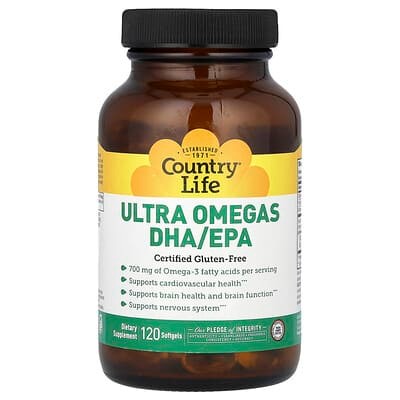

$20.54 $0.34 per serving


Product analysis
Ultra Omegas DHA/EPA offers relatively good value for its DHA content. Unspecified omega-3 oil forms limit comparison with alternatives that identify them.
AI assessment of the formula, label and price. How scoring works
Nutrient Quality21
The DHA and EPA oil forms are unspecified, so their relative absorption qualities remain uncertain. Other component details do not resolve that uncertainty.
Ingredient Transparency62
DHA and EPA amounts are disclosed, but their oil forms are unclear. An additional component lacks a clear amount, leaving part of the combination unresolved.
Value For Money68
DHA offers favorable value, while EPA offers more moderate value. Those comparisons concern the full serving cost rather than separately priced ingredients.
Customer Satisfaction77
Customer feedback is positive. A moderate review base gives that satisfaction pattern some support.
Product Focus65
DHA and EPA keep the main formula centered on omega-3 supplementation. Unclear additional component details leave part of the combination harder to assess.
- Format
Softgel - Container
- 120 Softgel(s)
- Per serving
- $0.34
- Customer rating
- 4.7 · 470 ratings
Goals

Impact
High effect
Fish Oil · 1000 mgVitamin E · 4 IU
EPA and DHA provide the relevant connection to triglyceride metabolism. The serving separately declares 200 mg EPA and 500 mg DHA; these are active amounts, while the unresolved fish-oil declaration is not treated as additional combined EPA+DHA. This does not reproduce the much larger purified-component trial exposures or establish prevention of major cardiovascular events. The unresolved vitamin E amount limits its saved contribution.
How this product is rated for Cardiovascular Support
Ingredient fit73
The recognized ingredients give the formula a focused cardiovascular connection, without establishing a clinical effect. Explicit EPA and DHA amounts contribute separately; an unresolved oil declaration is not converted to combined active content.
Goal fit
The recognized ingredients give the formula a focused cardiovascular connection, without establishing a clinical effect.
Dose adequacy
Explicit EPA and DHA amounts contribute separately; an unresolved oil declaration is not converted to combined active content.
Pathways60
The saved support centers on triglyceride metabolism, without establishing cardiovascular-event prevention.
Depth
The saved support centers on triglyceride metabolism, without establishing cardiovascular-event prevention.
Breadth
Only the leading area meets the saved coverage criterion, leaving support narrow across the assessed cardiovascular areas.
Evidence83
EPA leads the recognized evidence for triglyceride-related measures, without establishing routine event prevention.
Evidence strength
EPA leads the recognized evidence for triglyceride-related measures, without establishing routine event prevention.
Studied preparation
The saved result recognizes the preparations retained for this check; that recognition does not expand their demonstrated clinical benefits.
Formulation logic92
No required partner is missing and no configured conflict was matched. The amount check is limited by Vitamin E; the other retained ingredients meet it.
Partner coverage
The recognized ingredients can contribute alone or have their required partner; no missing-partner limitation was found.
Conflicts
No configured conflict was matched in the supplied facts; this does not establish general safety.
Effective doses
The amount check is limited by Vitamin E; the other retained ingredients meet it.

Impact
Moderate effect
Fish Oil · 1000 mgVitamin E · 4 IU
EPA and DHA may lower some markers of inflammation in the blood. These omega-3 fats relate to the way the body makes fatty-acid signals involved in inflammation. That gives them a relevant role here, although changes in blood markers don’t reliably tell you whether you’ll feel better or gain a broad everyday health benefit.
How this product is rated for Inflammation
Ingredient fit56
The ingredients have a direct connection to inflammation-related processes.
Goal fit
The ingredients have a direct connection to inflammation-related processes.
Dose adequacy
DHA 500 mg, EPA 200 mg per selected serving; these amounts do not by themselves show how much benefit to expect.
Pathways10
The main connection involves fatty-acid signals that help regulate inflammation.
Depth
The main connection involves fatty-acid signals that help regulate inflammation.
Breadth
The connection is narrow; broad effects across distinct inflammation processes remain unclear.
Evidence70
EPA and DHA may lower some markers of inflammation in the blood. These omega-3 fats relate to the way the body makes fatty-acid signals involved in inflammation.
Evidence strength
EPA and DHA may lower some markers of inflammation in the blood. These omega-3 fats relate to the way the body makes fatty-acid signals involved in inflammation.
Studied preparation
The declared ingredients match the relevant ingredient identities, without guaranteeing the same effects for every user.
Formulation logic88
The relevant ingredients can act individually, and no particular conflict is identified.
Partner coverage
The relevant ingredients do not require an additional partner ingredient for their individual roles.
Conflicts
No particular ingredient conflict is identified.
Effective doses
Amounts vary, and a usable vitamin E quantity in mg is unavailable; that limits the amount-specific interpretation.
Ingredients
| Ingredient | Amount per serving | Score |
|---|---|---|
Calories | 10 {Calories} | |
Calories from Fat | 10 {Calories} | |
Total Fat | 1 Gram(s) | |
Docosahexaenoic Acid | 500 mg | |
Eicosapentaenoic Acid | 200 mg | |
Vitamin E (D-Alpha-Tocopherol) | 4 IU | |
Fish Oil concentrate (Anchovy, Herring, Mackerel, Sardine, Tuna) | 1000 mg |
DHA · 500 mg OverallScore73
EPA (Eicosapentaenoic Acid) · 200 mg OverallScore45
DHA predominates, with 200 mg EPA alongside 500 mg DHA per two-softgel serving, so the balance is less suited to an EPA-focused comparison. A qualifying contaminant-testing or certification claim is recorded, although it has not been independently checked here.
How this ingredient is rated
Active Ingredient Quality & Bioavailability50
The molecular form remains uncertain, limiting the absorption comparison. EPA is only part of the total oil; the declared antioxidant does not verify freshness.
Molecular Form and Bioavailability
The molecular form is not established in the saved facts, so neither triglyceride nor ethyl ester form can be assumed.
EPA Concentration Density
EPA makes up 20% of the declared fish oil, so the total oil amount should not be read as EPA.
Oxidation Protection
Tocopherol is declared as a single antioxidant; its presence does not establish measured freshness or oxidation levels.
Dose, Safety & Label Transparency38
The balance favors DHA, making the formula less focused on EPA despite a clearly stated EPA amount. A qualifying purity-testing claim is recorded.
Absolute EPA Dose per Serving
The serving supplies 200 mg EPA; the EPA amount is stated separately from the total oil.
EPA-Centric Ratio
DHA (500 mg) substantially exceeds EPA (200 mg), making the balance less aligned with an EPA-focused comparison.
Purity and Contaminant Testing
A qualifying contaminant-testing or certification claim is recorded; this reflects the stored claim, not independently checked laboratory results.
Value50
The whole product costs about $0.34 per serving, equivalent to $1.71 per gram of EPA. That gives moderate value when comparing EPA alone.
Price per Gram of EPA
About $1.71 per gram of EPA, based on the whole product’s price and declared EPA amount; EPA-specific value is moderate.
Alternative products
Report alternatives
Sources
Published studies used for the product analysis and the top-ranked studies for each ingredient and goal.
- Marine Omega-3 Supplementation and Cardiovascular Disease: An Updated Meta-Analysis of 13 Randomized Controlled Trials Involving 127 477 Participants.
- Impact of omega-3 fatty acids on hypertriglyceridemia, lipidomics, and gut microbiome in patients with type 2 diabetes.
- A systematic review of fish-oil supplements for the prevention and treatment of hypertension.
- Effects of fish oil-derived fatty acids on suboptimal cardiovascular health: A multicenter, randomized, double-blind, placebo-controlled trial.
- Effect of High-Dose Marine Omega-3 Fatty Acids on Atherosclerosis: A Systematic Review and Meta-Analysis of Randomized Clinical Trials.
- Supplementation with vitamin E alone is associated with reduced myocardial infarction: a meta-analysis.
- Vitamin E ameliorates blood cholesterol level and alters gut microbiota composition: A randomized controlled trial.
- Effects of long-term vitamin E supplementation on cardiovascular events and cancer: a randomized controlled trial.
- Independent and combined associations of dietary antioxidant exposure with all-cause and cause-specific mortality in the general population.
- Tocotrienol rich fraction supplementation improved lipid profile and oxidative status in healthy older adults: A randomized controlled study.
- Dose-dependent effects of fish oil on cardio-metabolic biomarkers in healthy middle-aged and elderly Chinese people: a double-blind randomized controlled trial.
- Eicosapentaenoic acid supplementation alleviates pruritus, enhances skin moisture, and mitigates depression in maintenance hemodialysis patients.
- Lowering effects of fish oil supplementation on proinflammatory markers in hypertension: results from a randomized controlled trial.
- The effects of ω-3 fish oil emulsion-based parenteral nutrition plus combination treatment for acute paraquat poisoning.
- Effects of Omega-3 Fatty Acid Intake in Patients Undergoing Dialysis: A Systematic Review and Meta-Analysis of Randomized Controlled Trials.
- Effects of delta-tocotrienol supplementation on Glycemic Control, oxidative stress, inflammatory biomarkers and miRNA expression in type 2 diabetes mellitus: A randomized control trial.
- Effect of vitamin E supplementation on serum C-reactive protein level: a meta-analysis of randomized controlled trials.
- Efficacy of Nutritional Interventions on Inflammatory Markers in Haemodialysis Patients: A Systematic Review and Limited Meta-Analysis.
- Vitamin E improves serum markers and histology in adults with metabolic dysfunction-associated steatotic liver disease: Systematic review and meta-analysis.
- Delta-tocotrienol supplementation improves biochemical markers of hepatocellular injury and steatosis in patients with nonalcoholic fatty liver disease: A randomized, placebo-controlled trial.