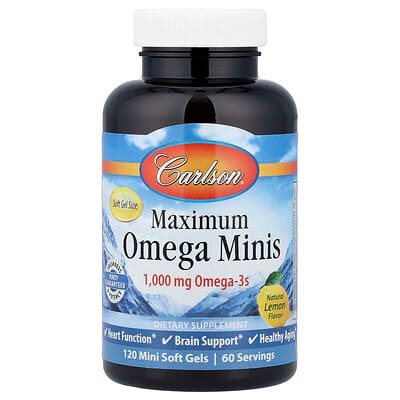
Maximum Omega Minis Natural Lemon Flavor

Maximum Omega Minis Natural Lemon Flavor

Carlson4.9 (1,209 ratings)
Format:Softgel Quantity: 120 Softgel(s) · 60 servings
Goals
$55.25 $0.92 per serving

Product analysis

52 out of 100

Maximum Omega Minis Natural Lemon Flavor may support how the body handles blood fats, with more limited support for joint comfort. Its separately stated EPA and DHA amounts help you compare the key omega-3 content.

AI assessment of the formula, label and price. How scoring works

Nutrient Quality20

The EPA and DHA forms are not clearly identified in the ingredient details. Their amounts alone do not establish an absorption advantage.

Ingredient Transparency70

The EPA and DHA amounts are separately disclosed, making active omega-3 comparisons possible. Their forms are not clearly stated.

Value For Money42

EPA offers moderate value, while DHA is less favorably priced at the full serving cost. The separate comparisons help show what you are paying for in the omega-3 mix.

Customer Satisfaction86

Customer ratings are very positive across a substantial review base. The many reviews give a broad view of satisfaction without proving the claimed benefits.

Product Focus68

Heart-related blood-fat handling is the clearest possible use, with more limited or variable support for joint comfort and mental focus. The wider claims do not imply faster calorie burning or an immediate concentration boost.

Format
Softgel
Container
120 Softgel(s)
Per serving
$0.92
Customer rating
4.9 · 1,209 ratings
Report analysis

Goals

Impact
High effect
B- Ingredient FitC- PathwaysA+ EvidenceA+ Formulation Logic
EPA (Eicosapentaenoic Acid) · 600 mg

EPA and DHA have triglyceride-related and selected vascular effects, but routine supplement findings do not establish general prevention of major cardiovascular events. The explicit active amounts allow comparison with omega-3 exposure, while fish-oil mass alone would not. DHA findings on blood pressure and heart rate come from particular populations and preparations; no extra benefit from combining EPA and DHA is established.

How this product is rated for Heart Health

Ingredient fit73

EPA (Eicosapentaenoic Acid), DHA (Docosahexaenoic Acid) provide the included contribution, with partial coverage of the comparison amounts.
Goal fit
EPA (Eicosapentaenoic Acid), DHA (Docosahexaenoic Acid) contribute alongside ingredients directed at other uses.
Dose adequacy
The included amounts partly cover the saved comparison ranges, which compare exposure rather than establish treatment doses.

Pathways56

The strongest recorded connection is triglyceride metabolism, with partial comparison-range coverage.
Depth
The strongest recorded connection is triglyceride metabolism, with partial comparison-range coverage.
Breadth
One configured pathway reached the coverage threshold, so the contribution remains focused.

Evidence100

EPA (Eicosapentaenoic Acid) provides the strongest included evidence; its clinical meaning remains limited by the outcomes and populations studied.
Evidence strength
EPA (Eicosapentaenoic Acid) provides the strongest included evidence; its clinical meaning remains limited by the outcomes and populations studied.
Studied preparation
The included preparations were matched to studied material, without establishing benefit outside the studied outcomes or populations.

Formulation logic100

The included ingredients have no recorded partner gap or configured conflict and clear the minimum amount threshold.
Partner coverage
The included ingredients can stand alone or have their required partner present.
Conflicts
No configured ingredient conflict was identified.
Effective doses
All included ingredients clear the saved minimum amount threshold; this does not guarantee a clinical benefit.
Study evidence
Skin Health
Impact
High effect
A Ingredient FitD PathwaysB EvidenceA+ Formulation Logic
Omega-3 · 1000 mg

EPA has UV-challenge evidence, but those findings do not establish routine skin benefit for a generic omega-3 amount or mixed oil preparation.

How this product is rated for Skin Health

Ingredient fit94

The declared active ingredients focus on the roles included for skin health. The relevant declared amounts fully meet or nearly meet the saved exposure comparison; this does not establish an optimal regimen.
Goal fit
The declared active ingredients focus on the roles included for skin health.
Dose adequacy
The relevant declared amounts fully meet or nearly meet the saved exposure comparison; this does not establish an optimal regimen.

Pathways50

The strongest saved connection is to Epidermal barrier lipids. Coverage across other roles is limited.
Depth
The strongest saved connection is to Epidermal barrier lipids.
Breadth
The broader saved findings cover Epidermal barrier lipids. .

Evidence78

Omega-3 leads the saved evidence finding. Accepted preparation matches do not remove the ingredient-specific limitations described above.
Evidence strength
Omega-3 provides the leading evidence contribution in the saved comparison; its clinical limitations still apply.
Studied preparation
The saved finding accepts the preparations used for its included ingredients; it does not establish that every labelled preparation matches a clinical trial.

Formulation logic100

The saved checks find no missing required partner or configured conflict. The included amounts pass the minimum comparison screen.
Partner coverage
The included ingredients do not lack a required partner under the saved finding; this does not establish added benefit from combining them.
Conflicts
No configured ingredient conflict was triggered by the supplied facts.
Effective doses
All ingredients included in this amount screen meet its minimum comparison level; that level is not a proven effective dose.
Study evidence
Omega-3 Supportive 35 studies
Metabolism Support
Impact
Moderate effect
D Ingredient FitF PathwaysA- EvidenceA+ Formulation Logic
Omega-3 · 1000 mg

Whether omega-3 makes your body burn more energy is unclear. Possible changes in resting metabolic rate vary across different groups of adults, so they don't translate reliably to routine use. The declared omega-3 amount is not by itself a promise of faster metabolism or fat loss.

How this product is rated for Metabolism Support

Ingredient fit49

Omega-3 has uncertain effects on resting energy use across different groups of adults.
Goal fit
Omega-3 is the sole confirmed active ingredient connected to this goal.
Dose adequacy
Omega-3: 1000 mg.

Pathways18

The nutrients relate to normal metabolic functions rather than a demonstrated heat-producing effect.
Depth
The nutrients relate to normal metabolic functions rather than a demonstrated heat-producing effect.
Breadth
No broad effect across the routes that increase energy expenditure is demonstrated by these ingredients.

Evidence89

Omega-3 has uncertain effects on resting energy use across different groups of adults.
Evidence strength
Omega-3 has uncertain effects on resting energy use across different groups of adults.
Studied preparation
The declared active ingredients can be identified; their form alone does not guarantee a metabolic benefit.

Formulation logic100

The ingredients have no identified partner gap or particular conflict. Their normal roles should not be confused with a guaranteed metabolic boost.
Partner coverage
No additional ingredient partner is required for the roles described here.
Conflicts
No particular ingredient conflict is identified.
Effective doses
The declared amounts allow comparison of the active ingredients, without guaranteeing a rise in metabolic rate.
Study evidence
Omega-3 Supportive 42 studies
Joint Health
Impact
Moderate effect
C+ Ingredient FitF PathwaysC+ EvidenceA+ Formulation Logic
Omega-3 · 1000 mg

EPA and DHA relate to the body's inflammatory response and may offer modest joint-comfort support with repeated intake. Findings vary across joint conditions and preparations, so the declared omega-3 amounts do not imply a predictable improvement in comfort.

How this product is rated for Joint Health

Ingredient fit66

Joint-related ingredients sit within a formula serving broader purposes. The assessed quantities provide a partial match to the saved benchmarks.
Goal fit
Joint-related ingredients sit within a formula serving broader purposes.
Dose adequacy
The assessed quantities provide a partial match to the saved benchmarks.

Pathways16

The main recorded contribution relates to inflammation and joint comfort. The saved findings show limited breadth across the assessed joint mechanisms.
Depth
The main recorded contribution relates to inflammation and joint comfort.
Breadth
The saved findings show limited breadth across the assessed joint mechanisms.

Evidence69

Omega-3 provides the strongest evidence contribution among the assessed ingredients. Qualifying ingredients are recorded as matching studied preparations.
Evidence strength
Omega-3 provides the strongest evidence contribution among the assessed ingredients.
Studied preparation
Qualifying ingredients are recorded as matching studied preparations.

Formulation logic100

The assessed ingredients can contribute independently or have their required partners. No ingredient conflict was flagged by the saved checks.
Partner coverage
The assessed ingredients can contribute independently or have their required partners.
Conflicts
No ingredient conflict was flagged by the saved checks.
Effective doses
All counted ingredients meet the saved minimum amount threshold.
Study evidence
Omega-3 Supportive 40 studies
Mental Focus
Impact
High effect
C+ Ingredient FitD+ PathwaysC- EvidenceA+ Formulation Logic

DHA contributes to brain-cell membranes, but its supplied cognitive evidence concerns months of use in adults with low DHA intake, chiefly for memory and reaction time. EPA research also concerns repeated intake and varied populations. These roles do not establish an immediate improvement in everyday concentration.

How this product is rated for Mental Focus

Ingredient fit66

DHA (Docosahexaenoic Acid), EPA (Eicosapentaenoic Acid) underpin this product’s connection to focus. Some amounts provide only a partial match to the saved comparison ranges.
Goal fit
The formula includes ingredients aimed at other purposes, so its focus connection is less concentrated.
Dose adequacy
The included amounts only partly meet the saved reference ranges for the relevant ingredients.

Pathways50

The main mapped contribution is synaptic plasticity and neuroprotection. The mechanism alone does not establish an acute focus benefit.
Depth
Synaptic plasticity and neuroprotection is the strongest mapped route, with partial coverage. That biological connection does not itself demonstrate acute focus improvement.
Breadth
The meaningful mapped contribution is concentrated in one route, with limited breadth across other aspects of focus.

Evidence56

The supplied evidence is limited for immediate everyday focus, despite the biological roles reflected in the saved findings.
Evidence strength
The leading ingredient supplies the evidence finding, but the supplied science does not establish routine acute focus enhancement.
Studied preparation
Preparation matching is incomplete for DHA.

Formulation logic100

The included ingredients have no identified configured conflict. No required partner is missing.
Partner coverage
No required partner is missing for the included ingredients.
Conflicts
No configured ingredient conflict was identified in the supplied findings.
Effective doses
The included ingredients meet the saved minimum amount threshold; that threshold is not a demonstrated effective dose for acute focus.
Study evidence

Ingredients

IngredientAmount per servingScore
Calories
15 Calorie(s)
Total Fat
1.5 Gram(s)
Marine Oil concentrate
1250 mg
Total Omega-3 Fatty Acids (reported as Triglycerides)
1000 mg 79
Eicosapentaenoic Acid
600 mg 82
Docosahexaenoic Acid
400 mg 79
Gluten Free Adults 18–50
Report overview
A Active Ingredient Quality & BioavailabilityA Dose, Safety & Label TransparencyD+ Value
Each serving provides 600 mg EPA and 400 mg DHA. The omega-3 is in triglyceride form.
How this ingredient is rated

Active Ingredient Quality & Bioavailability90

The saved information identifies a triglyceride form of EPA or its associated omega-3 oil. The 600 mg EPA is about 60% of the 1000 mg total omega-3s per serving.
Molecular Form and Bioavailability
The saved information identifies a triglyceride form of EPA or its associated omega-3 oil.
EPA Concentration Density
The 600 mg EPA is about 60% of the 1000 mg total omega-3s per serving.
Oxidation Protection
Tocopherol is recorded as an antioxidant; actual oxidation protection was not measured by the evaluation.

Dose, Safety & Label Transparency90

Each serving provides 600 mg EPA and 400 mg DHA. The saved evaluation records a qualifying testing or certification claim.
Absolute EPA Dose per Serving
Each serving supplies 600 mg EPA.
EPA-Centric Ratio
Each serving has 600 mg EPA and 400 mg DHA, so EPA is the larger amount.
Purity and Contaminant Testing
The saved evaluation records a qualifying third-party contaminant-testing or certification claim; the claim is not independent verification.

Value50

Based on the whole-product serving price, the cost is about $1.53 per gram of EPA.
Price per Gram of EPA
Based on the whole-product serving price, the cost is about $1.53 per gram of EPA.
A+ Active Ingredient Quality & BioavailabilityB- Dose, Safety & Label TransparencyD+ Value
Each serving provides 600 mg EPA and 400 mg DHA. Together they make up about 80% of the 1,250 mg oil in the serving.
How this ingredient is rated

Active Ingredient Quality & Bioavailability100

The omega-3 is identified as triglycerides. An antioxidant is also recorded.
Molecular Form & Absorption Potential
The omega-3 is listed in triglyceride form.
Source Purity & Oxidative Protection
The saved facts identify an oil source and an antioxidant; they do not establish measured freshness.

Dose, Safety & Label Transparency73

Each serving lists 600 mg EPA and 400 mg DHA. Together these account for about 80% of the oil.
EPA & DHA Label Specificity
The saved label facts list 600 mg EPA and 400 mg DHA per serving, with the amounts shown separately.
Active Ingredient Concentration
EPA and DHA make up about 80% of the 1,250 mg oil per serving.
Third-Party Purity Verification
A qualifying product certification or testing claim with an available analysis certificate is not established in the saved facts.

Value50

The whole-product price is about $0.92 per 1,000 mg of combined EPA and DHA.
Price per 1000mg of EPA+DHA
The whole-product price works out to about $0.92 per 1,000 mg of combined EPA and DHA.
DHA · 400 mg OverallScore79
A+ Active Ingredient Quality & BioavailabilityB+ Dose, Safety & Label TransparencyF Value
Each serving provides 400 mg of DHA in triglyceride form. Total omega-3 makes up 80% of the oil, and a qualifying purity-related claim is recorded.
How this ingredient is rated

Active Ingredient Quality & Bioavailability100

DHA is identified in triglyceride form. An antioxidant is recorded. Total omega-3 makes up 80% of the oil.
DHA Chemical Form & Bioavailability
The saved facts identify the DHA in triglyceride form.
Oxidation Protection & Stability
An antioxidant is recorded; that does not measure the oil’s freshness or oxidation.
Oil Concentration & Purity
Total omega-3 makes up 80% of the oil by weight; that is not the DHA percentage.

Dose, Safety & Label Transparency83

The serving provides 400 mg of DHA. A fish source is recorded. A qualifying purity-related claim is recorded.
DHA Absolute Dosage
The serving supplies 400 mg of DHA, treated moderately in the evaluation.
Purity & Heavy Metal Verification
A qualifying purity certification or pharmaceutical-grade claim is recorded; the claim is not independently verified.
Ingredient Source Transparency
A fish source is recorded; its identity and sustainability are not independently verified.

Value30

The whole-product price works out to about $2.30 per gram of DHA, a high cost in the ingredient comparison.
Price per Gram of DHA
The whole-product price works out to about $2.30 per gram of DHA, a high cost in the ingredient comparison.
Report alternatives

Sources

Published studies used for the product analysis and the top-ranked studies for each ingredient and goal.

  1. Effects of eicosapentaenoic acid on major coronary events in hypercholesterolaemic patients (JELIS): a randomised open-label, blinded endpoint analysis.
    Yokoyama M; Origasa H; Matsuzaki M; Matsuzawa Y; Saito Y; Ishikawa Y; Oikawa S; Sasaki J; Hishida H; Itakura H; Kita T; Kitabatake A; Nakaya N; Sakata T; Shimada K; Shirato K; Japan EPA lipid intervention study (JELIS) Investigators · Lancet (London, England) · 2007
    Randomized trial18,645 participantsHeart Health forEPA (Eicosapentaenoic Acid)
  2. Effects of EPA on coronary artery disease in hypercholesterolemic patients with multiple risk factors: sub-analysis of primary prevention cases from the Japan EPA Lipid Intervention Study (JELIS).
    Saito Y; Yokoyama M; Origasa H; Matsuzaki M; Matsuzawa Y; Ishikawa Y; Oikawa S; Sasaki J; Hishida H; Itakura H; Kita T; Kitabatake A; Nakaya N; Sakata T; Shimada K; Shirato K; JELIS Investigators, Japan · Atherosclerosis · 2008
    Randomized trial14,981 participantsHeart Health forEPA (Eicosapentaenoic Acid)
  3. Effects of omega-3 fatty acids on coronary revascularization and cardiovascular events: a meta-analysis.
    Dinu M; Sofi F; Lotti S; Colombini B; Mattioli AV; Catapano AL; Casula M; Baragetti A; Wong ND; Steg PG; Ambrosio G · European journal of preventive cardiology · 2024
    Meta-analysis134,144 participants18 studies pooledHeart Health forEPA (Eicosapentaenoic Acid)
  4. Incremental effects of eicosapentaenoic acid on cardiovascular events in statin-treated patients with coronary artery disease.
    Matsuzaki M; Yokoyama M; Saito Y; Origasa H; Ishikawa Y; Oikawa S; Sasaki J; Hishida H; Itakura H; Kita T; Kitabatake A; Nakaya N; Sakata T; Shimada K; Shirato K; Matsuzawa Y; JELIS Investigators · Circulation journal : official journal of the Japanese Circulation Society · 2009
    Randomized trialHeart Health forEPA (Eicosapentaenoic Acid)
  5. Omega-3 Fatty Acids for the Management of Hypertriglyceridemia: A Science Advisory From the American Heart Association.
    Skulas-Ray AC; Wilson PWF; Harris WS; Brinton EA; Kris-Etherton PM; Richter CK; Jacobson TA; Engler MB; Miller M; Robinson JG; Blum CB; Rodriguez-Leyva D; de Ferranti SD; Welty FK; American Heart Association Council on Arteriosclerosis, Thrombosis and Vascular Biology; Council on Lifestyle and Cardiometabolic Health; Council on Cardiovascular Disease in the Young; Council on Cardiovascular and Stroke Nursing; and Council on Clinical Cardiology · Circulation · 2020
    OtherHeart Health forEPA (Eicosapentaenoic Acid)
  6. Supplementation of fish oil and olive oil in patients with rheumatoid arthritis.
    Berbert AA; Kondo CR; Almendra CL; Matsuo T; Dichi I · Nutrition (Burbank, Los Angeles County, Calif.) · 2005
    Randomized trial43 participantsJoint Health forOmega-3
  7. Krill oil improved osteoarthritic knee pain in adults with mild to moderate knee osteoarthritis: a 6-month multicenter, randomized, double-blind, placebo-controlled trial.
    Stonehouse W; Benassi-Evans B; Bednarz J; Vincent AD; Hall S; Hill CL · The American journal of clinical nutrition · 2022
    Randomized trial235 participantsJoint Health forOmega-3
  8. Effects of omega-3 supplementation on lipid metabolism, inflammation, and disease activity in rheumatoid arthritis: a meta-analysis of randomized controlled trials.
    Wang W; Xu Y; Zhou J; Zang Y · Clinical rheumatology · 2024
    Meta-analysis1,018 participants18 studies pooledJoint Health forOmega-3
  9. Impact of type and dose of oral polyunsaturated fatty acid supplementation on disease activity in inflammatory rheumatic diseases: a systematic literature review and meta-analysis.
    Sigaux J; Mathieu S; Nguyen Y; Sanchez P; Letarouilly JG; Soubrier M; Czernichow S; Flipo RM; Sellam J; Daïen C · Arthritis research & therapy · 2022
    Meta-analysis1,420 participants30 studies pooledJoint Health forOmega-3
  10. A meta-analysis of the analgesic effects of omega-3 polyunsaturated fatty acid supplementation for inflammatory joint pain.
    Goldberg RJ; Katz J · Pain · 2007
    Meta-analysis17 studies pooledJoint Health forOmega-3
  11. The influence of n-3 polyunsaturated fatty acids on cognitive function in individuals without dementia: a systematic review and dose-response meta-analysis.
    Suh SW; Lim E; Burm SY; Lee H; Bae JB; Han JW; Kim KW · BMC medicine · 2024
    Meta-analysis9,660 participants24 studies pooledMental Focus forEPA (Eicosapentaenoic Acid)
  12. EPA supplementation improves teacher-rated behaviour and oppositional symptoms in children with ADHD.
    Gustafsson PA; Birberg-Thornberg U; Duchén K; Landgren M; Malmberg K; Pelling H; Strandvik B; Karlsson T · Acta paediatrica (Oslo, Norway : 1992) · 2011
    Randomized trial92 participantsMental Focus forEPA (Eicosapentaenoic Acid)
  13. Docosahexaenoic Acid (DHA) and Eicosapentaenoic Acid (EPA)-Should They Be Mandatory Supplements in Pregnancy?
    Amza M; Haj Hamoud B; Sima RM; Dinu MD; Gorecki GP; Popescu M; Gică N; Poenaru MO; Pleș L · Biomedicines · 2024
    Narrative reviewMental Focus forEPA (Eicosapentaenoic Acid)
  14. Supplementation with oil rich in eicosapentaenoic acid, but not in docosahexaenoic acid, improves global cognitive function in healthy, young adults: results from randomized controlled trials.
    Patan MJ; Kennedy DO; Husberg C; Hustvedt SO; Calder PC; Khan J; Forster J; Jackson PA · The American journal of clinical nutrition · 2021
    Randomized trial310 participantsMental Focus forEPA (Eicosapentaenoic Acid)
  15. Effects of omega-3 supplementation on glucose and lipid metabolism in patients with gestational diabetes: A meta-analysis of randomized controlled trials.
    Liu W; Gao M; Yang S; Sun C; Bi Y; Li Y; Wang J; Yuan X · Journal of diabetes and its complications · 2023
    Meta-analysis331 participants6 studies pooledMetabolism Support forOmega-3
  16. Hepatic de novo lipogenesis is suppressed and fat oxidation is increased by omega-3 fatty acids at the expense of glucose metabolism.
    Green CJ; Pramfalk C; Charlton CA; Gunn PJ; Cornfield T; Pavlides M; Karpe F; Hodson L · BMJ open diabetes research & care · 2021
    Randomized trial38 participantsMetabolism Support forOmega-3
  17. Clinical and metabolic response to flaxseed oil omega-3 fatty acids supplementation in patients with diabetic foot ulcer: A randomized, double-blind, placebo-controlled trial.
    Soleimani Z; Hashemdokht F; Bahmani F; Taghizadeh M; Memarzadeh MR; Asemi Z · Journal of diabetes and its complications · 2018
    Randomized trial60 participantsMetabolism Support Skin Health forOmega-3
  18. The Effects of Flaxseed Oil Omega-3 Fatty Acids Supplementation on Metabolic Status of Patients with Polycystic Ovary Syndrome: A Randomized, Double-Blind, Placebo-Controlled Trial.
    Mirmasoumi G; Fazilati M; Foroozanfard F; Vahedpoor Z; Mahmoodi S; Taghizadeh M; Esfeh NK; Mohseni M; Karbassizadeh H; Asemi Z · Experimental and clinical endocrinology & diabetes : official journal, German Society of Endocrinology [and] German Diabetes Association · 2018
    Randomized trial60 participantsMetabolism Support forOmega-3
  19. A combination of omega-3 and plant sterols regulate glucose and lipid metabolism in individuals with impaired glucose regulation: a randomized and controlled clinical trial.
    Wang JF; Zhang HM; Li YY; Xia S; Wei Y; Yang L; Wang D; Ye JJ; Li HX; Yuan J; Pan RR · Lipids in health and disease · 2019
    Randomized trial200 participantsMetabolism Support forOmega-3
  20. Dietetic intervention in psoriatic arthritis: the DIETA trial.
    Leite BF; Morimoto MA; Gomes CMF; Klemz BNC; Genaro PS; Shivappa N; Hébert JR; Damasceno NRT; Pinheiro MM · Advances in rheumatology (London, England) · 2022
    Randomized trial97 participantsSkin Health forOmega-3