
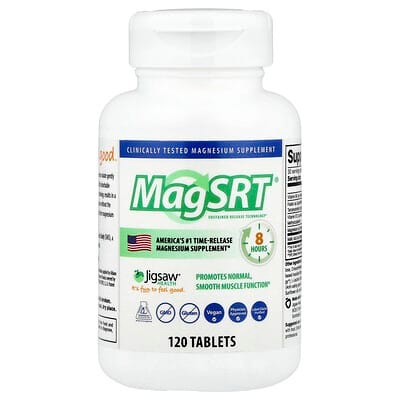

$27.97 $0.93 per serving


Product analysis
MagSRT combines magnesium with B vitamins to help fill nutritional gaps relevant to normal muscle, nerve and energy-related functions.
AI assessment of the formula, label and price. How scoring works
Nutrient Quality72
Magnesium malate and the folate form are favorable ingredient choices. The quality of the other named components remains uncertain.
Ingredient Transparency100
Amounts and forms are disclosed throughout the formula. That makes it straightforward to check the serving and compare ingredient sources.
Value For Money40
The magnesium and folate content are less economical for the serving cost. Value for the other components remains uncertain, so they do not establish a stronger price case for the combination.
Customer Satisfaction72
Customer ratings are very positive, but the amount of feedback is modest. The smaller review base makes the satisfaction picture less settled.
Product Focus61
Magnesium and B vitamins mainly help fill nutritional gaps supporting normal body functions. The 500 mg magnesium serving does not establish greater sleep, stress or other benefits, and suitability at that amount remains uncertain.
- Format
Tablet - Container
- 120 Tablet(s)
- Per serving
- $0.93
- Also available
 MagSRT$46.19
- Customer rating
- 4.7 · 110 ratings
Goals

Impact
High effect
Magnesium · 500 mgVitamin B12 · 6 mcg
Magnesium, folate, vitamins B6 and B12 support nutrient sufficiency, with potential relevance to tiredness when intake is inadequate or deficiency is present. Folate and B vitamins can be relevant to deficiency-related anaemia, while magnesium deficiency can cause fatigue and weakness. The supplied facts do not establish added energy in adequately nourished adults or an independent fatigue benefit from the malate component.
How this product is rated for Energy
Ingredient fit88
The relevant ingredients are focused on this goal, although the product is linked to other uses. The declared amounts provide partial or uneven support for the relevant ingredients.
Goal fit
The relevant ingredients are focused on this goal, although the product is linked to other uses.
Dose adequacy
The declared amounts provide partial or uneven support for the relevant ingredients.
Pathways0
The relevant role is nutrient sufficiency; no separate alertness, exercise or other listed energy route was covered.
Depth
The relevant role is nutrient sufficiency; no separate alertness, exercise or other listed energy route was covered.
Breadth
No separate energy route met the coverage threshold; nutritional support remains distinct from broad energy effects.
Evidence88
Magnesium provides the strongest evidence contribution here, with benefits limited to the relevant preparation or population.
Evidence strength
Magnesium provides the strongest evidence contribution here, with benefits limited to the relevant preparation or population.
Studied preparation
The saved findings recognize the credited preparations, while the supplied evidence retains its preparation and population limits.
Formulation logic100
The credited ingredients can stand alone in the saved findings, with no identified opposing combination.
Partner coverage
The relevant ingredients do not require an additional partner in the saved findings; no extra combination benefit is established.
Conflicts
No opposing ingredient combination was identified in the evaluated conflict checks.
Effective doses
The ingredients counted in the saved findings have meaningful amount support; this is distinct from proven fatigue-treatment doses.

Impact
Highest effect
Folate · 200 mcgVitamin B12 · 6 mcgMagnesium · 500 mg
Folate and B vitamins contribute nutrients relevant to normal metabolism and blood formation, with usefulness mainly when dietary intake falls short. Magnesium can make a substantial contribution to a dietary gap; its amount does not establish an extra energy, sleep or stress benefit.
How this product is rated for Everyday Health
Ingredient fit78
Relevant nutrients share the formula with ingredients for broader purposes, reducing its focus on the assessed general-health roles. Amount support is partial.
Goal fit
Relevant nutrients share the formula with ingredients for broader purposes, reducing its focus on the assessed general-health roles.
Dose adequacy
Amount support is partial under the saved comparison criteria; small or unresolved quantities limit the contribution assigned.
Pathways100
The main saved connection is energy metabolism cofactors. 3 assessed pathways meet the saved coverage requirement, spanning several nutritional roles rather than proving multiple clinical benefits.
Depth
The strongest saved connection is energy metabolism cofactors; this describes a supported ingredient role rather than a measured health improvement.
Breadth
3 assessed pathways meet the saved coverage requirement, spanning several nutritional roles rather than proving multiple clinical benefits.
Evidence86
Magnesium supplies the strongest included support in the saved findings; the scientific context confines expectations to nutritional contribution or narrowly studied outcomes.
Evidence strength
Magnesium supplies the strongest included support in the saved findings; the scientific context confines expectations to nutritional contribution or narrowly studied outcomes.
Studied preparation
The saved findings accept the included preparations; no chemical-form or delivery advantage follows from that match.
Formulation logic100
No required ingredient partner is missing in the saved findings; this does not establish an added benefit from combining ingredients. No configured ingredient conflict was identified in the supplied findings.
Partner coverage
No required ingredient partner is missing in the saved findings; this does not establish an added benefit from combining ingredients.
Conflicts
No configured ingredient conflict was identified in the supplied findings.
Effective doses
All counted ingredients meet the saved minimum amount criterion; this does not make it a proven clinical threshold.

Impact
High effect
Magnesium · 500 mgVitamin B12 · 6 mcgVitamin B6 · 5 mgFolate · 200 mcg
Magnesium contributes to vascular tone and may help arterial stiffness, especially when magnesium status is low. Findings for blood pressure and stiffness are inconsistent, including trials with no overall benefit; the supplied forms do not establish superior cardiovascular effects. Folate and B6 contribute to homocysteine metabolism; the small B12 amount was not counted in the saved findings.
How this product is rated for Cardiovascular Support
Ingredient fit67
Relevant ingredients sit within a broader formula, so cardiovascular support is only part of its focus.
Goal fit
Relevant ingredients sit within a broader formula, so cardiovascular support is only part of its focus.
Dose adequacy
The declared amounts provide partial support across the relevant ingredients; lower or unresolved amounts limit the finding.
Pathways54
Vascular tone and sodium balance is the main area represented in the saved findings. Other cardiovascular functions have less support here.
Depth
The strongest saved coverage concerns vascular tone and sodium balance.
Breadth
Coverage is concentrated in one main area rather than spread across several cardiovascular functions.
Evidence79
The saved findings include study-matched ingredients, but marker changes and normal nutrient roles do not establish cardiovascular-event prevention.
Evidence strength
Magnesium provides the strongest included evidence, with the population and outcome limitations described above.
Studied preparation
The included preparations meet the saved study-match criteria; this does not establish equivalent benefits for every person or form.
Formulation logic100
The included ingredients have no identified partner gap or configured conflict. Their amounts reach the saved minimum comparison.
Partner coverage
The included ingredients can contribute alone or have their required partner; no additional combination benefit is established.
Conflicts
No configured ingredient conflict was identified in the supplied facts.
Effective doses
The included ingredients reach the saved minimum amount comparison; this is not a proven clinical-benefit threshold.

Impact
High effect
Magnesium · 500 mgFolate · 200 mcgVitamin B12 · 6 mcgVitamin B6 · 5 mg
Magnesium is the main stress-related ingredient here, with conditional support when intake is low or in selected clinical settings. The 500 mg serving exceeds the highest supplied reference quantity, so its retained contribution does not establish added benefit or suitability at that exposure. Folate's connection is indirect, based on nutritional and mood-related findings. The small B6 and B12 amounts do not contribute meaningfully to the saved stress findings.
How this product is rated for Stress Relief
Ingredient fit69
Magnesium and folate provide the included contributions; an additional active and several linked goals reduce focus.
Goal fit
Magnesium and folate provide the included contributions; an additional active and several linked goals reduce focus.
Dose adequacy
Magnesium retains the endpoint finding above the reference range; folate contributes less, and the small B6 and B12 amounts are excluded.
Pathways50
Calming is the main area, with smaller nutrient-related mood and stress-regulation findings.
Depth
Magnesium supplies the strongest calming finding.
Breadth
Calming alone meets the criterion; the smaller mood and stress-related findings do not.
Evidence76
Magnesium leads the evidence finding, with applicability dependent on nutritional status and clinical context.
Evidence strength
Magnesium supplies the leading evidence contribution among the included ingredients.
Studied preparation
The included preparations receive recognition in the saved finding, which does not establish equal clinical performance across forms.
Formulation logic100
The included contributions have their required partners or can stand alone, with no evaluated conflict identified.
Partner coverage
No required partner is missing for the included contributions.
Conflicts
No evaluated ingredient conflict was identified in the supplied facts.
Effective doses
All ingredients retained in this finding meet the saved minimum amount criterion; this does not establish a clinically effective dose.

Impact
High effect
Magnesium · 500 mgVitamin B12 · 6 mcgVitamin B6 · 5 mgFolate · 200 mcg
Magnesium offers limited, inconsistent blood-pressure support. Its 500 mg per serving exceeds the highest amount underlying the comparison, without establishing extra benefit or suitability. Folate, B6 and B12 participate in homocysteine metabolism, but this biochemical role does not establish general cardiovascular prevention benefit; the particular B-vitamin forms do not change that limitation.
How this product is rated for Heart Health
Ingredient fit65
Heart-related ingredients sit within a broader formula with other active ingredients. The relevant declared amounts provide partial coverage of the saved exposure comparison.
Goal fit
Heart-related ingredients sit within a broader formula with other active ingredients.
Dose adequacy
The relevant declared amounts provide partial coverage of the saved exposure comparison.
Pathways57
The strongest saved connection is to blood-pressure and vascular-tone support. Coverage across other heart-related roles is limited.
Depth
The strongest saved connection is to blood-pressure and vascular-tone support.
Breadth
The broader saved findings cover blood-pressure and vascular-tone support. .
Evidence89
Magnesium leads the saved evidence finding. Accepted preparation matches do not remove the ingredient-specific limitations described above.
Evidence strength
Magnesium provides the leading evidence contribution in the saved comparison; its clinical limitations still apply.
Studied preparation
The saved finding accepts the preparations used for its included ingredients; it does not establish that every labelled preparation matches a clinical trial.
Formulation logic100
The saved checks find no missing required partner or configured conflict. The included amounts pass the minimum comparison screen.
Partner coverage
The included ingredients do not lack a required partner under the saved finding; this does not establish added benefit from combining them.
Conflicts
No configured ingredient conflict was triggered by the supplied facts.
Effective doses
All ingredients included in this amount screen meet its minimum comparison level; that level is not a proven effective dose.

Impact
Moderate effect
Magnesium · 500 mg
Magnesium supports normal muscle and energy-related function, with the clearest fitness contribution when intake is inadequate. The 500 mg declaration reaches the saved amount comparison, but higher intake is not evidence of better performance in people whose magnesium needs are already met.
How this product is rated for Fitness
Ingredient fit63
The relevant ingredients provide a partial connection to fitness.
Goal fit
Several other actives serve different goals; magnesium is the main assessed fitness ingredient.
Dose adequacy
Magnesium reaches the saved upper amount comparison.
Pathways0
The saved coverage is concentrated in no specific fitness area.
Depth
No specific fitness area receives coverage.
Breadth
No area reaches substantial coverage.
Evidence70
The evidence contribution depends on the ingredient and exercise context.
Evidence strength
Magnesium provides the strongest saved evidence contribution.
Studied preparation
The saved preparation check is satisfied for magnesium.
Formulation logic100
The saved partner and conflict checks are satisfied, with the amount findings noted below.
Partner coverage
No required partner is missing.
Conflicts
No configured ingredient conflict was found.
Effective doses
All relevant ingredients meet the saved minimum amount comparison.
Ingredients
| Ingredient | Amount per serving | Score |
|---|---|---|
Vitamin B6 (Pyridoxal 5-Phosphate Monohydrate) | 5 mg | |
Folate (Quatrefolic 5-Methyltetrahydrofolic Acid Glucosamine Salt) | 200 mcg | |
Vitamin B12 (Methylcobalamin) | 6 mcg | |
Magnesium (DiMagnesium Malate) | 500 mg | |
Malic Acid (DiMagnesium Malate) | 1436 mg |
Magnesium (DiMagnesium Malate) · 500 mg OverallScore71
Alternative products
Report alternatives
Sources
Published studies used for the product analysis and the top-ranked studies for each ingredient and goal.
- Association between RBC folate and lumbar bone mineral density in postmenopausal women, a cross-sectional study from NHANES 2009-2018.
- Genetic variants modify the associations of concentrations of methylmalonic acid, vitamin B-12, vitamin B-6, and folate with bone mineral density.
- Adequate Intake and Supplementation of B Vitamins, in Particular Folic Acid, can Play a Protective Role in Bone Health.
- Relation of homocysteine, folate, and vitamin B12 to bone mineral density of postmenopausal women.
- Dietary intake of folate, but not vitamin B2 or B12, is associated with increased bone mineral density 5 years after the menopause: results from a 10-year follow-up study in early postmenopausal women.
- Association between Serum Magnesium and Fractures: A Systematic Review and Meta-Analysis of Observational Studies.
- Bioabsorbable Magnesium-Based Materials Potential and Safety in Bone Surgery: A Systematic Review.
- Vascularized bone grafting fixed by biodegradable magnesium screw for treating osteonecrosis of the femoral head.
- An update on magnesium and bone health.
- Sex-specific differences in the association of magnesium intake with femoral neck bone mineral density among older adults.
- Effect of Vitamin B12 and Folic Acid Supplementation on Bone Mineral Density and Quantitative Ultrasound Parameters in Older People with an Elevated Plasma Homocysteine Level: B-PROOF, a Randomized Controlled Trial.
- Plasma B vitamins, homocysteine, and their relation with bone loss and hip fracture in elderly men and women.
- Relation between homocysteine and B-vitamin status indicators and bone mineral density in older Americans.
- The role of B-vitamin intake, B-vitamin-rich dietary patterns, the B-vitamin deficiency index in bone mineral density among school-aged children.
- Hyperhomocysteinemia is Associated with Inflammation, Bone Resorption, Vitamin B12 and Folate Deficiency and MTHFR C677T Polymorphism in Postmenopausal Women with Decreased Bone Mineral Density.
- The Effects of the AGE Inhibitor Pyridoxamine on Bone in Older Women With Type 2 Diabetes: A Randomized Clinical Trial.
- Dietary B vitamin intake and risk of hip fracture: the Singapore Chinese Health Study.
- Hip fracture patients may be vitamin B6 deficient. Controlled study of serum pyridoxal-5'-phosphate.
- Degree of mineralization-related collagen crosslinking in the femoral neck cancellous bone in cases of hip fracture and controls.
- Associations of dietary folate, vitamin B6 and B12 intake with cardiovascular outcomes in 115664 participants: a large UK population-based cohort.