
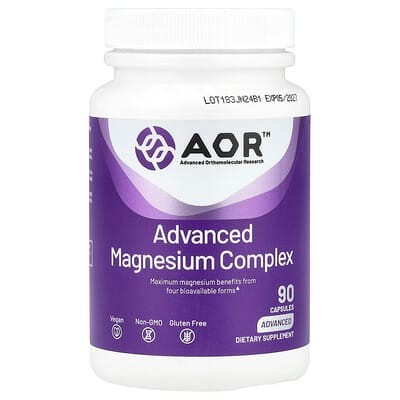
Advanced Magnesium Complex

Goals
$21.96 $0.24 per serving


Product analysis
Advanced Magnesium Complex can help fill part of a magnesium gap that matters for normal energy and bone functions. The magnesium blend omits the share of each form, making its individual contributions harder to compare.
AI assessment of the formula, label and price. How scoring works
Nutrient Quality52
The magnesium blend names several forms with favorable absorption potential. Their proportions are undisclosed, so the presence of glycinate or malate does not describe the whole blend.
Ingredient Transparency80
The declared amounts and forms are listed, making the sources easier to compare. The magnesium forms are not split by amount, so each form’s contribution remains unclear.
Value For Money52
The magnesium blend offers good value for its forms at the serving cost. Glycine is less economical, while dependable comparisons for the other contributions are unavailable.
Customer Satisfaction81
Customer feedback is favorable across 721 ratings. Those opinions describe satisfaction without proving effects on tiredness or other health outcomes.
Product Focus40
The clearest role is filling part of a mineral gap relevant to normal bone and energy functions. The broader potential uses do not establish detoxification or substantial cardiovascular benefits.
- Format
Capsule - Container
- 90 Capsule(s)
- Per serving
- $0.24
- Customer rating
- 4.8 · 721 ratings
Goals

Impact
Moderate effect
Magnesium · 300 mgGlycine · 1440 mgVitamin C · 300 mg

Impact
Moderate effect
Magnesium · 300 mgVitamin C · 300 mgGlycine · 1440 mg

Impact
Lower effect
Magnesium · 300 mgGlycine · 1440 mgVitamin C · 300 mg


Impact
Lower effect
Magnesium · 300 mgVitamin C · 300 mg

Impact
Moderate effect
Magnesium · 300 mgVitamin C · 300 mgGlycine · 1440 mg
Ingredients
| Ingredient | Amount per serving | Score |
|---|---|---|
Vitamin C (Magnesium Ascorbate) | 300 mg | |
Magnesium (Magnesium Ascorbate, Magnesium Aspartate, Magnesium Glycinate, Magnesium Malate) | 300 mg | |
Glycine (Magnesium Glycinate) | 1440 mg | |
Aspartate (Magnesium Aspartate) | 150 mg | |
Malate (Magnesium Malate) | 150 mg |
Magnesium (Magnesium Ascorbate, Magnesium Aspartate, Magnesium Glycinate, Magnesium Malate) · 300 mg OverallScore69
A serving provides 100 mg of elemental magnesium at a low cost per serving. The source is magnesium ascorbate, magnesium aspartate, magnesium glycinate and magnesium malate, with proportions undisclosed.
How this ingredient is rated
Active Ingredient Quality & Bioavailability53
The source is magnesium ascorbate, magnesium aspartate, magnesium glycinate and magnesium malate, with proportions undisclosed. No named patented chelation standard is identified.
Magnesium Form & Absorption Potential
The source is magnesium ascorbate, magnesium aspartate, magnesium glycinate and magnesium malate, with proportions undisclosed.
Patented Materials & Chelation Quality
No named patented chelation standard is identified.
Dose, Safety & Label Transparency78
The label states 100 mg of elemental magnesium per serving. No calcium or supporting magnesium cofactor is identified in the available facts.
Elemental Yield Transparency
The label states 100 mg of elemental magnesium per serving.
Therapeutic Dosage Alignment
A serving provides 100 mg of elemental magnesium.
Synergistic Formulation Logic
No calcium or supporting magnesium cofactor is identified in the available facts.
Value84
The serving cost is low; the magnesium forms and their unknown proportions matter when weighing its value.
Price Per Elemental Quality
The serving cost is low; the magnesium forms and their unknown proportions matter when weighing its value.
Glycine (Magnesium Glycinate) · 1440 mg OverallScore48
The serving provides 480 mg of glycine, with a high full-product cost per gram of glycine. That is a small amount relative to amounts used for sleep quality. A good manufacturing practice claim is present. Ordinary excipients or capsule materials are identified.
How this ingredient is rated
Active Ingredient Quality & Bioavailability60
A good manufacturing practice claim is present; it does not independently verify glycine purity.
Glycine Sourcing and Purity Standards
A good manufacturing practice claim is present; it does not independently verify glycine purity.
Dose, Safety & Label Transparency44
480 mg of glycine per serving is a small amount relative to amounts used for sleep quality. The amount is disclosed and ordinary excipients or capsule materials are identified.
Clinically Relevant Dosage
480 mg of glycine per serving is a small amount relative to amounts used for sleep quality.
Label Transparency and Yield Disclosure
The glycine yield from the chelate is disclosed.
Clean Label and Excipient Quality
Ordinary excipients or capsule materials are identified.
Value30
The full product price per gram of glycine is high; other ingredients contribute to that price.
Cost Efficiency per 1,000mg of Glycine
The full product price per gram of glycine is high; other ingredients contribute to that price.
Alternative products
Report alternatives
Sources
Published studies used for the product analysis and the top-ranked studies for each ingredient and goal.
- Implantoplasty Versus Glycine Air Abrasion for the Surgical Treatment of Peri-implantitis: A Randomized Clinical Trial.
- Amino Acid Intakes Are Associated With Bone Mineral Density and Prevalence of Low Bone Mass in Women: Evidence From Discordant Monozygotic Twins.
- Type V osteogenesis imperfecta: a new form of brittle bone disease.
- Associations of Dietary and Circulating Choline and Glycine With Bone Mineral Density: UK Biobank Analyses With Mendelian Randomization.
- Metabolomic insights into amino acid signatures and pathways associated with osteoporosis in Iranian elderly population.
- Association between Serum Magnesium and Fractures: A Systematic Review and Meta-Analysis of Observational Studies.
- Bioabsorbable Magnesium-Based Materials Potential and Safety in Bone Surgery: A Systematic Review.
- Vascularized bone grafting fixed by biodegradable magnesium screw for treating osteonecrosis of the femoral head.
- An update on magnesium and bone health.
- Sex-specific differences in the association of magnesium intake with femoral neck bone mineral density among older adults.
- Can Dietary Intake of Vitamin C-Oriented Foods Reduce the Risk of Osteoporosis, Fracture, and BMD Loss? Systematic Review With Meta-Analyses of Recent Studies.
- Dietary vitamin C intake and the risk of hip fracture: a dose-response meta-analysis.
- Smoking, antioxidant vitamins, and the risk of hip fracture.
- Micronutrients and the risk of hip fracture: Case-control study.
- Favorable effect of dietary vitamin C on bone mineral density in postmenopausal women (KNHANES IV, 2009): discrepancies regarding skeletal sites, age, and vitamin D status.
- Circulating and dietary magnesium and risk of cardiovascular disease: a systematic review and meta-analysis of prospective studies.
- Magnesium and the risk of cardiovascular events: a meta-analysis of prospective cohort studies.
- Quantitative Association Between Serum/Dietary Magnesium and Cardiovascular Disease/Coronary Heart Disease Risk: A Dose-Response Meta-analysis of Prospective Cohort Studies.
- Comparative Efficacy of Nutraceuticals on Endothelial Function: A Systematic Review and Network Meta-Analysis.
- Serum magnesium, mortality, and cardiovascular disease in chronic kidney disease and end-stage renal disease patients: a systematic review and meta-analysis.