



Iron Supportive
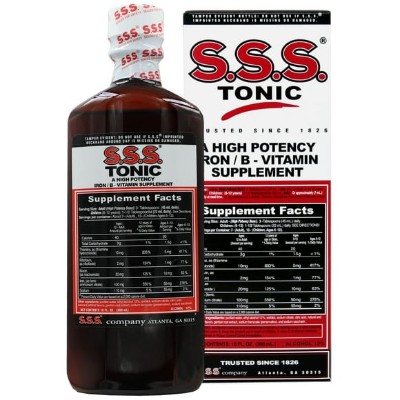
$10.87 $0.54 per serving
Product analysis
AI assessment of the formula, label and price. How scoring works
Nutrient Quality43
Ingredient Transparency100
Value For Money64
Customer Satisfaction80
Product Focus72
- Format
Liquid - Container
- 10 Liquid(s)
- Per serving
- $0.54
- Customer rating
- 4.7 · 996 ratings
Goals
Impact
High effect
Riboflavin · 2.4 mgThiamin · 5 mgIron · 100 mg
S.S.S Tonic fits energy support when low iron or vitamin intake contributes to fatigue. The selected 3 Tbsp serving supplies 100 mg iron, so the catalogue’s 0.5 Tbsp serving would give a misleading comparison. Iron is the leading ingredient for deficiency-related fatigue; riboflavin at 2.4 mg supports normal energy metabolism, with a fatigue benefit tied to inadequate intake.
Thiamin Disputed
Riboflavin Mixed

Impact
High effect
Iron · 100 mg
S.S.S Tonic is most relevant to hair health when iron deficiency contributes to shedding. The selected 3 Tbsp label serving supplies 100 mg of iron, which is the main contribution and makes nutritional need central to the choice. Niacin at 20 mg adds a smaller nutritional component, with no direct hair benefit established from its circulation role. The catalogue's 0.5 Tbsp serving differs from the 3 Tbsp label denominator used for these amounts.
Iron Disputed
Niacin Disputed
Ingredients
| Ingredient | Amount per serving | Score |
|---|---|---|
Thiamine | 5 mg | |
Riboflavin | 2.4 mg | |
Niacin (Niacinamide) | 20 mg | |
Iron (Ferric Ammonium Citrate) | 100 mg |
Iron (Ferric Ammonium Citrate) · 100 mg OverallScore48
S.S.S Company S.S.S Tonic has a high iron amount that calls for caution: 100 mg per serving. The iron source is Ferric Ammonium Citrate. High amounts carry a greater risk of side effects and accidental toxicity. At $0.026 per 5 mg of iron, the iron is good value. A serving of the full formula costs $0.51.
Alternative products
Report alternatives
Sources
Published studies used for the product analysis and the top-ranked studies for each ingredient and goal.
- Large-dose intravenous ferric carboxymaltose injection for iron deficiency anemia in heavy uterine bleeding: a randomized, controlled trial.
- The Effect of Parenteral or Oral Iron Supplementation on Fatigue, Sleep, Quality of Life and Restless Legs Syndrome in Iron-Deficient Blood Donors: A Secondary Analysis of the IronWoMan RCT.
- Ferric carboxymaltose vs. oral iron in the treatment of pregnant women with iron deficiency anemia: an international, open-label, randomized controlled trial (FER-ASAP).
- Effect of iron therapy on fatigue symptoms in non-anaemic iron deficient women of reproductive age- A Randomized Controlled Trial.
- Intravenous iron isomaltoside treatment of women suffering from severe fatigue after postpartum hemorrhage.
- Physicochemical properties of and volatile compounds in riboflavin fortified cloudy apple juice; study of its effect on job fatigue among Egyptian construction workers.
- Vitamin B status in patients with chronic fatigue syndrome.
- B-vitamins, related vitamers, and metabolites in patients with quiescent inflammatory bowel disease and chronic fatigue treated with high dose oral thiamine.
- Metabolic features of chronic fatigue syndrome.
- Effectiveness of Riboflavin in Inherited Metabolic Diseases: A Systematic Review
- Influence of thiamin supplementation on the health and general well-being of an elderly Irish population with marginal thiamin deficiency.
- Randomised clinical trial: high-dose oral thiamine versus placebo for chronic fatigue in patients with quiescent inflammatory bowel disease.
- Dietary reference values for thiamin.
- Effects of thiamine supplementation on exercise-induced fatigue.
- Long-term maintenance treatment with 300 mg thiamine for fatigue in patients with inflammatory bowel disease: results from an open-label extension of the TARIF study.
- The Association Between Alopecia Areata and Iron Deficiency Anemia: A Large-Scale Population-Based Case-Control Study.
- Iron Deficiency and Nonscarring Alopecia in Women: Systematic Review and Meta-Analysis.
- Comparative Analysis of Postoperative Hair Loss and Micronutrient Deficiencies After One-Anastomosis Gastric Bypass Versus Sleeve Gastrectomy.
- Assessment of Serum Ferritin Levels in Female Patients With Telogen Effluvium.
- Diagnosis and treatment of female alopecia: Focusing on the iron deficiency-related alopecia.