
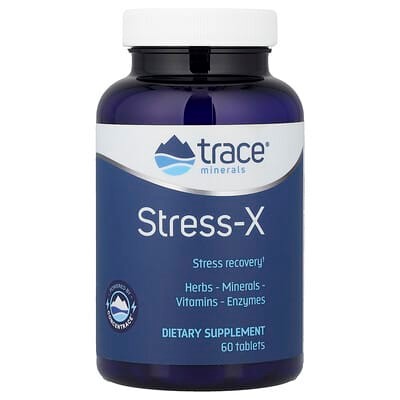

$22.99 $0.76 per serving


Product analysis
Stress-X provides vitamins and minerals that support normal energy use when dietary intake is low. Its undisclosed blends make the added calming appeal harder to judge.
AI assessment of the formula, label and price. How scoring works
Nutrient Quality46
Vitamin D3, natural-form vitamin E and several B vitamins have clearly described sources. Magnesium and multiple blend preparations remain less clear, limiting comparisons of the full mixture.
Ingredient Transparency68
The listed amounts make the main nutrients easier to compare. Missing blend breakdowns, chloride-source proportions and several preparation details leave part of the contents unclear.
Value For Money34
Several vitamins offer limited value at the cost of a full serving. Many other contributions lack a reliable comparison, so the extensive ingredient list does not establish good value.
Customer Satisfaction70
Customer ratings indicate very favorable satisfaction. The small review pool limits how broadly that experience can be generalized.
Product Focus8
The clearest benefits concern filling nutrient gaps relevant to normal energy and immune function. The broad mix and unnamed blends leave its stress-specific contribution less clear.
- Format
Tablet - Container
- 60 Tablet(s)
- Per serving
- $0.76
- Customer rating
- 4.7 · 52 ratings
Goals

Impact
Highest effect
Folate · 400 mcgVitamin B12 · 40 mcgVitamin D · 1000 IUMagnesium · 80 mgBoron · 0.6 mgSelenium · 5 mcgZinc · 10 mgVitamin C · 175 mg
Magnesium provides a nutritional contribution when dietary intake is low. The declared B vitamins contribute to ordinary nutrient availability, with their main connection here in metabolism. Folate and vitamin B12 contribute to nutrition related to blood formation. These nutritional roles do not establish additional health benefits when intake is already adequate.
How this product is rated for Everyday Health
Ingredient fit79
The declared nutrients provide a nutritional connection to general health. Amount support varies across contributing ingredients.
Goal fit
The declared nutrients provide general nutritional connections alongside the formula’s other ingredients.
Dose adequacy
Contributing amounts provide partial support against the saved amount references; the reference comparison does not establish a clinical dose-response.
Pathways80
The strongest connection is energy metabolism cofactors. The formula also represents the areas listed below.
Depth
The strongest represented area is energy metabolism cofactors, describing nutritional roles rather than a measured improvement in health.
Breadth
The represented areas are energy metabolism cofactors, one-carbon metabolism and blood formation.
Evidence82
Vitamin B9 (Folate) is the leading retained contribution. The supplied context supports nutritional availability when intake is low, without establishing added benefit with adequate intake.
Evidence strength
Vitamin B9 (Folate) provides the leading retained contribution; its nutritional relevance does not establish broad disease prevention.
Studied preparation
The retained preparations meet the saved checks; no superiority of chemical form or delivery follows.
Formulation logic100
No configured conflict or missing required partner was identified; the retained amount threshold does not establish clinical effectiveness.
Partner coverage
No required partner is missing among the retained ingredients; combining them does not establish extra health benefit.
Conflicts
No configured ingredient conflict was identified.
Effective doses
The retained ingredients meet the amount threshold used here, which is not proof of clinical benefit.

Impact
Moderate effect
Vitamin D · 1000 IUVitamin B5 · 25 mgMagnesium · 80 mgRiboflavin · 8 mgThiamin · 10 mgVitamin B12 · 40 mcgPotassium · 60 mg
B vitamins, vitamin C and magnesium provide nutritional support relevant to tiredness when intake is inadequate. Vitamin D's fatigue evidence concerns deficient adults, making that benefit conditional. Valerian's sedative action may work against daytime alertness.
How this product is rated for Energy
Ingredient fit62
The counted ingredients are relevant to nutritional or fatigue support, while the formula also serves other goals. The counted amounts have a partial match to the saved dose comparison.
Goal fit
The counted ingredients are relevant to nutritional or fatigue support, while the formula also serves other goals.
Dose adequacy
The counted amounts have a partial match to the saved dose comparison.
Pathways0
No direct alertness, muscle-buffering, mitochondrial, stress-fatigue or blood-flow contribution was assigned; nutritional relevance is assessed separately.
Depth
No direct alertness, muscle-buffering, mitochondrial, stress-fatigue or blood-flow contribution was assigned; nutritional relevance is assessed separately.
Breadth
No assessed area reaches the saved breadth threshold.
Evidence95
Vitamin D provides the strongest saved evidence finding at the assessed amount. The counted preparations meet the saved studied-preparation criteria.
Evidence strength
Vitamin D provides the strongest saved evidence finding at the assessed amount.
Studied preparation
The counted preparations meet the saved studied-preparation criteria.
Formulation logic93
The counted ingredients work independently or have their required partners. Valerian's sedative action conflicts with alertness.
Partner coverage
The counted ingredients work independently or have their required partners.
Conflicts
Valerian's sedative action conflicts with alertness.
Effective doses
9 of 9 counted ingredients meet the saved minimum amount comparison.
Vitamin B5 Not classified
No linked studies yet.

Impact
Lower effect
Magnesium · 80 mgZinc · 10 mgVitamin D · 1000 IUBoron · 0.6 mg
Vitamin B6 Not classified
No linked studies yet.

Impact
Moderate effect
Magnesium · 80 mgVitamin C · 175 mgZinc · 10 mgVitamin A · 2500 IUVitamin D · 1000 IUSelenium · 5 mcg
Vitamin D at 25 mcg and zinc at 10 mg support normal immune-cell function. Vitamin C at 175 mg adds antioxidant and barrier support, while folate and vitamins B6 and B12 help maintain nutrient sufficiency. Those functions do not guarantee stronger infection resistance when intake is adequate.
How this product is rated for Immunity
Ingredient fit46
Relevant immune ingredients are present alongside ingredients serving other needs. Small or unresolved relevant amounts limit the contribution.
Goal fit
Relevant immune ingredients are present alongside ingredients serving other needs.
Dose adequacy
Small or unresolved relevant amounts limit the contribution.
Pathways47
Lymphocyte function and immune regulation is the strongest area of support in the saved findings. The saved findings show meaningful coverage of 1 aspect of immune support, with less coverage elsewhere.
Depth
Lymphocyte function and immune regulation is the strongest area of support in the saved findings.
Breadth
The saved findings show meaningful coverage of 1 aspect of immune support, with less coverage elsewhere.
Evidence100
Zinc provides the strongest relevant evidence at the assessed amount; normal nutritional function is distinct from preventing infections. The qualifying ingredients match preparations represented in the supplied evidence.
Evidence strength
Zinc provides the strongest relevant evidence at the assessed amount; normal nutritional function is distinct from preventing infections.
Studied preparation
The qualifying ingredients match preparations represented in the supplied evidence.
Formulation logic93
The assessed ingredients can contribute on their own or have their required partner present. No ingredient conflicts were identified in the saved assessment. Some ingredients had small or unresolved amounts, including Vitamin A, Vitamin E.
Partner coverage
The assessed ingredients can contribute on their own or have their required partner present.
Conflicts
No ingredient conflicts were identified in the saved assessment.
Effective doses
Some ingredients had small or unresolved amounts, including Vitamin A, Vitamin E.

Impact
Moderate effect
Biotin · 120 mcgVitamin D · 1000 IUZinc · 10 mgVitamin C · 175 mg
Zinc may help with diffuse shedding when low intake is responsible. Biotin has a similarly conditional role, while vitamin C contributes to normal collagen formation and iron absorption without a clear independent regrowth benefit. The added B vitamins and sulfur-containing ingredients don't make the combination a demonstrated treatment for hair loss when nutrient intake is adequate.
How this product is rated for Hair Health
Ingredient fit49
Zinc may help when low intake contributes to shedding.
Goal fit
Zinc may help when low intake contributes to shedding.
Dose adequacy
Zinc supplies 10 mg per serving; the amount alone doesn't predict hair growth.
Pathways14
Nutrient functions and hair-related mechanisms do not by themselves demonstrate regrowth or improvement across different causes of hair loss.
Depth
Antioxidant-related ingredients are present, but their normal roles do not by themselves show hair regrowth.
Breadth
A broad effect across distinct causes of hair loss is unclear.
Evidence98
Zinc may help when low intake contributes to shedding. Ingredient form and the cause of hair loss affect how relevant a possible benefit is.
Evidence strength
Zinc may help when low intake contributes to shedding. Benefits when nutrient intake is adequate are unclear.
Studied preparation
The ingredient forms are identifiable for comparison; this does not imply that they will regrow hair.
Formulation logic92
No particular ingredient conflict or missing required partner is identified. Ingredient amounts alone do not show that the combination improves hair growth.
Partner coverage
No required ingredient partner is identified as missing; this does not imply an added benefit from combining ingredients.
Conflicts
No particular ingredient conflict is identified.
Effective doses
Some ingredients have low or unresolved amounts, which limits how their contribution can be interpreted.

Impact
Moderate effect
Folate · 400 mcgMagnesium · 80 mgVitamin B12 · 40 mcgVitamin D · 1000 IU
Vitamin C supports collagen formation, while vitamin D supports bone and muscle function and B12 supports normal nerve function. Their clearest role in healthy aging is helping fill dietary gaps; benefit beyond adequate nutrition is uncertain. Zinc, selenium and folate contribute to normal nutrient-dependent processes, without supporting a promise of longer life.
How this product is rated for Longevity
Ingredient fit50
The relevant nutrients provide a partial connection within a broad multivitamin.
Goal fit
Many other actives serve different goals, so the formula has a broader focus.
Dose adequacy
Overall amount coverage is partial across the relevant nutrients.
Pathways0
No aging-related area receives coverage in the saved assessment.
Depth
No area has meaningful saved coverage.
Breadth
No area reaches substantial coverage.
Evidence83
The saved evidence finding is strongest for a nutrient contribution, with dietary-need qualifications.
Evidence strength
Vitamin D supplies the strongest saved evidence contribution.
Studied preparation
The saved preparation check is satisfied for ingredients meeting the amount comparison.
Formulation logic96
Most relevant nutrients meet the amount comparison, without a flagged conflict.
Partner coverage
No required partner is missing.
Conflicts
No configured ingredient conflict was found.
Effective doses
Five of six relevant ingredients meet the minimum amount comparison; vitamin E falls below it.
Boron Not classified
No linked studies yet.
Ingredients
| Ingredient | Amount per serving | Score |
|---|---|---|
Calories | 5 Calorie(s) | |
Total Carbohydrates | 2 Gram(s) | |
Vitamin A (Vitamin A Palmitate) | 2500 IU | |
Vitamin C (Ascorbic Acid) | 175 mg | |
Vitamin D (Cholecalciferol) | 1000 IU | |
Vitamin E (D-Alpha-Tocopherol Succinate) | 10 IU | |
Thiamine (Thiamine Hydrochloride) | 10 mg | |
Riboflavin | 8 mg | |
Niacin | 18 mg | |
Vitamin B6 (Pyridoxide HCl) | 13 mg | |
Folic Acid | 400 mcg | |
Vitamin B12 (Methylcobalamin) | 40 mcg | |
Biotin | 120 mcg | |
Pantothenic Acid (D-Calcium Pantothenate) | 25 mg | |
Magnesium (from ConcenTrace Blend) | 80 mg | |
Zinc (Zinc Citrate) | 10 mg | |
Selenium (Selenium Amino Acid Chelate) | 5 mcg | |
Chromium (Chromium Amino Acid Chelate) | 15 mcg | |
Chloride (ConcenTrace Blend, NaCl) | 450 mg | |
Sodium (Sodium Chloride) | 35 mg | |
Potassium (Potassium Citrate) | 60 mg | |
ConcenTrace Blend | 566 mg | |
Herbal Blend | 308 mg | |
Food Concentrate Complex | 172 mg | |
Sulfate (from ConcenTrace) | 20 mg | |
PABA | 7 mg | |
Boron (Boron Citrate) | 0.6 mg |
Chloride (ConcenTrace Blend, NaCl) · 450 mg OverallScore57
The serving provides a comparatively large 450 mg of chloride. Sodium chloride is a recorded source; another source and the proportions are unspecified in the saved facts.
How this ingredient is rated
Active Ingredient Quality & Bioavailability26
Sodium chloride is a recorded source; another source and the proportions are unspecified in the saved facts.
Chloride source quality
Sodium chloride is a recorded source; another source and the proportions are unspecified in the saved facts.
Dose, Safety & Label Transparency91
The serving contains 450 mg of chloride; sodium chloride is recorded among the sources, but the full breakdown is unknown.
Chloride amount per serving
The serving provides a comparatively large 450 mg of chloride.
Amount and source disclosure
The saved facts record 450 mg of chloride and sodium chloride among its sources; the full source breakdown is unknown.
Value50
The whole-product serving costs about $0.77 and provides 450 mg of chloride.
Price per serving
The whole-product serving costs about $0.77 and provides 450 mg of chloride.
Vitamin B6 (Pyridoxide HCl) · 13 mg OverallScore75
Each serving provides 13 mg of vitamin B6 from pyridoxine Hydrochloride. The whole-product price is about $0.059 per mg of B6.
How this ingredient is rated
Ingredient Form & Label Quality100
The identified B6 source is pyridoxine Hydrochloride. The evaluation did not flag the specified additives.
Vitamin B6 Form Identification
The identified B6 source is pyridoxine Hydrochloride.
Clean Label and Excipient Purity
None of the specified additives were flagged in the evaluation; that does not establish that the formula is additive-free.
Dose, Safety & Label Transparency71
Each serving provides 13 mg of B6, above the amount favored in this comparison. The B6 amount and its source, pyridoxine Hydrochloride, are identified.
Vitamin B6 Dose & Safety Policy
Each serving provides 13 mg of B6, above the amount favored in this comparison.
Label Transparency
The B6 amount and its source, pyridoxine Hydrochloride, are identified.
Value32
The whole-product price is about $0.059 per mg of B6; that price includes the rest of the product.
Vitamin B6 Price Efficiency
The whole-product price is about $0.059 per mg of B6; that price includes the rest of the product.
Thiamin (Thiamine Hydrochloride) · 10 mg OverallScore65
Each serving provides 10 mg of thiamin from thiamine hydrochloride, a moderate amount in this comparison. The whole-product price works out to about $7.66 per 100 mg of thiamin, a high cost on this ingredient basis.
How this ingredient is rated
Active Ingredient Quality & Bioavailability70
The thiamin comes from thiamine hydrochloride, a standard water-soluble form. The evaluation does not identify flagged sweeteners or colors, though other excipients may still be present.
Thiamin Chemical Form
Thiamine hydrochloride is a standard, water-soluble form of thiamin.
Excipient Purity
The evaluation does not identify flagged sweeteners or colors; other excipients may still be present.
Dose, Safety & Label Transparency72
Each serving lists 10 mg of thiamin, a moderate amount in this comparison. Both the amount and the source are identified in the saved facts.
Thiamin Dosage Potency
The serving contains 10 mg of thiamin, a moderate amount for this comparison.
Label Transparency & Proprietary Blends
The amount and source are specified: 10 mg of thiamin per serving.
Value40
The whole-product price works out to about $7.66 per 100 mg of thiamin, a high cost for this ingredient.
Price per Declared Dose
The whole-product price works out to about $7.66 per 100 mg of thiamin, a high cost for this ingredient.
Alternative products
Report alternatives
Sources
Published studies used for the product analysis and the top-ranked studies for each ingredient and goal.
- Magnesium-L-threonate improves sleep quality and daytime functioning in adults with self-reported sleep problems: A randomized controlled trial.
- Total magnesium intake and risk of frailty in older women.
- Red blood cell magnesium and chronic fatigue syndrome.
- Exercise, magnesium and immune function.
- [Efficacy of potassium N-acetylaminosuccinate (Cogitum) in the treatment of asthenic syndrome: results of double-blind placebo-controlled trial].
- Human resting energy expenditure in relation to dietary potassium.
- Physicochemical properties of and volatile compounds in riboflavin fortified cloudy apple juice; study of its effect on job fatigue among Egyptian construction workers.
- Vitamin B status in patients with chronic fatigue syndrome.
- B-vitamins, related vitamers, and metabolites in patients with quiescent inflammatory bowel disease and chronic fatigue treated with high dose oral thiamine.
- Metabolic features of chronic fatigue syndrome.
- Effectiveness of Riboflavin in Inherited Metabolic Diseases: A Systematic Review
- Influence of thiamin supplementation on the health and general well-being of an elderly Irish population with marginal thiamin deficiency.
- Randomised clinical trial: high-dose oral thiamine versus placebo for chronic fatigue in patients with quiescent inflammatory bowel disease.
- Dietary reference values for thiamin.
- Effects of thiamine supplementation on exercise-induced fatigue.
- Long-term maintenance treatment with 300 mg thiamine for fatigue in patients with inflammatory bowel disease: results from an open-label extension of the TARIF study.
- A new perspective on vitamin B12 deficiency in rheumatology: a case-based review.
- Effects of Vitamin B12 Supplementation on Cognitive Function, Depressive Symptoms, and Fatigue: A Systematic Review, Meta-Analysis, and Meta-Regression.
- Patients' experiences with methylcobalamin injections in amyotrophic lateral sclerosis.
- Cobalamin deficiency: clinical picture and radiological findings.