
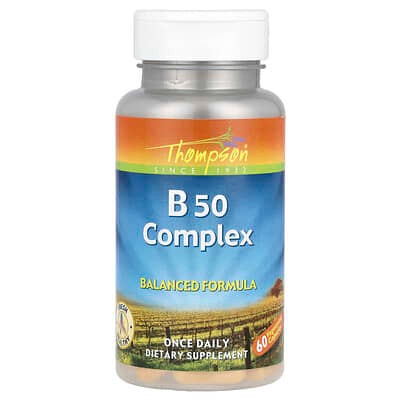

$5.38 $0.08 per serving


Product analysis
B 50 Complex offers low-cost B-vitamin support for normal energy metabolism when dietary intake falls short. The added blend lacks component details, leaving its extra contribution unclear.
AI assessment of the formula, label and price. How scoring works
Nutrient Quality59
Several B-vitamin sources are clearly identified, including niacinamide and calcium pantothenate. Standard riboflavin is less favored in the form comparison, and some preparations remain unspecified.
Ingredient Transparency70
The listed amounts are clear, but some source forms are omitted. The blend total also does not identify its individual components.
Value For Money64
The low serving cost works well for riboflavin, niacin and B6. Value is less favorable for some other nutrients and cannot be established for every contribution.
Customer Satisfaction86
Customer ratings indicate high satisfaction. Thousands of ratings provide a broad base of feedback.
Product Focus37
The clearest role is filling B-vitamin gaps involved in normal energy metabolism. The unidentified blend makes its additional role harder to judge.
- Format
Capsule - Container
- 60 Capsule(s)
- Per serving
- $0.08
- Customer rating
- 4.7 · 2,862 ratings
Goals

Impact
High effect
Vitamin B5 · 50 mgRiboflavin · 50 mgThiamin · 50 mgVitamin B12 · 50 mcg
Thiamin, riboflavin, niacin, B6, folate and pantothenic acid support normal energy metabolism or help address deficiency-related tiredness. These roles do not establish an extra energy boost when nutrient intake is adequate. B12 is also present, but its 50 mcg per serving falls below the saved contribution threshold; that does not mean it is nutritionally ineffective.
How this product is rated for Energy
Ingredient fit93
Six B vitamins contribute, mainly through nutritional sufficiency.
Goal fit
Six B vitamins contribute, mainly through nutritional sufficiency.
Dose adequacy
Most credited vitamins reach the saved amount references; pantothenic acid receives partial amount recognition.
Pathways0
The contribution concerns nutrient sufficiency; no listed direct alertness, exercise or stress-fatigue pathway receives coverage.
Depth
No listed direct energy pathway receives coverage from the credited nutrients.
Breadth
No listed pathway reaches the coverage threshold.
Evidence78
Riboflavin provides the strongest recognized evidence contribution at its saved amount. Its practical benefit remains subject to the population and nutrient-status limits described above.
Evidence strength
Riboflavin leads the evidence contribution among ingredients at recognized amounts.
Studied preparation
The credited ingredients meet the saved preparation criterion; this does not establish benefit for every user.
Formulation logic100
The credited ingredients require no missing partner, and no configured conflict was found. All credited amounts pass the saved minimum contribution threshold.
Partner coverage
Every credited ingredient can contribute without a missing required partner.
Conflicts
No configured ingredient conflict was identified.
Effective doses
All credited ingredients pass the saved minimum amount threshold; this is not proof of a clinically effective dose.
Vitamin B5 Not classified
No linked studies yet.

Impact
High effect
Biotin · 50 mcgNiacin · 50 mgVitamin B12 · 50 mcgRiboflavin · 50 mgThiamin · 50 mgVitamin B5 · 50 mgVitamin B6 · 50 mg
B vitamins help the body use carbohydrate, fat and protein through their normal roles in energy metabolism. Filling a nutritional gap supports those essential processes, but extra B vitamins have not been shown here to make the body burn more energy when intake is adequate. Their normal metabolic roles should therefore be distinguished from a faster metabolic rate or lasting weight loss.
How this product is rated for Metabolism Support
Ingredient fit85
B vitamins supply the main metabolic connection; the saved amount comparison describes the declared serving rather than a proven boost.
Goal fit
B vitamins provide the main metabolic connection alongside ingredients serving other purposes.
Dose adequacy
The declared amounts reach the reference ranges unevenly, without establishing that increasing them would increase energy expenditure.
Pathways0
No tracked route to increased energy expenditure is covered by the included nutrients.
Depth
No tracked pathway for increasing energy expenditure receives coverage.
Breadth
None of the tracked pathways reaches the coverage threshold.
Evidence100
B vitamins receive evidence and preparation findings, while the supplied scientific context limits claims about a faster metabolic rate.
Evidence strength
Thiamin leads the saved evidence finding, but normal carbohydrate metabolism does not demonstrate an extra increase in energy expenditure.
Studied preparation
The counted preparations receive study matches in the saved findings; this does not establish a direct metabolism boost from each form.
Formulation logic100
No required companion or configured conflict is identified, and the counted amounts clear the minimum comparison threshold.
Partner coverage
No required companion is missing for the counted ingredients; this does not establish an extra benefit from their combination.
Conflicts
No configured ingredient conflict is identified in the saved findings.
Effective doses
All counted ingredients clear the saved minimum amount threshold, which is a comparison cutoff rather than a proven metabolism-boosting dose.
Ingredients
| Ingredient | Amount per serving | Score |
|---|---|---|
Thiamine (Thiamine Mononitrate) | 50 mg | |
Riboflavin | 50 mg | |
Niacin (Niacinamide) | 50 mg | |
Vitamin B6 (Pyridoxine Hydrochloride) | 50 mg | |
Folic Acid | 400 mcg | |
Vitamin B12 (Cyanocobalamin) | 50 mcg | |
Biotin | 50 mcg | |
Pantothenic Acid (Calcium Pantothenate) | 50 mg | |
Base Complex Blend | 205 mg |
Niacin (Niacinamide) · 50 mg OverallScore81
Vitamin B6 (Pyridoxine Hydrochloride) · 50 mg OverallScore75
Riboflavin · 50 mg OverallScore72
The serving lists 50 mg of riboflavin, an amount the evaluation considers substantial for metabolic support. Standard riboflavin must be converted by the body before participating in energy metabolism.
How this ingredient is rated
Active Ingredient Quality & Bioavailability30
The listed form is standard riboflavin, which the body converts before it participates in energy metabolism.
Riboflavin Form Quality
The listed form is standard riboflavin, which the body converts before it participates in energy metabolism.
Dose, Safety & Label Transparency100
The serving lists 50 mg of riboflavin, an amount the evaluation considers substantial for metabolic support. The saved ingredients panel has no artificial colors or synthetic sweeteners flagged by the evaluation.
Dosage for Energy & Metabolism
The serving lists 50 mg of riboflavin, an amount the evaluation considers substantial for metabolic support.
R5P Elemental Yield Transparency
The phosphate-yield question does not apply to the listed standard riboflavin.
Additive Purity
The saved ingredients panel has no artificial colors or synthetic sweeteners flagged by the evaluation.
Value100
The whole-product serving costs about $0.09.
Price per Serving Value
The whole-product serving costs about $0.09.
Alternative products
Report alternatives
Sources
Published studies used for the product analysis and the top-ranked studies for each ingredient and goal.
- Physicochemical properties of and volatile compounds in riboflavin fortified cloudy apple juice; study of its effect on job fatigue among Egyptian construction workers.
- Vitamin B status in patients with chronic fatigue syndrome.
- B-vitamins, related vitamers, and metabolites in patients with quiescent inflammatory bowel disease and chronic fatigue treated with high dose oral thiamine.
- Metabolic features of chronic fatigue syndrome.
- Effectiveness of Riboflavin in Inherited Metabolic Diseases: A Systematic Review
- Influence of thiamin supplementation on the health and general well-being of an elderly Irish population with marginal thiamin deficiency.
- Randomised clinical trial: high-dose oral thiamine versus placebo for chronic fatigue in patients with quiescent inflammatory bowel disease.
- Dietary reference values for thiamin.
- Effects of thiamine supplementation on exercise-induced fatigue.
- Long-term maintenance treatment with 300 mg thiamine for fatigue in patients with inflammatory bowel disease: results from an open-label extension of the TARIF study.
- A new perspective on vitamin B12 deficiency in rheumatology: a case-based review.
- Effects of Vitamin B12 Supplementation on Cognitive Function, Depressive Symptoms, and Fatigue: A Systematic Review, Meta-Analysis, and Meta-Regression.
- Patients' experiences with methylcobalamin injections in amyotrophic lateral sclerosis.
- Cobalamin deficiency: clinical picture and radiological findings.
- Vitamin B12 Deficiency: Common Questions and Answers.
- Biotin and contribution to normal energy-yielding metabolism: evaluation of a health claim pursuant to Article 14 of Regulation (EC) No 1924/2006.
- Pregnancy and lactation alter biomarkers of biotin metabolism in women consuming a controlled diet.
- Survey of the effect of biotin on glycemic control and plasma lipid concentrations in type 1 diabetic patients in kermanshah in iran (2008-2009)
- Chromium picolinate and biotin combination improves glucose metabolism in treated, uncontrolled overweight to obese patients with type 2 diabetes
- Biotin supplementation reduces plasma triacylglycerol and VLDL in type 2 diabetic patients and in nondiabetic subjects with hypertriglyceridemia