


Magnesium Supportive
$59.99 $1.99 per serving
Product analysis
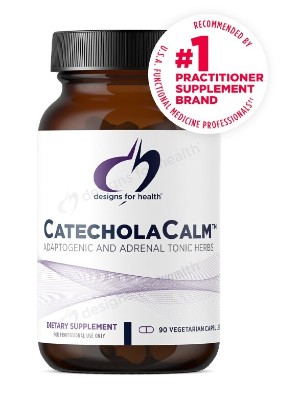
Designs for Health CatecholaCalm is a relaxation formula with 200 mg of L-theanine per three capsules, an amount that may help ease stress-related tension. Lemon balm, passionflower and valerian complement its calming purpose, but the latter two can work against daytime alertness; the blend is relatively expensive for its main calming ingredients.
AI assessment of the formula, label and price. How scoring works
Nutrient Quality51
Several nutrients come in useful forms, notably the active forms of riboflavin and B6 and magnesium malate. The herbal preparations and amino acids vary in how much is known about their precise form and quality.
Ingredient Transparency95
The label gives individual amounts for all 14 actives, which makes the formula's doses easy to check. Most forms are described, although taurine and theanine lack more detailed form information.
Value For Money35
The price covers a broad formula, but the main calming ingredients are relatively expensive for their individual amounts. Thiamin and pantothenic acid offer more favorable value, which may matter less to someone primarily seeking relaxation.
Customer Satisfaction71
Customers rate the formula very positively, averaging 4.77 out of 5. With 22 ratings, the feedback is encouraging but comes from a fairly small group.
Product Focus63
The formula fits relaxation and stress support most naturally, with B vitamins contributing to normal nervous-system function. Its 14 actives cover several related purposes, but calming herbs make it less suited to alertness-oriented uses.
- Format
Capsule - Container
- 90 Capsule(s)
- Per serving
- $1.99
- Customer rating
- 4.8 · 22 ratings
Goals

Impact
High effect
Vitamin B12 · 2 mgVitamin B6 · 5 mgThiamin · 50 mgMagnesium · 75 mgAshwagandha · 100 mg
CatecholaCalm offers a limited brain-health fit through calm attention and nutritional support. Theanine at 200 mg provides the clearest direct connection to selected attention tasks. Vitamin B12 at 2,000 mcg and thiamin at 50 mg supply nutrients whose deficiency can impair brain function; the large amounts do not imply extra benefit when intake is already adequate. Phosphatidylserine at 50 mg adds a small membrane-related rationale with inconsistent memory findings.
Vitamin B12 Supportive
Thiamin Supportive
Vitamin B6 Supportive
Theanine Supportive
Ashwagandha Supportive
Phospholipids (unspecified) No studies yet

Impact
High effect
Ashwagandha · 100 mgMagnesium · 75 mgVitamin B12 · 2 mgVitamin B6 · 5 mgVitamin C · 100 mgTheanine · 200 mg
CatecholaCalm offers relaxation-focused support led by 200 mg theanine. Theanine has direct tension and stress-response relevance, while sustained relief is less certain. Ashwagandha at 100 mg adds a smaller contribution because its amount and preparation provide a weaker match to the supplied stress findings.
Ashwagandha Supportive
Valerian Supportive
Theanine Supportive
Magnesium Supportive
Vitamin C Supportive
Vitamin B6 Supportive
Vitamin B12 Mixed
Taurine Supportive
Phospholipids (unspecified) No studies yet
Vitamin B5 No studies yet

Impact
High effect
Vitamin B6 · 5 mgVitamin B12 · 2 mgMagnesium · 75 mgAshwagandha · 100 mg
CatecholaCalm has a practical calming contribution from its 200 mg theanine, with narrower nutritional support alongside it. Theanine may help with stress-associated tension. Vitamin B12 at 2,000 mcg and vitamin B6 at 5 mg support normal nervous-system function, with mood relevance chiefly when correcting inadequate status.
Magnesium Supportive
Ashwagandha Supportive
Vitamin B12 Supportive
Vitamin B6 Supportive
Valerian Supportive
Theanine Supportive

Impact
High effect
Thiamin · 50 mgVitamin B6 · 5 mgVitamin B12 · 2 mgMagnesium · 75 mgAshwagandha · 100 mgTheanine · 200 mg
CatecholaCalm has a limited cognitive fit centred on theanine’s possible support for selected verbal and executive tasks. Its 200 mg theanine amount matches the supplied regimen, where the clearest cognitive signal was limited to people starting with lower performance. Thiamin at 50 mg and vitamin B12 at 2,000 mcg add nutritional support for brain function, most relevant when an inadequate supply contributes to cognitive problems.
Vitamin B12 Disputed
Thiamin Supportive
Theanine Supportive
Magnesium Supportive
Ashwagandha Supportive
Vitamin B6 Supportive
Phospholipids (unspecified) No studies yet

Impact
High effect
Magnesium · 75 mgTheanine · 200 mg
CatecholaCalm offers a reasonable calming approach to sleep support, led by 200 mg L-theanine. That amount may help sleep quality with repeated use. Lemon balm at 100 mg adds a smaller calming contribution than the amounts used in the supplied sleep findings.
Valerian Supportive
Magnesium Supportive
Ashwagandha Supportive
Theanine Supportive
Vitamin B6 Disputed
Taurine No studies yet

Impact
High effect
Vitamin B6 · 5 mgVitamin B12 · 2 mgMagnesium · 75 mgTheanine · 200 mg
CatecholaCalm has a calm-attention component, but its sedative botanicals make it a less straightforward choice for staying alert. Passion flower and valerian, each declared at 100 mg, work against alertness in the supplied conflict check. The 200 mg theanine serving is the main attention ingredient. Vitamin B12 at 2,000 mcg and thiamin at 50 mg add nutritional support relevant to concentration when a deficiency is present.
Theanine Supportive
Ashwagandha Supportive
Vitamin B12 Disputed
Magnesium Supportive
Vitamin B6 Disputed

Impact
High effect
Vitamin B12 · 2 mgVitamin B12 · 2 mgVitamin B6 · 5 mgMagnesium · 75 mgTheanine · 200 mg
CatecholaCalm offers a limited fit for sustained attention, with a daytime tradeoff from sedative herbs. Its 200 mg L-theanine provides the clearest attention support. Passionflower and valerian, at 100 mg each, can lower daytime arousal. Vitamin B12 at 2,000 mcg mainly matters when a deficiency contributes to fatigue or poor concentration.
Vitamin B12 Supportive
Magnesium Supportive
Ashwagandha Supportive
Vitamin B6 Disputed
Theanine Supportive
Ingredients
| Ingredient | Amount per serving | Score |
|---|---|---|
Vitamin C (Ascorbic Acid) | 100 mg | |
Thiamine (Thiamine Hydrochloride) | 50 mg | |
Riboflavin (Riboflavin 5-Phosphate) | 10 mg | |
Vitamin B-6 (Pyridoxal 5-Phosphate) | 5 mg | |
Vitamin B12 (Methylcobalamin) | 2 mg | |
Pantothenic Acid | 50 mg | |
Magnesium (Di-Magnesium Malate) | 75 mg | |
Taurine | 300 mg | |
L-Theanine | 200 mg | |
Lemon Balm (Rosmarinic Acid) | 100 mg | |
Passion Flower (Flavonoids) | 100 mg | |
Valerian (Valerenic Acid) | 100 mg | |
Ashwaganda (Withanolides) | 100 mg | |
Phosphatidylserine (Soy Lecithin) | 50 mg |
Theanine · 200 mg OverallScore78
Designs for Health CatecholaCalm offers a useful amount of L-Theanine at 200 mg per serving. The form is L-Theanine; no branded source or purity claim is recorded. The price is high: $1.00 per 100 mg of L-Theanine, with a serving costing $2.00; the serving price covers the whole product.
Ashwagandha (Withanolides) · 100 mg OverallScore70
Designs for Health CatecholaCalm is a reasonable ashwagandha choice, with 100 mg per serving. The specific ashwagandha preparation is unspecified. It lists 1.5% withanolides. The price offers limited value at $4.00 per 200 mg of the total ashwagandha preparation; the full product serving costs $2.00. The estimate uses the total preparation weight, so the amount of extract or active compounds remains uncertain.
Valerian (Valerenic Acid) · 100 mg OverallScore82
Designs for Health CatecholaCalm offers 100 mg of Valeriana officinalis per serving; the valerenic acid content is stated. The stated valerenic acid content is 0.8%. $5.00 per 250 mg of valerian is high, and $2.00 per serving pays for the full formula.
Alternative products
Report alternatives
Sources
Published studies used for the product analysis and the top-ranked studies for each ingredient and goal.
- Acute and Repeated Ashwagandha Supplementation Improves Markers of Cognitive Function and Mood.
- Effect of ashwagandha (Withania somnifera) extract with Sominone (Somin-On™) to improve memory in adults with mild cognitive impairment: A randomized, double-blind, placebo-controlled study.
- Efficacy of Withania somnifera supplementation on adult's cognition and mood.
- A clinical assessment of the therapeutic effects of Ashwagandha root extract on cognitive performance, sleep, and fatigue in children aged 6-12 years.
- Efficacy and Safety of Ashwagandha Root Extract on Cognitive Functions in Healthy, Stressed Adults: A Randomized, Double-Blind, Placebo-Controlled Study.
- Antenatal magnesium sulfate and neuroprotection.
- No. 376-Magnesium Sulphate for Fetal Neuroprotection.
- Magnesium Sulfate Before Preterm Birth for Neuroprotection: An Updated Cochrane Systematic Review.
- Magnesium sulphate for fetal neuroprotection at imminent risk for preterm delivery: a systematic review with meta-analysis and trial sequential analysis.
- Magnesium sulfate and fetal neuroprotection: overview of clinical evidence.
- Effects of L-Theanine Administration on Stress-Related Symptoms and Cognitive Functions in Healthy Adults: A Randomized Controlled Trial.
- A Randomized, Triple-Blind, Placebo-Controlled, Crossover Study to Investigate the Efficacy of a Single Dose of AlphaWave® L-Theanine on Stress in a Healthy Adult Population.
- Effects of Tea (Camellia sinensis) or its Bioactive Compounds l-Theanine or l-Theanine plus Caffeine on Cognition, Sleep, and Mood in Healthy Participants: A Systematic Review and Meta-Analysis of Randomized Controlled Trials.
- Assessing the effects of caffeine and theanine on the maintenance of vigilance during a sustained attention task.
- Effects of l-Theanine on Cognitive Function in Middle-Aged and Older Subjects: A Randomized Placebo-Controlled Study.
- Can thiamine substitution restore cognitive function in alcohol use disorder?
- EFNS guidelines for diagnosis, therapy and prevention of Wernicke encephalopathy.
- Diagnosis and treatment of Wernicke's encephalopathy: A systematic literature review.
- Vitamin Supplementation and Dementia: A Systematic Review.
- Association between dietary vitamin B1 intake and cognitive function among older adults: a cross-sectional study.