
Nutrient quality
Several marine and plant fatty acids provide useful breadth with antioxidant protection. Modest EPA and DHA plus unspecified forms reduce focused potency.
 Pure Formulas Pure Formulas | $ 27.89 | |
 iHerb iHerb | $ 27.89 | |
 Vitacost Vitacost | $ 27.89 | |
 Walmart Walmart | $ 27.89 |
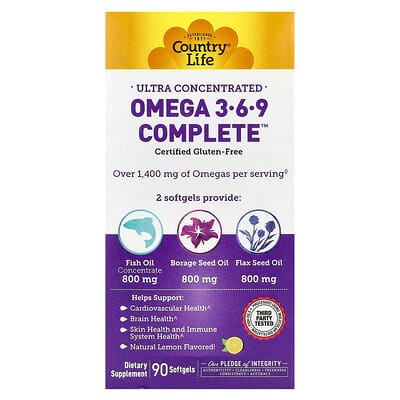
The serving supplies 240 mg EPA and 160 mg DHA from fish oil, plus 152 mg GLA from borage and 424 mg alpha-linolenic acid from flax. Oleic and linoleic acids round out the broad profile, with each important fatty acid listed separately.
Natural vitamin E helps protect the oxidation-prone oils, a meaningful advantage over unstabilized blends. The combined EPA and DHA amount is still a modest daily dose rather than a concentrated marine omega-3 serving.
Fish-oil molecular form and the extraction methods for borage and flax are not stated. Independent contaminant testing is also absent from the supplied details, and the two-softgel serving may be less convenient than a one-per-day option.
Several marine and plant fatty acids provide useful breadth with antioxidant protection. Modest EPA and DHA plus unspecified forms reduce focused potency.
Active fatty-acid amounts are clearly disclosed without a hidden blend. Complete use directions and inactive-ingredient details are not available.
The aggregate satisfaction measure is favorable, with response volume determining how much confidence it deserves. Comment-level evidence is absent, so recurring complaints and purpose fit cannot be verified.
Broad fatty-acid coverage and vitamin E provide some value. Modest marine omega potency and the multi-softgel serving weaken competitiveness.

Clearly disclosed EPA and DHA provide direct lipid and inflammatory support with strong human evidence. The combined active amount is a low daily dose rather than a therapeutic triglyceride-focused serving.
The molecular form and purification method are not disclosed, which limits confidence in absorption and contaminant control. Vitamin E helps protect the oil from oxidation, but greater EPA and DHA potency would be needed for deeper cardiovascular use.
| Ingredient | Amount per serving |
|---|---|
Calories | 25 Calorie(s) |
Total Fat | 2.5 Gram(s) |
Saturated Fat | 0.5 Gram(s) |
Monounsaturated Fat | 0.5 Gram(s) |
Polyunsaturated Fat | 2 Gram(s) |
Cholesterol | 5 mg |
Protein | 1 Gram(s) |
Vitamin E | 13.4 mg |
Fish Oil concentrate | 800 mg |
Eicosapentaenoic Acid | 240 mg |
Docosahexaenoic Acid | 160 mg |
Borage seed Oil | 800 mg |
Gamma-Linolenic Acid | 152 mg |
Linoleic Acid | 270 mg |
Oleic Acid | 109 mg |
Flax seed Oil | 800 mg |
Alpha-Linolenic Acid | 424 mg |
Linoleic Acid | 100 mg |
Oleic Acid | 79 mg |
Borage seed oil supplies a naturally concentrated source with a clearly stated active yield. The GLA amount is moderate, and vitamin E adds antioxidant support, although the extraction method is not disclosed. Cost efficiency per active amount is fair rather than exceptional.
Fish, borage, and flaxseed oils are clearly named, while extraction methods are not stated. Vitamin E adds meaningful oxidation protection, and the combined 188 mg oleic acid amount approaches the collection median. Transparent dosing is helpful, though cost efficiency remains average.
The explicitly listed 370 mg linoleic acid amount is below the collection median, limiting its use as a targeted supplement. Natural vitamin E helps protect the oils from oxidation, but the pressing or solvent-removal method is not stated. Cost per gram of linoleic acid is high.
Published studies used for the product analysis and the top-ranked studies for each ingredient and goal.