Product Image

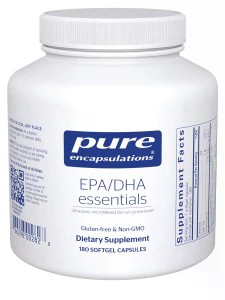
EPA/DHA Essentials

Pure Encapsulations
4.8
★ ★ ★ ★ ★
(139 ratings)
EPA (Eicosapentaenoic Acid) 300 mg
Fish Oil 1000 mg
DHA 200 mg
Product Image
Score75
A moderate EPA-and-DHA serving is clearly disclosed, but missing form and testing details limit confidence in oil quality.
How scoring works
Quantity:180 Capsule(s) • (180 servings)
Goals:
Anti-Inflammatory Support
Cardiovascular Support
Vision Support

Score 75

A moderate EPA-and-DHA serving is clearly disclosed, but missing form and testing details limit confidence in oil quality.
How scoring works
$71.00($0.39 per serving)
Pure Formulas
$ 71.00
Vitacost
$ 71.00
Report prices

Analysis

The formula supplies 300 mg EPA and 200 mg DHA per serving, giving a moderate omega-3 dose. Both key omega-3s are quantified, so the active amount is easy to assess.

The serving fits people who want a moderate daily omega-3 amount for cardiovascular support and anti-inflammatory support. The active-dose value is reasonable, though alternatives may provide more omega-3 per serving.

The label does not identify the omega-3 molecular form or provide independent purity and oxidation test results, so important quality details remain uncertain. The capsule(s) format may be convenient for routine use, but the disclosed facts do not establish freshness or contaminant control.

Who is it for
  • Adults seeking moderate daily omega-3 support
  • People who prefer clearly quantified EPA and DHA
Best for
  • Cardiovascular Support
  • Anti-Inflammatory Support
  • Vision Support

Pros

  • EPA and DHA are listed separately at 300 mg and 200 mg per serving
  • Useful moderate serving for routine supplementation
  • Serving count supports a practical daily routine

Cons

  • Omega-3 molecular form is not identified
  • Independent purity and oxidation testing is not provided
  • Users seeking a high dose may need more than one serving

Warnings

  • Avoid if you have a fish allergy because the active oil is fish-derived.
  • Fish oil can cause burping or stomach upset; taking it with a meal may improve tolerance.

Nutrient quality

80 Highest impact

Named small-fish sources and a balanced active profile provide a sound basic formula. The moderate dose and missing molecular-form, antioxidant, and testing details limit depth.

.

Ingredient transparency

83 Highest impact

Active amounts are individually disclosed, and no proprietary blend hides the supplied doses. Complete use directions, excipients, and some source or quality details remain unavailable.

.

Customer satisfaction

64 Moderate impact

Supplied aggregate data indicate very strong satisfaction with a limited response base. Specific comments are absent, so recurring complaints and purpose-specific experiences cannot be verified.

.

Value for money

68 High impact

Named sourcing and a simple formula provide fair value. A modest active dose and limited quality documentation weaken competitiveness.

.

Report analysis

Goals

Anti-Inflammatory Support
Impact
Highest effect
A Goal FitB Strength of SupportC- CoverageA+ Formula Quality
Fish Oil · 1000 mg

Clearly quantified EPA and DHA provide direct, evidence-backed support for healthy inflammatory signaling. The dose is useful but lower than amounts often used for more intensive inflammation goals.

It offers strong depth on the omega-3 pathway without unnecessary extras. People using anticoagulant or antiplatelet therapy should consider the added blood-thinning effect of fish oil.

Study evidence
Fish Oil Supportive 68 studies
Cardiovascular Support
Impact
High effect
A+ Goal FitD+ Strength of SupportC- CoverageA+ Formula Quality
Fish Oil · 1000 mg

The formula directly supports cardiovascular health with separately disclosed EPA and DHA from named small-fish sources. These omega-3 fats have strong evidence for lipid support, but the combined amount is modest for a targeted triglyceride effect.

The focused softgel is coherent and easy to assess, with no low-dose heart-health extras. Missing molecular-form, purification, independent-testing, and antioxidant-stabilizer details limit confidence in quality and oxidation control.

Vision Support
Impact
High effect
B Goal FitC Strength of SupportD+ CoverageA Formula Quality
EPA (Eicosapentaenoic Acid) · 300 mg

DHA supports retinal membrane structure, while EPA may contribute to ocular surface and inflammatory balance. The combination is relevant to vision but does not provide macular pigments or the antioxidant nutrients used in established eye formulas.

The 200 mg DHA and 300 mg EPA amounts provide a moderate contribution, with exact fatty-acid quantities clearly listed. Molecular form, oxidation protection, and independent contaminant testing are not disclosed.

Study evidence

Ingredients

IngredientAmount per serving
Calories
10 Calorie(s)
Total Fat
1 Gram(s)
Cholesterol
5 mg
Fish Oil concentrate
1000 mg
Eicosapentaenoic Acid
300 mg
Docosahexaenoic Acid
200 mg
Gluten Free Adults 18–50
Report overview
D- Active Ingredient Quality & BioavailabilityC Dose, Safety & Label TransparencyD+ Value

The formula provides a moderate 300 mg EPA dose with a favorable EPA-to-DHA ratio. Its molecular form, antioxidant protection, and contaminant testing are not disclosed. Cost efficiency is average for the amount of EPA delivered.

Fish Oil · 1000 mg OverallScore34
F Active Ingredient Quality & BioavailabilityD Dose, Safety & Label TransparencyD+ Value

The formula clearly provides separate EPA and DHA amounts, but their combined dose is modest. Its concentration is standard, while the named small-fish sources support ingredient origin. Molecular form, purification, independent testing, and antioxidant protection are not stated, and active cost is only average.

DHA · 200 mg OverallScore27
F Active Ingredient Quality & BioavailabilityF Dose, Safety & Label TransparencyF Value

Anchovy, mackerel, and sardine provide a transparent small-fish source with balanced EPA and DHA. The DHA serving remains low, and neither chemical form nor antioxidant protection is disclosed. The long supply does not overcome relatively high cost per active DHA and missing purity verification.

Loading alternative details
Report alternatives

Sources

Published studies used for the product analysis and the top-ranked studies for each ingredient and goal.

  1. Dose-dependent effects of fish oil on cardio-metabolic biomarkers in healthy middle-aged and elderly Chinese people: a double-blind randomized controlled trial.
    Song J; Hu M; Li C; Yang B; Ding Q; Wang C; Mao L · Food & function · 2018
    Randomized trial201 participantsAnti-Inflammatory Support forFish Oil
  2. Eicosapentaenoic acid supplementation alleviates pruritus, enhances skin moisture, and mitigates depression in maintenance hemodialysis patients.
    Lin YL; Wang CL; Chiang TI · Frontiers in nephrology · 2024
    Randomized trial60 participantsAnti-Inflammatory Support forFish Oil
  3. Lowering effects of fish oil supplementation on proinflammatory markers in hypertension: results from a randomized controlled trial.
    Yang B; Ren XL; Li ZH; Shi MQ; Ding F; Su KP; Guo XJ; Li D · Food & function · 2020
    Randomized trial77 participantsAnti-Inflammatory Support forFish Oil
  4. The effects of ω-3 fish oil emulsion-based parenteral nutrition plus combination treatment for acute paraquat poisoning.
    Meng Z; Dong Y; Gao H; Yao D; Gong Y; Meng Q; Zheng T; Cui X; Su X; Tian Y · The Journal of international medical research · 2019
    Randomized trial174 participantsAnti-Inflammatory Support forFish Oil
  5. Effects of Omega-3 Fatty Acid Intake in Patients Undergoing Dialysis: A Systematic Review and Meta-Analysis of Randomized Controlled Trials.
    Liu R; Jiang J; Fu Z; Liu C; Yao L; Quan H · Journal of the American Nutrition Association · 2022
    Meta-analysis49 studies pooledAnti-Inflammatory Support forFish Oil
  6. Dietary omega-3 LCPUFA intake in the prevention of neovascular age-related macular degeneration: a systematic review and meta-analysis.
    Meng XT; Shi YY; Hong-Yan Z · Nutricion hospitalaria · 2022
    Meta-analysis5 studies pooledVision Support forEPA (Eicosapentaenoic Acid)
  7. Dietary omega-3 polyunsaturated fatty acids and fish intake and risk of age-related macular degeneration.
    Jiang H; Shi X; Fan Y; Wang D; Li B; Zhou J; Pei C; Ma L · Clinical nutrition (Edinburgh, Scotland) · 2022
    Meta-analysis21 studies pooledVision Support forEPA (Eicosapentaenoic Acid)
  8. Dietary fatty acid intake, plasma fatty acid levels, and the risk of age-related macular degeneration (AMD): a dose-response meta-analysis of prospective cohort studies.
    Zhong Y; Wang K; Jiang L; Wang J; Zhang X; Xu J; Yao K · European journal of nutrition · 2021
    Meta-analysis167,581 participants11 studies pooledVision Support forEPA (Eicosapentaenoic Acid)
  9. Dietary ω-3 fatty acid and fish intake and incident age-related macular degeneration in women.
    Christen WG; Schaumberg DA; Glynn RJ; Buring JE · Archives of ophthalmology (Chicago, Ill. : 1960) · 2011
    Cohort study38,022 participantsVision Support forEPA (Eicosapentaenoic Acid)
  10. Can Omega-3 Fatty Acids Serve as a Preventive Strategy for Age-Related Macular Degeneration? A Systematic Review and Meta-Analysis.
    Chen KY; Chan HC; Chan CM · The Journal of nutrition · 2026
    Meta-analysis18 studies pooledVision Support forEPA (Eicosapentaenoic Acid)