
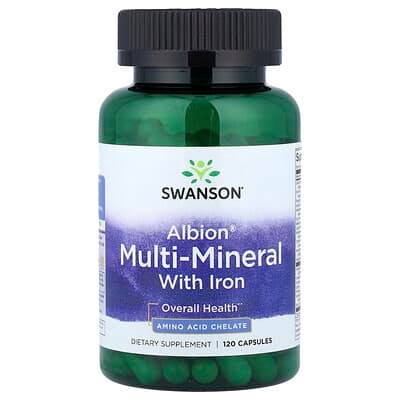
Albion Chelated Multi-Mineral

Goals
$9.89 $0.16 per serving

Product analysis
Albion Chelated Multi-Mineral offers several minerals to help fill dietary gaps, with zinc, selenium and iodine providing the clearest nutritional roles. It includes many additional ingredients, so the useful contribution depends on which nutrients you need.
AI assessment of the formula, label and price. How scoring works
Nutrient Quality48
Zinc glycinate is a favorable form, and the horsetail source is clearly identified. Quality remains uncertain for many other ingredients, while the selenium form offers a more modest quality profile.
Ingredient Transparency92
All listed ingredient amounts and most forms are disclosed. Missing forms for chlorella and the enzymes leave some preparations less easy to compare.
Value For Money58
Several key minerals offer favorable value, particularly iodine alongside zinc, selenium and iron. Value for many of the extra ingredients remains uncertain.
Customer Satisfaction78
Customer feedback is very positive across several hundred ratings. That gives useful satisfaction context without showing whether the minerals improve health.
Product Focus35
The strongest purpose is filling mineral gaps that affect normal immune, antioxidant and thyroid functions. The many added ingredients and wide range of intended uses make the formula less focused.
- Format
Capsule - Container
- 120 Capsule(s)
- Per serving
- $0.16
- Also available
 Albion Chelated Multi-Mineral without Iron$10.69
- Customer rating
- 4.7 · 648 ratings
Goals

Impact
High effect
Magnesium · 30 mgBoron · 4 mcgSelenium · 200 mcgZinc · 15 mg
Zinc and selenium contribute to normal immune and antioxidant functions, while iodine can help fill a gap relevant to thyroid health. These are nutritional contributions when intake is low, rather than established improvements above adequacy. Magnesium, calcium, iron and boron are present in amounts below the saved comparison thresholds; the chelated forms do not establish extra benefit.
How this product is rated for Everyday Health
Ingredient fit63
Zinc, Selenium, Iodine provide the main relevant contribution. The amounts provide mixed or partial contributions within the saved comparison.
Goal fit
Zinc, Selenium, Iodine are the relevant ingredients for the supplied general health findings.
Dose adequacy
The relevant declared amounts make partial or mixed contributions within the saved comparison; smaller amounts limit the contribution.
Pathways60
The strongest connection is to antioxidant and immune defence. The broader findings cover antioxidant and immune defence.
Depth
The strongest supplied connection is to antioxidant and immune defence.
Breadth
The findings cover antioxidant and immune defence, with other areas less supported or unrepresented.
Evidence82
The relevant nutrients have supported nutritional roles, with practical value in filling dietary gaps. Accepted preparations do not establish extra benefit or form superiority.
Evidence strength
The strongest supported contribution concerns nutrient availability when intake is low, rather than proven additional health outcomes with adequate intake.
Studied preparation
The relevant preparations match those accepted in the supplied findings; this does not establish superiority over other forms.
Formulation logic100
The relevant ingredients can contribute independently or have their listed partners, and no listed conflict was triggered. The retained amounts meet the comparison’s minimum threshold.
Partner coverage
The relevant ingredients can contribute independently or have their listed partners; no extra combined benefit is established.
Conflicts
No listed formulation conflict was triggered by the supplied ingredient and amount findings.
Effective doses
All ingredients retained in the supplied findings reach the comparison’s minimum amount threshold; that threshold is not a proven clinical dose.

Impact
High effect
Zinc · 15 mgIron · 4 mg
Zinc can help when low intake contributes to shedding, while selenium participates in antioxidant biology. Routine hair benefits from selenium remain uncertain, and excess can worsen hair loss. Iron is relevant to deficiency-related shedding, but its amount here received no independent contribution. Horsetail does not establish equivalence to the distinct silicon preparation studied in fine hair, and iodine’s thyroid role does not establish routine hair-loss treatment.
How this product is rated for Hair Health
Ingredient fit50
Hair-related ingredients sit within a broader formula containing actives aimed at other purposes. The recognized amounts provide partial support against the supplied comparison anchors; some are lower or unresolved.
Goal fit
Hair-related ingredients sit within a broader formula containing actives aimed at other purposes.
Dose adequacy
The recognized amounts provide partial support against the supplied comparison anchors; some are lower or unresolved.
Pathways55
The main recognized connection is follicle antioxidant protection, with limited certainty about actual hair outcomes.
Depth
The main recognized connection is follicle antioxidant protection, with limited certainty about actual hair outcomes.
Breadth
The recognized coverage is concentrated in one hair mechanism.
Evidence96
Zinc supplies the strongest recognized evidence contribution, with the ingredient-specific limitations described above.
Evidence strength
Zinc supplies the strongest recognized evidence contribution, with the ingredient-specific limitations described above.
Studied preparation
Iodine is not established as the preparation used in the relevant trials.
Formulation logic100
The recognized ingredients have no missing required partners or configured conflicts. Amount-based qualifications remain relevant.
Partner coverage
No missing required partner was identified among the recognized ingredients.
Conflicts
No configured ingredient conflict was identified; this is not a general safety finding.
Effective doses
The recognized ingredients meet the comparison’s minimum amount criterion, without establishing clinically effective hair-treatment doses.
Horsetail Not classified
No linked studies yet.

Impact
Moderate effect
Magnesium · 30 mgZinc · 15 mgBoron · 4 mcg
Zinc may help restore testosterone when low zinc is contributing to reduced levels. That makes its usefulness depend on a nutritional shortage, rather than taking extra to boost hormones when you already get enough. A zinc serving doesn't tell you whether testosterone is low or whether zinc is the cause.
How this product is rated for Testosterone Support
Ingredient fit43
Zinc may help restore testosterone when low zinc is contributing to reduced levels, without an increase when zinc is already adequate.
Goal fit
Zinc may help restore testosterone when low zinc is contributing to reduced levels, without an increase when zinc is already adequate.
Dose adequacy
Zinc provides 15 mg per serving; that amount alone doesn't show how much testosterone will change.
Pathways18
Zinc deficiency can reduce testosterone production, making nutritional need central to its relevance.
Depth
Zinc deficiency can reduce testosterone production, making nutritional need central to its relevance.
Breadth
The useful hormone connection is zinc replacement when needed, rather than multiple independent testosterone effects.
Evidence93
Zinc may help restore testosterone when low zinc is contributing to reduced levels, without an increase when zinc is already adequate.
Evidence strength
Zinc may help restore testosterone when low zinc is contributing to reduced levels, without an increase when zinc is already adequate.
Studied preparation
The zinc declaration is identifiable, without proving that this serving raises testosterone.
Formulation logic100
Zinc does not depend on a companion ingredient here. No particular ingredient conflict is identified.
Partner coverage
Zinc does not require another listed ingredient for its potential role here.
Conflicts
No particular conflict among the listed ingredients is identified.
Effective doses
Zinc provides 15 mg per serving; that amount alone doesn't show how much testosterone will change.

Impact
Moderate effect
Zinc · 15 mgCopper · 0.05 mgSelenium · 200 mcg
Zinc contributes to normal skin repair, while selenium supports antioxidant enzymes in skin. The saved findings emphasize the antioxidant aspect, but extra minerals have no established general skin benefit once needs are met. The small copper amount adds little to the assessed collagen contribution.
How this product is rated for Skin Health
Ingredient fit46
The relevant skin ingredients sit alongside ingredients serving other goals. The counted amounts provide partial overall dose support.
Goal fit
The relevant skin ingredients sit alongside ingredients serving other goals.
Dose adequacy
The counted amounts provide partial overall dose support.
Pathways43
Antioxidant support is the main assessed aspect.
Depth
Antioxidant support is the main assessed aspect.
Breadth
One skin aspect has substantial coverage, while support across other aspects remains limited.
Evidence83
Zinc provides the strongest evidence contribution in the saved findings, with the preparation and nutritional context affecting applicability. The counted ingredients match preparations represented in the supplied evidence.
Evidence strength
Zinc provides the strongest evidence contribution in the saved findings, with the preparation and nutritional context affecting applicability.
Studied preparation
The counted ingredients match preparations represented in the supplied evidence.
Formulation logic100
No required partner is missing and no assessed conflict was identified. All counted ingredients pass the saved minimum amount check, although their support differs.
Partner coverage
No required supporting partner is missing for the counted ingredients.
Conflicts
No assessed ingredient conflict was identified in the supplied findings.
Effective doses
All counted ingredients pass the saved minimum amount check, although their support differs.

Impact
High effect
Magnesium · 30 mgZinc · 15 mgSelenium · 200 mcg
Zinc and selenium supply nutrients involved in normal immune function. Iron can help address low intake that impairs immune-cell function, although the supplied context gives conflicting views on routine iron credit and does not establish extra benefit in adequately nourished adults. Copper is present in a small amount. The broader mineral formula does not establish infection prevention.
How this product is rated for Immunity
Ingredient fit47
The product has ingredients relevant to immunity, with the contribution limited by their available amounts and the wider formula.
Goal fit
The formula includes ingredients relevant to immunity alongside ingredients directed at other goals.
Dose adequacy
Some counted amounts are lower than the saved comparisons, or unavailable, limiting the amount-based contribution.
Pathways73
The saved findings describe a limited set of immune functions. These connections do not predict whether someone will develop an infection.
Depth
The strongest saved connection is oxidative and inflammatory balance. This describes the ingredient connection, not protection against infection.
Breadth
The saved findings cover lymphocyte function and immune regulation, oxidative and inflammatory balance, with less support across the remaining immune functions.
Evidence100
The ingredient findings must be read alongside their population and preparation limits; normal nutritional roles do not establish extra protection in adequately nourished adults.
Evidence strength
Zinc provides the strongest saved contribution; its supported role does not establish infection prevention.
Studied preparation
The saved findings accept the preparations of the counted ingredients with sufficient amounts; this does not establish that the complete formula was tested.
Formulation logic100
The saved formulation findings consider partners, ingredient conflicts and available amounts, without establishing synergy or overall safety.
Partner coverage
The counted ingredients do not require an additional partner for their saved contributions; this does not establish a combined benefit.
Conflicts
No configured ingredient conflict was found. This is not a broader safety assessment.
Effective doses
All counted ingredients reach the saved minimum amount threshold; this threshold is not proof of clinical effectiveness.

Ingredients
| Ingredient | Amount per serving | Score |
|---|---|---|
Calcium (TRAACS Calcium Glycinate Chelate) | 117.5 mg | |
Iron (TRAACS Ferrochel) | 4 mg | |
Phosphorus (Dicalcium Phosphate) | 27 mg | |
Iodine (Kelp) | 200 mcg | |
Magnesium (TRAACS Magnesium Lysyl Glycinate Chelate) | 30 mg | |
Zinc (TRAACS Zinc Glycinate Chelate) | 15 mg | |
Selenium (Albion Selenium Amino Acid Complex) | 200 mcg | |
Copper (TRAACS Copper Glycinate Chelate) | 0.05 mg | |
Manganese (TRAACS Manganese Bisglycinate Chelate) | 0.56 mg | |
Chromium (TRAACS Chromium Nicotinate Glycinate Chelate) | 12 mcg | |
Molybdenum (TRAACS Molybdenum Glycinate Chelate) | 12.5 mcg | |
Potassium (Albion Potassium Amino Acid Complex) | 72 mg | |
Horsetail grass stem extract (Silica) | 62 mg | |
Chlorella | 5 mg | |
Amylase | 3.32 mg | |
Lipase | 3.32 mg | |
Protease | 3.32 mg | |
Vanadium (TRAACS Vanadium Nicotinate Glycinate Chelate) | 15 mcg | |
Boron (Albion Bororganic Glycine) | 4 mcg |
Zinc (TRAACS Zinc Glycinate Chelate) · 15 mg OverallScore82
The serving provides 15 mg of zinc as zinc bisglycinate. The serving also has 0.05 mg of copper, much less than its zinc amount.
How this ingredient is rated
Active Ingredient Quality & Bioavailability100
The named source is zinc bisglycinate.
Zinc Form Bioavailability
The named source is zinc bisglycinate.
Dose, Safety & Label Transparency64
The serving declares 15 mg of zinc. It also provides 0.05 mg of copper.
Elemental Dose Transparency
The elemental zinc amount and its source are stated; the serving contains 15 mg of zinc.
Zinc Dosage Safety & Effectiveness
The declared amount is 15 mg zinc per serving.
Zinc-to-Copper Mineral Balance
The same serving contains 0.05 mg copper, much less than its 15 mg zinc; other sources also contribute to intake.
Value80
A whole-product serving costs about $0.16 and contains 15 mg of zinc.
Price Per Serving Efficiency
A whole-product serving costs about $0.16 and contains 15 mg of zinc.
Iodine (Kelp) · 200 mcg OverallScore74
Each serving lists 200 mcg of iodine, but its chemical form is unknown. The missing form makes its absorption harder to assess from the saved information.
How this ingredient is rated
Active Ingredient Quality & Bioavailability34
The chemical form of iodine is unknown, leaving its absorption characteristics unclear. Marine sourcing is recorded without qualifying sourcing details.
Iodine Form & Bioavailability
The iodine chemical form is unspecified, so its absorption cannot be assessed from the saved information.
Marine Source Purity & Sourcing
A marine source is recorded, but qualifying organic or geographic sourcing claims are not available in the saved facts; this does not establish contamination.
Dose, Safety & Label Transparency100
The stated serving supplies 200 mcg of iodine. The amount is assessed favorably for daily iodine support.
Dosage Efficacy for Daily Support
The 200 mcg per serving is assessed favorably for daily iodine support.
Dosage Safety & Upper Limits
The amount in one serving does not trigger the assessment’s high-iodine caution; total intake from all sources is unknown.
Elemental Iodine Transparency
The amount of iodine is stated as 200 mcg per serving.
Value100
A whole-product serving costs about $0.16, covering all its ingredients.
Price Per Effective Serving
The price is about $0.16 per whole-product serving.
Selenium (Albion Selenium Amino Acid Complex) · 200 mcg OverallScore77
A serving provides 200 mcg of selenium, the amount favored by the evaluation for targeted support. The estimated cost is about $0.16 per 200 mcg of selenium, based on the whole-product serving price.
How this ingredient is rated
Active Ingredient Quality & Bioavailability53
A selenium amino acid complex is identified, but its specific chemical identity is unresolved.
Selenium Chemical Form
A selenium amino acid complex is named without a more specific compound identified.
Form Transparency & Isomer Specificity
The disclosure identifies a complex but not a more specific selenium compound.
Dose, Safety & Label Transparency100
A serving provides 200 mcg of selenium, the amount favored by the evaluation for targeted support. The amount is below the upper limit used in the evaluation.
Dosage Efficacy Sweet Spot
The 200 mcg serving matches the amount favored by the evaluation for targeted support.
Safety Margin & UL Adherence
The 200 mcg serving is below the upper limit used in the evaluation, leaving a margin for selenium from other sources.
Value80
The estimated cost is about $0.16 per 200 mcg of selenium, based on the whole-product serving price.
Price per 200 mcg Serving
The estimated cost is about $0.16 per 200 mcg of selenium, based on the whole-product serving price.
Alternative products
Report alternatives
Sources
Published studies used for the product analysis and the top-ranked studies for each ingredient and goal.
- Association of radioactive iodine treatment with survivorship symptoms and primary care utilisation in women of reproductive age with thyroid cancer: a retrospective cohort study.
- Energy level and fatigue after surgery for thyroid cancer: A population-based study of patient-reported outcomes.
- Health-Related Quality of Life in Differentiated Thyroid Cancer Survivors: A Cross-Sectional Study From Turkey.
- Large-dose intravenous ferric carboxymaltose injection for iron deficiency anemia in heavy uterine bleeding: a randomized, controlled trial.
- The Effect of Parenteral or Oral Iron Supplementation on Fatigue, Sleep, Quality of Life and Restless Legs Syndrome in Iron-Deficient Blood Donors: A Secondary Analysis of the IronWoMan RCT.
- Ferric carboxymaltose vs. oral iron in the treatment of pregnant women with iron deficiency anemia: an international, open-label, randomized controlled trial (FER-ASAP).
- Effect of iron therapy on fatigue symptoms in non-anaemic iron deficient women of reproductive age- A Randomized Controlled Trial.
- Intravenous iron isomaltoside treatment of women suffering from severe fatigue after postpartum hemorrhage.
- Magnesium-L-threonate improves sleep quality and daytime functioning in adults with self-reported sleep problems: A randomized controlled trial.
- Total magnesium intake and risk of frailty in older women.
- Red blood cell magnesium and chronic fatigue syndrome.
- Exercise, magnesium and immune function.
- [Efficacy of potassium N-acetylaminosuccinate (Cogitum) in the treatment of asthenic syndrome: results of double-blind placebo-controlled trial].
- Human resting energy expenditure in relation to dietary potassium.
- Vanadium exposure-induced neurobehavioral alterations among Chinese workers.
- A cross-sectional analysis of air pollution in primary schools and children fatigue.
- Effects of boron supplementation on the severity and duration of pain in primary dysmenorrhea.
- Efficacy and safety of tavaborole topical solution, 5%, a novel boron-based antifungal agent, for the treatment of toenail onychomycosis: Results from 2 randomized phase-III studies.
- The efficacy and safety of tavaborole, a novel, boron-based pharmaceutical agent: phase 2 studies conducted for the topical treatment of toenail onychomycosis.
- Boron neutron capture therapy (BNCT) for glioblastoma multiforme: a phase II study evaluating a prolonged high-dose of boronophenylalanine (BPA).