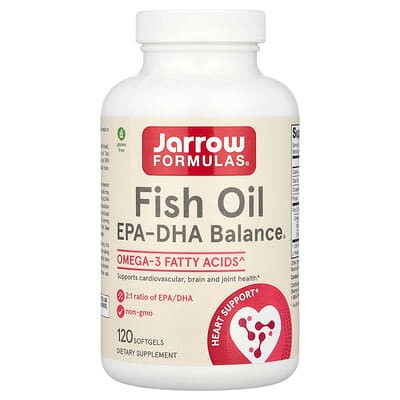
EPA-DHA Balance

EPA-DHA Balance

Jarrow Formulas4.8 (17,353 ratings)
Format:Softgel Quantity: 120 Softgel(s) · 60 servings
Goals

Product analysis

53 out of 100

EPA-DHA Balance supplies omega-3 fats that may help lower triglycerides and offer modest joint support in some circumstances. Its unclear oil-form details make comparison of preparations harder.

AI assessment of the formula, label and price. How scoring works

Nutrient Quality20

EPA and DHA are identified, but their exact forms are not clearly disclosed. That leaves uncertainty about the oil preparation and how readily the body can use it.

Ingredient Transparency70

The EPA and DHA amounts and their composition are disclosed. Their exact forms are not, so active quantities are easier to compare than preparations.

Value For Money42

Value is moderate for EPA and less favourable for DHA. The full serving cost is therefore harder to justify if DHA is the main reason for buying.

Customer Satisfaction93

Customer feedback is very positive across many thousands of ratings. The broad review base supports confidence in satisfaction, without proving heart or joint benefits.

Product Focus70

The clearest role concerns EPA and DHA support for blood-fat levels, especially triglycerides. Wider expectations for skin, immediate focus or metabolism are less dependable.
Format
Softgel
Container
120 Softgel(s)
Per serving
$0.81
Customer rating
4.8 · 17,353 ratings
Report analysis

Goals

Impact
Highest effect
B+ Ingredient FitC PathwaysA+ EvidenceA+ Formulation Logic
EPA (Eicosapentaenoic Acid) · 800 mg

Declared EPA and DHA provide a limited connection to triglyceride and vascular markers. The 800 mg EPA serving leads the saved result; the two DHA identities refer to the same declaration and should not be counted twice. Fish oil mass does not add another active contribution or establish synergy. Routine supplementation does not inherit the cardiovascular-event benefits of prescription purified EPA in selected high-risk patients.

How this product is rated for Heart Health

Ingredient fit84

EPA and DHA account for the relevant ingredient findings. Their amounts receive partial comparison recognition overall.
Goal fit
EPA and DHA provide the relevant connections; the saved focus also reflects other ingredients and linked uses.
Dose adequacy
Amount recognition is partial overall, reflecting the supplied quantities and preparation-specific comparisons.

Pathways60

The strongest saved connection is triglyceride metabolism. Coverage reaches the threshold in one pathway.
Depth
The strongest saved contribution concerns triglyceride metabolism; this mechanism or marker does not itself establish prevention of cardiovascular events.
Breadth
Only triglyceride metabolism reached the tracked coverage threshold.

Evidence100

EPA leads the recognised evidence contribution. The included preparations receive recognition, subject to the specific clinical limitations.
Evidence strength
EPA provides the strongest recognised evidence contribution, with the population and outcome limitations described for that ingredient.
Studied preparation
The included preparations receive recognition in the saved comparison, without establishing broader preventive effects.

Formulation logic100

Included ingredients meet the saved amount threshold and lack no required partners. No configured conflict was identified.
Partner coverage
No required partner is missing for the included ingredients.
Conflicts
No configured conflict was identified in the supplied facts.
Effective doses
All included ingredients reach the saved amount threshold; this is a comparison threshold rather than a proven clinically effective dose.
Study evidence
Cardiovascular Support
Impact
Highest effect
B+ Ingredient FitC PathwaysB+ EvidenceA+ Formulation Logic
Fish Oil · 2000 mg

EPA and DHA can lower triglycerides, which is the main cardiovascular role supported here. The separately declared active amounts receive recognition, but total oil weight is not an additional active dose. Trials used particular exposures and populations, so the recorded triglyceride contribution does not demonstrate prevention of cardiovascular events or improved heart rhythm.

How this product is rated for Cardiovascular Support

Ingredient fit81

The formula contains ingredients relevant to skin nutrition. Their amounts and the presence of other actives determine how focused this finding is.
Goal fit
Relevant ingredients sit within a broader formula containing other actives, which limits its focus on this goal.
Dose adequacy
The disclosed amounts provide partial support; smaller or unresolved quantities limit the amount finding.

Pathways60

The strongest recorded coverage concerns triglyceride metabolism; this is a mechanism finding, not proof of fewer cardiovascular events.
Depth
The strongest recorded coverage concerns triglyceride metabolism; this is a mechanism finding, not proof of fewer cardiovascular events.
Breadth
One cardiovascular mechanism reaches the coverage threshold, with limited coverage of the others.

Evidence83

EPA declared active provides the strongest recognized evidence contribution, subject to the ingredient-specific population and preparation limits.
Evidence strength
EPA declared active provides the strongest recognized evidence contribution, subject to the ingredient-specific population and preparation limits.
Studied preparation
The saved result accepts the relevant preparations, although this does not establish that the finished product matches a skin trial.

Formulation logic100

The included ingredients have no recorded missing partners or configured conflicts. Amount limitations are retained separately.
Partner coverage
No missing required ingredient partner limits the saved finding; this does not establish an added combination benefit.
Conflicts
No configured ingredient conflict was identified in the supplied evaluation.
Effective doses
All ingredients included in this finding meet the saved minimum amount threshold, without proving a clinical response.
Study evidence
Fish Oil Supportive 185 studies
Inflammation
Impact
High effect
C Ingredient FitD- PathwaysC+ EvidenceA+ Formulation Logic
Fish Oil · 2000 mg

EPA and DHA can influence inflammatory fatty-acid mediators, with supplied human analyses reporting lower inflammatory markers. Their separate declarations receive recognition here and are not pooled into a guessed combined fish-oil dose. The generic fish-oil active amount remains unresolved. These findings do not establish a routine clinical anti-inflammatory benefit from this serving.

How this product is rated for Inflammation

Ingredient fit65

The formula includes relevant nutrients alongside broader ingredients. Unresolved declarations and small amounts limit how closely some ingredients match the supplied comparisons.
Goal fit
The relevant ingredient declarations form a focused comparison for this goal, although clinical applicability remains limited.
Dose adequacy
Declared amounts only partly match the supplied comparisons; unresolved active quantities cannot establish adequacy.

Pathways40

EPA and DHA provide the strongest assigned route through inflammatory fatty-acid mediators.
Depth
EPA and DHA provide the strongest assigned route through inflammatory fatty-acid mediators.
Breadth
Only one assigned route reaches the supplied coverage criterion, leaving limited breadth.

Evidence70

EPA leads the saved evidence finding, with supplied human analyses reporting changes in inflammatory markers.
Evidence strength
EPA leads the saved evidence finding, with supplied human analyses reporting changes in inflammatory markers.
Studied preparation
The supplied comparison accepts the relevant preparations; this does not establish equivalence of every formulation or a matching daily regimen.

Formulation logic100

No listed conflict or missing required partner is identified. Amount comparisons do not demonstrate an added benefit from combining ingredients.
Partner coverage
No required partner is missing among the recognized ingredients; this does not establish synergy.
Conflicts
No listed conflict is triggered by the supplied ingredient and amount facts.
Effective doses
All recognized ingredients meet the minimum amount comparison, which is not a proven biological threshold.
Study evidence
Fish Oil Supportive 68 studies
Skin Health
Impact
High effect
A Ingredient FitD PathwaysB EvidenceA+ Formulation Logic
Omega-3 · 1200 mg

Omega-3 supplies fatty acids, but the generic identity does not establish routine skin improvement. Specific purified-EPA UV-challenge findings cannot be transferred to this fish-oil formulation. The fish-oil material amount is not an additional omega-3 dose.

How this product is rated for Skin Health

Ingredient fit92

Omega-3 provides the recognized skin connections. The declared counted amounts receive full recognition.
Goal fit
The recognized ingredients provide a focused skin connection, with links to other goals also affecting focus.
Dose adequacy
The counted amounts receive full recognition; this does not establish greater cosmetic benefit from larger supplement amounts.

Pathways50

The strongest recognized coverage concerns epidermal barrier lipids. Coverage is concentrated in one area.
Depth
Epidermal barrier lipids is the strongest recognized area; the supplied ingredient limitations still constrain practical expectations.
Breadth
One area meets the supplied coverage requirement, leaving limited breadth across other skin outcomes.

Evidence78

Omega-3 leads the saved evidence finding. Preparation, population and outcome limitations constrain transfer to routine skin benefits.
Evidence strength
Omega-3 has the strongest recognized evidence among the counted ingredients; its specific limitations determine which skin benefits can be described.
Studied preparation
The saved findings recognize the counted preparations; that does not resolve the supplied context's composition, population or outcome limitations.

Formulation logic100

No required partner is missing and no assessed conflict is recorded among the counted ingredients.
Partner coverage
The counted ingredients do not require an additional missing partner; no extra combination benefit is established.
Conflicts
No assessed conflict is recorded; this does not establish comprehensive interaction testing.
Effective doses
All counted ingredients meet the saved minimum amount criterion, which is not proof of a clinically effective cosmetic dose.
Study evidence
Omega-3 Supportive 35 studies
Joint Health
Impact
High effect
B- Ingredient FitF PathwaysC+ EvidenceA+ Formulation Logic
Omega-3 · 1200 mg

Omega-3 fatty acids, including EPA and DHA, may provide small improvements in joint pain, stiffness or function in some inflammatory-joint and osteoarthritis settings. Findings are mixed, with important large trials showing no benefit. The evidence concerns sustained study regimens, so a label serving does not establish the same exposure or outcome, and it does not show cartilage repair or prevention.

How this product is rated for Joint Health

Ingredient fit74

Omega-3, EPA and DHA supply focused joint-related contributions.
Goal fit
Omega-3, EPA and DHA supply focused joint-related contributions.
Dose adequacy
The known fatty-acid amounts provide partial contributions.

Pathways20

Inflammation control receives the strongest saved coverage. Inflammation control has limited coverage below the saved breadth criterion.
Depth
Inflammation control receives the strongest saved coverage; this does not establish structural repair.
Breadth
Inflammation control has limited coverage below the saved breadth criterion.

Evidence69

Omega-3 anchors the saved evidence finding, with population, regimen and preparation limits on expected symptom benefit.
Evidence strength
Omega-3 anchors the saved evidence finding; the supplied clinical limitations remain relevant.
Studied preparation
The counted preparations are accepted in the saved finding; this does not establish identical clinical effects across products.

Formulation logic100

The counted ingredients work independently or have their required partner; no configured conflict was found.
Partner coverage
The counted ingredients work independently or have their required partner; no extra combination benefit is established.
Conflicts
No configured ingredient conflict was found.
Effective doses
All 3 counted ingredients provide meaningful amounts under the saved criteria.
Study evidence
Omega-3 Supportive 40 studies
Metabolism Support
Impact
Moderate effect
D+ Ingredient FitD- PathwaysA- EvidenceA+ Formulation Logic
Omega-3 · 1200 mg

Whether omega-3 raises your resting calorie use is unclear for adults in general. Possible effects have varied between different groups of people, so they don't translate into a dependable metabolism boost from this serving. Changes in insulin-related processes are also different from an increase in whole-body energy expenditure.

How this product is rated for Metabolism Support

Ingredient fit51

Omega-3 has an uncertain effect on resting energy use across adults.
Goal fit
Omega-3 has an uncertain effect on resting energy use across adults.
Dose adequacy
The serving provides Omega-3 1200 mg. These amounts alone don't predict an increase in calorie burning.

Pathways42

The relevant connection is stimulation of energy use, with the size and persistence of any effect uncertain.
Depth
The relevant connection is stimulation of energy use, with the size and persistence of any effect uncertain.
Breadth
The connection is limited to stimulation of energy use, rather than several distinct effects on calorie burning.

Evidence89

Omega-3 has an uncertain effect on resting energy use across adults.
Evidence strength
Omega-3 has an uncertain effect on resting energy use across adults.
Studied preparation
The declared ingredient forms match the relevant preparation descriptions; this alone does not predict the size of a benefit.

Formulation logic100

No particular ingredient conflict or missing required partner is identified.
Partner coverage
No required companion ingredient is missing for the ingredient roles described here.
Conflicts
No particular ingredient conflict is identified.
Effective doses
Declared amounts allow comparison, but a dose reference is not a minimum effective amount for increasing calorie burning.
Study evidence
Omega-3 Supportive 42 studies
Mental Focus
Impact
High effect
B- Ingredient FitC- PathwaysC- EvidenceA+ Formulation Logic

DHA contributes to brain membrane structure, while EPA and DHA have been studied with repeated omega-3 intake. The supplied evidence does not establish an immediate improvement in concentration from this serving. Positive DHA findings involved people with low intake taking it for months, and broader long-term omega-3 findings were not consistently positive. These distinctions limit what can be expected for acute mental focus.

How this product is rated for Mental Focus

Ingredient fit70

The serving has focus-related ingredients, with amount suitability and broader-purpose ingredients assessed separately.
Goal fit
The formula includes ingredients for other purposes, so its focus-related contribution is less concentrated.
Dose adequacy
The declared serving receives partial amount credit; matching an amount reference does not establish an effective dose for acute focus.

Pathways58

The saved mechanism finding is concentrated in the roles described below. Mechanism coverage does not establish clinical improvement.
Depth
The strongest mapped role is synaptic plasticity and neuroprotection; this describes the saved mechanism finding rather than a demonstrated clinical effect.
Breadth
Only one assessed route reaches the saved coverage threshold, so the mapped contribution remains narrow.

Evidence56

The strongest saved evidence finding and preparation matches are described separately. Scientific limitations still determine which focus benefits can be claimed.
Evidence strength
EPA leads the saved evidence finding, although omega-3 evidence does not establish acute concentration improvement.
Studied preparation
DHA (Docosahexaenoic Acid) does not match the saved studied-preparation requirement; the other qualifying ingredients do. This limits transfer of preparation-specific findings.

Formulation logic100

Partner requirements, recorded conflicts and minimum amounts shape the saved formulation finding.
Partner coverage
The saved partner check finds no missing required partner among the credited ingredients.
Conflicts
No configured conflict was recorded in the supplied facts; this is not a general safety assessment.
Effective doses
All credited ingredients meet the saved minimum amount threshold; that threshold does not prove a clinically effective focus dose.
Study evidence

Ingredients

IngredientAmount per servingScore
Calories
20 Calorie(s)
Total Fat
2 Gram(s)
Fish Oil concentrate
2000 mg 63
Omega-3 Fatty Acids
1200 mg 62
Eicosapentaenoic Acid
800 mg 70
Docosahexaenoic Acid
400 mg 59
Gluten Free Adults 18–50
Report overview
C- Active Ingredient Quality & BioavailabilityA Dose, Safety & Label TransparencyD+ Value
A serving supplies 800 mg of EPA alongside 400 mg of DHA, giving it an EPA emphasis. The oil is described as purified, although its molecular form is unresolved in the available facts.
How this ingredient is rated

Active Ingredient Quality & Bioavailability58

EPA accounts for 40% of the fish oil.
Molecular Form and Bioavailability
The molecular form of the EPA oil is not established in the available facts.
EPA Concentration Density
EPA accounts for 40% of the declared fish oil amount.
Oxidation Protection
Tocopherol is recorded as an antioxidant in the formula.

Dose, Safety & Label Transparency92

A serving has 800 mg of EPA and 400 mg of DHA. The oil is described as purified.
Absolute EPA Dose per Serving
A serving provides 800 mg of EPA.
EPA-Centric Ratio
The serving has more EPA than DHA.
Purity and Contaminant Testing
The oil is described as purified; no third-party contaminant-testing claim is recorded.

Value50

The whole-product cost is about $1.02 per gram of EPA.
Price per Gram of EPA
The whole-product cost is about $1.02 per gram of EPA.
Omega-3 · 1200 mg OverallScore62
D+ Active Ingredient Quality & BioavailabilityC Dose, Safety & Label TransparencyB+ Value
A serving of two softgels lists 800 mg EPA and 400 mg DHA. Together they make up about 60% of the 2,000 mg of oil and cost about $0.68 per gram.
How this ingredient is rated

Active Ingredient Quality & Bioavailability52

The omega-3's molecular form is not established in the saved facts. An antioxidant is also recorded.
Molecular Form & Absorption Potential
EPA and DHA are identified, but the omega-3's molecular form is not established in the saved facts.
Source Purity & Oxidative Protection
An antioxidant is recorded, although its identity and more specific source details are not given in the saved facts.

Dose, Safety & Label Transparency64

EPA and DHA are listed separately and account for about 60% of the stated oil amount. A testing claim is recorded without an established qualifying certification or available analysis certificate.
EPA & DHA Label Specificity
A serving of two softgels lists 800 mg EPA and 400 mg DHA separately.
Active Ingredient Concentration
EPA and DHA together make up about 60% of the 2,000 mg of oil per serving.
Third-Party Purity Verification
A testing claim is recorded, but a qualifying certification or available analysis certificate is not established in the saved facts.

Value80

A whole-product serving costs about $0.82 and provides 1,200 mg of EPA plus DHA.
Price per 1000mg of EPA+DHA
At the listed price, EPA plus DHA costs about $0.68 per gram, based on the labeled serving.
Fish Oil · 2000 mg OverallScore63
D- Active Ingredient Quality & BioavailabilityA- Dose, Safety & Label TransparencyD+ Value
Each serving provides 800 mg of EPA and 400 mg of DHA from 2,000 mg of fish oil. At the whole-product serving price, that works out to about $0.68 per gram of EPA and DHA combined.
How this ingredient is rated

Active Ingredient Quality & Bioavailability44

The molecular form is not established in the saved facts. The evaluation records a specific purification method, although its name is not in the saved facts.
Omega-3 Molecular Form
The molecular form is not established in the saved facts.
Purification & Filtration Method
The evaluation records a specific purification method, although its name is not in the saved facts.
Third-Party Purity & Potency Verification
The saved facts do not record an independent-testing claim.
Source & Sustainability
The evaluation recognizes a fish source that meets its sourcing criteria.

Dose, Safety & Label Transparency88

A serving provides 1,200 mg of EPA and DHA combined. EPA and DHA together account for about 60% of the 2,000 mg of fish oil per serving. A qualifying antioxidant is recorded.
Total Active Omega-3 Dose (EPA + DHA)
A serving provides 1,200 mg of EPA and DHA combined.
Omega-3 Potency & Concentration
EPA and DHA together account for about 60% of the 2,000 mg of fish oil per serving.
EPA & DHA Individual Disclosure
EPA and DHA are listed separately at 800 mg and 400 mg per serving, respectively.
Oxidation Protection (Stabilizers)
The evaluation records a qualifying antioxidant, though its identity is not specified in the saved facts.

Value50

The whole-product serving price works out to about $0.68 per gram of EPA and DHA combined.
Cost Per Gram of Active EPA + DHA
The whole-product serving price works out to about $0.68 per gram of EPA and DHA combined.
Report alternatives

Sources

Published studies used for the product analysis and the top-ranked studies for each ingredient and goal.

  1. Marine Omega-3 Supplementation and Cardiovascular Disease: An Updated Meta-Analysis of 13 Randomized Controlled Trials Involving 127 477 Participants.
    Hu Y; Hu FB; Manson JE · Journal of the American Heart Association · 2020
    Meta-analysis127,477 participants13 studies pooledCardiovascular Support forFish Oil
  2. Impact of omega-3 fatty acids on hypertriglyceridemia, lipidomics, and gut microbiome in patients with type 2 diabetes.
    Lu J; Liu R; Ren H; Wang S; Hu C; Shi Z; Li M; Liu W; Wan Q; Su Q; Li Q; Zheng H; Qu S; Yang F; Ji H; Lin H; Qi H; Wu X; Wu K; Chen Y; Xu Y; Xu M; Wang T; Zheng J; Ning G; Zheng R; Bi Y; Zhong H; Wang W · Med (New York, N.Y.) · 2025
    Randomized trial309 participantsCardiovascular Support forFish Oil
  3. A systematic review of fish-oil supplements for the prevention and treatment of hypertension.
    Campbell F; Dickinson HO; Critchley JA; Ford GA; Bradburn M · European journal of preventive cardiology · 2013
    Meta-analysis1,524 participants17 studies pooledCardiovascular Support forFish Oil
  4. Effects of fish oil-derived fatty acids on suboptimal cardiovascular health: A multicenter, randomized, double-blind, placebo-controlled trial.
    Zeng Q; Dong SY; Liu YP; Fu J; Shuai P; Zhao ZM; Li TX · Nutrition, metabolism, and cardiovascular diseases : NMCD · 2017
    Randomized trial422 participantsCardiovascular Support forFish Oil
  5. Effect of High-Dose Marine Omega-3 Fatty Acids on Atherosclerosis: A Systematic Review and Meta-Analysis of Randomized Clinical Trials.
    Sekikawa A; Cui C; Sugiyama D; Fabio A; Harris WS; Zhang X · Nutrients · 2020
    Meta-analysis6 studies pooledCardiovascular Support forFish Oil
  6. Effects of eicosapentaenoic acid on major coronary events in hypercholesterolaemic patients (JELIS): a randomised open-label, blinded endpoint analysis.
    Yokoyama M; Origasa H; Matsuzaki M; Matsuzawa Y; Saito Y; Ishikawa Y; Oikawa S; Sasaki J; Hishida H; Itakura H; Kita T; Kitabatake A; Nakaya N; Sakata T; Shimada K; Shirato K; Japan EPA lipid intervention study (JELIS) Investigators · Lancet (London, England) · 2007
    Randomized trial18,645 participantsHeart Health forEPA (Eicosapentaenoic Acid)
  7. Effects of EPA on coronary artery disease in hypercholesterolemic patients with multiple risk factors: sub-analysis of primary prevention cases from the Japan EPA Lipid Intervention Study (JELIS).
    Saito Y; Yokoyama M; Origasa H; Matsuzaki M; Matsuzawa Y; Ishikawa Y; Oikawa S; Sasaki J; Hishida H; Itakura H; Kita T; Kitabatake A; Nakaya N; Sakata T; Shimada K; Shirato K; JELIS Investigators, Japan · Atherosclerosis · 2008
    Randomized trial14,981 participantsHeart Health forEPA (Eicosapentaenoic Acid)
  8. Effects of omega-3 fatty acids on coronary revascularization and cardiovascular events: a meta-analysis.
    Dinu M; Sofi F; Lotti S; Colombini B; Mattioli AV; Catapano AL; Casula M; Baragetti A; Wong ND; Steg PG; Ambrosio G · European journal of preventive cardiology · 2024
    Meta-analysis134,144 participants18 studies pooledHeart Health forEPA (Eicosapentaenoic Acid)
  9. Incremental effects of eicosapentaenoic acid on cardiovascular events in statin-treated patients with coronary artery disease.
    Matsuzaki M; Yokoyama M; Saito Y; Origasa H; Ishikawa Y; Oikawa S; Sasaki J; Hishida H; Itakura H; Kita T; Kitabatake A; Nakaya N; Sakata T; Shimada K; Shirato K; Matsuzawa Y; JELIS Investigators · Circulation journal : official journal of the Japanese Circulation Society · 2009
    Randomized trialHeart Health forEPA (Eicosapentaenoic Acid)
  10. Omega-3 Fatty Acids for the Management of Hypertriglyceridemia: A Science Advisory From the American Heart Association.
    Skulas-Ray AC; Wilson PWF; Harris WS; Brinton EA; Kris-Etherton PM; Richter CK; Jacobson TA; Engler MB; Miller M; Robinson JG; Blum CB; Rodriguez-Leyva D; de Ferranti SD; Welty FK; American Heart Association Council on Arteriosclerosis, Thrombosis and Vascular Biology; Council on Lifestyle and Cardiometabolic Health; Council on Cardiovascular Disease in the Young; Council on Cardiovascular and Stroke Nursing; and Council on Clinical Cardiology · Circulation · 2020
    OtherHeart Health forEPA (Eicosapentaenoic Acid)
  11. Dose-dependent effects of fish oil on cardio-metabolic biomarkers in healthy middle-aged and elderly Chinese people: a double-blind randomized controlled trial.
    Song J; Hu M; Li C; Yang B; Ding Q; Wang C; Mao L · Food & function · 2018
    Randomized trial201 participantsInflammation forFish Oil
  12. Eicosapentaenoic acid supplementation alleviates pruritus, enhances skin moisture, and mitigates depression in maintenance hemodialysis patients.
    Lin YL; Wang CL; Chiang TI · Frontiers in nephrology · 2024
    Randomized trial60 participantsInflammation forFish Oil
  13. Lowering effects of fish oil supplementation on proinflammatory markers in hypertension: results from a randomized controlled trial.
    Yang B; Ren XL; Li ZH; Shi MQ; Ding F; Su KP; Guo XJ; Li D · Food & function · 2020
    Randomized trial77 participantsInflammation forFish Oil
  14. The effects of ω-3 fish oil emulsion-based parenteral nutrition plus combination treatment for acute paraquat poisoning.
    Meng Z; Dong Y; Gao H; Yao D; Gong Y; Meng Q; Zheng T; Cui X; Su X; Tian Y · The Journal of international medical research · 2019
    Randomized trial174 participantsInflammation forFish Oil
  15. Effects of Omega-3 Fatty Acid Intake in Patients Undergoing Dialysis: A Systematic Review and Meta-Analysis of Randomized Controlled Trials.
    Liu R; Jiang J; Fu Z; Liu C; Yao L; Quan H · Journal of the American Nutrition Association · 2022
    Meta-analysis49 studies pooledInflammation forFish Oil
  16. Supplementation of fish oil and olive oil in patients with rheumatoid arthritis.
    Berbert AA; Kondo CR; Almendra CL; Matsuo T; Dichi I · Nutrition (Burbank, Los Angeles County, Calif.) · 2005
    Randomized trial43 participantsJoint Health forOmega-3
  17. Krill oil improved osteoarthritic knee pain in adults with mild to moderate knee osteoarthritis: a 6-month multicenter, randomized, double-blind, placebo-controlled trial.
    Stonehouse W; Benassi-Evans B; Bednarz J; Vincent AD; Hall S; Hill CL · The American journal of clinical nutrition · 2022
    Randomized trial235 participantsJoint Health forOmega-3
  18. Effects of omega-3 supplementation on lipid metabolism, inflammation, and disease activity in rheumatoid arthritis: a meta-analysis of randomized controlled trials.
    Wang W; Xu Y; Zhou J; Zang Y · Clinical rheumatology · 2024
    Meta-analysis1,018 participants18 studies pooledJoint Health forOmega-3
  19. Impact of type and dose of oral polyunsaturated fatty acid supplementation on disease activity in inflammatory rheumatic diseases: a systematic literature review and meta-analysis.
    Sigaux J; Mathieu S; Nguyen Y; Sanchez P; Letarouilly JG; Soubrier M; Czernichow S; Flipo RM; Sellam J; Daïen C · Arthritis research & therapy · 2022
    Meta-analysis1,420 participants30 studies pooledJoint Health forOmega-3
  20. A meta-analysis of the analgesic effects of omega-3 polyunsaturated fatty acid supplementation for inflammatory joint pain.
    Goldberg RJ; Katz J · Pain · 2007
    Meta-analysis17 studies pooledJoint Health forOmega-3