
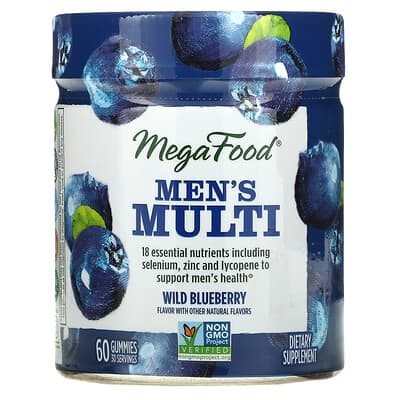

$14.93 $0.49 per serving


Product analysis
Men's Multi Wild Blueberry may help fill nutrient gaps that affect everyday health, immune function and bone support. The clearest benefits come from meeting nutritional needs, with less convincing support for its broader heart-related aims.
AI assessment of the formula, label and price. How scoring works
Nutrient Quality37
The nutrient forms vary in quality, with molybdenum a more favorable choice and vitamin K and selenium less favorable choices. Most other ingredients lack enough quality information for a confident comparison.
Ingredient Transparency93
Amounts and most nutrient forms are disclosed, making the formula fairly easy to compare. A few entries still lack form details.
Value For Money39
Value is mixed: vitamin K and molybdenum look more favorable, while selenium and lycopene appear expensive for the amounts provided. Most other nutrients lack enough price information for a firm comparison of the whole formula.
Customer Satisfaction74
Buyer ratings are positive across a moderate number of reviews. That suggests general satisfaction, while leaving effectiveness and safety to other evidence.
Product Focus41
The formula fits broad nutritional support, with its clearest role in everyday health, immunity and bone support. Its many ingredients span several aims, while the broader heart-related benefits are less clear.
- Format
Gummy - Container
- 60 Gummy(ies)
- Per serving
- $0.49
- Customer rating
- 4.7 · 224 ratings
Goals

Impact
High effect
Vitamin C · 90 mgZinc · 6 mgVitamin A · 600 mcg RAEVitamin D · 25 mcgSelenium · 55 mcg
Zinc, Vitamin D and Selenium contribute to normal immune function, without establishing extra protection when intake is adequate. Vitamin A supports normal immune and barrier functions when intake is low. Folate, Vitamin B6 and Vitamin B12 can help fill dietary gaps that impair immune-cell function.
How this product is rated for Immunity
Ingredient fit56
Lower or unavailable amounts limit the contribution compared with the saved references.
Goal fit
The formula includes immunity-related ingredients alongside ingredients directed at other goals.
Dose adequacy
Lower or unavailable amounts limit the contribution compared with the saved references.
Pathways66
The strongest saved connection is lymphocyte function and immune regulation, rather than a direct measure of infection protection.
Depth
The strongest saved connection is lymphocyte function and immune regulation, rather than a direct measure of infection protection.
Breadth
The saved findings cover lymphocyte function and immune regulation, oxidative and inflammatory balance.
Evidence100
Vitamin D provides the leading saved contribution; its supported role does not establish infection prevention.
Evidence strength
Vitamin D provides the leading saved contribution; its supported role does not establish infection prevention.
Studied preparation
The saved findings accept the preparations with sufficient amounts; this does not establish testing of the complete formula.
Formulation logic100
All counted ingredients reach the saved minimum amount threshold, which is not proof of clinical effectiveness.
Partner coverage
The counted ingredients can contribute without an additional partner; this does not establish synergy.
Conflicts
No configured ingredient conflict was identified.
Effective doses
All counted ingredients reach the saved minimum amount threshold, which is not proof of clinical effectiveness.

Impact
Highest effect
Folate · 300 mcg DFEVitamin B12 · 6 mcgVitamin D · 25 mcgVitamin K · 90 mcgSelenium · 55 mcgZinc · 6 mgVitamin C · 90 mg
B vitamins and folate contribute to normal metabolism and blood formation, while vitamins D and K contribute to mineral nutrition. Selenium supplies a nutrient used in antioxidant enzymes, with no established additional benefit when selenium intake is adequate. The folate declaration in mcg DFE is separate from its folic-acid mass and is not added to it.
How this product is rated for Everyday Health
Ingredient fit72
B vitamins, folate, vitamins D and K, and selenium provide the relevant connection. Their amounts make nutritional contributions of varying size.
Goal fit
The meaningful connection comes from b vitamins, folate, vitamins d and k, and selenium; product naming and broader uses do not establish extra benefit.
Dose adequacy
Amounts provide uneven contributions across the included nutrients, rather than demonstrating a biological limit or an ideal dose.
Pathways100
The relevant areas are blood formation, metabolism, mineral nutrition and antioxidant functions. Several nutritional areas have substantial representation.
Depth
The strongest contribution concerns blood formation, metabolism, mineral nutrition and antioxidant functions.
Breadth
Several nutritional areas have substantial representation.
Evidence82
Folate leads the saved finding. The supported role remains nutritional, without established added benefit above adequate intake.
Evidence strength
Folate provides the leading evidence contribution, subject to the supplied population and nutritional limits.
Studied preparation
The included preparations satisfy the supplied comparison; the finding does not establish superior effects from named forms or delivery methods.
Formulation logic100
No configured ingredient conflict was identified; this finding does not establish overall safety. The included ingredients meet the amount threshold and have no missing required partner.
Partner coverage
The included ingredients work independently or have their required partner; no extra combination benefit follows.
Conflicts
No configured ingredient conflict was identified; this finding does not establish overall safety.
Effective doses
The included ingredients meet the saved amount threshold; this does not prove clinical effectiveness.

Impact
High effect
Vitamin K · 90 mcgVitamin D · 25 mcgZinc · 6 mgVitamin C · 90 mg
Vitamin D helps calcium absorption and supports mineralization when intake or vitamin D status is low. The saved nutrient contributions do not establish routine fracture prevention.
How this product is rated for Bone Health
Ingredient fit51
The formula supplies several bone-related nutrients, with much of its support tied to normal nutrition. The included nutrients provide mixed amount comparisons; several reach their saved references while others provide partial contributions.
Goal fit
The formula supplies several bone-related nutrients, with much of its support tied to normal nutrition.
Dose adequacy
The included nutrients provide mixed amount comparisons; several reach their saved references while others provide partial contributions.
Pathways65
The saved findings concentrate on calcium absorption, collagen formation.
Depth
The saved findings concentrate on calcium absorption, collagen formation.
Breadth
These areas reach the saved coverage threshold.
Evidence98
Zinc supplies the strongest saved evidence. Normal nutrient roles and limited bone-density findings do not establish routine fracture prevention.
Evidence strength
Zinc supplies the strongest saved evidence; its retained contribution does not establish fracture prevention.
Studied preparation
The included preparations meet the saved preparation criterion; this does not prove superior absorption or fracture outcomes.
Formulation logic96
Vitamin D retains an individual contribution, but calcium is absent or below the required partner amount. No configured conflict was identified.
Partner coverage
Vitamin D retains an individual contribution, but calcium is absent or below the required partner amount.
Conflicts
No configured conflict was identified in the supplied findings.
Effective doses
All included ingredients reach the saved minimum amount criterion; that criterion is not a proven clinical dose.

Impact
Moderate effect
Vitamin K · 90 mcgVitamin D · 25 mcgSelenium · 55 mcgVitamin B12 · 6 mcgVitamin B6 · 1.7 mgVitamin E · 15 mgLycopene · 2 mgFolate · 300 mcg DFENiacin · 8 mg NEVitamin C · 90 mg
Men's Multi Wild Blueberry provides selenium (55 mcg), vitamin D (25 mcg), folate (300 mcg DFE) and lycopene (2 mg) per serving. Homocysteine clearance is its closest cardiovascular pathway, but it stays below the coverage mark, so none of the target routes reaches meaningful coverage.
How this product is rated for Cardiovascular Support
Ingredient fit51
Several vitamins and lycopene align with cardiovascular markers, but nine active ingredients are off-goal in this broad multi.
Goal fit
Six ingredients contribute to the goal, while nine actives including biotin, zinc and blueberry are off-goal.
Dose adequacy
Four credited ingredients have declared serving amounts; any unknown amount adds no dose support.
Pathways14
Homocysteine clearance has partial coverage, but no target pathway reaches the coverage mark.
Depth
Homocysteine clearance is the best-covered pathway, though coverage remains partial.
Breadth
None of the target pathways reaches the coverage mark; homocysteine comes closest.
Evidence69
Folate has the strongest evidence ceiling among effective ingredients, and four relevant ingredients use studied preparations.
Evidence strength
Folate has the strongest evidence ceiling here, below the goal's top ceiling.
Studied preparation
Four credited ingredients have effective amounts in preparations represented in studies.
Formulation logic100
The relevant ingredients need no missing partners or listed conflict, and all four meet the amount comparison.
Partner coverage
Each credited ingredient works alone or has its needed partner.
Conflicts
No listed stimulant or high-sodium trigger appears in the ingredient declarations.
Effective doses
All four credited ingredients reach the relevant amount comparison.

Impact
Moderate effect
Vitamin K · 90 mcgVitamin B12 · 6 mcgVitamin B6 · 1.7 mgFolate · 300 mcg DFEVitamin D · 25 mcg
Folate supports normal homocysteine metabolism, with B6 and B12 adding smaller contributions at the declared amounts. Thiamin supports normal heart function, while vitamin D and selenium contribute through nutritional sufficiency. These nutrient roles should not be read as evidence of preventing cardiovascular events.
How this product is rated for Heart Health
Ingredient fit47
The formula mainly addresses broader nutrition or other purposes, with a limited focus on heart health. The counted amounts provide partial coverage of the saved serving comparison.
Goal fit
The formula mainly addresses broader nutrition or other purposes, with a limited focus on heart health.
Dose adequacy
The counted amounts provide partial coverage of the saved serving comparison.
Pathways15
The clearest contribution involves homocysteine clearance, with partial coverage in the saved findings. Support remains focused, with no assessed heart-health mechanism reaching the saved coverage threshold.
Depth
The clearest contribution involves homocysteine clearance, with partial coverage in the saved findings.
Breadth
Support remains focused, with no assessed heart-health mechanism reaching the saved coverage threshold.
Evidence89
Vitamin B9 (Folate) supplies the strongest relevant evidence at a counted amount, with benefits limited to the particular nutritional or intermediate outcomes assessed. The preparation counted here matches that recognized in the supplied evidence.
Evidence strength
Vitamin B9 (Folate) supplies the strongest relevant evidence at a counted amount, with benefits limited to the particular nutritional or intermediate outcomes assessed.
Studied preparation
The preparation counted here matches that recognized in the supplied evidence.
Formulation logic100
The counted ingredients can contribute independently or have their needed partner. No configured ingredient conflict was identified in the saved assessment. The ingredients counted here reach meaningful amounts in the saved serving comparison.
Partner coverage
The counted ingredients can contribute independently or have their needed partner.
Conflicts
No configured ingredient conflict was identified in the saved assessment.
Effective doses
The ingredients counted here reach meaningful amounts in the saved serving comparison.
Ingredients
| Ingredient | Amount per serving | Score |
|---|---|---|
Calories | 25 Calorie(s) | |
Total Carbohydrate | 6 Gram(s) | |
Vitamin A (Beta-Carotene) | 600 mcg RAE | |
Vitamin C (Ascorbic Acid) | 90 mg | |
Vitamin D3 (Cholecalciferol) | 25 mcg | |
Vitamin E (D-Alpha-Tocopheryl Acetate) | 15 mg | |
Vitamin K (Phytonadione) | 90 mcg | |
Thiamine (Thiamine Mononitrate) | 0.6 mg | |
Riboflavin | 0.65 mg | |
Niacin (Niacinamide) | 8 mg NE | |
Vitamin B6 (Pyridoxine Hydrochloride) | 1.7 mg | |
Folate (Folic Acid) | 300 mcg DFE | |
Vitamin B12 (Methylcobalamin) | 6 mcg | |
Biotin | 30 mcg | |
Iodine (Potassium Iodide) | 60 mcg | |
Zinc (Zinc Citrate) | 6 mg | |
Selenium (Sodium Selenate) | 55 mcg | |
Chromium (Chromium Chloride) | 50 mcg | |
Molybdenum (Sodium Molybdate) | 35 mcg | |
Sodium | 15 mg | |
Lycopene (Tomato) | 2 mg | |
Blueberry | 100 mg |
Molybdenum (Sodium Molybdate) · 35 mcg OverallScore64
Each serving supplies 35 mcg of molybdenum as sodium molybdate. That is a relatively small amount in a whole-product serving costing about $0.50.
How this ingredient is rated
Active Ingredient Quality & Bioavailability56
The molybdenum is listed as sodium molybdate, a soluble form. No branded source is identified in the saved facts.
Molybdenum Chemical Form
Sodium molybdate is a soluble form of molybdenum.
Branded or Patented Source
No branded molybdenum source is identified in the saved facts.
Dose, Safety & Label Transparency64
Each serving provides 35 mcg of molybdenum, a relatively small amount. That serving alone does not exceed the adult upper intake limit.
Elemental Dose Optimization
The label lists 35 mcg of molybdenum per serving, a relatively small amount.
Upper Limit (UL) Safety Compliance
The 35 mcg per serving does not exceed the adult upper intake limit. Other sources of molybdenum are not included.
Value80
A whole-product serving costs about $0.50 for the stated amount of molybdenum.
Price per Effective Serving
A whole-product serving costs about $0.50 for the stated amount of molybdenum.
Selenium (Sodium Selenate) · 55 mcg OverallScore43
A serving supplies 55 mcg of selenium as sodium selenate. The inorganic form has lower cellular retention than organic forms.
How this ingredient is rated
Active Ingredient Quality & Bioavailability32
Sodium selenate is an inorganic form associated with lower cellular retention than organic forms; no trademarked source is identified in the saved facts.
Selenium Chemical Form
Sodium selenate is an inorganic selenium form associated with lower cellular retention than organic forms.
Form Transparency & Isomer Specificity
The saved facts name sodium selenate but do not identify a trademarked source.
Dose, Safety & Label Transparency70
A serving supplies 55 mcg of selenium.
Dosage Efficacy Sweet Spot
The serving provides 55 mcg of selenium, a relatively small amount.
Safety Margin & UL Adherence
The evaluation does not flag the serving amount as excessive.
Value10
About $1.81 per 200 mcg of selenium, based on whole-product pricing.
Price per 200 mcg Serving
About $1.81 per 200 mcg of selenium, based on whole-product pricing.
Lycopene (Tomato) · 2 mg OverallScore70
A serving provides 2 mg of lycopene. Based on the whole-product price, 10 mg of lycopene works out to about $2.49.
How this ingredient is rated
Composition and Label Disclosure
No separate source or delivery criteria were evaluated for lycopene.
Composition and Label Disclosure100
The amount of lycopene is specified for the selected serving.
Declared Active Lycopene Amount
A serving lists 2 mg of lycopene.
Commercial Price and Usability10
The whole-product price works out to about $2.49 per 10 mg of lycopene.
Whole-Product Cost per 10 mg Declared Active Lycopene
The whole-product price works out to about $2.49 per 10 mg of lycopene.
Alternative products
Report alternatives
Sources
Published studies used for the product analysis and the top-ranked studies for each ingredient and goal.
- Association between RBC folate and lumbar bone mineral density in postmenopausal women, a cross-sectional study from NHANES 2009-2018.
- Genetic variants modify the associations of concentrations of methylmalonic acid, vitamin B-12, vitamin B-6, and folate with bone mineral density.
- Adequate Intake and Supplementation of B Vitamins, in Particular Folic Acid, can Play a Protective Role in Bone Health.
- Relation of homocysteine, folate, and vitamin B12 to bone mineral density of postmenopausal women.
- Dietary intake of folate, but not vitamin B2 or B12, is associated with increased bone mineral density 5 years after the menopause: results from a 10-year follow-up study in early postmenopausal women.
- Evaluating the Protective Role of Vitamin A Supplementation in Periodontal Health: A Comprehensive Systematic Review and Meta-Analysis.
- Dietary vitamin A intake and bone health in the elderly: the Rotterdam Study.
- Vitamin A and its dervatives effect on bone mineral density, a systematic review.
- Association of vitamins with bone mineral density and osteoporosis measured by dual-energy x-ray absorptiometry: a cross-sectional study.
- Association of dietary consumption and serum levels of vitamin A and β-carotene with bone mineral density in Chinese adults.
- Effect of Vitamin B12 and Folic Acid Supplementation on Bone Mineral Density and Quantitative Ultrasound Parameters in Older People with an Elevated Plasma Homocysteine Level: B-PROOF, a Randomized Controlled Trial.
- Plasma B vitamins, homocysteine, and their relation with bone loss and hip fracture in elderly men and women.
- Relation between homocysteine and B-vitamin status indicators and bone mineral density in older Americans.
- The role of B-vitamin intake, B-vitamin-rich dietary patterns, the B-vitamin deficiency index in bone mineral density among school-aged children.
- Hyperhomocysteinemia is Associated with Inflammation, Bone Resorption, Vitamin B12 and Folate Deficiency and MTHFR C677T Polymorphism in Postmenopausal Women with Decreased Bone Mineral Density.
- The Effects of the AGE Inhibitor Pyridoxamine on Bone in Older Women With Type 2 Diabetes: A Randomized Clinical Trial.
- Dietary B vitamin intake and risk of hip fracture: the Singapore Chinese Health Study.
- Hip fracture patients may be vitamin B6 deficient. Controlled study of serum pyridoxal-5'-phosphate.
- Degree of mineralization-related collagen crosslinking in the femoral neck cancellous bone in cases of hip fracture and controls.
- Can Dietary Intake of Vitamin C-Oriented Foods Reduce the Risk of Osteoporosis, Fracture, and BMD Loss? Systematic Review With Meta-Analyses of Recent Studies.