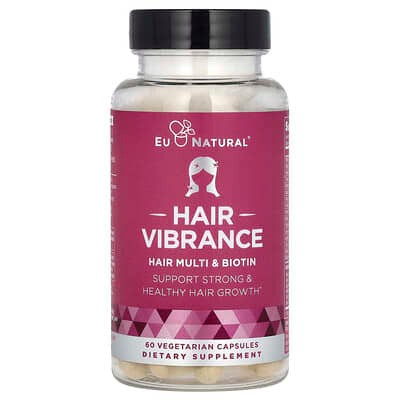
Vibrance

Vibrance

Eu Natural4.2 (1,249 ratings)
Format:Capsule Quantity: 60 Capsule(s) · 30 servings
Goals
$24.99 $0.83 per serving

About this product

The strongest case is nutritional support, with a more limited case for brittle nails. Biotin may help some people with brittle nails, but the findings are limited and higher amounts do not establish greater benefit. Ordinary hair thinning is a different concern, and extra biotin does not establish regrowth when intake is adequate.

Vitamin D3, methylfolate and zinc bisglycinate are clearly named forms. The product facts list 5,000 mcg biotin and 4,000 IU vitamin D, while some goal findings use smaller amounts from a different serving basis. Confirming the capsule serving is therefore important before comparing doses or combining supplements.

The 857 mg hair complex does not disclose enough detail to judge each added ingredient. Iron is listed at 9 mg as an amino acid chelate without a specific carrier, and zinc in the same formula may compete with its absorption. The broader formula costs relatively more than several of its individual nutrients would suggest, so its value depends on needing the combination.

Who is it for
  • Adults with dietary gaps affecting normal skin, hair or nail nutrition
  • People considering biotin for brittle nails who accept the limited evidence
Best for
  • Combining B vitamins and selected minerals for nutritional support
  • Brittle-nail support where a biotin supplement is being considered

Pros

  • Zinc uses the specifically named bisglycinate form
  • Methylfolate and vitamin D3 are identified
  • Biotin has a more relevant connection to brittle nails than to routine hair regrowth

Cons

  • Individual amounts in the hair complex are unavailable
  • Iron's specific chelate carrier is not identified
  • Combined iron and zinc may compete for absorption
  • The premium is harder to justify for a single nutrient need

Warnings

  • The supplied capsule and serving details use different biotin and vitamin D amounts; confirm the label serving before adding other supplements containing either nutrient.

Product analysis

54 out of 100

Vibrance may help fill nutritional gaps and has limited support for brittle nails. Unidentified blend components make the full contents harder to check.

AI assessment of the formula, label and price. How scoring works

Nutrient Quality63

Several vitamins and minerals use favorable forms, including vitamin D, folate and zinc. Unspecified forms and unidentified blend components leave other parts of the mixture harder to judge.

Ingredient Transparency74

Amounts and most forms are disclosed for the listed entries. The unidentified blend components and omitted forms leave the full composition less clear.

Value For Money33

Several nutrients are expensive for the amounts supplied, particularly selenium, riboflavin and manganese. Moderate value for biotin and uncertainty elsewhere do not establish an economical combination.

Customer Satisfaction72

Customer ratings are generally positive across a substantial number of buyers. The volume gives a broad satisfaction picture without proving any nutritional or cosmetic benefit.

Product Focus20

The clearest role is filling nutrient gaps, with limited support for brittle nails. The broad set of intended uses does not establish extra energy, hair growth or hormone benefits when nutrient intake is adequate.

Format
Capsule
Container
60 Capsule(s)
Per serving
$0.83
Customer rating
4.2 · 1,249 ratings
Report analysis

Goals

Everyday Health
Impact
Highest effect
B Ingredient FitA+ PathwaysB+ EvidenceA+ Formulation Logic
Folate · 400 mcgVitamin B12 · 60 mcgVitamin D · 4000 IUSelenium · 70 mcgZinc · 15 mgVitamin C · 60 mg

B vitamins and folate supply nutrients used in normal metabolism and blood formation, while vitamin D supports mineral-related nutrition. Iron and iodine may help fill low dietary intake, with smaller zinc and selenium contributions to normal defence functions. These nutritional roles do not establish additional benefit when intake is adequate. The saved findings use the selected one-capsule serving and do not multiply its amounts by the suggested frequency.

How this product is rated for Everyday Health

Ingredient fit76

The relevant ingredients contribute to energy metabolism, blood formation, mineral metabolism, normal defence functions. Their main value is nutrient availability when intake is low. Boron remain unresolved and add no established contribution.
Goal fit
The counted ingredients align with the nutritional roles described here, although the product is also linked to other goals.
Dose adequacy
Vitamin B3 (Niacin), Vitamin B9 (Folate) and Zinc provide smaller contributions than the other counted nutrients; the serving does not establish the full daily intake.

Pathways100

The counted ingredients span energy metabolism, blood formation, mineral metabolism, normal defence functions. These are contributions to normal nutrient functions rather than proof of broad health improvements.
Depth
Folate and the accompanying B vitamins provide the strongest contribution to normal blood formation.
Breadth
The saved findings extend across energy metabolism, blood formation, mineral metabolism, normal defence functions; this describes nutritional roles rather than proven improvements in all these areas.

Evidence82

Vitamin B9 (Folate) anchors the strongest supported nutritional contribution. The preparation findings do not establish extra benefit from named chemical forms or supplementation above adequate intake.
Evidence strength
Vitamin B9 (Folate) provides the strongest supported contribution among the counted ingredients, primarily as nutrition for low intake rather than demonstrated extra benefit above adequacy.
Studied preparation
The counted preparations meet the saved preparation finding; no superiority of a named form or delivery method is established.

Formulation logic100

The independently counted ingredients satisfy the amount and partner checks, with no evaluated conflict triggered. These findings do not establish synergy or overall suitability.
Partner coverage
The counted nutrients work independently or have their required partner present; this does not establish an added combination benefit.
Conflicts
None of the evaluated ingredient combinations triggered a conflict finding; this does not establish overall suitability.
Effective doses
All independently counted ingredients meet the saved amount check; smaller present ingredients may remain outside this finding.
Study evidence
Folate Supportive 80 studies
Selenium Supportive 70 studies
Vitamin C Supportive 56 studies
Vitamin D Supportive 115 studies
Zinc Supportive 60 studies
Impact
High effect
C Ingredient FitB- PathwaysA+ EvidenceA+ Formulation Logic
Biotin · 5000 mcg

Biotin has limited evidence for improving brittle nails and nail growth, based largely on small studies with weak controls. The 2500 mcg per serving reaches the reviewed amount comparison, but higher amounts have not shown additional nail benefit. A serving does not establish the sustained daily regimen used in those studies. Zinc can help when deficiency causes nail changes, without established extra benefit when intake is adequate.

How this product is rated for Nail Health

Ingredient fit61

This broader nutrient formula has a nail-related nutritional connection through biotin and zinc, with variable amounts and limited nail-specific evidence.
Goal fit
Nail-related nutrients appear alongside many ingredients serving broader nutritional purposes.
Dose adequacy
Amounts provide substantial but varied exposure recognition; this does not establish a proven nail response.

Pathways70

Keratinization cofactors are the only substantially represented area in the saved findings.
Depth
Keratinization cofactors are the only substantially represented area in the saved findings.
Breadth
One nail-related area reaches substantial representation; broader coverage is limited.

Evidence99

Biotin leads the saved evidence comparison, but the small studies do not establish robust routine efficacy.
Evidence strength
Biotin leads the saved evidence comparison, but the small studies do not establish robust routine efficacy.
Studied preparation
Selenium does not meet the saved studied-preparation comparison; the other amount-qualified ingredients do.

Formulation logic96

The assessed ingredients require no missing partner, but unresolved vitamin E falls below the minimum amount comparison. No configured conflict was identified.
Partner coverage
The assessed ingredients work alone or have their required partner.
Conflicts
No configured ingredient conflict was identified.
Effective doses
Vitamin E's unresolved amount falls below the minimum comparison; the other included ingredients meet it.
Study evidence
Biotin Supportive 8 studies
Iron Disputed 4 studies
Selenium Adverse 1 study
Vitamin C Supportive 1 study
Vitamin D Supportive 8 studies
Vitamin E Supportive 6 studies
Zinc No effect 1 study
Hair Health
Impact
Moderate effect
C- Ingredient FitF PathwaysA+ EvidenceA+ Formulation Logic
Biotin · 5000 mcgVitamin D · 4000 IUZinc · 15 mgIron · 9 mgVitamin C · 60 mg

Biotin may help with diffuse shedding caused by biotin deficiency, and it has a role in a few rare hair-shaft disorders. Those situations differ from ordinary hair thinning, so a high biotin amount alone isn't a reason to expect regrowth when you already get enough.

How this product is rated for Hair Health

Ingredient fit58

Biotin may help with diffuse shedding caused by biotin deficiency, and it has a role in a few rare hair-shaft disorders. Those situations differ from ordinary hair thinning, so a high biotin amount alone isn't a reason to expect regrowth when you already get enough.
Goal fit
Several nutrients relate to hair biology, but the number of ingredients does not show that they will regrow hair.
Dose adequacy
Selenium: 35 mcg; Iron: 4.5 mg; Vitamin C: 30 mg. These serving amounts are comparisons, not proof of a hair benefit.

Pathways11

The ingredients relate most closely to normal antioxidant functions around hair follicles, which does not itself demonstrate regrowth.
Depth
The ingredients relate most closely to normal antioxidant functions around hair follicles, which does not itself demonstrate regrowth.
Breadth
The ingredients do not provide a broad, demonstrated approach to the different causes of hair loss.

Evidence98

Zinc may help reduce diffuse shedding if you're low in it. That benefit concerns correcting a deficiency; extra zinc hasn't been shown to regrow hair when you already get enough.
Evidence strength
Zinc may help reduce diffuse shedding if you're low in it.
Studied preparation
The preparation identities fit the relevant ingredient information; this does not make routine hair regrowth certain.

Formulation logic96

No required partner is missing and no particular conflict is identified. Ingredient amounts still need to be interpreted individually.
Partner coverage
No required ingredient partner is identified as missing.
Conflicts
No particular ingredient conflict is identified.
Effective doses
Vitamin D has low or unresolved serving amounts relative to the comparison amounts.
Study evidence
Biotin Supportive 4 studies
Folate Mixed 15 studies
Iron Disputed 25 studies
Niacin Disputed 2 studies
Selenium Disputed 7 studies
Vitamin D Disputed 34 studies
Vitamin E No effect 3 studies
Zinc Supportive 22 studies
Immunity
Impact
High effect
C- Ingredient FitC PathwaysA+ EvidenceA+ Formulation Logic
Vitamin C · 60 mgZinc · 15 mgVitamin D · 4000 IUSelenium · 70 mcg

Vitamin D and zinc contribute to normal immune-cell function, while folate, vitamins B6 and B12, selenium and iron can help when low intake impairs those processes. The main recognized role is lymphocyte-related immune regulation. Several amounts are partial contributions rather than complete nutritional coverage. These roles do not establish extra protection against infection once nutrient needs are met.

How this product is rated for Immunity

Ingredient fit56

Relevant nutrients contribute to immune function, while additional actives broaden the formula beyond the supported contributions.
Goal fit
Relevant nutrients contribute to immune function, while additional actives broaden the formula beyond the supported contributions.
Dose adequacy
The serving supplies partial amounts against the saved references; this comparison does not establish an optimal dose or a clinical response.

Pathways60

The strongest area reaches the saved coverage threshold; contributions to other immune functions remain smaller or absent.
Depth
The strongest recognized area is lymphocyte function and immune regulation; this describes functional coverage rather than observed infection prevention.
Breadth
The strongest area reaches the saved coverage threshold; contributions to other immune functions remain smaller or absent.

Evidence100

Zinc drives the strongest saved evidence finding, within the supplied limits on normal immune function and respiratory outcomes.
Evidence strength
Zinc drives the strongest saved evidence finding, within the supplied limits on normal immune function and respiratory outcomes.
Studied preparation
The saved result recognizes the preparations meeting its amount threshold; no superiority of particular forms is established.

Formulation logic97

No configured ingredient conflict was triggered; the finding covers only the evaluated combinations. Most recognized ingredients meet the saved minimum amount threshold; vitamin E's usable amount remains unresolved.
Partner coverage
Recognized ingredients work independently or have their required partners; this does not establish added combination benefit.
Conflicts
No configured ingredient conflict was triggered; the finding covers only the evaluated combinations.
Effective doses
Most recognized ingredients meet the saved minimum amount threshold; vitamin E's usable amount remains unresolved.
Study evidence
Iron Supportive 23 studies
Selenium Mixed 37 studies
Vitamin C Supportive 53 studies
Vitamin D Supportive 85 studies
Vitamin E Supportive 21 studies
Zinc Supportive 73 studies
Impact
Moderate effect
D Ingredient FitF PathwaysA EvidenceA+ Formulation Logic
Zinc · 15 mgVitamin D · 4000 IU

Zinc may help restore testosterone when zinc levels are low. Vitamin D's possible hormone connection is also conditional; taking it when you already have enough hasn't reliably raised testosterone. The undisclosed vitamin E amount adds uncertainty about that ingredient, without changing zinc's dependence on your starting nutrient status.

How this product is rated for Testosterone Support

Ingredient fit45

Zinc's testosterone benefit is most relevant when zinc levels are low. Zinc provides 7.5 mg per serving; that amount alone doesn't predict a testosterone increase.
Goal fit
Zinc's testosterone benefit is most relevant when zinc levels are low. Other ingredients broaden the mixture beyond testosterone-related nutrients.
Dose adequacy
Zinc provides 7.5 mg per serving; that amount alone doesn't predict a testosterone increase.

Pathways7

Zinc deficiency can affect testosterone; this doesn't imply that extra zinc stimulates hormone production when intake is adequate.
Depth
Zinc deficiency can affect testosterone; this doesn't imply that extra zinc stimulates hormone production when intake is adequate.
Breadth
The ingredient mix doesn't demonstrate several independent ways to raise testosterone in everyday use.

Evidence91

Zinc's testosterone benefit is most relevant when zinc levels are low. Ingredient form alone does not predict the hormone effect.
Evidence strength
Zinc's testosterone benefit is most relevant when zinc levels are low.
Studied preparation
The declared nutrient forms identify what is supplied, but don't guarantee a testosterone response.

Formulation logic95

The relevant nutrients need no missing partner, and no particular ingredient conflict is identified.
Partner coverage
No required ingredient partner is missing for the nutrient contribution described here.
Conflicts
No particular ingredient conflict is identified here.
Effective doses
Vitamin E has an undisclosed individual amount, so their amounts can't be compared reliably.
Study evidence
Selenium No effect 16 studies
Vitamin D Supportive 56 studies
Vitamin E Disputed 3 studies
Zinc Disputed 7 studies
Bone Health
Impact
High effect
D+ Ingredient FitB+ PathwaysA+ EvidenceA+ Formulation Logic
Vitamin D · 4000 IUManganese · 2 mgZinc · 15 mgVitamin C · 60 mg

Vitamin D supports calcium absorption and normal mineralization, particularly when vitamin D intake or status is low. Its 50 mcg serving does not establish additional fracture prevention in generally healthy adults. Zinc and manganese have normal bone-related roles without isolated evidence of extra skeletal benefit in adequately nourished adults. Boron presence is unresolved, and bamboo does not establish a verified silicon amount or a preparation-specific bone benefit.

How this product is rated for Bone Health

Ingredient fit54

Zinc is a key ingredient in the saved bone-related findings. The amounts provide uneven support.
Goal fit
Bone-related nutrients are part of a broader formula with ingredients serving other purposes.
Dose adequacy
The disclosed amounts provide uneven or partial support; unknown quantities limit their contributions without establishing ineffectiveness.

Pathways80

Coverage is strongest for calcium absorption and regulation. The breadth finding includes calcium absorption and regulation, bone collagen formation.
Depth
The strongest saved coverage concerns calcium absorption and regulation; coverage does not establish a change in bone density or fracture risk.
Breadth
The routes meeting the breadth criterion are calcium absorption and regulation, bone collagen formation. Other bone functions receive less or no coverage.

Evidence98

Zinc has normal bone-related roles, but the supplied evidence does not isolate added adult bone-density or fracture benefits from zinc supplementation.
Evidence strength
Zinc has normal bone-related roles, but the supplied evidence does not isolate added adult bone-density or fracture benefits from zinc supplementation.
Studied preparation
The credited preparations meet the saved criteria, while the supplied nutritional, population and outcome limitations still apply.

Formulation logic96

The saved findings identify an unmet partner requirement for vitamin d; its contribution is retained with that limitation. No evaluated ingredient conflict was identified.
Partner coverage
The saved findings identify an unmet partner requirement for vitamin d; its contribution is retained with that limitation.
Conflicts
No ingredient conflict was identified by the evaluated rules.
Effective doses
All credited ingredients meet the saved minimum amount criterion; this is not a proven effective dose or fracture-prevention threshold.
Study evidence
Folate Supportive 50 studies
Manganese Adverse 12 studies
Vitamin C Supportive 46 studies
Vitamin D Supportive 202 studies
Zinc Supportive 33 studies

Ingredients

IngredientAmount per servingScore
Vitamin C (Ascorbic Acid)
60 mg
Vitamin D (Cholecalciferol)
4000 IU 70
Vitamin E (D-Alpha-Tocopheryl Succinate)
30 IU 53
Thiamin (Thiamine Hydrochloride)
15 mg 68
Riboflavin
17 mg 40
Niacin (Niacinamide)
20 mg
Vitamin B6 (Pyridoxine Hydrochloride)
10 mg
Folate (L-Methylfolate)
400 mcg 84
Vitamin B12 (Methylcobalamin)
60 mcg
Biotin
5000 mcg 85
Pantothenic Acid (Calcium Pantothenate)
10 mg
Iron (Iron Amino Acid Chelate)
9 mg 45
Zinc (TRAACS Zinc Bisglycinate Chelate)
15 mg 70
Selenium (L-Selenomethionine)
70 mcg 70
Manganese (TRAACS Manganese Bisglycinate Chelate)
2 mg 78
Vibrance Healthy Hair Complex
857 mg
Adults 18–50
Report overview
Biotin · 5000 mcg OverallScore85
B+ Active Ingredient Quality & BioavailabilityA+ Dose, Safety & Label TransparencyC Value
5,000 mcg of biotin per serving falls within a range used for hair and nail support. The cost for biotin alone is high, though the package also contains other vitamins and minerals. The label lists biotin without specifying its isomer.
How this ingredient is rated

Active Ingredient Quality & Bioavailability82

The label lists biotin without specifying its isomer. No artificial colors are indicated and no artificial sweeteners are indicated.
Biologically Active d-Biotin Isomer
The label lists biotin without specifying its isomer.
Excipient Purity
No artificial colors are indicated and no artificial sweeteners are indicated.

Dose, Safety & Label Transparency100

The label lists 5,000 mcg of biotin per serving. That falls within a range used for hair and nail support.
Biotin Potency for Health Goals
The label lists 5,000 mcg of biotin per serving. That falls within a range used for hair and nail support.
Label Transparency & Exact Disclosure
The biotin amount is clearly listed as 5,000 mcg per serving.

Value60

The cost for biotin alone is high, though the package also contains other vitamins and minerals.
Price per 5,000 mcg Biotin
The cost for biotin alone is high, though the package also contains other vitamins and minerals.
A Active Ingredient Quality & BioavailabilityA+ Dose, Safety & Label TransparencyD- Value
Each serving supplies 400 mcg of folate as L-5-Methyltetrahydrofolate, at a high cost per serving. L-5-methyltetrahydrofolate is an active form that bypasses the MTHFR conversion step.
How this ingredient is rated

Active Ingredient Quality & Bioavailability91

L-5-methyltetrahydrofolate is an active form that bypasses the MTHFR conversion step. An L-isomer marker is indicated.
Folate Form Hierarchy
L-5-methyltetrahydrofolate is an active form that bypasses the MTHFR conversion step.
Patented Sources & Isomeric Purity
An L-isomer marker is indicated.

Dose, Safety & Label Transparency100

The serving lists 400 mcg of folate.
Folate Dosage by Declared Basis
The serving lists 400 mcg of folate.

Value40

The cost per serving is high.
Price per Bioavailable Serving
The cost per serving is high.
A+ Active Ingredient Quality & BioavailabilityC Dose, Safety & Label TransparencyF Value
+1
A serving supplies 15 mg of zinc at a high cost per serving. The zinc comes as zinc bisglycinate. The copper amount is unknown, so the zinc-to-copper balance is unclear.
How this ingredient is rated

Active Ingredient Quality & Bioavailability100

The zinc comes as zinc bisglycinate.
Zinc Form Bioavailability
The zinc comes as zinc bisglycinate.

Dose, Safety & Label Transparency61

The zinc amount and source are stated. The copper amount is unknown, so the zinc-to-copper balance is unclear.
Elemental Dose Transparency
The elemental zinc amount and its source are stated.
Zinc Dosage Safety & Effectiveness
A serving provides 15 mg of zinc.
Zinc-to-Copper Mineral Balance
The copper amount is unknown, so the zinc-to-copper balance is unclear.

Value30

The cost per serving is high.
Price Per Serving Efficiency
The cost per serving is high.
Report alternatives

Sources

Published studies used for the product analysis and the top-ranked studies for each ingredient and goal.

  1. Association between RBC folate and lumbar bone mineral density in postmenopausal women, a cross-sectional study from NHANES 2009-2018.
    Wei H; Jin Z; Zhou L; Tang G; Chai S; Che X; Tan Y; Zeng W · Frontiers in endocrinology · 2025
    Cross-sectional study1,315 participantsBone Health forFolate
  2. Genetic variants modify the associations of concentrations of methylmalonic acid, vitamin B-12, vitamin B-6, and folate with bone mineral density.
    Liu CT; Karasik D; Xu H; Zhou Y; Broe K; Cupples LA; Cpgm de Groot L; Ham A; Hannan MT; Hsu YH; Jacques P; McLean RR; Paul L; Selhub J; Trajanoska K; van der Velde N; van Schoor N; Kiel DP · The American journal of clinical nutrition · 2021
    Cohort study4,310 participantsBone Health forFolate
  3. Adequate Intake and Supplementation of B Vitamins, in Particular Folic Acid, can Play a Protective Role in Bone Health.
    Rondanelli M; Tartara A; Fossari F; Vecchio V; Faliva MA; Naso M; Perna S; Nichetti M; Peroni G · Current aging science · 2022
    Narrative review35,298 participants29 studies pooledBone Health forFolate Bone Health forVitamin B6
  4. Relation of homocysteine, folate, and vitamin B12 to bone mineral density of postmenopausal women.
    Cagnacci A; Baldassari F; Rivolta G; Arangino S; Volpe A · Bone · 2004
    Cross-sectional study161 participantsBone Health forFolate
  5. Dietary intake of folate, but not vitamin B2 or B12, is associated with increased bone mineral density 5 years after the menopause: results from a 10-year follow-up study in early postmenopausal women.
    Rejnmark L; Vestergaard P; Hermann AP; Brot C; Eiken P; Mosekilde L · Calcified tissue international · 2008
    Cohort study1,869 participantsBone Health forFolate
  6. Risk of Environmental Chemicals on Bone Fractures Is Independent of Low Bone Mass in US Adults: Insights from 2017 to 2018 NHANES.
    Ling R; Ai Y; Chen C; Zhang J; Zou Z; Cheng S; Li C; Li X; Wang B · Metabolites · 2023
    Cross-sectional study2,640 participantsBone Health forManganese
  7. The Manganese-Bone Connection: Investigating the Role of Manganese in Bone Health.
    Taskozhina G; Batyrova G; Umarova G; Issanguzhina Z; Kereyeva N · Journal of clinical medicine · 2024
    Narrative reviewBone Health forManganese
  8. Associations of multiple metals with bone mineral density: A population-based study in US adults.
    Wei MH; Cui Y; Zhou HL; Song WJ; Di DS; Zhang RY; Huang Q; Liu JA; Wang Q · Chemosphere · 2021
    Cross-sectional studyBone Health forManganese
  9. Sex-specific associations of urinary mixed-metal concentrations with femoral bone mineral density among older people: an NHANES (2017-2020) analysis.
    Li H; Li G; Yi M; Zhou J; Deng Y; Huang Y; He S; Meng X; Liu L · Frontiers in public health · 2024
    Cross-sectional study31 participantsBone Health forManganese
  10. Relationship between blood manganese and bone mineral density and bone mineral content in adults: A population-based cross-sectional study.
    Wang C; Zhu Y; Long H; Ou M; Zhao S · PloS one · 2022
    Cross-sectional study9,732 participantsBone Health forManganese
  11. Effect of Vitamin B12 and Folic Acid Supplementation on Bone Mineral Density and Quantitative Ultrasound Parameters in Older People with an Elevated Plasma Homocysteine Level: B-PROOF, a Randomized Controlled Trial.
    Enneman AW; Swart KM; van Wijngaarden JP; van Dijk SC; Ham AC; Brouwer-Brolsma EM; van der Zwaluw NL; Dhonukshe-Rutten RA; van der Cammen TJ; de Groot LC; van Meurs J; Lips P; Uitterlinden AG; Zillikens MC; van Schoor NM; van der Velde N · Calcified tissue international · 2016
    Randomized trial1,111 participantsBone Health forVitamin B12
  12. Plasma B vitamins, homocysteine, and their relation with bone loss and hip fracture in elderly men and women.
    McLean RR; Jacques PF; Selhub J; Fredman L; Tucker KL; Samelson EJ; Kiel DP; Cupples LA; Hannan MT · The Journal of clinical endocrinology and metabolism · 2008
    Cohort study1,002 participantsBone Health forVitamin B12
  13. Relation between homocysteine and B-vitamin status indicators and bone mineral density in older Americans.
    Morris MS; Jacques PF; Selhub J · Bone · 2006
    Cross-sectional study1,550 participantsBone Health forVitamin B12
  14. The role of B-vitamin intake, B-vitamin-rich dietary patterns, the B-vitamin deficiency index in bone mineral density among school-aged children.
    Tan L; Zhang Y; Cui N; Huang S; Weng S; Bao M; Jiang Y; Huang M; Yang X · Pediatric research · 2026
    Cross-sectional study1,026 participantsBone Health forVitamin B12
  15. Hyperhomocysteinemia is Associated with Inflammation, Bone Resorption, Vitamin B12 and Folate Deficiency and MTHFR C677T Polymorphism in Postmenopausal Women with Decreased Bone Mineral Density.
    De Martinis M; Sirufo MM; Nocelli C; Fontanella L; Ginaldi L · International journal of environmental research and public health · 2020
    Cross-sectional study252 participantsBone Health forVitamin B12
  16. The Effects of the AGE Inhibitor Pyridoxamine on Bone in Older Women With Type 2 Diabetes: A Randomized Clinical Trial.
    Brossfield AV; McMahon DJ; Fernando J; Omeragic B; Majeed R; Agarwal S; Sroga GE; Wang B; Vashishth D; Rubin MR · The Journal of clinical endocrinology and metabolism · 2025
    Randomized trial55 participantsBone Health forVitamin B6
  17. Dietary B vitamin intake and risk of hip fracture: the Singapore Chinese Health Study.
    Dai Z; Wang R; Ang LW; Yuan JM; Koh WP · Osteoporosis international : a journal established as result of cooperation between the European Foundation for Osteoporosis and the National Osteoporosis Foundation of the USA · 2014
    Cohort study63,257 participantsBone Health forVitamin B6
  18. Hip fracture patients may be vitamin B6 deficient. Controlled study of serum pyridoxal-5'-phosphate.
    Reynolds TM; Marshall PD; Brain AM · Acta orthopaedica Scandinavica · 1993
    Case-control study103 participantsBone Health forVitamin B6
  19. Degree of mineralization-related collagen crosslinking in the femoral neck cancellous bone in cases of hip fracture and controls.
    Saito M; Fujii K; Marumo K · Calcified tissue international · 2006
    Case-control study50 participantsBone Health forVitamin B6
  20. Can Dietary Intake of Vitamin C-Oriented Foods Reduce the Risk of Osteoporosis, Fracture, and BMD Loss? Systematic Review With Meta-Analyses of Recent Studies.
    Zeng LF; Luo MH; Liang GH; Yang WY; Xiao X; Wei X; Yu J; Guo D; Chen HY; Pan JK; Huang HT; Liu Q; Guan ZT; Han YH; Zhao D; Zhao JL; Hou SR; Wu M; Lin JT; Li JH; Liang WX; Ou AH; Wang Q; Li ZP; Liu J · Frontiers in endocrinology · 2020
    Meta-analysis19,484 participants17 studies pooledBone Health forVitamin C



