
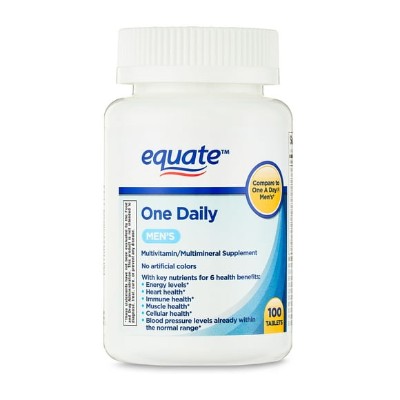

$5.48 $0.05 per serving

Product analysis
One Daily Men's Health offers an economical mix of nutrients that can help fill dietary gaps and support normal immune and energy functions. Most ingredient preparations are not clearly identified in the main nutrient listing, making quality comparisons difficult.
AI assessment of the formula, label and price. How scoring works
Nutrient Quality20
Most preparations are not clearly identified in the main nutrient listing, leaving much of the form quality uncertain. Synthetic vitamin E and zinc oxide are less favorable form choices, and several mineral mixtures have unclear proportions.
Ingredient Transparency64
Amounts are listed for the named nutrients, making the declared serving easy to see. Nearly all forms are missing from the main nutrient listing, limiting a detailed comparison of preparations.
Value For Money63
Vitamin A and several minerals compare favorably on cost, making much of the formula economical. Vitamin E offers weaker value, and value for a number of other nutrients remains uncertain.
Customer Satisfaction87
Customer ratings are strongly positive across thousands of reviews. The substantial feedback gives a useful satisfaction picture without establishing the proposed health benefits.
Product Focus35
The clearest purpose is nutritional support when the diet falls short. The broad ingredient mix covers several health aims, without establishing extra benefits when nutrient needs are already met.
- Format
Tablet - Container
- 100 Tablet(s)
- Per serving
- $0.05
- Also available
 One Daily Men's Health$9.82
- Customer rating
- 4.7 · 3,007 ratings
Goals

Impact
Highest effect
Folate · 400 mcgVitamin B12 · 18 mcgVitamin D · 700 IUMagnesium · 140 mgVitamin K · 20 mcgSelenium · 110 mcgZinc · 15 mgVitamin C · 60 mg
Magnesium contributes to normal energy and mineral metabolism, with usefulness mainly when dietary intake falls short. The B vitamins provide nutritional support for normal metabolism and, where folate and B12 are included, blood formation. Vitamin C, Zinc and Selenium offer nutritional support for normal antioxidant or immune functions when intake is low. Amounts above nutritional adequacy do not establish additional general-health benefit.
How this product is rated for Everyday Health
Ingredient fit78
Vitamin B6, Zinc, Vitamin B9 (Folate) and Selenium connects this product to routine nutrient provision. Its practical value depends on filling dietary gaps.
Goal fit
Nutritional support shares the formula with ingredients aimed at other goals, reducing its focus on routine nutrient provision.
Dose adequacy
The relevant amounts make a partial nutritional contribution against the supplied amount references, rather than covering every included nutrient equally.
Pathways100
Normal energy metabolism is the strongest represented nutritional role. Several nutritional roles are represented.
Depth
Normal energy metabolism is the strongest represented nutritional role.
Breadth
The represented roles include energy metabolism cofactors, one-carbon metabolism and blood formation, antioxidant and immune defence, with breadth determined by the supplied amounts.
Evidence86
Magnesium is the main contributor to the saved evidence finding. The supplied evidence supports nutritional usefulness when intake is low, without establishing extra benefit in adequately nourished adults.
Evidence strength
Magnesium leads the saved evidence finding; its relevance is nutritional support when intake is low, without established benefit above adequacy.
Studied preparation
The included nutrient declarations satisfy the supplied preparation checks, without evidence that a particular form or delivery method provides greater general-health benefit.
Formulation logic98
The supplied checks identify no missing required partner or configured conflict. Some included nutrient amounts remain below the comparison threshold.
Partner coverage
No required nutrient partner is missing under the supplied checks; co-presence does not establish added benefit from the combination.
Conflicts
No configured ingredient conflict was identified in the supplied checks.
Effective doses
Vitamin D falls below the supplied amount threshold; other included contributions meet it. This threshold is a comparison reference, not proven clinical efficacy.

Impact
High effect
Magnesium · 140 mgVitamin C · 60 mgZinc · 15 mgVitamin A · 3500 IUVitamin D · 700 IUSelenium · 110 mcg
Zinc and selenium provide nutrients used in normal immune function; selenium is not expected to add benefit when status is already adequate. Copper, B6, B12 and folate can help fill dietary gaps that impair immune-cell function. Vitamin A, D and E amounts remain unresolved, limiting their contributions. These nutritional roles do not establish prevention of infection or stronger immunity above adequacy.
How this product is rated for Immunity
Ingredient fit52
Relevant ingredients contribute to the immune goal, while additional actives make the formula less focused on these functions.
Goal fit
Relevant ingredients contribute to the immune goal, while additional actives make the formula less focused on these functions.
Dose adequacy
The relevant amounts contribute partly to the saved comparisons, with unresolved quantities contributing less.
Pathways73
The strongest represented area is oxidative and inflammatory balance. The saved findings extend across two immune functions, with the remaining areas less represented.
Depth
The strongest represented area is oxidative and inflammatory balance.
Breadth
The saved findings extend across two immune functions, with the remaining areas less represented.
Evidence100
Zinc leads the saved evidence finding, primarily reflecting nutritional roles rather than proven added infection prevention.
Evidence strength
Zinc leads the saved evidence finding, primarily reflecting nutritional roles rather than proven added infection prevention.
Studied preparation
The counted preparations match the saved preparation finding; this does not establish superior benefit from particular forms or delivery.
Formulation logic93
The counted ingredients have their relevant partners or contribute independently, and no listed formulation conflict was triggered.
Partner coverage
The counted ingredients can contribute independently or have their relevant partners; an extra combined benefit is not established.
Conflicts
No listed formulation conflict was triggered; this does not establish safety of the whole product.
Effective doses
The unresolved Vitamin D, Vitamin A, Vitamin E amounts fall below the saved minimum comparison; the other counted ingredients reach it.

Impact
High effect
Vitamin K · 20 mcgMagnesium · 140 mgCalcium · 210 mgVitamin D · 700 IUCopper · 2 mgManganese · 2 mgZinc · 15 mgVitamin C · 60 mg
Calcium and magnesium supply minerals needed for normal bone metabolism when dietary intake is low. Vitamin C supports collagen formation and copper helps cross-link that matrix, with the clearest benefit from correcting inadequate intake. Vitamin D is present but its active amount remains unresolved, limiting assessment of calcium-absorption support. The vitamin K declaration does not establish the MK-7 preparation used in the supplied bone studies.
How this product is rated for Bone Health
Ingredient fit57
Bone-related nutrients sit within a broader formula containing ingredients serving other purposes. Unresolved active nutrient amounts limit assessment, alongside the declared amounts of other bone-related ingredients.
Goal fit
Bone-related nutrients sit within a broader formula containing ingredients serving other purposes.
Dose adequacy
Unresolved active nutrient amounts limit assessment, alongside the declared amounts of other bone-related ingredients.
Pathways60
The strongest finding concerns the collagen framework of bone, rather than direct mineral supply. Support is concentrated in collagen matrix formation.
Depth
The strongest finding concerns the collagen framework of bone, rather than direct mineral supply.
Breadth
Support is concentrated in collagen matrix formation.
Evidence98
Zinc leads the saved evidence comparison, but supplied context does not establish independent routine bone-density or fracture benefit. The counted preparations meet the saved preparation criteria, without establishing superior forms or guaranteed clinical outcomes.
Evidence strength
Zinc leads the saved evidence comparison, but supplied context does not establish independent routine bone-density or fracture benefit.
Studied preparation
The counted preparations meet the saved preparation criteria, without establishing superior forms or guaranteed clinical outcomes.
Formulation logic92
The calcium–vitamin D pairing is incomplete in the saved findings, limiting complementary mineral and absorption support. No configured ingredient conflict was identified in the supplied findings.
Partner coverage
The calcium–vitamin D pairing is incomplete in the saved findings, limiting complementary mineral and absorption support.
Conflicts
No configured ingredient conflict was identified in the supplied findings.
Effective doses
Vitamin D, Vitamin A do not meet the saved amount criterion; this differs from demonstrating ineffectiveness.

Impact
Moderate effect
Magnesium · 140 mgZinc · 15 mgVitamin D · 700 IU
Zinc may help restore testosterone when low zinc is contributing to low levels. The benefit concerns correcting a deficiency; taking extra zinc when you already get enough isn't known to raise testosterone.
How this product is rated for Testosterone Support
Ingredient fit38
Zinc is most relevant when low zinc is contributing to low testosterone.
Goal fit
Zinc relates to testosterone through deficiency correction; other declared nutrients do not imply an additional hormone benefit.
Dose adequacy
Zinc 15 mg; Selenium 110 mcg; Vitamin B6 3 mg; Magnesium 140 mg. These serving amounts do not guarantee a testosterone increase.
Pathways18
The relevant connection is nutritional status rather than a guaranteed increase in testosterone.
Depth
The ingredients relate to testosterone production or availability, without implying a predictable hormone increase.
Breadth
A broad effect across the proposed hormone routes is not supported here.
Evidence93
Zinc is most relevant when low zinc is contributing to low testosterone.
Evidence strength
Zinc is most relevant when low zinc is contributing to low testosterone.
Studied preparation
The relevant ingredient preparations match those in the hormone context, while the limits on who may benefit still apply.
Formulation logic90
No particular ingredient conflict or missing required partner is identified.
Partner coverage
No required ingredient partner is missing for the included ingredients.
Conflicts
No particular ingredient conflict is identified.
Effective doses
Vitamin D, Vitamin E are below the comparison range used here; this alone doesn't prove ineffectiveness.
Vitamin B6 Not classified
No linked studies yet.

Impact
High effect
Biotin · 75 mcgVitamin D · 700 IUZinc · 15 mgVitamin C · 60 mg
Zinc can help when deficiency contributes to diffuse shedding. Selenium and copper have normal antioxidant and pigmentation roles, but those functions do not establish routine hair regrowth. Biotin, vitamin C and B12 fall below the saved inclusion criteria, while unresolved vitamin A and D amounts limit interpretation.
How this product is rated for Hair Health
Ingredient fit56
Relevant ingredients and their declared amounts shape this finding. The recognized amounts provide partial coverage of the supplied comparison anchors; unresolved amounts contribute nothing to this finding.
Goal fit
Relevant nutritional ingredients are present alongside a broader formula.
Dose adequacy
The recognized amounts provide partial coverage of the supplied comparison anchors; unresolved amounts contribute nothing to this finding.
Pathways55
The strongest recorded coverage concerns follicle antioxidant protection, rather than a demonstrated clinical hair outcome.
Depth
The strongest recorded coverage concerns follicle antioxidant protection, rather than a demonstrated clinical hair outcome.
Breadth
One named pathway reaches the supplied coverage criterion; broader coverage is limited.
Evidence98
Zinc provides the strongest recognized evidence contribution, subject to its specific hair-benefit limitations.
Evidence strength
Zinc provides the strongest recognized evidence contribution, subject to its specific hair-benefit limitations.
Studied preparation
The recognized preparations match those accepted in the saved comparison; that alone does not prove hair regrowth.
Formulation logic93
The saved findings identify no missing required partners or configured conflicts. The supplied amount criterion was not met for Vitamin A, Vitamin D.
Partner coverage
No missing required partner reduced the recognized ingredients’ contributions.
Conflicts
No configured ingredient conflict was recorded; this is not a general safety assessment.
Effective doses
The supplied amount criterion was not met for Vitamin A, Vitamin D.

Impact
High effect
Zinc · 15 mgVitamin C · 60 mgCopper · 2 mgSelenium · 110 mcgLycopene · 300 mcgVitamin E · 22.5 IU
Vitamin C and zinc support collagen formation and repair when intake is low, while niacin, riboflavin, B6 and biotin help prevent the skin changes caused by their deficiencies. These nutritional roles do not establish extra cosmetic benefit when intake is adequate. The small lycopene amount limits its relevance to the mixed findings on UV-related skin changes, and unresolved vitamin amounts restrict other contributions.
How this product is rated for Skin Health
Ingredient fit57
Recognized ingredients share the formula with ingredients serving other purposes, so its focus on skin is limited. Several nutrients contribute, but low lycopene and unresolved amounts limit the amount-based findings.
Goal fit
Recognized ingredients share the formula with ingredients serving other purposes, so its focus on skin is limited.
Dose adequacy
Several nutrients contribute, but low lycopene and unresolved amounts limit the amount-based findings.
Pathways76
The saved result places omega-3 under barrier lipids, but generic omega-3 cannot inherit the effects of purified EPA.
Depth
The saved result places omega-3 under barrier lipids, but generic omega-3 cannot inherit the effects of purified EPA.
Breadth
Collagen-related and UV-related areas meet the saved coverage criterion; broader clinical skin benefits are not established.
Evidence89
The strongest recognized nutrient findings do not establish extra cosmetic benefit in adequately nourished adults.
Evidence strength
The strongest recognized nutrient findings do not establish extra cosmetic benefit in adequately nourished adults.
Studied preparation
The saved result recognizes the retained preparations; the supplied scientific context still limits transfer of benefits from specific interventions.
Formulation logic93
No required partner is missing and no configured conflict was matched. Some recognized ingredients fall short of the amount check because their amounts are low or unresolved.
Partner coverage
The recognized ingredients can contribute alone or have the required partner; no missing-partner limitation was found.
Conflicts
No configured conflict was matched in the supplied facts; this does not establish general safety.
Effective doses
Some recognized ingredients fall short of the amount check because their amounts are low or unresolved.

Impact
Lower effect
Biotin · 75 mcg
Magnesium Not classified
No linked studies yet.
Ingredients
| Ingredient | Amount per serving | Score |
|---|---|---|
Vitamin A (Beta-Carotene) | 3500 IU | |
Vitamin C | 60 mg | |
Vitamin D | 700 IU | |
Vitamin E | 22.5 IU | |
Vitamin K | 20 mcg | |
Thiamine | 1.35 mg | |
Riboflavin | 1.7 mg | |
Niacin | 18 mg | |
Vitamin B6 | 3 mg | |
Folic Acid | 400 mcg | |
Vitamin B12 | 18 mcg | |
Biotin | 75 mcg | |
Pantothenic Acid | 16 mg | |
Calcium | 210 mg | |
Magnesium | 140 mg | |
Zinc | 15 mg | |
Selenium | 110 mcg | |
Copper | 2 mg | |
Manganese | 2 mg | |
Chromium | 120 mcg | |
Lycopene | 300 mcg |
Vitamin A (Beta-Carotene) · 3500 IU OverallScore60
The serving provides 3,500 IU of vitamin A at a low cost for the amount. Beta-carotene is named on the vitamin A row; retinyl acetate appears in Other Ingredients.
How this ingredient is rated
Active Ingredient Quality & Bioavailability33
Beta-carotene is named on the vitamin A row; retinyl acetate appears in Other Ingredients.
Vitamin A Chemical Form & Source
Beta-carotene is named on the vitamin A row; retinyl acetate appears in Other Ingredients.
Dose, Safety & Label Transparency67
The serving provides 3,500 IU of vitamin A. Retinyl acetate appears only in Other Ingredients, leaving the full source split unclear.
Dosage Efficacy & Safety Thresholds
The serving provides 3,500 IU of vitamin A.
Label Transparency of Specific Forms
Retinyl acetate appears only in Other Ingredients, leaving the full source split unclear.
Value100
The cost for the vitamin A amount is low.
Price per 5,000 IU Dose
The cost for the vitamin A amount is low.
Calcium · 210 mg OverallScore61
A serving provides 210 mg calcium at a low cost per serving. The source of that calcium is unclear. A flow agent is listed.
How this ingredient is rated
Active Ingredient Quality & Bioavailability37
The calcium amount is stated, but its source is unclear.
Calcium Form & Absorption Potential
The calcium source is unspecified; Other Ingredients lists Dicalcium Phosphate, Calcium Carbonate, Calcium Pantothenate and Calcium Silicate, but their contribution to the calcium total is unclear.
Elemental Calcium Transparency
The label states 210 mg calcium per serving, but does not name its source on the calcium line.
Dose, Safety & Label Transparency66
Each serving provides 210 mg calcium. The ingredients include a flow agent.
Absorption-Optimized Serving Dose
Each serving provides 210 mg calcium.
Formulation Purity & Additives
The ingredients include a flow agent.
Value100
The cost per serving is low.
Price Per Serving Efficiency
The cost per serving is low.
Zinc · 15 mg OverallScore62
A serving provides 15 mg of zinc as zinc oxide. The form is assessed less favorably for absorption than some alternatives.
How this ingredient is rated
Active Ingredient Quality & Bioavailability20
Zinc Oxide is assessed less favorably for absorption than some other zinc forms.
Zinc Form Bioavailability
Zinc Oxide is assessed less favorably for absorption than some other zinc forms.
Dose, Safety & Label Transparency85
A serving supplies 15 mg of zinc and 2 mg of copper. Both amounts are stated.
Elemental Dose Transparency
The amount of elemental zinc and its source form are stated.
Zinc Dosage Safety & Effectiveness
A serving supplies 15 mg of zinc.
Zinc-to-Copper Mineral Balance
The serving has 15 mg of zinc and 2 mg of copper, a ratio of about 7.5:1. The preferred balance is uncertain.
Value100
A whole-product serving costs about $0.05, which is low in this comparison.
Price Per Serving Efficiency
A whole-product serving costs about $0.05, which is low in this comparison.
Alternative products
Report alternatives
Sources
Published studies used for the product analysis and the top-ranked studies for each ingredient and goal.
- What is the impact of daily oral supplementation of vitamin D3 (cholecalciferol) plus calcium on the incidence of hip fracture in older people? A systematic review and meta-analysis.
- Calcium supplementation prevents seasonal bone loss and changes in biochemical markers of bone turnover in elderly New England women: a randomized placebo-controlled trial.
- The effects of calcium supplementation (milk powder or tablets) and exercise on bone density in postmenopausal women.
- The efficacy of calcium supplementation alone in elderly Thai women over a 2-year period: a randomized controlled trial.
- Calcium-enriched foods and bone mass growth in prepubertal girls: a randomized, double-blind, placebo-controlled trial.
- The Association between Dietary and Circulating Copper Levels and Osteoporosis: a Scoping Review.
- Association between dietary copper, iron, zinc, selenium intake and osteopenia or osteoporosis in elderly hypertensive patients: a retrospective cohort study.
- Associations of dietary copper intake with total bone mineral density and lumbar spine bone mineral density in American adults.
- The association between dietary mineral intake and bone mineral density: a cross-sectional study.
- Association between dietary copper intake and bone mineral density in children and adolescents aged 8-19 years: A cross-sectional study.
- Association between RBC folate and lumbar bone mineral density in postmenopausal women, a cross-sectional study from NHANES 2009-2018.
- Genetic variants modify the associations of concentrations of methylmalonic acid, vitamin B-12, vitamin B-6, and folate with bone mineral density.
- Adequate Intake and Supplementation of B Vitamins, in Particular Folic Acid, can Play a Protective Role in Bone Health.
- Relation of homocysteine, folate, and vitamin B12 to bone mineral density of postmenopausal women.
- Dietary intake of folate, but not vitamin B2 or B12, is associated with increased bone mineral density 5 years after the menopause: results from a 10-year follow-up study in early postmenopausal women.
- Association between Serum Magnesium and Fractures: A Systematic Review and Meta-Analysis of Observational Studies.
- Bioabsorbable Magnesium-Based Materials Potential and Safety in Bone Surgery: A Systematic Review.
- Vascularized bone grafting fixed by biodegradable magnesium screw for treating osteonecrosis of the femoral head.
- An update on magnesium and bone health.
- Sex-specific differences in the association of magnesium intake with femoral neck bone mineral density among older adults.