




Magnesium Supportive
$9.00 $0.30 per serving
Product analysis
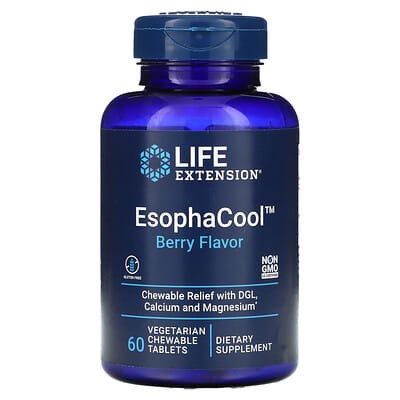
Life Extension EsophaCool combines chewable minerals and deglycyrrhizinated licorice for upper-digestive comfort. Two tablets provide 75 mg of GutGard licorice extract and 200 mg each of calcium and magnesium, although the licorice amount is half the daily amount associated with the supplied evidence for short-term comfort.
AI assessment of the formula, label and price. How scoring works
Nutrient Quality25
Calcium and magnesium are listed as carbonate sources, with less favorable form quality for magnesium. The named GutGard extract identifies the licorice preparation, although its form quality cannot be assessed further.
Ingredient Transparency75
The label provides amounts for all three active ingredients, distinguishing elemental mineral amounts from carbonate compound weights. Specific mineral-form details are less complete.
Value For Money62
The mineral quantities offer moderate to good comparative value. The value of the licorice extract, central to the digestive purpose, cannot be established separately.
Customer Satisfaction70
The average rating of 4.5 out of 5 indicates generally favorable feedback. The 251 ratings provide a useful basis for judging customer experience.
Product Focus60
Upper-digestive comfort is the clearest intended use, mainly through its licorice extract. The calcium and magnesium add nutritional roles, but the formula has a less direct fit for its other assessed goals.
- Format
Tablet - Container
- 60 Tablet(s)
- Per serving
- $0.30
- Customer rating
- 4.5 · 251 ratings
Goals

Impact
High effect
Magnesium · 200 mg
EsophaCool is most relevant to upper-digestive comfort through its identified GutGard licorice extract. The 75 mg serving provides half the daily amount associated with the supplied short-term symptom support. Its 200 mg magnesium declaration gives a smaller bowel-water contribution, with the carbonate source kept separate from the elemental amount.

Impact
High effect
Magnesium · 200 mg
EsophaCool has a narrower everyday-health role through its magnesium content. Magnesium at 200 mg contributes to normal energy metabolism. The directions describe use as needed, so repeated daily servings are not assumed.
Magnesium Supportive

Impact
Moderate effect
Magnesium · 200 mg
Magnesium Supportive

Impact
Moderate effect
Magnesium · 200 mgCalcium · 200 mg
EsophaCool has a limited bone-health fit through its magnesium rather than a complete bone-support formula. The assessed serving supplies 200 mg of magnesium for normal bone metabolism and a smaller 200 mg calcium contribution to mineral intake. Its as-needed directions should not be turned into a fixed daily mineral regimen.
Calcium Supportive
Magnesium Supportive


Impact
Moderate effect
Magnesium · 200 mg
Magnesium Supportive

Impact
Moderate effect
Magnesium · 200 mg
Magnesium Supportive
Ingredients
| Ingredient | Amount per serving | Score |
|---|---|---|
Calcium | 200 mg | |
Magnesium | 200 mg | |
GutGard Deglycyrrhizinated Licorice (DGL) extract (Total Flavonoids) | 75 mg |
Magnesium · 200 mg OverallScore57
Life Extension EsophaCool provides a stated amount of magnesium: 200 mg per serving. The magnesium comes as Magnesium Carbonate. The full formula costs $0.30 per serving, or $0.15 per 100 mg of magnesium.
Alternative products
Report alternatives
Sources
Published studies used for the product analysis and the top-ranked studies for each ingredient and goal.
- What is the impact of daily oral supplementation of vitamin D3 (cholecalciferol) plus calcium on the incidence of hip fracture in older people? A systematic review and meta-analysis.
- Calcium supplementation prevents seasonal bone loss and changes in biochemical markers of bone turnover in elderly New England women: a randomized placebo-controlled trial.
- The effects of calcium supplementation (milk powder or tablets) and exercise on bone density in postmenopausal women.
- The efficacy of calcium supplementation alone in elderly Thai women over a 2-year period: a randomized controlled trial.
- Calcium-enriched foods and bone mass growth in prepubertal girls: a randomized, double-blind, placebo-controlled trial.
- Association between Serum Magnesium and Fractures: A Systematic Review and Meta-Analysis of Observational Studies.
- Bioabsorbable Magnesium-Based Materials Potential and Safety in Bone Surgery: A Systematic Review.
- Vascularized bone grafting fixed by biodegradable magnesium screw for treating osteonecrosis of the femoral head.
- An update on magnesium and bone health.
- Sex-specific differences in the association of magnesium intake with femoral neck bone mineral density among older adults.
- Circulating and dietary magnesium and risk of cardiovascular disease: a systematic review and meta-analysis of prospective studies.
- Magnesium and the risk of cardiovascular events: a meta-analysis of prospective cohort studies.
- Quantitative Association Between Serum/Dietary Magnesium and Cardiovascular Disease/Coronary Heart Disease Risk: A Dose-Response Meta-analysis of Prospective Cohort Studies.
- Comparative Efficacy of Nutraceuticals on Endothelial Function: A Systematic Review and Network Meta-Analysis.
- Serum magnesium, mortality, and cardiovascular disease in chronic kidney disease and end-stage renal disease patients: a systematic review and meta-analysis.
- Magnesium-L-threonate improves sleep quality and daytime functioning in adults with self-reported sleep problems: A randomized controlled trial.
- Total magnesium intake and risk of frailty in older women.
- Red blood cell magnesium and chronic fatigue syndrome.
- Exercise, magnesium and immune function.
- Perioperative systemic magnesium to minimize postoperative pain: a meta-analysis of randomized controlled trials.