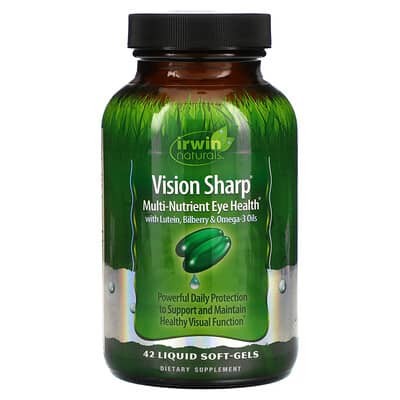
Vision Sharp Multi-Nutrient Eye Health

Vision Sharp Multi-Nutrient Eye Health

Irwin Naturals4.5 (2,571 ratings)
Format:Softgel Quantity: 42 Softgel(s) · 21 servings
Goals

Product analysis

47 out of 100

Vision Sharp Multi-Nutrient Eye Health provides lutein that contributes to the light-filtering pigment in the retina. The fish-oil total does not identify the amounts of its main active fats, making that part of the formula difficult to compare.

AI assessment of the formula, label and price. How scoring works

Nutrient Quality20

Most ingredient forms are unspecified, preventing a close comparison of quality. The fish-oil form is also unclear, so its relative absorption quality cannot be judged confidently.

Ingredient Transparency66

Most amounts and several mixture breakdowns are disclosed. Many forms remain unspecified, and the completeness of one additional mixture cannot be established.

Value For Money39

The flavonoid contribution offers limited value for its amount. Most other comparisons, including the cost for the main fish-oil fats, remain uncertain.

Customer Satisfaction80

Customer ratings are favorable across a substantial review base. They describe satisfaction without establishing vision or focus benefits.

Product Focus54

Lutein gives the formula its clearest connection to eye health. The broader focus and cognitive uses are less certain because ginkgo findings are mixed and fish-oil mass does not establish a DHA amount.

Format
Softgel
Container
42 Softgel(s)
Per serving
$1.19
Customer rating
4.5 · 2,571 ratings
Report analysis

Goals

Impact
High effect
C Ingredient FitB- PathwaysA+ EvidenceA+ Formulation Logic
Zinc · 15 mgVitamin E · 80 mgVitamin C · 400 mgVitamin A · 8600 mcg

Lutein provides a focused connection to macular pigment and blue-light filtering. The separately recorded 10 mg per serving supports that connection, while the 2 mg zeaxanthin receives no separate contribution in the saved result. Bilberry’s screen-fatigue findings concern Omnica specifically; this preparation is not matched to it. Vitamin A supports the visual cycle and dark adaptation when intake is low; correcting deficiency can address night blindness. More vitamin A does not establish better vision once intake is adequate.

How this product is rated for Eye Health

Ingredient fit62

The formula’s relevant ingredients give a partial connection to vision support, with serving amounts determining how much each contributes.
Goal fit
The relevant ingredients share the formula with other actives, so its focus extends beyond vision support.
Dose adequacy
The recorded amounts give partial or uneven support, with unresolved amounts contributing no dose support.

Pathways73

The strongest assigned connection is macular pigment and blue-light filtering, a narrower finding than improvement in overall vision.
Depth
The strongest assigned connection is macular pigment and blue-light filtering, a narrower finding than improvement in overall vision.
Breadth
The findings cover both antioxidant defense and a second visual mechanism, while other aspects remain less supported.

Evidence99

Lutein anchors this finding, with the limits of its studied population and intervention still applying.
Evidence strength
Lutein anchors this finding, with the limits of its studied population and intervention still applying.
Studied preparation
Bilberry is not matched to the specific preparation used for screen-fatigue outcomes; other recognized preparation matches do not remove that limitation.

Formulation logic96

No conflict is identified by the evaluated rules. Partner requirements are satisfied, with amounts varying in their relevance.
Partner coverage
The evaluated ingredients work alone or have the required partner; no extra benefit from combining them is established.
Conflicts
No conflict is identified by the evaluated rules.
Effective doses
Ginkgo lacks enough resolved amount for inclusion; the other counted ingredients meet the saved amount threshold.
Study evidence
Flavonoid Supportive 5 studies
Ginkgo Supportive 11 studies
Vitamin A Supportive 65 studies
Vitamin C Disputed 24 studies
Vitamin E Disputed 35 studies
Zinc Supportive 39 studies
Mental Focus
Impact
Moderate effect
C- Ingredient FitD- PathwaysC EvidenceA+ Formulation Logic

Ginkgo at 120 mg is the main ingredient with an attention-related role, although the evidence is mixed. Zinc supports normal nutrient functions, with any concentration benefit depending on nutritional need rather than a predictable immediate effect.

How this product is rated for Mental Focus

Ingredient fit59

Focus-related ingredients sit within a broader formula containing ingredients for other purposes. The ingredients counted in the saved assessment meet its reference amounts.
Goal fit
Focus-related ingredients sit within a broader formula containing ingredients for other purposes.
Dose adequacy
The ingredients counted in the saved assessment meet its reference amounts.

Pathways44

The strongest saved connection is cerebral energy supply, with partial coverage. One assessed mechanism reaches the saved coverage threshold, so the focus support is relatively narrow.
Depth
The strongest saved connection is cerebral energy supply, with partial coverage.
Breadth
One assessed mechanism reaches the saved coverage threshold, so the focus support is relatively narrow.

Evidence62

Ginkgo provides the strongest evidence contribution among the ingredients meeting the saved amount criteria; that finding does not guarantee a focus benefit. The ingredients counted at relevant amounts match the preparations accepted by the saved assessment.
Evidence strength
Ginkgo provides the strongest evidence contribution among the ingredients meeting the saved amount criteria; that finding does not guarantee a focus benefit.
Studied preparation
The ingredients counted at relevant amounts match the preparations accepted by the saved assessment.

Formulation logic100

The counted ingredients can contribute independently or have their relevant partner present. No configured ingredient conflict was identified in the saved findings. All ingredients counted in this finding reach its minimum amount threshold.
Partner coverage
The counted ingredients can contribute independently or have their relevant partner present.
Conflicts
No configured ingredient conflict was identified in the saved findings.
Effective doses
All ingredients counted in this finding reach its minimum amount threshold.
Study evidence
Ginkgo Supportive 28 studies
Zinc Mixed 16 studies
Brain Health
Impact
Moderate effect
D+ Ingredient FitD- PathwaysC- EvidenceA+ Formulation Logic

Ginkgo at 120 mg offers a limited, preparation-dependent connection to cognitive function. Zinc supports normal nutrition, while the declared fish oil amount cannot be treated as a DHA amount; broad memory improvement is uncertain.

How this product is rated for Brain Health

Ingredient fit53

The relevant ingredients sit within a broader formula with other nutritional or performance purposes. The relevant amounts provide a reasonable but incomplete match to the comparison amounts.
Goal fit
The relevant ingredients sit within a broader formula with other nutritional or performance purposes.
Dose adequacy
The relevant amounts provide a reasonable but incomplete match to the comparison amounts.

Pathways43

The strongest connection is cerebral energy metabolism, with a meaningful but partial contribution. The meaningful contribution is concentrated in one assessed brain-related function.
Depth
The strongest connection is cerebral energy metabolism, with a meaningful but partial contribution.
Breadth
The meaningful contribution is concentrated in one assessed brain-related function.

Evidence58

Ginkgo supplies the strongest relevant support, with limited grounds for broad cognitive claims. The saved assessment finds a match to studied preparations for the ingredients at relevant amounts.
Evidence strength
Ginkgo supplies the strongest relevant support, with limited grounds for broad cognitive claims.
Studied preparation
The saved assessment finds a match to studied preparations for the ingredients at relevant amounts.

Formulation logic100

The assessed ingredients can contribute on their own or have their required partner. No configured ingredient conflict was identified in the supplied assessment. 2 of 2 assessed ingredients meet the saved minimum amount threshold.
Partner coverage
The assessed ingredients can contribute on their own or have their required partner.
Conflicts
No configured ingredient conflict was identified in the supplied assessment.
Effective doses
2 of 2 assessed ingredients meet the saved minimum amount threshold.
Study evidence
Ginkgo Supportive 90 studies
Zinc Supportive 38 studies
Productivity Boost
Impact
Moderate effect
D Ingredient FitD- PathwaysA EvidenceA+ Formulation Logic
Zinc · 15 mgOmega-3 · 303 mg

Zinc provides nutritional support, while ginkgo at 120 mg relates to mixed cognitive findings. The omega-3 declaration does not add a demonstrated everyday work benefit in the supplied evidence. The saved contribution is concentrated in nerve-cell support rather than alertness.

How this product is rated for Productivity Boost

Ingredient fit45

Only part of this broader formula aligns specifically with productivity support. The amounts provide partial alignment with the saved exposure comparison.
Goal fit
Only part of this broader formula aligns specifically with productivity support.
Dose adequacy
The amounts provide partial alignment with the saved exposure comparison.

Pathways44

The main saved contribution concerns nerve-cell support. One mechanism has meaningful coverage; the contribution is concentrated rather than broad.
Depth
The main saved contribution concerns nerve-cell support.
Breadth
One mechanism has meaningful coverage; the contribution is concentrated rather than broad.

Evidence91

Zinc provides the strongest assessed evidence contribution at its amount. The ingredients counted at adequate amounts match the saved preparation criteria.
Evidence strength
Zinc provides the strongest assessed evidence contribution at its amount.
Studied preparation
The ingredients counted at adequate amounts match the saved preparation criteria.

Formulation logic100

All 2 assessed ingredients meet the saved minimum amount comparison. No conflict was identified by the supplied ingredient checks.
Partner coverage
The assessed ingredients work independently or have their required partner.
Conflicts
No conflict was identified by the supplied ingredient checks.
Effective doses
All 2 assessed ingredients meet the saved minimum amount comparison.
Study evidence
Ginkgo Supportive 20 studies
Omega-3 Supportive 46 studies
Zinc Supportive 11 studies
Inflammation
Impact
Moderate effect
D Ingredient FitD+ PathwaysA+ EvidenceA Formulation Logic
Fish Oil · 1010 mgVitamin E · 80 mgVitamin C · 400 mg

Vitamin C and vitamin E relate to antioxidant defenses, while zinc may help address a nutritional gap. Fish oil is present, but its total mass alone cannot be treated as a defined EPA and DHA dose. Ginger is present without a resolved amount, so its contribution is uncertain.

How this product is rated for Inflammation

Ingredient fit46

Relevant ingredients share the formula with ingredients intended for other purposes, making the saved goal focus less concentrated. The assessed amounts provide partial support against the saved dose references; the saved dose assessment is 44.7 out of 100.
Goal fit
Relevant ingredients share the formula with ingredients intended for other purposes, making the saved goal focus less concentrated.
Dose adequacy
The assessed amounts provide partial support against the saved dose references; the saved dose assessment is 44.7 out of 100.

Pathways51

The strongest saved coverage concerns oxidative and mitochondrial stress, with substantial coverage. One assessed mechanism reaches the saved coverage threshold, so support remains concentrated in one aspect of the goal.
Depth
The strongest saved coverage concerns oxidative and mitochondrial stress, with substantial coverage.
Breadth
One assessed mechanism reaches the saved coverage threshold, so support remains concentrated in one aspect of the goal.

Evidence96

Vitamin E leads the saved evidence assessment at an assessed amount. The finding reflects the supplied comparison, not a promise of benefit. The saved assessment identifies the qualifying ingredients as matching its studied-preparation category.
Evidence strength
Vitamin E leads the saved evidence assessment at an assessed amount. The finding reflects the supplied comparison, not a promise of benefit.
Studied preparation
The saved assessment identifies the qualifying ingredients as matching its studied-preparation category.

Formulation logic94

The assessed ingredients can work independently or have their listed partner. Three of four assessed ingredients reach the saved dose threshold; ginger does not.
Partner coverage
The assessed ingredients can work independently or have their listed partner.
Conflicts
No ingredient conflict is recorded in the saved assessment.
Effective doses
Three of four assessed ingredients reach the saved dose threshold; ginger does not.
Study evidence
Fish Oil Supportive 68 studies
Ginger Supportive 30 studies
Vitamin C Supportive 50 studies
Vitamin E Supportive 20 studies
Zinc Supportive 64 studies
Impact
Moderate effect
D Ingredient FitD+ PathwaysB- EvidenceA+ Formulation Logic
Fish Oil · 1010 mgVitamin E · 80 mgVitamin C · 400 mg

Vision Sharp Multi-Nutrient Eye Health lists 400 mg vitamin C and 80 mg vitamin E, which provide the saved route to vessel-wall oxidative protection. That is a narrow marker link, not evidence of fewer cardiovascular events. Many other actives are outside this goal, and the fish-oil label does not state active EPA/DHA amounts.

How this product is rated for Cardiovascular Support

Ingredient fit50

Vitamin C and E provide the clearest cardiovascular connection, while many other listed actives are outside this goal.
Goal fit
The relevant vitamins connect to oxidative protection, but numerous unrelated actives and linked goals dilute focus.
Dose adequacy
Vitamin C and E have disclosed serving amounts; the fish-oil label does not identify active EPA/DHA amounts.

Pathways53

The saved contribution is focused on LDL and vessel-wall oxidative protection, with little breadth.
Depth
Oxidative protection is the most covered route, from the counted vitamin amounts.
Breadth
Only oxidative protection reaches the level needed to count as covered.

Evidence72

Vitamin C has the strongest evidence among the counted ingredients, and both relevant preparations are represented in studies.
Evidence strength
Vitamin C has the strongest evidence here, but stronger evidence is available for another ingredient in this goal.
Studied preparation
Both counted vitamin preparations at relevant amounts are represented in studies.

Formulation logic100

The counted vitamins work alone or with listed partners, and no conflict trigger is matched.
Partner coverage
Each ingredient counted for this goal works alone or has its needed partner.
Conflicts
The saved ingredients trigger no cardiovascular conflict penalty.
Effective doses
Both counted vitamin amounts reach the minimum level used in this comparison.
Study evidence
Fish Oil Supportive 185 studies
Vitamin C Supportive 101 studies
Vitamin E Mixed 79 studies
Cognitive Support
Impact
Moderate effect
D+ Ingredient FitD- PathwaysF EvidenceA+ Formulation Logic

Ginkgo is relevant to selected attention tasks and cerebral blood flow, with limited confidence because the 120 mg extract is unidentified. Zinc adds nutritional support with mixed cognitive findings; fish-oil mass alone does not establish a DHA dose.

How this product is rated for Cognitive Support

Ingredient fit52

A substantial part of the formula addresses needs outside cognitive support. The relevant amounts provide substantial but incomplete exposure support.
Goal fit
A substantial part of the formula addresses needs outside cognitive support.
Dose adequacy
The relevant amounts provide substantial but incomplete exposure support.

Pathways40

Cerebral blood flow is the strongest supported mechanism, with moderate coverage. One cognitive mechanism reaches the saved coverage target; support across other mechanisms is limited.
Depth
Cerebral blood flow is the strongest supported mechanism, with moderate coverage.
Breadth
One cognitive mechanism reaches the saved coverage target; support across other mechanisms is limited.

Evidence40

Ginkgo provides the strongest evidence contribution among the ingredients counted at a sufficient amount. Its support remains specific to the supplied cognitive findings. Some counted preparations match the studied forms; Ginkgo remain unmatched.
Evidence strength
Ginkgo provides the strongest evidence contribution among the ingredients counted at a sufficient amount. Its support remains specific to the supplied cognitive findings.
Studied preparation
Some counted preparations match the studied forms; Ginkgo remain unmatched.

Formulation logic100

The counted ingredients can contribute independently or have their required partner. No configured ingredient conflict was identified in the supplied findings. 2 of 2 counted ingredients meet the saved minimum exposure threshold.
Partner coverage
The counted ingredients can contribute independently or have their required partner.
Conflicts
No configured ingredient conflict was identified in the supplied findings.
Effective doses
2 of 2 counted ingredients meet the saved minimum exposure threshold.
Study evidence
Ginkgo Supportive 87 studies
Zinc Supportive 48 studies

Ingredients

IngredientAmount per servingScore
Calories
20 Calorie(s)
Total Fat
1 Gram(s)
Cholesterol
5 mg
Total Carbohydrates
1 Gram(s)
Protein
1 Gram(s)
Vitamin A (Beta-Carotene)
8600 mcg
Vitamin C (Ascorbic Acid)
400 mg
Vitamin E (D-Alpha-Tocopherol)
80 mg
Zinc (Zinc Oxide)
15 mg
Manganese (Manganese Aspartate)
2 mg 70
Fish Oil (Anchovy, Sardine)
1010 mg 10
Omega-3 Fatty Acids
303 mg 27
Bilberry Fruit Extract
320 mg
Anthocyanidins
80 mg
Ginkgo leaf extract
120 mg 85
Flavone Glycosides
29 mg
Terpene Lactones
7.2 mg
Citrus Bioflavonoids (Citrus spp.)
38 mg
Bioflavonoids
30 mg 53
Lutein
10 mg
Zeaxanthin
2 mg
BioPerine Complex
12 mg
BioPerine (Black Pepper Fruit Extract)
0 NP
Ginger Rhizome Extract (Gingerols)
0 NP
Adults 18–50 Women
Report overview
Flavonoid · 30 mg OverallScore53
F Active Ingredient Quality & BioavailabilityB+ Dose, Safety & Label TransparencyF Value
Each serving declares 38 mg of flavonoid ingredient. The whole-product price works out to about $3.13 per 100 mg of that declared ingredient, relatively high for the amount.
How this ingredient is rated

Active Ingredient Quality & Bioavailability35

The flavonoid preparation and active-marker concentration are not established in the available facts. A secondary absorption-enhancing ingredient is identified, without establishing its effect on flavonoids.
Standardization and Active Marker Disclosure
The available facts do not establish a flavonoid marker percentage, extract ratio, or raw-powder source.
Bioavailability and Delivery Technology
The evaluation identifies a secondary absorption-enhancing ingredient; its effect on flavonoid absorption is not established here.

Dose, Safety & Label Transparency82

The declared flavonoid ingredient amount is 38 mg per serving; it does not establish individual compound amounts.
Declared Flavonoid Ingredient Amount
Each serving declares 38 mg of flavonoid ingredient.
Label Transparency and Blend Clarity
The 38 mg aggregate amount per serving is disclosed; individual flavonoid amounts are not established.

Value30

The whole-product price works out to about $3.13 per 100 mg of declared flavonoid ingredient.
Price per 100mg Declared Flavonoid Ingredient
The whole-product price works out to about $3.13 per 100 mg of declared flavonoid ingredient.
Ginkgo · 120 mg OverallScore85
B- Composition And Label DisclosureA+ Composition And Label Disclosure
The serving lists 120 mg of ginkgo leaf extract. The saved details report 24% flavones and 6% terpenes for that preparation.
How this ingredient is rated

Composition and Label Disclosure70

The saved details report 24% flavones and 6% terpenes for the ginkgo preparation. The saved facts contain no qualifying ginkgolic-acid limit declaration; they do not establish its concentration.
Marker and Preparation Disclosure
The saved details report 24% flavones and 6% terpenes for the ginkgo preparation.
Declared Ginkgolic Acid Limit
The saved facts contain no qualifying ginkgolic-acid limit declaration; they do not establish its concentration.

Composition and Label Disclosure100

The serving lists 120 mg of ginkgo leaf extract.
Individual Preparation Amount Disclosure
The serving lists 120 mg of ginkgo leaf extract.

Commercial Price and Usability

The evaluation does not include a price comparison for ginkgo.
B+ Active Ingredient Quality & BioavailabilityA- Dose, Safety & Label TransparencyF Value
A serving of 2 softgels provides 2 mg of manganese as manganese aspartate. The whole-product serving costs about $1.19.
How this ingredient is rated

Active Ingredient Quality & Bioavailability80

Manganese Aspartate is a named organic acid salt.
Manganese Chemical Form
Manganese Aspartate is a named organic acid salt.

Dose, Safety & Label Transparency86

The manganese amount is stated as 2 mg per 2 softgels serving.
Manganese Dosage Efficacy & Safety
A serving provides 2 mg of manganese.
Elemental Weight Disclosure
The saved facts specify 2 mg of manganese itself per serving.

Value20

A whole-product serving costs about $1.19 and provides 2 mg of manganese.
Price per Serving vs. Median
A whole-product serving costs about $1.19 and provides 2 mg of manganese.
Report alternatives

Sources

Published studies used for the product analysis and the top-ranked studies for each ingredient and goal.

  1. Efficacy and adverse effects of ginkgo biloba for cognitive impairment and dementia: a systematic review and meta-analysis.
    Tan MS; Yu JT; Tan CC; Wang HF; Meng XF; Wang C; Jiang T; Zhu XC; Tan L · Journal of Alzheimer's disease : JAD · 2015
    Meta-analysis2,561 participants9 studies pooledBrain Health forGinkgo
  2. Efficacy of Ginkgo biloba extract EGb 761® in dementia with behavioural and psychological symptoms: A systematic review.
    von Gunten A; Schlaefke S; Überla K · The world journal of biological psychiatry : the official journal of the World Federation of Societies of Biological Psychiatry · 2017
    Meta-analysis1,628 participants4 studies pooledBrain Health Cognitive Support forGinkgo
  3. Ginkgo biloba extract EGb 761 is safe and effective in the treatment of mild dementia - a meta-analysis of patient subgroups in randomised controlled trials.
    Riepe M; Hoerr R; Schlaefke S · The world journal of biological psychiatry : the official journal of the World Federation of Societies of Biological Psychiatry · 2025
    Meta-analysis782 participants4 studies pooledBrain Health Productivity Boost forGinkgo
  4. Ginkgo biloba extract EGb 761® improves cognition and overall condition after ischemic stroke: Results from a pilot randomized trial.
    Cui M; You T; Zhao Y; Liu R; Guan Y; Liu J; Liu X; Wang X; Dong Q · Frontiers in pharmacology · 2023
    Randomized trial201 participantsBrain Health Productivity Boost forGinkgo
  5. Ginkgo biloba extract EGb 761® in dementia with neuropsychiatric features: a randomised, placebo-controlled trial to confirm the efficacy and safety of a daily dose of 240 mg.
    Herrschaft H; Nacu A; Likhachev S; Sholomov I; Hoerr R; Schlaefke S · Journal of psychiatric research · 2012
    Randomized trial410 participantsBrain Health forGinkgo
  6. Efficacy of Zinc Supplement in Minimal hepatic Encephalopathy: A prospective, Randomized Controlled Study (Zinc-MHE Trial).
    Janyajirawong R; Vilaichone RK; Sethasine S · Asian Pacific journal of cancer prevention : APJCP · 2021
    Randomized trial69 participantsBrain Health Cognitive Support forZinc
  7. A preliminary report: effects of zinc and micronutrient repletion on growth and neuropsychological function of urban Chinese children.
    Penland JG; Sandstead HH; Alcock NW; Dayal HH; Chen XC; Li JS; Zhao F; Yang JJ · Journal of the American College of Nutrition · 1997
    Randomized trial372 participantsBrain Health Cognitive Support forZinc
  8. Association between zinc deficiency and cognitive decline in community-dwelling older adults.
    Marchetti MF; Silva GMD; Freiria CN; Borim FSA; Brito TRP; Milanski M; Corona LP · Ciencia & saude coletiva · 2022
    Cross-sectional study591 participantsBrain Health forZinc
  9. Zinc status, psychological and nutritional assessment in old people recruited in five European countries: Zincage study.
    Marcellini F; Giuli C; Papa R; Gagliardi C; Dedoussis G; Herbein G; Fulop T; Monti D; Rink L; Jajte J; Mocchegiani E · Biogerontology · 2007
    Cross-sectional study853 participantsBrain Health forZinc
  10. Zinc alleviates stroke development through autophagy-mediated modulation of immune microenvironment.
    Qiu Z; Liu X; Li J; Yin H; Luo J; Lin Z; Rexiati M; Abulaiti A; Yasen A; Xing L; Aili D; Meng B; Li X; You Z; He J; Huang C; Qian Z; Chen J · Frontiers in immunology · 2025
    OtherBrain Health forZinc
  11. Marine Omega-3 Supplementation and Cardiovascular Disease: An Updated Meta-Analysis of 13 Randomized Controlled Trials Involving 127 477 Participants.
    Hu Y; Hu FB; Manson JE · Journal of the American Heart Association · 2020
    Meta-analysis127,477 participants13 studies pooledCardiovascular Support forFish Oil
  12. Impact of omega-3 fatty acids on hypertriglyceridemia, lipidomics, and gut microbiome in patients with type 2 diabetes.
    Lu J; Liu R; Ren H; Wang S; Hu C; Shi Z; Li M; Liu W; Wan Q; Su Q; Li Q; Zheng H; Qu S; Yang F; Ji H; Lin H; Qi H; Wu X; Wu K; Chen Y; Xu Y; Xu M; Wang T; Zheng J; Ning G; Zheng R; Bi Y; Zhong H; Wang W · Med (New York, N.Y.) · 2025
    Randomized trial309 participantsCardiovascular Support forFish Oil
  13. A systematic review of fish-oil supplements for the prevention and treatment of hypertension.
    Campbell F; Dickinson HO; Critchley JA; Ford GA; Bradburn M · European journal of preventive cardiology · 2013
    Meta-analysis1,524 participants17 studies pooledCardiovascular Support forFish Oil
  14. Effects of fish oil-derived fatty acids on suboptimal cardiovascular health: A multicenter, randomized, double-blind, placebo-controlled trial.
    Zeng Q; Dong SY; Liu YP; Fu J; Shuai P; Zhao ZM; Li TX · Nutrition, metabolism, and cardiovascular diseases : NMCD · 2017
    Randomized trial422 participantsCardiovascular Support forFish Oil
  15. Effect of High-Dose Marine Omega-3 Fatty Acids on Atherosclerosis: A Systematic Review and Meta-Analysis of Randomized Clinical Trials.
    Sekikawa A; Cui C; Sugiyama D; Fabio A; Harris WS; Zhang X · Nutrients · 2020
    Meta-analysis6 studies pooledCardiovascular Support forFish Oil
  16. Vitamin C may reduce troponin and CKMB levels after PCI and CABG: a meta-analysis.
    Rozemeijer S; Hemilä H; van Baaren M; de Man AME · BMC cardiovascular disorders · 2023
    Meta-analysis872 participants7 studies pooledCardiovascular Support forVitamin C
  17. Vitamin C improves endothelium-dependent vasodilation by restoring nitric oxide activity in essential hypertension.
    Taddei S; Virdis A; Ghiadoni L; Magagna A; Salvetti A · Circulation · 1998
    Clinical trial49 participantsCardiovascular Support forVitamin C
  18. Vitamin C supplementation improves blood pressure and oxidative stress after acute exercise in patients with poorly controlled type 2 diabetes mellitus: A randomized, placebo-controlled, cross-over study.
    Boonthongkaew C; Tong-Un T; Kanpetta Y; Chaungchot N; Leelayuwat C; Leelayuwat N · The Chinese journal of physiology · 2021
    Randomized trial24 participantsCardiovascular Support forVitamin C
  19. Vascular benefits of vitamin C supplementation against fine particulate air pollution in healthy adults: A double-blind randomised crossover trial.
    Ren J; Liang J; Wang J; Yin B; Zhang F; Li X; Zhu S; Tian H; Cui Q; Song J; Liu G; Ling W; Ma Y · Ecotoxicology and environmental safety · 2022
    Randomized trial58 participantsCardiovascular Support forVitamin C
  20. Ascorbic acid reduces blood pressure and arterial stiffness in type 2 diabetes.
    Mullan BA; Young IS; Fee H; McCance DR · Hypertension (Dallas, Tex. : 1979) · 2003
    Randomized trial30 participantsCardiovascular Support forVitamin C