
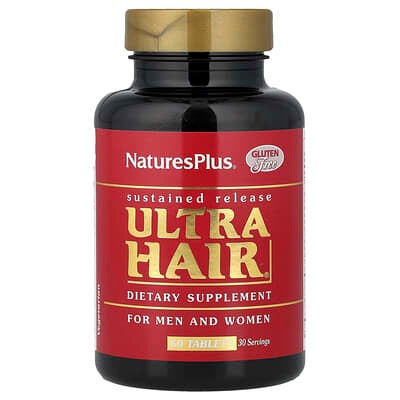

$23.33 $0.77 per serving


Product analysis
Ultra Hair provides vitamins that support normal hair and skin nutrition, with the clearest benefits when intake is low. The wider blend mainly offers nutritional support rather than established regrowth for people already getting enough.
AI assessment of the formula, label and price. How scoring works
Nutrient Quality58
Several vitamin forms are clearly identified, including a favorable folate form. Other preparations are unspecified or insufficiently characterized, so quality varies across the blend.
Ingredient Transparency89
All ingredient amounts and most forms are stated, making basic serving comparisons straightforward. Missing preparation details make several parts of the blend harder to compare.
Value For Money38
Value is uneven, with B6 and vitamin A comparing favorably while several other vitamins look costly. Uncertainty about zinc and inositol leaves additional limits on judging the whole blend.
Customer Satisfaction76
Customer ratings are positive across nearly a thousand reviews. They describe satisfaction without establishing hair regrowth or the safety of large nutrient amounts.
Product Focus56
The clearest benefits involve filling nutrient gaps that affect normal hair, skin and metabolic functions. B6 reaches 100 mg per serving, a high amount that raises a suitability concern without establishing extra benefit.
- Format
Tablet - Container
- 60 Tablet(s)
- Per serving
- $0.77
- Also available
 Ultra Hair$32.94
- Customer rating
- 4.5 · 974 ratings
Goals


Impact
Highest effect
Folate · 400 mcgZinc · 5 mgVitamin C · 500 mg

Impact
High effect
Zinc · 5 mgVitamin C · 500 mg

Impact
Moderate effect
Vitamin B5 · 500 mgRiboflavin · 100 mgThiamin · 30 mg
Vitamin B5 Not classified
No linked studies yet.

Impact
Moderate effect
Vitamin C · 500 mgZinc · 5 mgVitamin A · 10000 IU
L-Cysteine Not classified
No linked studies yet.

Impact
High effect
Folate · 400 mcgVitamin B6 · 100 mgZinc · 5 mgVitamin C · 500 mgCholine · 210 mgRiboflavin · 100 mg
L-Cysteine Not classified
No linked studies yet.
Riboflavin Not classified
No linked studies yet.
Vitamin B6 Not classified
No linked studies yet.
Ingredients
| Ingredient | Amount per serving | Score |
|---|---|---|
Vitamin A (Beta-Carotene) | 10000 IU | |
Vitamin C (Ascorbic Acid) | 500 mg | |
Thiamine (Thiamine Hydrochloride) | 30 mg | |
Riboflavin | 100 mg | |
Niacin (Niacinamide) | 30 mg | |
Vitamin B6 (Pyridoxine Hydrochloride) | 100 mg | |
Folate (Calcium L-5-Methyltetrahydrofolate) | 400 mcg | |
Biotin | 2000 mcg | |
Pantothenic Acid (Calcium Pantothenate) | 500 mg | |
Zinc (Zinc Soy Amino Acid Chelate) | 5 mg | |
Inositol | 500 mg | |
Choline (Choline Bitartrate) | 210 mg | |
PABA | 100 mg | |
L-Cysteine | 100 mg |
PABA · 100 mg OverallScore80
100 mg of PABA per serving comes at a high cost per 100 mg. PABA is named, but no purity grade is specified. The Other Ingredients list has no artificial colors, titanium dioxide, or hydrogenated oils.
How this ingredient is rated
Active Ingredient Quality & Bioavailability80
PABA is named, but no pharmaceutical grade or high-purity designation is given.
PABA Source & Grade
PABA is named without a stated purity grade.
Dose, Safety & Label Transparency100
The amount is clearly stated at 100 mg per serving. The Other Ingredients list has no artificial colors, titanium dioxide, or hydrogenated oils.
PABA Dosage Alignment
The serving supplies 100 mg of PABA.
Label Disclosure Clarity
The PABA amount is separately stated as 100 mg per serving.
Additive and Excipient Quality
The Other Ingredients list has no artificial colors, titanium dioxide, or hydrogenated oils.
Value40
The cost per 100 mg of PABA is high.
Price per 100mg PABA
The cost per 100 mg of PABA is high.
Folate (Calcium L-5-Methyltetrahydrofolate) · 400 mcg OverallScore84
A serving lists 400 mcg of folate at a high cost per serving. It uses L-5-methyltetrahydrofolate calcium. The L form bypasses the MTHFR conversion step.
How this ingredient is rated
Active Ingredient Quality & Bioavailability91
The folate uses L-5-methyltetrahydrofolate calcium. It is an active form that bypasses the MTHFR conversion step.
Folate Form Hierarchy
It is an active form that bypasses the MTHFR conversion step.
Patented Sources & Isomeric Purity
The L designation indicates the active isomer; no named branded source is identified.
Dose, Safety & Label Transparency100
The serving declares 400 mcg of folate.
Folate Dosage by Declared Basis
The serving declares 400 mcg of folate.
Value40
The cost per serving is high.
Price per Bioavailable Serving
The cost per serving is high.
Vitamin B5 (Calcium Pantothenate) · 500 mg OverallScore80
A serving provides 500 mg of vitamin B5. The estimated cost for the amount of B5 is high, based on the full serving price. Calcium Pantothenate is a stable, well-absorbed form of B5.
How this ingredient is rated
Active Ingredient Quality & Bioavailability90
Calcium Pantothenate is a stable, well-absorbed form of B5.
Vitamin B5 Chemical Form
Calcium Pantothenate is a stable, well-absorbed form of B5.
Dose, Safety & Label Transparency100
A serving provides 500 mg of vitamin B5. The B5 amount and its Calcium Pantothenate source are specified.
Dosage Potency and Efficacy
A serving provides 500 mg of vitamin B5.
Label Transparency & Source Clarity
The B5 amount and its Calcium Pantothenate source are specified.
Value20
The estimated cost for the amount of B5 is high, based on the full serving price.
Price per 500mg Vitamin B5
The estimated cost for the amount of B5 is high, based on the full serving price.
Alternative products
Report alternatives
Sources
Published studies used for the product analysis and the top-ranked studies for each ingredient and goal.
- Physicochemical properties of and volatile compounds in riboflavin fortified cloudy apple juice; study of its effect on job fatigue among Egyptian construction workers.
- Vitamin B status in patients with chronic fatigue syndrome.
- B-vitamins, related vitamers, and metabolites in patients with quiescent inflammatory bowel disease and chronic fatigue treated with high dose oral thiamine.
- Metabolic features of chronic fatigue syndrome.
- Effectiveness of Riboflavin in Inherited Metabolic Diseases: A Systematic Review
- Influence of thiamin supplementation on the health and general well-being of an elderly Irish population with marginal thiamin deficiency.
- Randomised clinical trial: high-dose oral thiamine versus placebo for chronic fatigue in patients with quiescent inflammatory bowel disease.
- Dietary reference values for thiamin.
- Effects of thiamine supplementation on exercise-induced fatigue.
- Long-term maintenance treatment with 300 mg thiamine for fatigue in patients with inflammatory bowel disease: results from an open-label extension of the TARIF study.
- Intakes of Folate, Vitamin B6, and Vitamin B12 in Relation to All-Cause and Cause-Specific Mortality: A National Population-Based Cohort.
- The responsiveness of plasma homocysteine to small increases in dietary folic acid: a primary care study.
- Associations of Serum Folate and Homocysteine Concentrations with All-Cause, Cardiovascular Disease, and Cancer Mortality in Men and Women in Korea: the Cardiovascular Disease Association Study.
- The concept of folic acid supplementation and its role in prevention of neural tube defect among pregnant women: PRISMA.
- Systematic review of adverse health outcomes associated with high serum or red blood cell folate concentrations.
- Dietary intake and blood concentrations of antioxidants and the risk of cardiovascular disease, total cancer, and all-cause mortality: a systematic review and dose-response meta-analysis of prospective studies.
- Scientific Opinion on the substantiation of a health claim related to vitamin C and increasing non haem iron absorption pursuant to Article 14 of Regulation (EC) No 1924/2006.
- Vitamin C Depletion and All-Cause Mortality in Renal Transplant Recipients.
- Associations of Serum Biomarkers of Fruit and Vegetable Intake With the Risk of Cause-Specific Mortality and All-Cause Mortality: A National Prospective Cohort Study.
- Relation between plasma ascorbic acid and mortality in men and women in EPIC-Norfolk prospective study: a prospective population study. European Prospective Investigation into Cancer and Nutrition.