
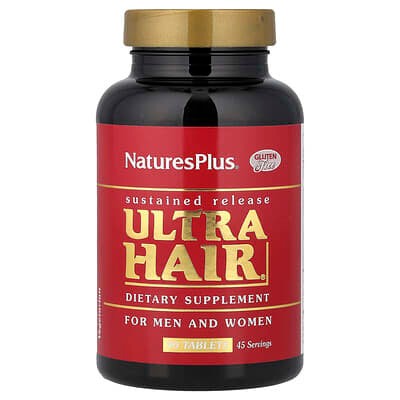

$32.94 $0.73 per serving


Product analysis
Ultra Hair provides nutrients that can help fill dietary gaps affecting normal hair maintenance and energy metabolism. Biotin-related hair benefits are most relevant to deficiency, while extra regrowth with adequate intake is uncertain.
AI assessment of the formula, label and price. How scoring works
Nutrient Quality59
Some B vitamins use favorable forms, while other forms are unspecified or remain uncertain. The mixture therefore offers uneven form quality rather than a consistent advantage across every ingredient.
Ingredient Transparency89
All listed amounts and most forms are identified. Several unspecified forms still limit a complete comparison with other hair-focused formulas.
Value For Money42
Value varies by nutrient, with favorable comparisons for vitamin A and B6 alongside weaker value for several others. Some ingredients also lack a clear price comparison, so the formula is not consistently economical.
Customer Satisfaction76
Customer ratings are generally positive across hundreds of reviews. That provides a useful picture of satisfaction without establishing hair regrowth.
Product Focus55
The main role is nutritional support, with hair benefits most relevant when intake is low. The high B6 serving is a concern for routine use, and larger amounts do not establish extra benefit.
- Format
Tablet - Container
- 90 Tablet(s)
- Per serving
- $0.73
- Also available
 Ultra Hair$23.33
- Customer rating
- 4.5 · 974 ratings
Goals

Impact
Moderate effect
Vitamin B5 · 500 mgRiboflavin · 100 mgThiamin · 30 mg
Thiamin, riboflavin, niacin, B5 and B6 support normal energy metabolism, while folate contributes to blood formation. Vitamin C also helps cover needs relevant to deficiency-related tiredness. The high vitamin amounts do not establish additional energy benefits once nutritional needs are met.
How this product is rated for Energy
Ingredient fit76
Energy-related nutrients form a substantial part of the assessed formula alongside other uses. The assessed amounts align closely with the full saved exposure comparisons; this is not proof of added energy.
Goal fit
Energy-related nutrients form a substantial part of the assessed formula alongside other uses.
Dose adequacy
The assessed amounts align closely with the full saved exposure comparisons; this is not proof of added energy.
Pathways0
The saved findings identify no coverage of the specific energy mechanisms assessed; the nutritional roles remain relevant. None of the assessed mechanisms reaches the saved coverage threshold.
Depth
The saved findings identify no coverage of the specific energy mechanisms assessed; the nutritional roles remain relevant.
Breadth
None of the assessed mechanisms reaches the saved coverage threshold.
Evidence78
Vitamin B2 (Riboflavin) provides the strongest saved evidence connection at the assessed amounts, without implying an energy benefit for every user. The ingredients included in the saved effective-amount comparison meet its preparation criteria; no extra benefit from a named form is implied.
Evidence strength
Vitamin B2 (Riboflavin) provides the strongest saved evidence connection at the assessed amounts, without implying an energy benefit for every user.
Studied preparation
The ingredients included in the saved effective-amount comparison meet its preparation criteria; no extra benefit from a named form is implied.
Formulation logic100
The assessed ingredients can stand alone or have the required partner present. No configured ingredient conflicts were identified in the supplied findings. 7 of 7 assessed ingredients meet the saved minimum exposure comparison, which does not guarantee an effect.
Partner coverage
The assessed ingredients can stand alone or have the required partner present.
Conflicts
No configured ingredient conflicts were identified in the supplied findings.
Effective doses
7 of 7 assessed ingredients meet the saved minimum exposure comparison, which does not guarantee an effect.
Vitamin B5 Not classified
No linked studies yet.

Impact
Moderate effect
Vitamin C · 500 mgZinc · 5 mgVitamin A · 10000 IU
Vitamin C at 500 mg and zinc at 5 mg support normal immune function. Folate and B6 add nutritional support, while the vitamin A amount remains unresolved.
How this product is rated for Immunity
Ingredient fit46
Relevant immune nutrients are part of a broader blend serving several purposes. Unresolved or smaller amounts limit the combined contribution.
Goal fit
Relevant immune nutrients are part of a broader blend serving several purposes.
Dose adequacy
Unresolved or smaller amounts limit the combined contribution.
Pathways40
The strongest saved contribution concerns innate immune-cell activity. One immune area reaches the saved coverage threshold; coverage remains selective.
Depth
The strongest saved contribution concerns innate immune-cell activity.
Breadth
One immune area reaches the saved coverage threshold; coverage remains selective.
Evidence100
Vitamin C provides the strongest evidence contribution in the saved assessment. The main practical benefit is supporting normal function rather than guaranteeing protection from infection. The assessed effective ingredients are accepted in the saved preparation assessment.
Evidence strength
Vitamin C provides the strongest evidence contribution in the saved assessment. The main practical benefit is supporting normal function rather than guaranteeing protection from infection.
Studied preparation
The assessed effective ingredients are accepted in the saved preparation assessment.
Formulation logic94
No configured ingredient conflict was identified. Three of four assessed contributors reach the saved minimum; vitamin A has no resolved amount.
Partner coverage
The assessed ingredients can contribute alone or have their required partner.
Conflicts
No configured ingredient conflict was identified.
Effective doses
Three of four assessed contributors reach the saved minimum; vitamin A has no resolved amount.
L-Cysteine Not classified
No linked studies yet.

Impact
High effect
Biotin · 2000 mcgZinc · 5 mgVitamin C · 500 mg
Biotin can help with hair changes caused by biotin deficiency, with limited evidence beyond deficiency and rare hair-shaft disorders. Cysteine provides building material for hair proteins, but its standalone hair benefit is unestablished. Vitamin C supports normal collagen formation; the zinc amount is too small to contribute to the saved findings.
How this product is rated for Hair Health
Ingredient fit74
The formula contains hair-relevant nutrients, but its focus and contributing amounts vary. The declared amounts do not by themselves establish hair growth.
Goal fit
The formula includes hair-relevant ingredients alongside ingredients directed at other goals.
Dose adequacy
Contributing amounts vary, with some below the saved comparison benchmarks.
Pathways60
The strongest recorded route is antioxidant-related, with limited breadth across the other specified routes.
Depth
Antioxidant-related ingredients provide the strongest recorded route; this does not establish follicular regrowth.
Breadth
Only the antioxidant-related route reaches the saved coverage benchmark.
Evidence80
Zinc is central to the saved evidence finding, while its supported hair role remains correction of inadequate intake. Preparation matches do not establish extra regrowth.
Evidence strength
Biotin leads the contributing evidence, but relevant benefits are limited mainly to deficiency and rare hair-shaft disorders.
Studied preparation
Contributing forms meet the saved preparation comparison, which does not establish routine hair-growth benefit.
Formulation logic95
No missing required partner or conflict was identified, but vitamin A does not clear the saved minimum amount comparison.
Partner coverage
No required ingredient partner is missing among the ingredients that contribute.
Conflicts
No ingredient conflict was identified by the supplied checks.
Effective doses
Vitamin A lacks a usable amount for the saved minimum benchmark; the other contributing ingredients clear it.

Impact
High effect
Zinc · 5 mgVitamin C · 500 mg
Vitamin C supports collagen formation and healing when intake is low, while biotin, riboflavin and B6 help correct deficiency-related skin problems. Vitamin A supports normal skin-cell development, and B5 supplies a precursor for barrier lipids, but these roles do not establish cosmetic improvement in adequately nourished adults. Vitamin A’s amount cannot be evaluated in the required units; niacinamide and zinc contribute too little to count.
How this product is rated for Skin Health
Ingredient fit69
The formula contains ingredients relevant to skin nutrition. Their amounts and the presence of other actives determine how focused this finding is.
Goal fit
Relevant skin nutrients sit within a broader formula containing ingredients without an established role for this goal.
Dose adequacy
The disclosed amounts provide partial support; smaller or unresolved quantities limit the amount finding.
Pathways18
The strongest recorded coverage concerns epidermal barrier lipids; this describes the saved finding, not a demonstrated clinical effect.
Depth
The strongest recorded coverage concerns epidermal barrier lipids; this describes the saved finding, not a demonstrated clinical effect.
Breadth
No evaluated skin mechanism reaches the coverage threshold.
Evidence100
Vitamin C provides the strongest recognized evidence contribution, subject to the ingredient-specific population and preparation limits.
Evidence strength
Vitamin C provides the strongest recognized evidence contribution, subject to the ingredient-specific population and preparation limits.
Studied preparation
The saved result accepts the relevant preparations, although this does not establish that the finished product matches a skin trial.
Formulation logic96
The included ingredients have no recorded missing partners or configured conflicts. Amount limitations are retained separately.
Partner coverage
No missing required ingredient partner limits the saved finding; this does not establish an added combination benefit.
Conflicts
No configured ingredient conflict was identified in the supplied evaluation.
Effective doses
Vitamin A does not meet the saved amount threshold; the other included ingredients do.

Impact
High effect
Folate · 400 mcgVitamin B6 · 100 mgZinc · 5 mgVitamin C · 500 mgCholine · 210 mgRiboflavin · 100 mg
Choline supports normal liver fat export, particularly when intake is inadequate; the declared 210 mg per serving contributes to the liver-focused findings without proving extra toxin clearance. Folate supports methyl-group metabolism, but arsenic-related findings concern specific exposed populations. Riboflavin and B6 have cofactor roles, and vitamin C provides antioxidant support, none of which establishes general toxin removal from supplementation.
How this product is rated for Liver & Detox
Ingredient fit56
The formula includes ingredients connected to the goal alongside ingredients serving broader nutritional or other purposes. The five included ingredients provide a mixed amount contribution.
Goal fit
The formula includes ingredients connected to the goal alongside ingredients serving broader nutritional or other purposes.
Dose adequacy
The five included ingredients provide a mixed amount contribution.
Pathways43
The strongest saved connection is liver cell integrity and fat export; this describes a biological category, not measured toxin clearance. Only one biological category meets the saved coverage comparison, leaving limited breadth across the goal.
Depth
The strongest saved connection is liver cell integrity and fat export; this describes a biological category, not measured toxin clearance.
Breadth
Only one biological category meets the saved coverage comparison, leaving limited breadth across the goal.
Evidence96
Folate leads the saved evidence finding, but its supporting context does not establish routine toxin clearance.
Evidence strength
Folate leads the saved evidence finding, but its supporting context does not establish routine toxin clearance.
Studied preparation
Some included preparations match the saved comparison; vitamin b2 and vitamin b6 lack that match. This does not establish product-specific clearance efficacy.
Formulation logic100
The included ingredients do not require a missing partner, and no configured conflict was identified.
Partner coverage
The included ingredients can contribute without a missing required partner; this does not establish an added benefit from combining them.
Conflicts
No configured ingredient conflict was identified; this is a limited formulation check, not a general safety conclusion.
Effective doses
All included ingredients meet the saved amount threshold; that threshold is not a proven effective detoxification dose.
L-Cysteine Not classified
No linked studies yet.
Riboflavin Not classified
No linked studies yet.
Vitamin B6 Not classified
No linked studies yet.

Impact
Highest effect
Folate · 400 mcgZinc · 5 mgVitamin C · 500 mg
B vitamins and folate contribute nutrients used in normal energy and one-carbon metabolism, helping fill dietary gaps. Their presence does not establish a boost in energy or additional benefit once nutritional needs are met. Vitamin C adds a nutritional contribution. The 100 mg vitamin B6 per serving triggers the evaluated formulation concern; high amounts do not establish extra nutritional benefit.
How this product is rated for Everyday Health
Ingredient fit80
Relevant nutrients share the formula with other actives, so its focus extends beyond general nutritional support. The serving provides uneven nutrient amounts, with some contributing more toward the comparison references than others.
Goal fit
Relevant nutrients share the formula with other actives, so its focus extends beyond general nutritional support.
Dose adequacy
The serving provides uneven nutrient amounts, with some contributing more toward the comparison references than others.
Pathways80
The strongest assigned connection is energy metabolism cofactors, reflecting a specific role rather than broad improvement in health.
Depth
The strongest assigned connection is energy metabolism cofactors, reflecting a specific role rather than broad improvement in health.
Breadth
Two areas have substantial assigned coverage, while the other roles remain less covered.
Evidence82
Vitamin B9 (Folate) anchors this finding; the supplied evidence supports conditional nutritional or population-specific relevance rather than universal benefit.
Evidence strength
Vitamin B9 (Folate) anchors this finding; the supplied evidence supports conditional nutritional or population-specific relevance rather than universal benefit.
Studied preparation
The evaluated preparations meet the saved criteria; no chemical form or delivery advantage is established.
Formulation logic93
Vitamin B6 at 100 mg per serving triggers the evaluated formulation concern. Partner requirements are satisfied; the included serving amounts have differing nutritional relevance.
Partner coverage
The included ingredients work alone or have required partners, without establishing additional combination benefit.
Conflicts
Vitamin B6 at 100 mg per serving triggers the evaluated formulation concern.
Effective doses
The counted ingredients meet the configured amount threshold; that does not establish a treatment dose or greater benefit above adequacy.
Ingredients
| Ingredient | Amount per serving | Score |
|---|---|---|
Vitamin A (Beta-Carotene) | 10000 IU | |
Vitamin C (Ascorbic Acid) | 500 mg | |
Thiamine (Thiamine Hydrochloride) | 30 mg | |
Riboflavin | 100 mg | |
Niacin (Niacinamide) | 30 mg | |
Vitamin B6 (Pyridoxine Hydrochloride) | 100 mg | |
Folate (Calcium L-5-Methyltetrahydrofolate) | 400 mcg | |
Biotin | 2000 mcg | |
Pantothenic Acid (Calcium Pantothenate) | 500 mg | |
Zinc (Zinc Soy Amino Acid Chelate) | 5 mg | |
Inositol | 500 mg | |
Choline (Choline Bitartrate) | 210 mg | |
PABA | 100 mg | |
L-Cysteine | 100 mg |
PABA · 100 mg OverallScore80
A serving lists 100 mg of PABA. At the whole-product serving price, the cost works out to about $0.73 per 100 mg of PABA.
How this ingredient is rated
Active Ingredient Quality & Bioavailability80
PABA is named in the available facts; no grade or purity designation is recorded.
PABA Source & Grade
PABA is named in the available facts; no grade or purity designation is recorded.
Dose, Safety & Label Transparency100
The PABA amount is listed per serving. The saved other-ingredients information identifies no artificial dyes, titanium dioxide or hydrogenated oils.
PABA Dosage Alignment
The listed serving contains 100 mg of PABA.
Label Disclosure Clarity
The PABA amount is listed as 100 mg per serving.
Additive and Excipient Quality
The saved other-ingredients information identifies no artificial dyes, titanium dioxide or hydrogenated oils.
Value40
At the whole-product serving price, the cost works out to about $0.73 per 100 mg of PABA.
Price per 100mg PABA
At the whole-product serving price, the cost works out to about $0.73 per 100 mg of PABA.
Folate (Calcium L-5-Methyltetrahydrofolate) · 400 mcg OverallScore84
Each serving lists 400 mcg of folate as L-methylfolate. The whole-product price is about $0.73 per serving.
How this ingredient is rated
Active Ingredient Quality & Bioavailability91
The folate is L-5-MTHF, an active form of folate.
Folate Form Hierarchy
The folate is L-5-MTHF, an active form of folate.
Patented Sources & Isomeric Purity
The L-5-MTHF name identifies the L form; no branded source is recorded in the available facts.
Dose, Safety & Label Transparency100
The serving lists 400 mcg of folate; its amount is recorded in mcg without a DFE basis.
Folate Dosage by Declared Basis
The serving lists 400 mcg of folate; its amount is recorded in mcg without a DFE basis.
Value40
The whole-product price is about $0.73 per serving.
Price per Bioavailable Serving
The whole-product price is about $0.73 per serving.
Vitamin B5 (Calcium Pantothenate) · 500 mg OverallScore80
Each serving provides 500 mg of vitamin B5 from calcium pantothenate. At the whole-product serving price, that works out to about $0.73 per 500 mg of B5.
How this ingredient is rated
Active Ingredient Quality & Bioavailability90
Calcium Pantothenate is a stable, well-absorbed form of vitamin B5.
Vitamin B5 Chemical Form
Calcium Pantothenate is a stable, well-absorbed B5 salt.
Dose, Safety & Label Transparency100
Each serving provides 500 mg of vitamin B5. The B5 amount and its Calcium Pantothenate source are both identified.
Dosage Potency and Efficacy
Each serving provides 500 mg of vitamin B5.
Label Transparency & Source Clarity
The B5 amount and its Calcium Pantothenate source are both identified.
Value20
At the whole-product serving price, the cost is about $0.73 per 500 mg of B5.
Price per 500mg Vitamin B5
At the whole-product serving price, the cost is about $0.73 per 500 mg of B5.
Alternative products
Report alternatives
Sources
Published studies used for the product analysis and the top-ranked studies for each ingredient and goal.
- Physicochemical properties of and volatile compounds in riboflavin fortified cloudy apple juice; study of its effect on job fatigue among Egyptian construction workers.
- Vitamin B status in patients with chronic fatigue syndrome.
- B-vitamins, related vitamers, and metabolites in patients with quiescent inflammatory bowel disease and chronic fatigue treated with high dose oral thiamine.
- Metabolic features of chronic fatigue syndrome.
- Effectiveness of Riboflavin in Inherited Metabolic Diseases: A Systematic Review
- Influence of thiamin supplementation on the health and general well-being of an elderly Irish population with marginal thiamin deficiency.
- Randomised clinical trial: high-dose oral thiamine versus placebo for chronic fatigue in patients with quiescent inflammatory bowel disease.
- Dietary reference values for thiamin.
- Effects of thiamine supplementation on exercise-induced fatigue.
- Long-term maintenance treatment with 300 mg thiamine for fatigue in patients with inflammatory bowel disease: results from an open-label extension of the TARIF study.
- Intakes of Folate, Vitamin B6, and Vitamin B12 in Relation to All-Cause and Cause-Specific Mortality: A National Population-Based Cohort.
- The responsiveness of plasma homocysteine to small increases in dietary folic acid: a primary care study.
- Associations of Serum Folate and Homocysteine Concentrations with All-Cause, Cardiovascular Disease, and Cancer Mortality in Men and Women in Korea: the Cardiovascular Disease Association Study.
- The concept of folic acid supplementation and its role in prevention of neural tube defect among pregnant women: PRISMA.
- Systematic review of adverse health outcomes associated with high serum or red blood cell folate concentrations.
- Dietary intake and blood concentrations of antioxidants and the risk of cardiovascular disease, total cancer, and all-cause mortality: a systematic review and dose-response meta-analysis of prospective studies.
- Scientific Opinion on the substantiation of a health claim related to vitamin C and increasing non haem iron absorption pursuant to Article 14 of Regulation (EC) No 1924/2006.
- Vitamin C Depletion and All-Cause Mortality in Renal Transplant Recipients.
- Associations of Serum Biomarkers of Fruit and Vegetable Intake With the Risk of Cause-Specific Mortality and All-Cause Mortality: A National Prospective Cohort Study.
- Relation between plasma ascorbic acid and mortality in men and women in EPIC-Norfolk prospective study: a prospective population study. European Prospective Investigation into Cancer and Nutrition.