
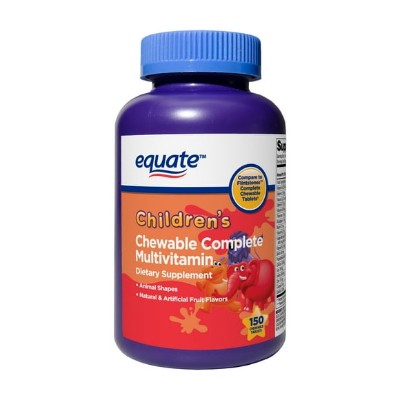
Children's Chewable Complete Multivitamin

Goals
$8.64 $0.05 per serving

Product analysis
Children’s Chewable Complete Multivitamin offers a broad mix of nutrients that may help fill dietary gaps. Most individual forms are not identified, which makes ingredient quality difficult to compare.
AI assessment of the formula, label and price. How scoring works
Nutrient Quality21
Most nutrient forms are unspecified, so their relative quality is hard to judge. The named vitamin A source does not establish a quality advantage for the rest of the formula.
Ingredient Transparency64
All listed ingredient amounts are disclosed, helping you check the serving. Most individual forms are not identified, which limits comparisons between similar multivitamins.
Value For Money53
Iron, iodine, copper and vitamin K appear economical at the full serving price. Value for most other nutrients remains uncertain, so those strengths do not settle the value of the whole formula.
Customer Satisfaction77
Customer feedback is generally positive across more than a thousand ratings. The substantial feedback base supports a reasonably established picture of satisfaction.
Product Focus45
The formula mainly supports nutrient intake relevant to immune function and energy metabolism. Some benefit comparisons use an adult serving and adult evidence, which limits their usefulness for children.
- Format
Tablet - Container
- 150 Tablet(s)
- Per serving
- $0.05
- Customer rating
- 4.4 · 1,615 ratings
Goals

Impact
High effect
Vitamin C · 60 mgZinc · 12 mgVitamin A · 900 mcgVitamin D · 15 mcg
Vitamin A supports normal barriers, while zinc and vitamin D support normal immune-cell function. Copper, folate and vitamins B6 and B12 can help restore function when intake is deficient; iron has a similar role in iron deficiency. These roles do not establish extra protection in adequately nourished adults. The saved findings use the selected one-tablet adult panel.
How this product is rated for Immunity
Ingredient fit64
Relevant nutrient amounts contribute, with formula focus and serving quantities shaping the ingredient finding.
Goal fit
Relevant nutrients sit within a broader formula containing ingredients aimed at other goals.
Dose adequacy
Serving amounts provide a partial match to the saved comparisons; this does not mean a corresponding fraction of clinical benefit.
Pathways66
The strongest assigned area is lymphocyte function and immune regulation. These ingredient associations do not establish clinical infection protection.
Depth
The strongest assigned area is lymphocyte function and immune regulation; this ingredient association does not establish reduced infection risk.
Breadth
Coverage is concentrated in barrier and antimicrobial defense, lymphocyte function and immune regulation. Other areas have less support in the saved findings.
Evidence100
Zinc provides the leading evidence contribution. The supported roles remain bounded by nutritional status and the preparation or regimen studied.
Evidence strength
Zinc leads the saved evidence finding, supporting a bounded nutrient role rather than general infection prevention.
Studied preparation
The saved preparation finding is complete for the included ingredients; matching an ingredient does not establish a tested whole-product regimen.
Formulation logic100
No missing required partner or configured ingredient conflict was identified. The serving amounts meet the included minimum comparisons without establishing a combined clinical benefit.
Partner coverage
No missing required partner limits the included ingredients in the saved findings; this does not demonstrate an added benefit from combining them.
Conflicts
No configured ingredient conflict was identified. This finding does not establish overall safety or cover every possible interaction.
Effective doses
The included ingredients reach the saved minimum amount threshold, which is not a proven effective clinical immune dose.

Impact
Moderate effect
Iodine · 150 mcgVitamin D · 15 mcgVitamin B5 · 10 mgRiboflavin · 1.7 mgThiamin · 1.5 mgVitamin B12 · 6 mcgIron · 18 mg
B vitamins support normal energy metabolism and help maintain nutritional adequacy. Iron and folate also relate to fatigue associated with inadequate nutrient status. Benefits are most plausible when a dietary gap is present; high vitamin amounts do not guarantee extra energy.
How this product is rated for Energy
Ingredient fit67
The saved findings identify 10 relevant contributors within a broader ingredient mix. Declared amounts provide partial support against the saved references. Undisclosed amounts cannot add amount support.
Goal fit
The saved findings identify 10 relevant contributors within a broader ingredient mix.
Dose adequacy
Declared amounts provide partial support against the saved references. Undisclosed amounts cannot add amount support.
Pathways0
The saved findings assign no direct coverage to the five energy pathways; nutritional support is considered separately. No energy pathway reaches the saved threshold for substantial coverage.
Depth
The saved findings assign no direct coverage to the five energy pathways; nutritional support is considered separately.
Breadth
No energy pathway reaches the saved threshold for substantial coverage.
Evidence97
Iron provides the strongest evidence contribution in the saved findings. Nutritional adequacy and correcting a shortfall are distinct from an extra energy boost. Most qualifying contributors have recognized preparations in the saved findings; preparation support is missing for Iodine.
Evidence strength
Iron provides the strongest evidence contribution in the saved findings. Nutritional adequacy and correcting a shortfall are distinct from an extra energy boost.
Studied preparation
Most qualifying contributors have recognized preparations in the saved findings; preparation support is missing for Iodine.
Formulation logic100
No unmet ingredient-partner requirement appears in the saved findings. No configured ingredient conflict was matched in the saved findings. All credited contributors meet the saved minimum amount threshold, which does not guarantee a noticeable energy benefit.
Partner coverage
No unmet ingredient-partner requirement appears in the saved findings.
Conflicts
No configured ingredient conflict was matched in the saved findings.
Effective doses
All credited contributors meet the saved minimum amount threshold, which does not guarantee a noticeable energy benefit.
Vitamin B5 Not classified
No linked studies yet.

Impact
High effect
Biotin · 40 mcgVitamin D · 15 mcgZinc · 12 mgIron · 18 mgVitamin C · 60 mg
Iron and zinc can help address dietary gaps associated with diffuse shedding. Copper contributes to normal pigmentation and connective-tissue biology, without establishing routine hair regrowth. This is a nutritional approach: the other vitamins do not establish additional growth when intake is adequate, and several small or unresolved amounts limit the saved findings.
How this product is rated for Hair Health
Ingredient fit70
The formula’s hair relevance and usable amounts determine this finding. Smaller or unresolved amounts limit the contribution.
Goal fit
Hair-related ingredients sit within a broader formula, so some of the formula serves other purposes.
Dose adequacy
The recognized amounts contribute unevenly, with smaller or unresolved amounts limiting the finding.
Pathways9
The strongest recorded contribution concerns hair-fibre building blocks; this is not proof of improved growth.
Depth
The strongest recorded contribution concerns hair-fibre building blocks; this is not proof of improved growth.
Breadth
None of the specific mechanisms reached the required coverage level.
Evidence97
Zinc leads the saved evidence finding, with hair benefits still limited by its specific nutritional or preparation context.
Evidence strength
Zinc leads the saved evidence finding, with hair benefits still limited by its specific nutritional or preparation context.
Studied preparation
Most contributing preparations matched those recognized in the saved result; iodine did not.
Formulation logic97
No required partner or configured conflict reduced the contributions. Some amounts did not reach the minimum comparison threshold.
Partner coverage
No missing required partner reduced the recognized contributions; this does not demonstrate added benefit from combining ingredients.
Conflicts
No configured ingredient conflict was identified in the supplied calculation.
Effective doses
Some counted ingredients fell below the minimum amount threshold or had unresolved amounts, limiting their contribution.

Impact
Moderate effect
Iron · 18 mgVitamin B12 · 6 mcgVitamin B12 · 6 mcgVitamin B6 · 2 mgZinc · 12 mg
B vitamins support normal energy metabolism, while iron, B12 and zinc support normal development and function. Benefits for fatigue or concentration depend on nutritional need. The supplied comparison uses adult productivity evidence, so it offers limited guidance on a children's formula.
How this product is rated for Productivity Boost
Ingredient fit50
The relevant ingredients share the formula with ingredients directed at other needs. The assessed amounts provide a partial match to the saved dose comparisons.
Goal fit
The relevant ingredients share the formula with ingredients directed at other needs.
Dose adequacy
The assessed amounts provide a partial match to the saved dose comparisons.
Pathways14
The strongest saved connection is synaptic plasticity and neuroprotection, with limited coverage. None of the reviewed mechanisms reaches the saved level for broad coverage.
Depth
The strongest saved connection is synaptic plasticity and neuroprotection, with limited coverage.
Breadth
None of the reviewed mechanisms reaches the saved level for broad coverage.
Evidence91
Zinc provides the strongest saved evidence at the assessed amount, within the limits of the reviewed context. The assessed preparations match those recognized in the saved review.
Evidence strength
Zinc provides the strongest saved evidence at the assessed amount, within the limits of the reviewed context.
Studied preparation
The assessed preparations match those recognized in the saved review.
Formulation logic100
The assessed ingredients can work independently or have their relevant partner. No ingredient conflicts were recorded in the saved assessment. 3 of 3 assessed ingredients reach the saved amount threshold.
Partner coverage
The assessed ingredients can work independently or have their relevant partner.
Conflicts
No ingredient conflicts were recorded in the saved assessment.
Effective doses
3 of 3 assessed ingredients reach the saved amount threshold.
Ingredients
| Ingredient | Amount per serving | Score |
|---|---|---|
Total Carbohydrates | 1 Gram(s) | |
Vitamin A (Beta-Carotene) | 900 mcg | |
Vitamin C | 60 mg | |
Vitamin D3 | 15 mcg | |
Vitamin E | 13.5 mg | |
Vitamin K | 55 mcg | |
Thiamine | 1.5 mg | |
Riboflavin | 1.7 mg | |
Niacin | 15 mg | |
Vitamin B6 | 2 mg | |
Folate | 680 mcg DFE | |
Vitamin B12 | 6 mcg | |
Biotin | 40 mcg | |
Pantothenic Acid | 10 mg | |
Calcium | 100 mg | |
Iron | 18 mg | |
Iodine | 150 mcg | |
Zinc | 12 mg | |
Copper | 2 mg | |
Sodium | 10 mg |
Iodine · 150 mcg OverallScore88
The serving provides 150 mcg of iodine at a low cost per serving, offering an amount suited to daily iodine support. The iodine form is unresolved; potassium iodide appears in Other Ingredients but is not assigned to the iodine amount.
How this ingredient is rated
Active Ingredient Quality & Bioavailability69
The iodine form is unresolved; potassium iodide appears in Other Ingredients but is not assigned to the iodine amount.
Iodine Form & Bioavailability
The iodine form is unresolved; potassium iodide appears in Other Ingredients but is not assigned to the iodine amount.
Marine Source Purity & Sourcing
No marine iodine source is indicated, so the seaweed-specific purity concern does not apply.
Dose, Safety & Label Transparency100
The label states 150 mcg of iodine per serving. That amount supports daily iodine intake and is below the adult upper intake limit.
Dosage Efficacy for Daily Support
The 150 mcg serving supports daily iodine intake.
Dosage Safety & Upper Limits
The 150 mcg serving is below the adult upper intake limit.
Elemental Iodine Transparency
The label states the iodine amount, though its source is not assigned on the iodine row.
Value100
The cost per labeled serving is low.
Price Per Effective Serving
The cost per labeled serving is low.
Iron · 18 mg OverallScore63
A serving provides 18 mg of iron at a low cost per serving. The iron source is unclear. Zinc is also present and may compete with iron for absorption.
How this ingredient is rated
Active Ingredient Quality & Bioavailability6
Ferrous fumarate appears in Other Ingredients, but its contribution to the iron total is unclear. Zinc is also listed and may compete with iron for absorption. The serving also contains 60 mg of vitamin C, B12 and folate.
Iron Chemical Form & Bioavailability
Ferrous fumarate appears in Other Ingredients, but its contribution to the iron total is unclear.
Absorption Support & Blocker Avoidance
Zinc is also listed and may compete with iron for absorption. The serving also contains 60 mg of vitamin C, B12 and folate.
Dose, Safety & Label Transparency100
The iron amount is stated as 18 mg per serving.
Elemental Iron Label Clarity
The iron amount is stated.
Dosage Effectiveness & Safety Range
A serving provides 18 mg of iron.
Value100
The cost per serving is low.
Price per Effective Serving
The cost per serving is low.
Copper · 2 mg OverallScore60
The labeled serving provides 2 mg copper, but its source is unresolved; cupric oxide appears in other ingredients and is poorly absorbed. The whole-product serving costs about $0.03, while the amount of copper attributable to the oxide is unknown.
How this ingredient is rated
Active Ingredient Quality & Bioavailability15
Cupric oxide appears in other ingredients and is poorly absorbed; the copper row’s source and the amount attributable to oxide remain unresolved. The label gives 2 mg copper; cupric oxide is named in other ingredients rather than on the copper row.
Copper Form Bioavailability
Cupric oxide appears in other ingredients and is poorly absorbed; the copper row’s source and the amount attributable to oxide remain unresolved.
Elemental Copper Labeling Clarity
The label gives 2 mg copper; cupric oxide is named in other ingredients rather than on the copper row.
Dose, Safety & Label Transparency85
One serving contains 2 mg copper and 12 mg zinc. Their ratio is about 6:1, below the evaluated balance.
Copper Dosage Safety & Efficacy
The labeled serving provides 2 mg copper, the amount favored in this assessment.
Zinc-to-Copper Balance
With 12 mg zinc and 2 mg copper, the ratio is about 6:1, below the evaluated balance.
Value100
A whole-product serving costs about $0.03 and supplies 2 mg copper.
Price Per Serving Efficiency
A whole-product serving costs about $0.03 and supplies 2 mg copper.
Alternative products
Report alternatives
Sources
Published studies used for the product analysis and the top-ranked studies for each ingredient and goal.
- Association of radioactive iodine treatment with survivorship symptoms and primary care utilisation in women of reproductive age with thyroid cancer: a retrospective cohort study.
- Energy level and fatigue after surgery for thyroid cancer: A population-based study of patient-reported outcomes.
- Health-Related Quality of Life in Differentiated Thyroid Cancer Survivors: A Cross-Sectional Study From Turkey.
- Large-dose intravenous ferric carboxymaltose injection for iron deficiency anemia in heavy uterine bleeding: a randomized, controlled trial.
- The Effect of Parenteral or Oral Iron Supplementation on Fatigue, Sleep, Quality of Life and Restless Legs Syndrome in Iron-Deficient Blood Donors: A Secondary Analysis of the IronWoMan RCT.
- Ferric carboxymaltose vs. oral iron in the treatment of pregnant women with iron deficiency anemia: an international, open-label, randomized controlled trial (FER-ASAP).
- Effect of iron therapy on fatigue symptoms in non-anaemic iron deficient women of reproductive age- A Randomized Controlled Trial.
- Intravenous iron isomaltoside treatment of women suffering from severe fatigue after postpartum hemorrhage.
- Physicochemical properties of and volatile compounds in riboflavin fortified cloudy apple juice; study of its effect on job fatigue among Egyptian construction workers.
- Vitamin B status in patients with chronic fatigue syndrome.
- B-vitamins, related vitamers, and metabolites in patients with quiescent inflammatory bowel disease and chronic fatigue treated with high dose oral thiamine.
- Metabolic features of chronic fatigue syndrome.
- Effectiveness of Riboflavin in Inherited Metabolic Diseases: A Systematic Review
- Influence of thiamin supplementation on the health and general well-being of an elderly Irish population with marginal thiamin deficiency.
- Randomised clinical trial: high-dose oral thiamine versus placebo for chronic fatigue in patients with quiescent inflammatory bowel disease.
- Dietary reference values for thiamin.
- Effects of thiamine supplementation on exercise-induced fatigue.
- Long-term maintenance treatment with 300 mg thiamine for fatigue in patients with inflammatory bowel disease: results from an open-label extension of the TARIF study.
- A new perspective on vitamin B12 deficiency in rheumatology: a case-based review.
- Effects of Vitamin B12 Supplementation on Cognitive Function, Depressive Symptoms, and Fatigue: A Systematic Review, Meta-Analysis, and Meta-Regression.