
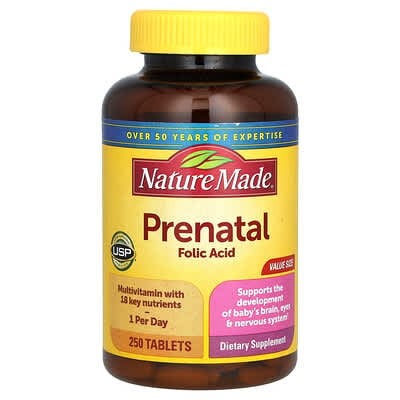

$26.98 $0.10 per serving


Product analysis
Prenatal Folic Acid supplies nutrients for normal blood formation and bone nutrition, with favorable value for several of its minerals.
AI assessment of the formula, label and price. How scoring works
Nutrient Quality39
Iodine uses a favorable form, while calcium carbonate is a middle-range choice and vitamin K1 is less favored. Several other forms are unspecified or cannot be confidently compared.
Ingredient Transparency94
Amounts and most forms are disclosed, making much of the label easy to follow. Missing riboflavin, folate and biotin forms limit a complete comparison.
Value For Money53
The serving price compares favorably for calcium, iron, iodine and vitamin K. Most other nutrient value comparisons remain uncertain.
Customer Satisfaction89
Customer feedback is very positive across a substantial review history. The reviews support satisfaction without establishing nutritional completeness.
Product Focus50
The formula offers broad nutritional support where low intake contributes to bone needs or tiredness. Its longer nutrient list does not establish extra energy, hair growth or work output when intake is adequate.
- Format
Tablet - Container
- 250 Tablet(s)
- Per serving
- $0.10
- Customer rating
- 4.8 · 2,866 ratings
Goals

Impact
Moderate effect
Biotin · 30 mcgVitamin D · 25 mcgZinc · 11 mgIron · 27 mgVitamin C · 85 mg
Low iron or zinc can contribute to diffuse shedding, so these nutrients may help when that is the cause. A serving supplies both, but that doesn't tell you whether they match the reason for your hair loss. Extra iron or zinc isn't known to produce regrowth when your nutrient intake is already adequate.
How this product is rated for Hair Health
Ingredient fit64
Zinc provides a conditional connection to shedding caused by low zinc. Other ingredients have differing roles and do not automatically add hair-regrowth benefits.
Goal fit
Zinc relates to deficiency-associated shedding; ingredients aimed at other uses do not necessarily improve hair growth.
Dose adequacy
Vitamin B12: 5.2 mcg; Zinc: 11 mg; Vitamin B7 (Biotin): 30 mcg per selected serving; these amounts are comparisons, not a promise of hair growth.
Pathways0
The ingredients do not provide a clear direct connection to the hair mechanisms described here.
Depth
The ingredients do not provide a clear direct connection to the hair mechanisms described here.
Breadth
No direct hair-mechanism benefit is identified from these ingredients.
Evidence97
Zinc’s useful hair connection is correction of low zinc associated with shedding; routine regrowth in adults getting enough remains uncertain.
Evidence strength
Zinc’s useful hair connection is correction of low zinc associated with shedding; routine regrowth in adults getting enough remains uncertain.
Studied preparation
Iodine’s role in thyroid hormone production does not demonstrate that this preparation treats ordinary hair loss.
Formulation logic96
No particular ingredient conflict or missing required partner is identified. That does not imply an added benefit from combining the ingredients.
Partner coverage
No required ingredient partner is identified as missing.
Conflicts
No particular ingredient conflict is identified.
Effective doses
The folate amount is unresolved here, so its amount-dependent contribution cannot be determined.

Impact
High effect
Iodine · 150 mcgVitamin D · 25 mcgVitamin B5 · 6 mgMagnesium · 45 mgRiboflavin · 1.4 mgThiamin · 1.4 mgVitamin B12 · 5.2 mcgIron · 27 mg
Iron can help relieve fatigue caused by iron deficiency, while folate, riboflavin, niacin, pantothenic acid, vitamin B6 and vitamin C can help when intake is deficient. Adequate nutrition does not establish an additional energy boost. The vitamin B12 and magnesium amounts receive no contribution in the saved findings, without implying they have no nutritional value.
How this product is rated for Energy
Ingredient fit73
Iron contributes a relevant declared amount, with formula focus and serving quantity shaping the ingredient finding.
Goal fit
Relevant ingredients sit within a broader formula containing ingredients aimed at other goals.
Dose adequacy
The serving provides a partial match to the saved amount comparisons, which are not clinical benefit percentages.
Pathways0
No energy pathway receives coverage. A nutrient contribution for deficiency-related fatigue remains separate from a stimulant effect or extra energy in adequate adults.
Depth
No energy pathway receives coverage; the nutrient contribution remains distinct from an alertness or general fatigue-relief effect.
Breadth
No energy area reaches the saved coverage target, so broad energy effects are not established.
Evidence97
Iron leads the saved evidence finding. The supplied context limits expectations according to nutrient status, preparation and the population studied.
Evidence strength
Iron provides the leading evidence contribution; its nutritional-status, population and preparation limits still determine the benefit that can be described.
Studied preparation
Some included ingredients lack a matching studied preparation, limiting transfer of the clinical findings to their declared forms.
Formulation logic100
The included ingredients meet the saved minimum amount comparisons, with no missing partner or configured conflict. These findings do not establish a combined benefit or overall safety.
Partner coverage
No missing required partner limits the included ingredients; this does not establish added benefit from combining them.
Conflicts
No configured ingredient conflict was identified; this does not establish overall safety or cover every possible interaction.
Effective doses
The included ingredients meet the saved minimum amount comparison, which is not proof of a clinically effective personal fatigue dose.
Vitamin B5 Not classified
No linked studies yet.

Impact
Moderate effect
Iron · 27 mgVitamin B12 · 5.2 mcgVitamin B12 · 5.2 mcgVitamin B6 · 1.9 mgZinc · 11 mgMagnesium · 45 mg
B vitamins support normal energy metabolism, with folate and 27 mg iron most relevant to fatigue and concentration when they fill a dietary gap. Higher folate amounts do not imply more energy or greater work output when nutritional needs are met.
How this product is rated for Productivity Boost
Ingredient fit56
The relevant ingredients form part of a broader formula serving several health goals. The assessed amounts provide a substantial but incomplete exposure match.
Goal fit
The relevant ingredients form part of a broader formula serving several health goals.
Dose adequacy
The assessed amounts provide a substantial but incomplete exposure match.
Pathways13
The strongest assessed contribution relates to nerve-cell function and protection, with partial coverage. No assessed pathway reaches the saved substantial-coverage threshold.
Depth
The strongest assessed contribution relates to nerve-cell function and protection, with partial coverage.
Breadth
No assessed pathway reaches the saved substantial-coverage threshold.
Evidence91
Zinc provides the strongest assessed evidence at an eligible amount; the supplied population and outcome limits still apply. The ingredients assessed at eligible amounts match the preparations recognized in the saved findings.
Evidence strength
Zinc provides the strongest assessed evidence at an eligible amount; the supplied population and outcome limits still apply.
Studied preparation
The ingredients assessed at eligible amounts match the preparations recognized in the saved findings.
Formulation logic100
The assessed ingredients work alone or have their required partner. No configured ingredient conflict was identified. 3 of 3 assessed ingredients meet the saved minimum exposure threshold. Reaching it does not guarantee improved productivity.
Partner coverage
The assessed ingredients work alone or have their required partner.
Conflicts
No configured ingredient conflict was identified.
Effective doses
3 of 3 assessed ingredients meet the saved minimum exposure threshold. Reaching it does not guarantee improved productivity.

Impact
High effect
Vitamin K · 90 mcgMagnesium · 45 mgVitamin B12 · 5.2 mcgVitamin B6 · 1.9 mgFolate · 1330 mcg DFEVitamin D · 25 mcg
Vitamin B12 supports homocysteine processing alongside folate and B6, without a standalone heart-health benefit. Thiamin fills a nutritional gap when intake is low; deficiency can harm heart function, while extra intake has no established cardiovascular benefit when intake is adequate. Folate helps process homocysteine, but lowering this marker does not generally establish protection against major heart outcomes.
How this product is rated for Heart Health
Ingredient fit61
Magnesium, Vitamin B9 (Folate), Vitamin B6 connect to heart-related functions. Some amounts provide only partial exposure relative to the supplied comparisons.
Goal fit
Magnesium, Vitamin B9 (Folate), Vitamin B6 provide the relevant connection; the product's broader ingredient and goal mix limits its focus.
Dose adequacy
Magnesium, Vitamin B6, Vitamin B12 provide partial exposure compared with the supplied comparison ranges; this does not establish an ineffective dose.
Pathways60
The clearest connection is homocysteine clearance. Support is concentrated in that route.
Depth
The strongest represented route is homocysteine clearance, with support limited to the ingredients and amounts supplied.
Breadth
The findings cover one route, with limited breadth beyond that mechanism.
Evidence89
Magnesium supplies the strongest relevant support here, though blood-pressure results are inconsistent.
Evidence strength
Magnesium supplies the strongest relevant support here, though blood-pressure results are inconsistent.
Studied preparation
The eligible declared ingredients meet the supplied preparation comparison; this does not establish superiority over other forms.
Formulation logic100
The relevant ingredients do not require another partner, and no specified conflict was identified. The amount comparisons do not establish added benefit from combining ingredients.
Partner coverage
The relevant ingredients can contribute without an additional required partner; no extra combination benefit is established.
Conflicts
No specified ingredient conflict was identified in the supplied findings.
Effective doses
The ingredients included in this finding clear the supplied minimum exposure comparison; this is not a proven clinical efficacy threshold.

Impact
High effect
Vitamin K · 90 mcgMagnesium · 45 mgCalcium · 250 mgVitamin D · 25 mcgZinc · 11 mgVitamin C · 85 mg
Calcium supplies mineral for normal bone structure and can help fill a dietary intake gap; its 250 mg per serving is a contribution to total intake, not a daily target. Vitamin D supports calcium absorption and deficiency-related mineralization; larger amounts do not establish extra fracture protection in adults with adequate status. Vitamin C supports normal collagen formation; correcting low intake is distinct from extra bone benefit when intake is adequate.
How this product is rated for Bone Health
Ingredient fit59
Relevant ingredients sit within a broader formula, so only part of the product is specifically connected to bone health. Amounts provide only partial support against the saved references; small or unresolved amounts limit what can be attributed to the formula.
Goal fit
Relevant ingredients sit within a broader formula, so only part of the product is specifically connected to bone health.
Dose adequacy
Amounts provide only partial support against the saved references; small or unresolved amounts limit what can be attributed to the formula.
Pathways80
The main recorded connection is collagen matrix formation. Coverage is concentrated in a limited set of bone-related processes, leaving other aspects without substantial support.
Depth
The strongest recorded connection concerns collagen matrix formation, with substantial coverage from the included ingredients.
Breadth
Coverage is concentrated in a limited set of bone-related processes, leaving other aspects without substantial support.
Evidence100
Calcium provides the strongest recorded evidence. The qualifying preparations match the supplied evidence.
Evidence strength
Calcium provides the strongest recorded ingredient evidence at a qualifying amount; its population and outcome limitations still apply.
Studied preparation
The qualifying preparations match those recognized in the supplied evidence; this does not show that the finished product was tested.
Formulation logic100
The ingredients work independently or have the required partner in the supplied findings. No listed formulation conflict was matched in the supplied findings. This is limited to the specified checks.
Partner coverage
The ingredients work independently or have the required partner in the supplied findings.
Conflicts
No listed formulation conflict was matched in the supplied findings. This is limited to the specified checks.
Effective doses
All ingredients included in this finding meet its minimum amount threshold; the threshold is not proof of clinical effectiveness.
Ingredients
| Ingredient | Amount per serving | Score |
|---|---|---|
Vitamin A (Beta-Carotene) | 770 mcg | |
Vitamin C (Ascorbic Acid) | 85 mg | |
Vitamin D3 (Cholecalciferol) | 25 mcg | |
Vitamin E (DL-Alpha-Tocopheryl Acetate) | 15 mg | |
Vitamin K (Phytonadione) | 90 mcg | |
Thiamine (Thiamine Mononitrate) | 1.4 mg | |
Riboflavin | 1.4 mg | |
Niacin (Niacinamide) | 18 mg | |
Vitamin B6 (Pyridoxine Hydrochloride) | 1.9 mg | |
Folate | 1330 mcg DFE | |
Vitamin B12 (Cyanocobalamin) | 5.2 mcg | |
Biotin | 30 mcg | |
Pantothenic Acid (D-Calcium Pantothenate) | 6 mg | |
Calcium (Calcium Carbonate) | 250 mg | |
Iron (Ferrous Fumarate) | 27 mg | |
Iodine (Potassium Iodide) | 150 mcg | |
Magnesium (Magnesium Oxide) | 45 mg | |
Zinc (Zinc Oxide) | 11 mg |
Iodine (Potassium Iodide) · 150 mcg OverallScore100
Each serving provides 150 mcg of iodine at a low cost per serving. The amount fits the range for daily thyroid support. The iodine comes from Potassium Iodide.
How this ingredient is rated
Active Ingredient Quality & Bioavailability100
The iodine comes from Potassium Iodide. No marine iodine source is indicated, so marine sourcing concerns do not apply.
Iodine Form & Bioavailability
The iodine comes from Potassium Iodide.
Marine Source Purity & Sourcing
No marine iodine source is indicated, so marine sourcing concerns do not apply.
Dose, Safety & Label Transparency100
150 mcg per serving falls within the range for daily thyroid support. The 150 mcg serving is below the 1,100 mcg upper intake level.
Dosage Efficacy for Daily Support
150 mcg per serving falls within the range for daily thyroid support.
Dosage Safety & Upper Limits
The 150 mcg serving is below the 1,100 mcg upper intake level.
Elemental Iodine Transparency
The iodine amount and source are stated.
Value100
The cost per serving is low.
Price Per Effective Serving
The cost per serving is low.
Calcium (Calcium Carbonate) · 250 mg OverallScore72
Each serving provides 250 mg of calcium at a low cost per serving. The calcium comes from calcium carbonate. A flow agent is also listed.
How this ingredient is rated
Active Ingredient Quality & Bioavailability65
The calcium comes from calcium carbonate. The elemental calcium amount is stated.
Calcium Form & Absorption Potential
The calcium comes from calcium carbonate.
Elemental Calcium Transparency
The label states the elemental calcium amount and its source.
Dose, Safety & Label Transparency66
The label states 250 mg of elemental calcium per serving. A flow agent is listed; the sugar amount is unknown.
Absorption-Optimized Serving Dose
The label states 250 mg of elemental calcium per serving.
Formulation Purity & Additives
A flow agent is listed; the sugar amount is unknown.
Value100
The cost per serving is low.
Price Per Serving Efficiency
The cost per serving is low.
Iron (Ferrous Fumarate) · 27 mg OverallScore73
A serving provides 27 mg iron, a substantial amount, at a low cost. The iron comes from ferrous fumarate. It also contains zinc, which may compete with iron for absorption.
How this ingredient is rated
Active Ingredient Quality & Bioavailability31
The iron comes from ferrous fumarate. It also contains zinc, which may compete with iron for absorption.
Iron Chemical Form & Bioavailability
The iron comes from ferrous fumarate.
Absorption Support & Blocker Avoidance
It also contains zinc, which may compete with iron for absorption.
Dose, Safety & Label Transparency100
A serving provides 27 mg iron, a substantial amount.
Elemental Iron Label Clarity
The iron amount per serving is stated.
Dosage Effectiveness & Safety Range
A serving provides 27 mg iron, a substantial amount.
Value100
The cost per serving is low.
Price per Effective Serving
The cost per serving is low.
Alternative products
Report alternatives
Sources
Published studies used for the product analysis and the top-ranked studies for each ingredient and goal.
- What is the impact of daily oral supplementation of vitamin D3 (cholecalciferol) plus calcium on the incidence of hip fracture in older people? A systematic review and meta-analysis.
- Calcium supplementation prevents seasonal bone loss and changes in biochemical markers of bone turnover in elderly New England women: a randomized placebo-controlled trial.
- The effects of calcium supplementation (milk powder or tablets) and exercise on bone density in postmenopausal women.
- The efficacy of calcium supplementation alone in elderly Thai women over a 2-year period: a randomized controlled trial.
- Calcium-enriched foods and bone mass growth in prepubertal girls: a randomized, double-blind, placebo-controlled trial.
- Association between RBC folate and lumbar bone mineral density in postmenopausal women, a cross-sectional study from NHANES 2009-2018.
- Genetic variants modify the associations of concentrations of methylmalonic acid, vitamin B-12, vitamin B-6, and folate with bone mineral density.
- Adequate Intake and Supplementation of B Vitamins, in Particular Folic Acid, can Play a Protective Role in Bone Health.
- Relation of homocysteine, folate, and vitamin B12 to bone mineral density of postmenopausal women.
- Dietary intake of folate, but not vitamin B2 or B12, is associated with increased bone mineral density 5 years after the menopause: results from a 10-year follow-up study in early postmenopausal women.
- Association between Serum Magnesium and Fractures: A Systematic Review and Meta-Analysis of Observational Studies.
- Bioabsorbable Magnesium-Based Materials Potential and Safety in Bone Surgery: A Systematic Review.
- Vascularized bone grafting fixed by biodegradable magnesium screw for treating osteonecrosis of the femoral head.
- An update on magnesium and bone health.
- Sex-specific differences in the association of magnesium intake with femoral neck bone mineral density among older adults.
- Evaluating the Protective Role of Vitamin A Supplementation in Periodontal Health: A Comprehensive Systematic Review and Meta-Analysis.
- Dietary vitamin A intake and bone health in the elderly: the Rotterdam Study.
- Vitamin A and its dervatives effect on bone mineral density, a systematic review.
- Association of vitamins with bone mineral density and osteoporosis measured by dual-energy x-ray absorptiometry: a cross-sectional study.
- Association of dietary consumption and serum levels of vitamin A and β-carotene with bone mineral density in Chinese adults.