
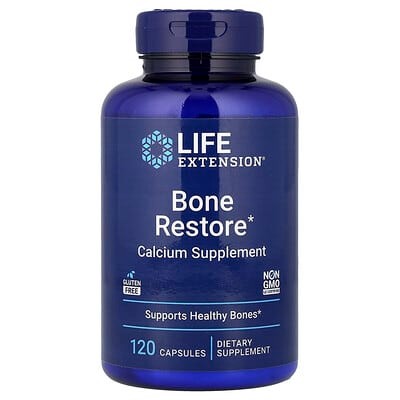

$16.50 $0.55 per serving


Product analysis
Bone Restore combines calcium with vitamin D to help fill nutritional gaps relevant to bone health. Its magnesium uses a less readily absorbed form, which matters if magnesium is a main reason for choosing it.
AI assessment of the formula, label and price. How scoring works
Nutrient Quality47
Calcium and boron use favorable forms, while magnesium oxide has limited absorption potential. The horsetail-derived silicon is not clearly characterized enough to judge its absorption.
Ingredient Transparency80
All listed nutrient amounts and forms are disclosed, making the formula straightforward to identify. The split between the calcium sources is missing, so their individual contributions remain unclear.
Value For Money39
Calcium sits in the middle range on serving cost, while magnesium and boron are less appealing on value. Silicon compares reasonably favorably on price, but several other nutrient comparisons remain uncertain.
Customer Satisfaction85
Customer feedback is very positive across many reviews. The volume gives a broad picture of satisfaction without establishing bone benefits.
Product Focus62
Bone nutrition is the clearest purpose, especially when mineral intake is low. The wider set of intended uses has more limited or conditional support.
- Format
Capsule - Container
- 120 Capsule(s)
- Per serving
- $0.55
- Customer rating
- 4.7 · 2,170 ratings
Goals

Impact
Highest effect
Magnesium · 300 mgCalcium · 700 mgVitamin D · 25 mcgManganese · 1 mgBoron · 3 mgZinc · 2 mg
Calcium and magnesium supply minerals needed for normal bone structure, particularly when dietary intake is low. Vitamin D supports calcium absorption and deficiency-related mineralization, without establishing routine fracture prevention in adequately nourished adults. Silicon from horsetail is not the choline-stabilized orthosilicic acid used in the supplied exploratory study, so its bone findings cannot be assumed to apply.
How this product is rated for Bone Health
Ingredient fit79
Calcium and magnesium provide substantial mineral amounts, with smaller contributions from the trace ingredients.
Goal fit
The formula concentrates on bone-related minerals and vitamin D.
Dose adequacy
Calcium and magnesium provide substantial mineral amounts, with smaller contributions from the trace ingredients.
Pathways80
Mineral supply and calcium absorption are the main areas; collagen-related support is smaller.
Depth
Bone mineral supply is the strongest area, led by calcium and magnesium.
Breadth
Mineral supply and calcium absorption are the main areas; collagen-related support is smaller.
Evidence98
Calcium leads the supplied support for normal mineralization and filling low intake; fracture trial results remain mixed. Silicon preparation limits remain.
Evidence strength
Calcium leads the supplied support for normal mineralization and filling low intake; fracture trial results remain mixed.
Studied preparation
Horsetail silicon does not match the studied silicon preparation; the other ingredients considered have recognized preparation matches.
Formulation logic100
The ingredients considered can contribute independently or have the partner required by the saved findings. No configured conflict was identified.
Partner coverage
The ingredients considered can contribute independently or have the partner required by the saved findings.
Conflicts
No configured ingredient conflict was identified in the supplied findings.
Effective doses
The ingredients counted here clear the saved amount threshold, which is not a proven fracture-prevention dose.

Impact
Highest effect
Vitamin D · 25 mcgMagnesium · 300 mgBoron · 3 mgZinc · 2 mg
Magnesium supplies a nutrient contribution to energy and mineral metabolism when dietary intake falls short. Calcium helps fill a dietary gap relevant to maintaining bone mineral. These nutritional roles do not establish improved health outcomes when intake is already adequate.
How this product is rated for Everyday Health
Ingredient fit73
Magnesium provides a meaningful nutritional connection, with amounts interpreted against the supplied intake comparisons.
Goal fit
Relevant nutrients share the formula with ingredients outside this goal, reducing its specific focus.
Dose adequacy
The counted amounts provide partial coverage of the saved reference ranges; these are nutritional comparisons, not proven clinical response thresholds.
Pathways80
The main recorded connection is energy metabolism cofactors. Nutrient coverage does not establish extra benefit in adequately nourished adults.
Depth
The strongest recorded coverage concerns energy metabolism cofactors, reflecting nutrient availability rather than a proven improvement in symptoms.
Breadth
Coverage extends to energy metabolism cofactors, bone and mineral metabolism.
Evidence86
Magnesium anchors the saved finding. Its nutritional role is more established than a broad improvement in health outcomes.
Evidence strength
Magnesium leads this finding; its support concerns nutritional availability rather than assured benefit above adequate intake.
Studied preparation
The counted preparations meet the saved comparison criteria, without an established benefit from a particular nutrient form or delivery method.
Formulation logic100
The counted nutrients meet the saved partner conditions, and no evaluated formulation concern is triggered.
Partner coverage
The counted nutrients work independently or meet the saved partner conditions; extra combination benefit is not established.
Conflicts
The supplied ingredients and amounts do not trigger the evaluated formulation concerns.
Effective doses
All counted ingredients meet the saved minimum amount criterion, which is distinct from a proven health-outcome dose.

Impact
High effect
Magnesium · 300 mgZinc · 2 mgVitamin D · 25 mcgBoron · 3 mg
Zinc supports normal testosterone production when low zinc intake or deficiency is corrected; extra zinc has not shown a testosterone benefit when intake is adequate. Magnesium has limited hormone findings from a small study involving exercise, which do not establish a routine testosterone increase. Vitamin D findings are mixed and any benefit may depend on initial deficiency. Boron has inconsistent, short-term hormone findings.
How this product is rated for Testosterone Support
Ingredient fit64
The main relevant ingredients are Zinc, Vitamin D, Magnesium. Their amounts and the broader formula determine how closely the product matches this goal.
Goal fit
The formula centers more closely on zinc and vitamin d and magnesium, though its hormone benefits remain conditional.
Dose adequacy
Some counted amounts only partly match the saved comparison ranges; a serving does not establish the daily exposure used in trials.
Pathways70
Free-testosterone availability is the strongest represented aspect.
Depth
Free-testosterone availability is the strongest represented aspect.
Breadth
Only one aspect reaches the saved coverage threshold; broader hormone support is not established.
Evidence81
Vitamin D is the main source of included hormone evidence; the supplied research does not establish universal testosterone enhancement.
Evidence strength
Vitamin D provides the strongest included hormone evidence, with the population and nutrient-status limits described above.
Studied preparation
The counted preparations match the saved preparation comparisons; this does not demonstrate an additional testosterone benefit.
Formulation logic100
The counted ingredients have their required partners. No configured conflict was found.
Partner coverage
No required ingredient partner is missing for the counted contributions; this does not establish synergy.
Conflicts
No configured ingredient conflict was identified in the supplied facts.
Effective doses
All counted ingredients pass the saved minimum amount comparison; that cutoff is not a proven clinical effective dose.

Impact
Moderate effect
Vitamin D · 25 mcgMagnesium · 300 mg
Magnesium at 300 mg supports normal nutritional functions related to tiredness, with most value when intake is low. Vitamin D at 25 mcg adds nutritional support, but evidence of fatigue relief comes from deficient adults rather than routine use in replete people.
How this product is rated for Energy
Ingredient fit54
The relevant ingredients sit within a broader formula with other nutritional or performance purposes. The amounts provide a reasonable but incomplete match to the comparison amounts.
Goal fit
The relevant ingredients sit within a broader formula with other nutritional or performance purposes.
Dose adequacy
The amounts provide a reasonable but incomplete match to the comparison amounts.
Pathways0
The saved assessment assigns nutritional support without a separate contribution to the assessed energy mechanisms. The saved findings show limited reach across the assessed energy mechanisms.
Depth
The saved assessment assigns nutritional support without a separate contribution to the assessed energy mechanisms.
Breadth
The saved findings show limited reach across the assessed energy mechanisms.
Evidence95
Vitamin D supplies the leading relevant support, within the nutrient or preparation-specific limits described. The saved assessment finds matching studied preparations at relevant amounts.
Evidence strength
Vitamin D supplies the leading relevant support, within the nutrient or preparation-specific limits described.
Studied preparation
The saved assessment finds matching studied preparations at relevant amounts.
Formulation logic100
The assessed ingredients can contribute on their own or have their required partner. No configured ingredient conflict was identified in the supplied assessment. 2 of 2 assessed ingredients meet the saved minimum amount threshold
Partner coverage
The assessed ingredients can contribute on their own or have their required partner.
Conflicts
No configured ingredient conflict was identified in the supplied assessment.
Effective doses
2 of 2 assessed ingredients meet the saved minimum amount threshold

Impact
High effect
Magnesium · 300 mgVitamin D · 25 mcg
Magnesium contributes to the balance of minerals and blood-vessel tone. Its blood-pressure effects in the supplied evidence are small and inconsistent, so a meaningful amount does not establish prevention of heart attacks or strokes.
How this product is rated for Heart Health
Ingredient fit56
Magnesium, Vitamin D provide the main connection to heart health; other active ingredients broaden the formula beyond this goal
Goal fit
Magnesium, Vitamin D provide the main connection to heart health; other active ingredients broaden the formula beyond this goal
Dose adequacy
The relevant amounts provide a partial contribution across the formula; higher amounts are not automatically more beneficial.
Pathways51
Electrolyte and vascular-tone balance is the strongest connection in the saved findings; this describes the ingredient roles, not a guaranteed effect.
Depth
Electrolyte and vascular-tone balance is the strongest connection in the saved findings; this describes the ingredient roles, not a guaranteed effect.
Breadth
The main areas represented are electrolyte and vascular-tone balance; other aspects have less support in this formula.
Evidence89
Magnesium provides the strongest relevant evidence here, with the population and benefit limits described above.
Evidence strength
Magnesium provides the strongest relevant evidence here, with the population and benefit limits described above.
Studied preparation
The contributing ingredient preparations match those recognized in the supplied comparison; this does not establish efficacy of the finished product.
Formulation logic100
The relevant ingredients do not depend on a missing partner in the supplied findings. No configured ingredient conflict was identified in the supplied findings.
Partner coverage
The relevant ingredients do not depend on a missing partner in the supplied findings.
Conflicts
No configured ingredient conflict was identified in the supplied findings.
Effective doses
The contributing ingredients have meaningful declared amounts for comparison, without proving a cardiovascular benefit.

Impact
Moderate effect
Vitamin D · 25 mcgZinc · 2 mg
The silicon here offers a possible connection to hair strength and thickness, rather than reversal of hair loss. It's supplied as a preparation whose equivalence to choline-stabilized orthosilicic acid is unclear, so the same hair-shaft effects can't be assumed. Vitamin D's associations with hair loss don't show that taking this combination will regrow hair.
How this product is rated for Hair Health
Ingredient fit50
Silicon may affect hair strength and thickness; this differs from reversing hair loss.
Goal fit
Silicon provides a connection to hair health, alongside ingredients used for other purposes.
Dose adequacy
Zinc: 2 mg; Silicon: 5 mg. These serving amounts do not predict hair growth.
Pathways6
The relevant connection is the hair shaft itself, rather than treatment of the cause of hair loss.
Depth
The relevant connection is the hair shaft itself, rather than treatment of the cause of hair loss.
Breadth
The connection is concentrated in this one aspect of hair health, rather than several distinct actions.
Evidence68
Silicon is not identified as the specific preparation associated with the relevant hair outcomes.
Evidence strength
Silicon may affect hair strength and thickness; this differs from reversing hair loss.
Studied preparation
Silicon is not identified as the specific preparation associated with the relevant hair outcomes.
Formulation logic100
No required partner is missing and no particular ingredient conflict is identified. The combination does not by itself imply an added hair benefit.
Partner coverage
No required ingredient partner is missing for the individual contributions described here.
Conflicts
No particular ingredient conflict is identified.
Effective doses
The relevant declared amounts meet their numerical comparison bands; this is not a guarantee of a hair benefit.
Ingredients
| Ingredient | Amount per serving | Score |
|---|---|---|
Vitamin D3 (Cholecalciferol) | 25 mcg | |
Calcium (Calcium Bisglycinate Chelate, Calcium Fructoborate, Dicalcium Malate) | 700 mg | |
Magnesium (Magnesium Oxide) | 300 mg | |
Zinc (Zinc Amino Acid Chelate) | 2 mg | |
Manganese (Manganese Amino Acid Chelate) | 1 mg | |
Silicon (Horsetail extract) | 5 mg | |
Boron (Calcium Fructoborate) | 3 mg |
Calcium (Calcium Bisglycinate Chelate, Calcium Fructoborate, Dicalcium Malate) · 700 mg OverallScore76
A serving provides 700 mg of elemental calcium from calcium bisglycinate, calcium fructoborate and dicalcium malate. The evaluation cautions that absorption may be less efficient at this serving amount.
How this ingredient is rated
Active Ingredient Quality & Bioavailability100
Calcium is recorded from calcium bisglycinate, calcium fructoborate and dicalcium malate; the stated amount is elemental calcium.
Calcium Form & Absorption Potential
The recorded sources are calcium bisglycinate, calcium fructoborate and dicalcium malate; their individual proportions are not established.
Elemental Calcium Transparency
The recorded 700 mg per serving refers to calcium itself, rather than the weight of a source compound.
Dose, Safety & Label Transparency64
The serving provides 700 mg of elemental calcium. The evaluation cautions that absorption may be less efficient at this amount. No configured artificial additive or flow agent was identified; the sugar amount is not recorded.
Absorption-Optimized Serving Dose
A serving provides 700 mg of calcium; the evaluation cautions that absorption may be less efficient at this amount.
Formulation Purity & Additives
No configured artificial additive or flow agent was identified; the sugar amount is not recorded.
Value50
The whole product costs about $0.55 per serving, a moderate serving price in the evaluation.
Price Per Serving Efficiency
A whole-product serving costs about $0.55; the comparison uses that serving price.
Boron (Calcium Fructoborate) · 3 mg OverallScore80
A serving supplies 3 mg boron as calcium fructoborate. The whole-product serving costs about $0.55.
How this ingredient is rated
Active Ingredient Quality & Bioavailability85
Boron is supplied as calcium fructoborate, a form rated favorably in the evaluation.
Boron Form & Bioavailability
Calcium Fructoborate is rated favorably in the form evaluation.
Trademarked & High-Purity Sources
The saved evaluation does not identify a recognized branded source or a qualifying purity marker.
Dose, Safety & Label Transparency100
The serving states 3 mg elemental boron and names its source form.
Elemental Dose Transparency
The saved label facts give 3 mg elemental boron per serving and identify the source form.
Dosage Efficacy & Safety Margin
A serving provides 3 mg boron, an amount the evaluation rates favorably.
Value30
The scaled whole-product cost is about $0.55 per 3 mg boron.
Price per 3mg Elemental Boron
The whole-product cost scales to about $0.55 per 3 mg boron; it includes all ingredients in the product.
Silicon (Horsetail extract) · 5 mg OverallScore58
A serving provides 5 mg of elemental silicon. Its chemical form is not resolved in the saved facts, which limits comparison with other forms.
How this ingredient is rated
Active Ingredient Quality & Bioavailability30
The saved facts do not resolve the chemical form of the silicon.
Silicon Chemical Form & Absorption
The silicon chemical form is unresolved in the saved facts, so it cannot be assessed.
Botanical Standardization & Extract Quality
The saved facts do not report a silica standardization percentage or an extract ratio.
Trademark and Source Transparency
The evaluation records an identified source, but the supplied facts do not name a more specific source.
Dose, Safety & Label Transparency80
Each serving declares 5 mg of elemental silicon.
Elemental Silicon Dosage Adequacy
Each serving provides 5 mg of elemental silicon, an amount that fits the evaluation’s dose criteria.
Label Transparency: Source vs. Active Yield
The elemental silicon amount is declared as 5 mg per serving.
Value70
The whole-product serving costs about $0.55.
Price per Serving Relative to Median
The price is about $0.55 per whole-product serving.
Alternative products
Report alternatives
Sources
Published studies used for the product analysis and the top-ranked studies for each ingredient and goal.
- [Comparative study of the urinary excretion of boron, calcium, magnesium and phosphorus in postmenopausal women with and without osteoporosis].
- Effect of dietary boron on mineral, estrogen, and testosterone metabolism in postmenopausal women.
- The relationship between boron and magnesium status and bone mineral density in the human: a review.
- Effects of boron supplementation on bone mineral density and dietary, blood, and urinary calcium, phosphorus, magnesium, and boron in female athletes.
- Metabolic responses of postmenopausal women to supplemental dietary boron and aluminum during usual and low magnesium intake: boron, calcium, and magnesium absorption and retention and blood mineral concentrations
- What is the impact of daily oral supplementation of vitamin D3 (cholecalciferol) plus calcium on the incidence of hip fracture in older people? A systematic review and meta-analysis.
- Calcium supplementation prevents seasonal bone loss and changes in biochemical markers of bone turnover in elderly New England women: a randomized placebo-controlled trial.
- The effects of calcium supplementation (milk powder or tablets) and exercise on bone density in postmenopausal women.
- The efficacy of calcium supplementation alone in elderly Thai women over a 2-year period: a randomized controlled trial.
- Calcium-enriched foods and bone mass growth in prepubertal girls: a randomized, double-blind, placebo-controlled trial.
- Association between Serum Magnesium and Fractures: A Systematic Review and Meta-Analysis of Observational Studies.
- Bioabsorbable Magnesium-Based Materials Potential and Safety in Bone Surgery: A Systematic Review.
- Vascularized bone grafting fixed by biodegradable magnesium screw for treating osteonecrosis of the femoral head.
- An update on magnesium and bone health.
- Sex-specific differences in the association of magnesium intake with femoral neck bone mineral density among older adults.
- Risk of Environmental Chemicals on Bone Fractures Is Independent of Low Bone Mass in US Adults: Insights from 2017 to 2018 NHANES.
- The Manganese-Bone Connection: Investigating the Role of Manganese in Bone Health.
- Associations of multiple metals with bone mineral density: A population-based study in US adults.
- Sex-specific associations of urinary mixed-metal concentrations with femoral bone mineral density among older people: an NHANES (2017-2020) analysis.
- Relationship between blood manganese and bone mineral density and bone mineral content in adults: A population-based cross-sectional study.