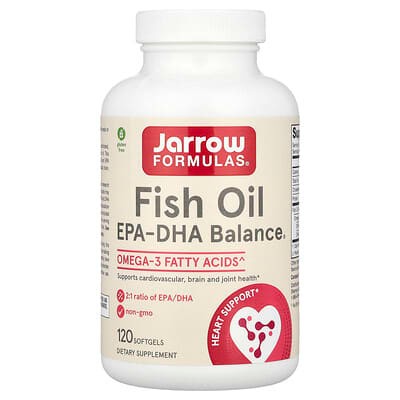
Product Image

EPA-DHA Balance

Jarrow Formulas
4.8
★ ★ ★ ★ ★
(17268 ratings)
EPA (Eicosapentaenoic Acid) 800 mg
Omega-3 1200 mg
Fish Oil 2000 mg
DHA 400 mg
Product Image
Score83
Substantial EPA and DHA in a better-value large bottle, though oil form and quality safeguards are not well documented.
How scoring works
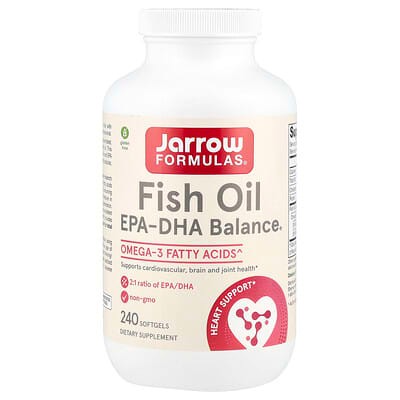
Quantity:240 Softgel(s) • (120 servings)
Goals:
Heart Health
Cardiovascular Support
Anti-Inflammatory Support
Skin Health
Joint Health
Metabolism Boost
Mental Focus

Score 83

Substantial EPA and DHA in a better-value large bottle, though oil form and quality safeguards are not well documented.
How scoring works
$80.99($0.67 per serving)
Pure Formulas
$ 80.99
Vitacost
$ 100.35
Daily Vita
$ 86.99
iHerb
$ 100.35
Walmart
$ 108.38
Vitacost
$ 92.29
Report prices

Analysis

A two-softgel serving supplies 1,200 mg omega-3s, split into 800 mg EPA and 400 mg DHA. The EPA-forward dose fits heart and inflammatory goals, while still providing a useful DHA contribution.

The label makes the active concentration easy to calculate and does not hide EPA or DHA within a generic oil total. Molecular form, source species, purification, independent testing, and freshness protection are not included in the supplied information.

With 120 servings, the larger package improves long-term value compared with the 60-serving option. It best suits people already comfortable taking two fish-oil softgels daily.

Who is it for
  • Established fish-oil users seeking a long supply
  • Adults focused on cardiovascular or inflammatory support
Best for
  • Large-package value
  • EPA-forward daily omega-3 intake

Pros

  • 800 mg EPA and 400 mg DHA per serving
  • Active amounts are clearly separated
  • Large bottle reduces serving cost

Cons

  • Two-softgel serving may be inconvenient
  • No molecular form or fish species is stated
  • No antioxidant or independent purity result is supplied

Warnings

  • Avoid with a fish allergy because the concentrate is fish-derived
  • The substantial EPA and DHA dose can add to anticoagulant or antiplatelet effects
  • Discard capsules with a pronounced rancid smell because freshness protection is not disclosed

Nutrient quality

88 Highest impact

Strong EPA and DHA concentration provides meaningful dose quality. Missing molecular-form, purification, and oxidation details reduce ingredient confidence.

Ingredient transparency

81 Highest impact

Active fatty-acid quantities are clearly disclosed without a hidden blend. Missing full directions, excipients, and some oil-quality details reduce completeness.

Customer satisfaction

72 High impact

The supplied average rating is very strong and the rating volume is substantial. No specific experience details were provided to judge repeated complaints or purpose alignment.

Value for money

90 Highest impact

Formula quality and active-serving economics support strong practical value. It compares favorably within the category despite remaining disclosure gaps.

Report analysis

Goals

Heart Health
Impact
Highest effect
A+ Goal FitA+ Strength of SupportB CoverageA+ Formula Quality
EPA (Eicosapentaenoic Acid) · 800 mg

A fully disclosed 800 mg of EPA and 400 mg of DHA provides a concentrated omega-3 serving with strong cardiovascular relevance. The EPA-forward profile directly supports triglyceride management and also contributes to inflammatory balance.

Two softgels deliver the full active amount without relying on a vague fish-oil total. EPA and DHA may modestly increase bleeding tendency with anticoagulant or antiplatelet medicines, especially alongside other products that affect clotting.

Study evidence
Cardiovascular Support
Impact
Highest effect
A Goal FitB+ Strength of SupportC CoverageA+ Formula Quality
Fish Oil · 2000 mg

EPA and DHA provide strong, direct support for triglyceride management and cardiovascular membrane function. The disclosed ratio emphasizes EPA while retaining a useful DHA contribution.

The combined omega-3 amount is meaningful, but the triglyceride or ethyl-ester form and oxidation testing are not stated. Two focused softgels provide depth in lipid support without unrelated ingredients.

Anti-Inflammatory Support
Impact
Highest effect
A Goal FitB- Strength of SupportC CoverageA+ Formula Quality
Fish Oil · 2000 mg

EPA and DHA directly support production of compounds that help resolve inflammatory signaling. Human evidence for marine omega-3 fats and inflammatory balance is strong when active intake is adequate.

The combined 1,200 mg EPA and DHA amount is meaningful, though higher intakes are often used for stronger anti-inflammatory effects. EPA and DHA amounts are clear, but molecular form, purification, independent testing, and oxidation protection are not disclosed. Fish oil is sourced from fish and may not be suitable for people with a fish allergy.

Study evidence
Fish Oil Supportive 68 studies
Skin Health
Impact
Highest effect
B Goal FitB+ Strength of SupportB- CoverageA Formula Quality
Omega-3 · 1200 mg

EPA and DHA may support the skin's lipid barrier and help regulate inflammatory stress. Human evidence for skin hydration and resilience is useful but less direct than evidence for collagen or ceramides.

The combined active amount is substantial and each fatty acid is clearly disclosed. A generic concentrate form with no fish source, antioxidant protection, or purity testing limits quality confidence.

Study evidence
Omega-3 Supportive 35 studies
Joint Health
Impact
High effect
B+ Goal FitB Strength of SupportC CoverageA Formula Quality
Omega-3 · 1200 mg

EPA and DHA provide meaningful support for inflammation-related joint comfort. The focused formula does not supply cartilage building blocks or joint lubrication.

Both major fatty acids are clearly disclosed in useful amounts. Fish oil may increase bleeding tendency when combined with anticoagulant or antiplatelet medicines.

Study evidence
Omega-3 Supportive 40 studies
Metabolism Boost
Impact
High effect
C Goal FitA- Strength of SupportD+ CoverageA- Formula Quality
Omega-3 · 1200 mg

EPA and DHA may support insulin sensitivity and metabolic health indirectly. Human evidence is useful for cardiometabolic markers, but omega-3 fats do not directly stimulate thermogenesis.

The 1200 mg total omega-3 amount, including 800 mg EPA and 400 mg DHA, provides a substantial dose. EPA, DHA, and total omega-3 amounts are clearly disclosed, though the oil form is not specified. The oil comes from fish and may not be suitable for people with a fish allergy.

Study evidence
Omega-3 Supportive 42 studies
Mental Focus
Impact
High effect
D+ Goal FitB Strength of SupportD+ CoverageA Formula Quality

EPA and DHA support long-term neuronal structure but do not provide a reliable same-day focus effect. The EPA-heavy profile lacks a direct alertness or neurotransmitter mechanism.

The disclosed fatty-acid amounts are substantial and easy to assess. Oil form, oxidation protection, and independent contaminant testing are not provided.

Study evidence

Ingredients

IngredientAmount per serving
Calories
20 Calorie(s)
Total Fat
2 Gram(s)
Fish Oil concentrate
2000 mg
Omega-3 Fatty Acids
1200 mg
Eicosapentaenoic Acid
800 mg
Docosahexaenoic Acid
400 mg
Gluten Free Adults 18–50
Report overview
D Active Ingredient Quality & BioavailabilityB+ Dose, Safety & Label TransparencyB+ Value

The EPA-focused profile is strong, with 800 mg of EPA and half as much DHA per serving. The label does not state triglyceride form, antioxidant protection, or third-party contaminant testing, leaving quality safeguards uncertain. The larger package provides comparatively efficient value for the EPA delivered.

Omega-3 · 1200 mg OverallScore62
D- Active Ingredient Quality & BioavailabilityC Dose, Safety & Label TransparencyA+ Value

Separate EPA and DHA amounts make the active dose easy to understand, and they form a solid share of the total oil. The concentrate form, generic fish source, and lack of listed antioxidant protection limit confidence in absorption and freshness. The larger package delivers excellent cost efficiency per active gram.

Fish Oil · 2000 mg OverallScore50
F Active Ingredient Quality & BioavailabilityB Dose, Safety & Label TransparencyB+ Value

The serving supplies a standard effective amount of EPA and DHA, with both fats clearly disclosed. Active fats make up a high share of the oil, but its molecular form, purification method, testing, and antioxidant protection are not stated. The larger bottle delivers good cost efficiency per gram of active omega-3s.

Loading alternative details
Report alternatives

Sources

Published studies used for the product analysis and the top-ranked studies for each ingredient and goal.

  1. Effects of eicosapentaenoic acid on major coronary events in hypercholesterolaemic patients (JELIS): a randomised open-label, blinded endpoint analysis.
    Yokoyama M; Origasa H; Matsuzaki M; Matsuzawa Y; Saito Y; Ishikawa Y; Oikawa S; Sasaki J; Hishida H; Itakura H; Kita T; Kitabatake A; Nakaya N; Sakata T; Shimada K; Shirato K; Japan EPA lipid intervention study (JELIS) Investigators · Lancet (London, England) · 2007
    Randomized trial18,645 participantsHeart Health forEPA (Eicosapentaenoic Acid)
  2. Effects of EPA on coronary artery disease in hypercholesterolemic patients with multiple risk factors: sub-analysis of primary prevention cases from the Japan EPA Lipid Intervention Study (JELIS).
    Saito Y; Yokoyama M; Origasa H; Matsuzaki M; Matsuzawa Y; Ishikawa Y; Oikawa S; Sasaki J; Hishida H; Itakura H; Kita T; Kitabatake A; Nakaya N; Sakata T; Shimada K; Shirato K; JELIS Investigators, Japan · Atherosclerosis · 2008
    Randomized trial14,981 participantsHeart Health forEPA (Eicosapentaenoic Acid)
  3. Meta-analysis Comparing Combined Use of Eicosapentaenoic Acid and Statin to Statin Alone.
    Doshi R; Kumar A; Thakkar S; Shariff M; Adalja D; Doshi A; Taha M; Gupta R; Desai R; Shah J; Gullapalli N · The American journal of cardiology · 2020
    Meta-analysis27,415 participants5 studies pooledHeart Health forEPA (Eicosapentaenoic Acid)
  4. Effect of omega-3 long-chain polyunsaturated fatty acid supplementation on heart rate: a meta-analysis of randomized controlled trials.
    Hidayat K; Yang J; Zhang Z; Chen GC; Qin LQ; Eggersdorfer M; Zhang W · European journal of clinical nutrition · 2019
    Meta-analysis3,000 participants51 studies pooledHeart Health forEPA (Eicosapentaenoic Acid)
  5. Long-Chain Polyunsaturated Fatty Acids Are Associated with Blood Pressure and Hypertension over 10-Years in Black South African Adults Undergoing Nutritional Transition.
    Zec MM; Schutte AE; Ricci C; Baumgartner J; Kruger IM; Smuts CM · Foods (Basel, Switzerland) · 2020
    Cohort study300 participantsHeart Health forEPA (Eicosapentaenoic Acid)
  6. Dose-dependent effects of fish oil on cardio-metabolic biomarkers in healthy middle-aged and elderly Chinese people: a double-blind randomized controlled trial.
    Song J; Hu M; Li C; Yang B; Ding Q; Wang C; Mao L · Food & function · 2018
    Randomized trial201 participantsAnti-Inflammatory Support forFish Oil
  7. Eicosapentaenoic acid supplementation alleviates pruritus, enhances skin moisture, and mitigates depression in maintenance hemodialysis patients.
    Lin YL; Wang CL; Chiang TI · Frontiers in nephrology · 2024
    Randomized trial60 participantsAnti-Inflammatory Support forFish Oil
  8. Lowering effects of fish oil supplementation on proinflammatory markers in hypertension: results from a randomized controlled trial.
    Yang B; Ren XL; Li ZH; Shi MQ; Ding F; Su KP; Guo XJ; Li D · Food & function · 2020
    Randomized trial77 participantsAnti-Inflammatory Support forFish Oil
  9. The effects of ω-3 fish oil emulsion-based parenteral nutrition plus combination treatment for acute paraquat poisoning.
    Meng Z; Dong Y; Gao H; Yao D; Gong Y; Meng Q; Zheng T; Cui X; Su X; Tian Y · The Journal of international medical research · 2019
    Randomized trial174 participantsAnti-Inflammatory Support forFish Oil
  10. Effects of Omega-3 Fatty Acid Intake in Patients Undergoing Dialysis: A Systematic Review and Meta-Analysis of Randomized Controlled Trials.
    Liu R; Jiang J; Fu Z; Liu C; Yao L; Quan H · Journal of the American Nutrition Association · 2022
    Meta-analysis49 studies pooledAnti-Inflammatory Support forFish Oil
  11. Effects of omega-3 fatty acids on coronary revascularization and cardiovascular events: a meta-analysis.
    Dinu M; Sofi F; Lotti S; Colombini B; Mattioli AV; Catapano AL; Casula M; Baragetti A; Wong ND; Steg PG; Ambrosio G · European journal of preventive cardiology · 2024
    Meta-analysis134,144 participants18 studies pooledHeart Health forEPA (Eicosapentaenoic Acid)
  12. Incremental effects of eicosapentaenoic acid on cardiovascular events in statin-treated patients with coronary artery disease.
    Matsuzaki M; Yokoyama M; Saito Y; Origasa H; Ishikawa Y; Oikawa S; Sasaki J; Hishida H; Itakura H; Kita T; Kitabatake A; Nakaya N; Sakata T; Shimada K; Shirato K; Matsuzawa Y; JELIS Investigators · Circulation journal : official journal of the Japanese Circulation Society · 2009
    Randomized trialHeart Health forEPA (Eicosapentaenoic Acid)
  13. Omega-3 Fatty Acids for the Management of Hypertriglyceridemia: A Science Advisory From the American Heart Association.
    Skulas-Ray AC; Wilson PWF; Harris WS; Brinton EA; Kris-Etherton PM; Richter CK; Jacobson TA; Engler MB; Miller M; Robinson JG; Blum CB; Rodriguez-Leyva D; de Ferranti SD; Welty FK; American Heart Association Council on Arteriosclerosis, Thrombosis and Vascular Biology; Council on Lifestyle and Cardiometabolic Health; Council on Cardiovascular Disease in the Young; Council on Cardiovascular and Stroke Nursing; and Council on Clinical Cardiology · Circulation · 2020
    OtherHeart Health forEPA (Eicosapentaenoic Acid)
  14. Supplementation of fish oil and olive oil in patients with rheumatoid arthritis.
    Berbert AA; Kondo CR; Almendra CL; Matsuo T; Dichi I · Nutrition (Burbank, Los Angeles County, Calif.) · 2005
    Randomized trial43 participantsJoint Health forOmega-3
  15. Krill oil improved osteoarthritic knee pain in adults with mild to moderate knee osteoarthritis: a 6-month multicenter, randomized, double-blind, placebo-controlled trial.
    Stonehouse W; Benassi-Evans B; Bednarz J; Vincent AD; Hall S; Hill CL · The American journal of clinical nutrition · 2022
    Randomized trial235 participantsJoint Health forOmega-3
  16. Effects of omega-3 supplementation on lipid metabolism, inflammation, and disease activity in rheumatoid arthritis: a meta-analysis of randomized controlled trials.
    Wang W; Xu Y; Zhou J; Zang Y · Clinical rheumatology · 2024
    Meta-analysis1,018 participants18 studies pooledJoint Health forOmega-3
  17. Impact of type and dose of oral polyunsaturated fatty acid supplementation on disease activity in inflammatory rheumatic diseases: a systematic literature review and meta-analysis.
    Sigaux J; Mathieu S; Nguyen Y; Sanchez P; Letarouilly JG; Soubrier M; Czernichow S; Flipo RM; Sellam J; Daïen C · Arthritis research & therapy · 2022
    Meta-analysis1,420 participants30 studies pooledJoint Health forOmega-3
  18. A meta-analysis of the analgesic effects of omega-3 polyunsaturated fatty acid supplementation for inflammatory joint pain.
    Goldberg RJ; Katz J · Pain · 2007
    Meta-analysis17 studies pooledJoint Health forOmega-3
  19. The influence of n-3 polyunsaturated fatty acids on cognitive function in individuals without dementia: a systematic review and dose-response meta-analysis.
    Suh SW; Lim E; Burm SY; Lee H; Bae JB; Han JW; Kim KW · BMC medicine · 2024
    Meta-analysis9,660 participants24 studies pooledMental Focus forEPA (Eicosapentaenoic Acid)
  20. EPA supplementation improves teacher-rated behaviour and oppositional symptoms in children with ADHD.
    Gustafsson PA; Birberg-Thornberg U; Duchén K; Landgren M; Malmberg K; Pelling H; Strandvik B; Karlsson T · Acta paediatrica (Oslo, Norway : 1992) · 2011
    Randomized trial92 participantsMental Focus forEPA (Eicosapentaenoic Acid)
  21. Docosahexaenoic Acid (DHA) and Eicosapentaenoic Acid (EPA)-Should They Be Mandatory Supplements in Pregnancy?
    Amza M; Haj Hamoud B; Sima RM; Dinu MD; Gorecki GP; Popescu M; Gică N; Poenaru MO; Pleș L · Biomedicines · 2024
    Narrative reviewMental Focus forEPA (Eicosapentaenoic Acid)
  22. Supplementation with oil rich in eicosapentaenoic acid, but not in docosahexaenoic acid, improves global cognitive function in healthy, young adults: results from randomized controlled trials.
    Patan MJ; Kennedy DO; Husberg C; Hustvedt SO; Calder PC; Khan J; Forster J; Jackson PA · The American journal of clinical nutrition · 2021
    Randomized trial310 participantsMental Focus forEPA (Eicosapentaenoic Acid)
  23. Effects of omega-3 supplementation on glucose and lipid metabolism in patients with gestational diabetes: A meta-analysis of randomized controlled trials.
    Liu W; Gao M; Yang S; Sun C; Bi Y; Li Y; Wang J; Yuan X · Journal of diabetes and its complications · 2023
    Meta-analysis331 participants6 studies pooledMetabolism Boost forOmega-3
  24. Hepatic de novo lipogenesis is suppressed and fat oxidation is increased by omega-3 fatty acids at the expense of glucose metabolism.
    Green CJ; Pramfalk C; Charlton CA; Gunn PJ; Cornfield T; Pavlides M; Karpe F; Hodson L · BMJ open diabetes research & care · 2021
    Randomized trial38 participantsMetabolism Boost forOmega-3
  25. Clinical and metabolic response to flaxseed oil omega-3 fatty acids supplementation in patients with diabetic foot ulcer: A randomized, double-blind, placebo-controlled trial.
    Soleimani Z; Hashemdokht F; Bahmani F; Taghizadeh M; Memarzadeh MR; Asemi Z · Journal of diabetes and its complications · 2018
    Randomized trial60 participantsMetabolism Boost Skin Health forOmega-3
  26. The Effects of Flaxseed Oil Omega-3 Fatty Acids Supplementation on Metabolic Status of Patients with Polycystic Ovary Syndrome: A Randomized, Double-Blind, Placebo-Controlled Trial.
    Mirmasoumi G; Fazilati M; Foroozanfard F; Vahedpoor Z; Mahmoodi S; Taghizadeh M; Esfeh NK; Mohseni M; Karbassizadeh H; Asemi Z · Experimental and clinical endocrinology & diabetes : official journal, German Society of Endocrinology [and] German Diabetes Association · 2018
    Randomized trial60 participantsMetabolism Boost forOmega-3
  27. A combination of omega-3 and plant sterols regulate glucose and lipid metabolism in individuals with impaired glucose regulation: a randomized and controlled clinical trial.
    Wang JF; Zhang HM; Li YY; Xia S; Wei Y; Yang L; Wang D; Ye JJ; Li HX; Yuan J; Pan RR · Lipids in health and disease · 2019
    Randomized trial200 participantsMetabolism Boost forOmega-3
  28. Dietetic intervention in psoriatic arthritis: the DIETA trial.
    Leite BF; Morimoto MA; Gomes CMF; Klemz BNC; Genaro PS; Shivappa N; Hébert JR; Damasceno NRT; Pinheiro MM · Advances in rheumatology (London, England) · 2022
    Randomized trial97 participantsSkin Health forOmega-3
  29. Omega-3 fatty acid supplement skin cancer prophylaxis in lung transplant recipients: A randomized, controlled pilot trial.
    Miura K; Vail A; Chambers D; Hopkins PM; Ferguson L; Grant M; Rhodes LE; Green AC · The Journal of heart and lung transplantation : the official publication of the International Society for Heart Transplantation · 2019
    Randomized trial49 participantsSkin Health forOmega-3
  30. Treatment of hard-to-heal wounds in ischaemic lower extremities with a novel fish skin-derived matrix.
    Lee YJ; Han HJ; Shim HS · Journal of wound care · 2024
    Randomized trial50 participantsSkin Health forOmega-3
  31. Effect of eicosapentaenoic acid, an omega-3 polyunsaturated fatty acid, on UVR-related cancer risk in humans. An assessment of early genotoxic markers.
    Rhodes LE; Shahbakhti H; Azurdia RM; Moison RM; Steenwinkel MJ; Homburg MI; Dean MP; McArdle F; Beijersbergen van Henegouwen GM; Epe B; Vink AA · Carcinogenesis · 2003
    Randomized trial42 participantsSkin Health forOmega-3