
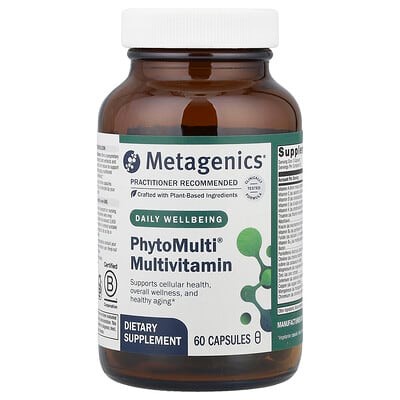

$41.50 $2.07 per serving


Product analysis
PhytoMulti Capsules offers broad nutrient support for normal skin and body functions, particularly when intake is low. An unidentified blend makes the full contents harder to check.
AI assessment of the formula, label and price. How scoring works
Nutrient Quality35
Many nutrient forms are named, but their quality remains uncertain. An unidentified blend and undisclosed source proportions prevent a full comparison of the mixture.
Ingredient Transparency73
All listed amounts and most forms are disclosed, making the main nutrients easier to check. Blend components and the proportions of mixed vitamin sources are undisclosed, leaving parts of the formula unclear.
Value For Money38
The full serving is expensive when considered as a source of lycopene. Value for most other nutrients remains uncertain.
Customer Satisfaction70
Customer ratings are positive. The very small number of responses leaves the wider pattern of satisfaction uncertain.
Product Focus10
The clearest use is filling nutrient gaps that affect normal skin and other body functions. Lutein and lycopene servings are below the relevant skin comparisons, and the unidentified blend leaves the broader purpose uncertain.
- Format
Capsule - Container
- 60 Capsule(s)
- Per serving
- $2.07
- Customer rating
- 4.7 · 35 ratings
Goals

Impact
High effect
Zinc · 15 mgVitamin C · 120 mgResveratrol · 10 mgCopper · 1 mgSelenium · 100 mcgLycopene · 6 mgVitamin E · 67 mg
Vitamin C helps form collagen, zinc supports skin repair, and B vitamins help maintain skin when intake is low. Copper supports connective-tissue cross-linking, but these normal nutrient roles do not establish additional cosmetic benefits with adequate intake. Lutein and lycopene offer limited UV-related evidence, but the declared 6 mg lutein and 6 mg lycopene per serving are below the main study anchors. Green-tea facts remain unresolved.
How this product is rated for Skin Health
Ingredient fit68
Skin-related ingredients are part of a broader formula. Disclosed amounts explain the retained findings, while unresolved ingredient facts limit additional conclusions.
Goal fit
Relevant skin ingredients appear in a broader formula with other actives, giving a partial focus on this goal.
Dose adequacy
Serving amounts provide the retained amount findings; larger amounts do not automatically mean greater skin benefit.
Pathways80
The saved findings concentrate on uv antioxidant defence. This describes the ingredient pattern, not a demonstrated whole-product skin effect.
Depth
The saved findings concentrate on uv antioxidant defence. This describes the ingredient pattern, not a demonstrated whole-product skin effect.
Breadth
Connective-tissue and UV-related pathways reach the coverage threshold; water-binding support remains absent from these findings.
Evidence89
Copper leads the retained evidence finding, but its connective-tissue role does not establish added skin benefit in copper-replete adults.
Evidence strength
Copper leads the retained evidence finding, but its connective-tissue role does not establish added skin benefit in copper-replete adults.
Studied preparation
Retained ingredients meet the preparation check, but the complete formula is not thereby established as equivalent to a skin trial.
Formulation logic100
No partner gaps or conflicts were identified. All retained ingredients meet the amount threshold, without establishing a proven daily skin-treatment regimen.
Partner coverage
The retained ingredients work independently or have their required partner, without demonstrated extra combination benefit.
Conflicts
No conflicts were identified by the evaluated ingredient checks.
Effective doses
All retained ingredients meet the amount threshold, without establishing a proven daily skin-treatment regimen.

Impact
High effect
Vitamin K · 120 mcgMagnesium · 40 mgVitamin D · 25 mcgSelenium · 100 mcgVitamin B12 · 200 mcgVitamin B6 · 25 mgVitamin E · 67 mgLycopene · 6 mgFolate · 1360 mcg DFENiacin · 50 mgVitamin C · 120 mg
Thiamin and selenium help fill nutritional gaps when deficiencies threaten heart function. Folate, B6 and B12 participate in homocysteine processing, but lowering that marker does not establish fewer cardiovascular events. Magnesium offers limited, inconsistent vascular-marker support at the declared amount. Lycopene findings are narrow and do not establish general prevention benefits. The broader formula does not establish added cardiovascular protection from its antioxidant or niacin ingredients.
How this product is rated for Cardiovascular Support
Ingredient fit68
The formula contains relevant nutrients alongside ingredients with broader purposes. Amount recognition is uneven; small or unresolved quantities limit the practical contribution.
Goal fit
The formula contains relevant nutrients alongside ingredients with broader purposes.
Dose adequacy
Amount recognition is uneven; small or unresolved quantities limit the practical contribution.
Pathways80
Homocysteine processing is the strongest recorded route; biological and antioxidant roles do not establish fewer cardiovascular events.
Depth
The strongest recorded route is homocysteine clearance, which describes a biological connection rather than demonstrated event prevention.
Breadth
Two routes have substantial recorded coverage; other routes remain weaker or absent.
Evidence83
Evidence is ingredient- and population-specific; normal nutrient functions and marker changes do not establish cardiovascular-event prevention.
Evidence strength
Lycopene supplies the strongest retained evidence recognition, subject to its specific population and outcome limitations.
Studied preparation
The counted ingredients received preparation recognition; this does not establish cardiovascular-event prevention.
Formulation logic100
No required partner is missing, and no matched conflict was found.
Partner coverage
No required partner is missing for the retained ingredient contributions.
Conflicts
No matched formulation conflict was found in the supplied declarations.
Effective doses
All counted ingredients met the saved amount criterion, which is not proof of clinical effectiveness.
Ingredients
| Ingredient | Amount per serving | Score |
|---|---|---|
Vitamin A (Mixed Carotenoids, Retinyl Acetate) | 3000 mcg | |
Vitamin C (Ascorbyl Palmitate, Ascorbic Acid) | 120 mg | |
Vitamin D (Cholecalciferol) | 25 mcg | |
Vitamin E (D-Alpha-Tocopheryl Succinate) | 67 mg | |
Vitamin K (Phytonadione) | 120 mcg | |
Thiamine (Thiamine Mononitrate) | 25 mg | |
Riboflavin | 15 mg | |
Niacin (Niacinamide) | 50 mg | |
Vitamin B6 (Pyridoxine Hydrochloride) | 25 mg | |
Folate (Calcium L-5-Methyltetrahydrofolate) | 1360 mcg DFE | |
Vitamin B12 (Methylcobalamin) | 200 mcg | |
Biotin | 500 mcg | |
Pantothenic Acid (Calcium D-Pantothenate) | 75 mg | |
Choline (Choline Bitartrate) | 25 mg | |
Iodine (Potassium Iodide) | 150 mcg | |
Magnesium (Magnesium Citrate) | 40 mg | |
Zinc (Zinc Citrate) | 15 mg | |
Selenium (Selenium Aspartate) | 100 mcg | |
Copper (Copper Citrate) | 1 mg | |
Manganese (Manganese Citrate) | 0.5 mg | |
Chromium (Chromium Polynicotinate) | 200 mcg | |
Molybdenum (Molybdenum Aspartate Complex) | 50 mcg | |
Proprietary Phytonutrient Blend | 400 mg | |
Myo-Inositol | 25 mg | |
Resveratrol (Polygonum cuspidatum root extract) | 10 mg | |
Lutein | 6 mg | |
Lycopene | 6 mg | |
Zeaxanthin | 2 mg |
Lycopene · 6 mg OverallScore70
A serving lists 6 mg of lycopene. At the whole-product serving price, the cost works out to about $3.46 per 10 mg of lycopene.
How this ingredient is rated
Composition and Label Disclosure
No additional composition or form criteria were evaluated.
Composition and Label Disclosure100
The serving lists 6 mg of lycopene.
Declared Active Lycopene Amount
The lycopene amount is listed as 6 mg per serving.
Commercial Price and Usability10
At the whole-product serving price, the cost works out to about $3.46 per 10 mg of lycopene.
Whole-Product Cost per 10 mg Declared Active Lycopene
At the whole-product serving price, the cost works out to about $3.46 per 10 mg of lycopene.
Resveratrol (Polygonum cuspidatum root extract) · 10 mg OverallScore31
A serving lists 10 mg of resveratrol, but the saved facts do not identify its trans-resveratrol amount. Without that amount, a price comparison per 250 mg of trans-resveratrol is unavailable.
How this ingredient is rated
Composition and Label Disclosure37
The saved facts identify resveratrol but do not establish the trans form or its concentration in the source.
Explicit Label Detail
Resveratrol is identified, but the saved facts do not establish whether it is the trans form.
Trans-Resveratrol Concentration Disclosure
The saved facts do not specify the concentration of trans-resveratrol in the source.
Composition and Label Disclosure40
A serving lists 10 mg of resveratrol, but a specific trans-resveratrol amount is not established.
Resveratrol Amount Disclosure
A serving lists 10 mg of resveratrol, but a specific trans-resveratrol amount is not established.
Commercial Price and Usability0
The whole-product serving price is known, but the trans-resveratrol amount is unavailable, so its price per 250 mg cannot be calculated.
Cost per 250 mg Declared Trans-Resveratrol
The whole-product serving price is known, but the trans-resveratrol amount is unavailable, so its price per 250 mg cannot be calculated.
Alternative products
Report alternatives
Sources
Published studies used for the product analysis and the top-ranked studies for each ingredient and goal.
- Associations of dietary folate, vitamin B6 and B12 intake with cardiovascular outcomes in 115664 participants: a large UK population-based cohort.
- Folate, Homocysteine, and Adverse Outcomes After Ischemic Stroke.
- Effect of folic acid on endothelial function following acute myocardial infarction.
- Folic acid enhances endothelial function and reduces blood pressure in smokers: a randomized controlled trial.
- 5-methyltetrahydrofolate, the active form of folic acid, restores endothelial function in familial hypercholesterolemia.
- Effects of lycopene intake on HDL-cholesterol and triglyceride levels: A systematic review with meta-analysis.
- Improvement of vascular endothelial function by intake of lycopene-rich tomato juice in healthy adults: a randomized, placebo-controlled, double-blind, parallel-group comparative study.
- Tomato and lycopene supplementation and cardiovascular risk factors: A systematic review and meta-analysis.
- Lycopene and tomato and risk of cardiovascular diseases: A systematic review and meta-analysis of epidemiological evidence.
- Lycopene and risk of cardiovascular diseases: A meta-analysis of observational studies.
- Circulating and dietary magnesium and risk of cardiovascular disease: a systematic review and meta-analysis of prospective studies.
- Magnesium and the risk of cardiovascular events: a meta-analysis of prospective cohort studies.
- Quantitative Association Between Serum/Dietary Magnesium and Cardiovascular Disease/Coronary Heart Disease Risk: A Dose-Response Meta-analysis of Prospective Cohort Studies.
- Comparative Efficacy of Nutraceuticals on Endothelial Function: A Systematic Review and Network Meta-Analysis.
- Serum magnesium, mortality, and cardiovascular disease in chronic kidney disease and end-stage renal disease patients: a systematic review and meta-analysis.
- The current state of niacin in cardiovascular disease prevention: a systematic review and meta-regression.
- Effects of niacin on apo A1 and B levels: a systematic review and meta-analysis of randomised controlled trials.
- Effect of lipid-lowering therapies on lipoprotein(a) levels: a comprehensive meta-analysis of randomized controlled trials.
- Extended-release niacin vs gemfibrozil for the treatment of low levels of high-density lipoprotein cholesterol. Niaspan-Gemfibrozil Study Group.
- Equivalent efficacy of a time-release form of niacin (Niaspan) given once-a-night versus plain niacin in the management of hyperlipidemia.