


Zinc Supportive
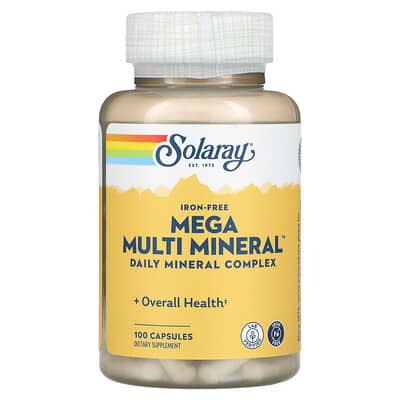
$12.89 $0.51 per serving
Product analysis
Solaray Iron-Free Mega Multi Mineral provides a broad mineral mix for everyday nutrition and bone health without iron. Four capsules supply 1,000 mg of calcium for bone structure, 500 mg of magnesium for bone and energy metabolism and 15 mg of zinc for normal immune function. The calcium and magnesium amounts are substantial, so total intake deserves particular attention.
AI assessment of the formula, label and price. How scoring works
Nutrient Quality49
Many mineral sources use named chelates, and the iodine and potassium blends contain multiple sources. Their precise binding details or proportions are not disclosed, so absorption potential varies in certainty.
Ingredient Transparency74
All applicable amounts and most nutrient forms are disclosed. The individual proportions of the iodine and potassium mixtures are not specified.
Value For Money57
The $0.51 serving offers good value for its substantial calcium and magnesium amounts, along with several trace minerals. Phosphorus, boron and vanadium offer less competitive value for their quantities.
Customer Satisfaction87
The 4.65 out of 5 average indicates favorable customer experiences. More than 4,000 ratings lend significant weight to the result.
Product Focus43
The mineral blend has a clear role in bone and everyday nutrition, with calcium and magnesium providing the largest mineral amounts. Its many other minerals broaden its potential applications, making it less narrowly targeted.
- Format
Capsule - Container
- 100 Capsule(s)
- Per serving
- $0.51
- Also available
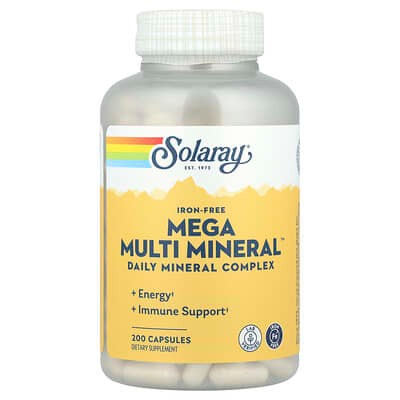 Iron-Free Mega Multi Mineral$20.79
- Customer rating
- 4.7 · 4,446 ratings
Goals

Impact
High effect
Magnesium · 500 mgZinc · 15 mgSelenium · 50 mcg
Iron-Free Mega Multi Mineral offers normal immune-function nutrition chiefly through 15 mg zinc and 50 mcg selenium. Zinc supports immune-cell function and regulation. Selenium supplies a smaller normal immune-function and oxidative-balance role. The 0.5 mg copper can add support when it helps fill a dietary gap that would otherwise impair immune function.
Selenium Mixed
Magnesium Supportive

Impact
Highest effect
Magnesium · 500 mgBoron · 1 mgSelenium · 50 mcgZinc · 15 mg
Iron-Free Mega Multi Mineral offers broad mineral nutrition, but its 500 mg magnesium serving is a high supplemental amount whose suitability needs review. Magnesium is the leading contribution to nutrient metabolism. Calcium at 1,000 mg adds bone nutrition, while 15 mg zinc and 50 mcg selenium provide smaller contributions to immune and antioxidant nutrition.
Magnesium Supportive
Selenium Supportive
Zinc Supportive
Boron Supportive

Impact
Moderate effect
Zinc · 15 mgMagnesium · 500 mg
Iron-Free Mega Multi Mineral fits metabolism mainly as mineral support for normal enzyme and thyroid function. Zinc at 15 mg supports normal enzyme function and leads the supplied contribution assessment. Magnesium at 500 mg supplies a mineral needed for ATP-related chemistry. Iodine at 225 mcg supplies a component of thyroid hormones, giving it a role in maintaining iodine sufficiency.
Magnesium Supportive
Chromium Supportive
Selenium Mixed
Iodine Mixed
Zinc Supportive
Vanadium Supportive

Impact
High effect
Magnesium · 500 mg
Iron-Free Mega Multi Mineral offers a narrow heart-health fit through magnesium’s limited support for blood-pressure regulation. Its 500 mg magnesium serving leads that role, while 59 mg potassium adds a smaller nutritional contribution to vascular tone.
Potassium Supportive
Magnesium Supportive
Selenium Mixed

Impact
Moderate effect
Magnesium · 500 mg
Iron-Free Mega Multi Mineral offers conditional nutritional stress support, led by magnesium. Its 500 mg elemental magnesium serving contributes to neural calming when magnesium status is low; suitability at this amount is unassessed. Zinc at 15 mg adds a smaller role whose relevance depends on nutritional status.
Magnesium Supportive
Zinc Supportive

Impact
Moderate effect
Potassium · 59 mgMagnesium · 500 mgSelenium · 50 mcg
Iron-Free Mega Multi Mineral offers a narrow cardiovascular fit led by 500 mg magnesium per serving. Magnesium may support vascular function, although blood-pressure and arterial-stiffness effects are inconsistent. Potassium at 59 mg is small compared with exposures associated with blood-pressure changes. Selenium at 50 mcg is relevant mainly when correcting deficiency.
Magnesium Supportive
Potassium Supportive
Selenium Supportive
Ingredients
| Ingredient | Amount per serving | Score |
|---|---|---|
Calories | 5 Calorie(s) | |
Calcium (Calcium Amino Acid Chelate Complex) | 1000 mg | |
Phosphorus (Potassium Phosphate) | 22 mg | |
Iodine (Kelp, Potassium Iodide) | 225 mcg | |
Magnesium (Magnesium Amino Acid Chelate Complex) | 500 mg | |
Zinc (Zinc Amino Acid Chelate Complex) | 15 mg | |
Selenium (Selenomethionine) | 50 mcg | |
Copper (Copper Amino Acid Chelate Complex) | 0.5 mg | |
Manganese (Manganese Amino Acid Chelate Complex) | 5 mg | |
Chromium (Chromium Polynicotinate) | 50 mcg | |
Molybdenum | 50 mcg | |
Potassium (Potassium Chloride, Potassium Phosphate) | 59 mg | |
Boron (Boric Acid) | 1 mg | |
Vanadium (Vanadium Amino Acid Chelate Complex) | 25 mcg | |
Glutamic Acid Hydrochloride | 50 mg |
Manganese (Manganese Amino Acid Chelate Complex) · 5 mg OverallScore83
Solaray Iron-Free Mega Multi Mineral provides 5 mg of manganese per serving, an amount for bone and joint support; the manganese comes from Manganese Amino Acid Chelate. The manganese offers moderate value at $0.21 per 2 mg of manganese; a serving of the full product costs $0.52.
Iodine (Kelp, Potassium Iodide) · 225 mcg OverallScore73
Solaray Iron-Free Mega Multi Mineral provides a useful 225 mcg of iodine per serving, with potassium iodide and an unspecified form. Potassium iodide is named, but another iodine form and its proportion are unknown. At $0.34 per 150 mcg of iodine, the price is good value. The full serving costs $0.52 for the full formula.
Glutamic Acid · 50 mg OverallScore71
Solaray Iron-Free Mega Multi Mineral supplies 50 mg of Glutamic Acid Hydrochloride per serving and is expensive at $1.29 per 100 mg of estimated glutamic acid. The full formula costs $0.52 per serving. The L form is not specified. The free glutamic acid amount is unknown.
Alternative products
Report alternatives
Sources
Published studies used for the product analysis and the top-ranked studies for each ingredient and goal.
- [Comparative study of the urinary excretion of boron, calcium, magnesium and phosphorus in postmenopausal women with and without osteoporosis].
- Effect of dietary boron on mineral, estrogen, and testosterone metabolism in postmenopausal women.
- The relationship between boron and magnesium status and bone mineral density in the human: a review.
- Effects of boron supplementation on bone mineral density and dietary, blood, and urinary calcium, phosphorus, magnesium, and boron in female athletes.
- Metabolic responses of postmenopausal women to supplemental dietary boron and aluminum during usual and low magnesium intake: boron, calcium, and magnesium absorption and retention and blood mineral concentrations
- What is the impact of daily oral supplementation of vitamin D3 (cholecalciferol) plus calcium on the incidence of hip fracture in older people? A systematic review and meta-analysis.
- Calcium supplementation prevents seasonal bone loss and changes in biochemical markers of bone turnover in elderly New England women: a randomized placebo-controlled trial.
- The effects of calcium supplementation (milk powder or tablets) and exercise on bone density in postmenopausal women.
- The efficacy of calcium supplementation alone in elderly Thai women over a 2-year period: a randomized controlled trial.
- Calcium-enriched foods and bone mass growth in prepubertal girls: a randomized, double-blind, placebo-controlled trial.
- The Association between Dietary and Circulating Copper Levels and Osteoporosis: a Scoping Review.
- Association between dietary copper, iron, zinc, selenium intake and osteopenia or osteoporosis in elderly hypertensive patients: a retrospective cohort study.
- Associations of dietary copper intake with total bone mineral density and lumbar spine bone mineral density in American adults.
- The association between dietary mineral intake and bone mineral density: a cross-sectional study.
- Association between dietary copper intake and bone mineral density in children and adolescents aged 8-19 years: A cross-sectional study.
- Association between Serum Magnesium and Fractures: A Systematic Review and Meta-Analysis of Observational Studies.
- Bioabsorbable Magnesium-Based Materials Potential and Safety in Bone Surgery: A Systematic Review.
- Vascularized bone grafting fixed by biodegradable magnesium screw for treating osteonecrosis of the femoral head.
- An update on magnesium and bone health.
- Sex-specific differences in the association of magnesium intake with femoral neck bone mineral density among older adults.