
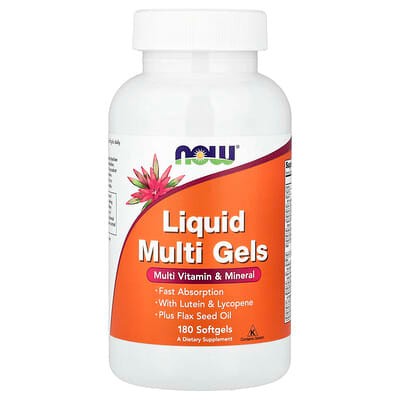

$33.50 $0.37 per serving


Product analysis
Liquid Multi Gels brings together vitamins and minerals that can help fill dietary gaps and support normal metabolism. Several undisclosed forms and mineral mixture proportions limit how closely the formula can be compared with alternatives.
AI assessment of the formula, label and price. How scoring works
Nutrient Quality54
Several vitamin forms are clear, while folate and biotin forms are unspecified. Missing proportions for calcium and magnesium mixtures also limit a useful comparison of their forms.
Ingredient Transparency79
Ingredient quantities are disclosed throughout the formula. Some forms and mineral mixture proportions are missing, so the label is clearer about amounts than about every ingredient source.
Value For Money51
The formula offers mixed value, with vitamin B6, vitamin E and several minerals among its stronger points. Some nutrients offer less for the serving cost, and value remains uncertain for ingredients with incomplete comparison information.
Customer Satisfaction79
Customer ratings are strongly positive, with a sizeable body of feedback. They describe satisfaction but cannot show whether the claimed health effects occur.
Product Focus17
The formula is broad, with its clearest use in supporting adequate nutrient intake. The many ingredients and proposed benefits make it less focused for someone with a single nutritional priority.
- Format
Softgel - Container
- 180 Softgel(s)
- Per serving
- $0.37
- Also available
 Liquid Multi Gels$15.10
- Customer rating
- 4.7 · 755 ratings
Goals

Impact
High effect
Magnesium · 100 mgVitamin C · 300 mgZinc · 15 mgVitamin A · 10000 IUVitamin D · 400 IUSelenium · 70 mcg

Impact
Highest effect
Folate · 800 mcgVitamin B12 · 100 mcgVitamin D · 400 IUMagnesium · 100 mgBoron · 500 mcgSelenium · 70 mcgZinc · 15 mgVitamin C · 300 mg

Impact
Lower effect
Vitamin D · 400 IUVitamin E · 400 IUVitamin C · 300 mg

Impact
Moderate effect
Iodine · 150 mcgVitamin D · 400 IUVitamin B5 · 50 mgMagnesium · 100 mgRiboflavin · 25 mgThiamin · 50 mgVitamin B12 · 100 mcgIron · 9 mgPotassium · 25 mg
Vitamin B5 Not classified
No linked studies yet.

Impact
Moderate effect
Zinc · 15 mgVitamin C · 300 mgCopper · 1 mgSelenium · 70 mcgLycopene · 250 mcgVitamin E · 400 IU

Impact
Moderate effect
Zinc · 15 mgVitamin E · 400 IUVitamin C · 300 mgCopper · 1 mgVitamin A · 10000 IU
carotenoids Not classified
No linked studies yet.
Ingredients
| Ingredient | Amount per serving | Score |
|---|---|---|
Calories | 10 Calorie(s) | |
Total Fat | 1 Gram(s) | |
Vitamin A (Beta-Carotene, Retinyl Palmitate) | 10000 IU | |
Vitamin C (Ascorbic Acid) | 300 mg | |
Vitamin D (Cholecalciferol) | 400 IU | |
Vitamin E (D-Alpha-Tocopherol) | 400 IU | |
Thiamine (Thiamine Hydrochloride) | 50 mg | |
Riboflavin | 25 mg | |
Niacin (Niacinamide) | 50 mg | |
Vitamin B6 (Pyridoxine Hydrochloride) | 50 mg | |
Folic Acid | 800 mcg | |
Vitamin B12 (Cyanocobalamin) | 100 mcg | |
Biotin | 300 mcg | |
Pantothenic Acid (Calcium Pantothenate) | 50 mg | |
Calcium (Calcium AAC, Calcium Carbonate, Calcium Citrate) | 100 mg | |
Iron (Ferrochel Bisglycinate AAC) | 9 mg | |
Iodine (Potassium Iodide) | 150 mcg | |
Magnesium (Magnesium Citrate, Magnesium Oxide) | 100 mg | |
Zinc (Zinc Amino Acid Chelate) | 15 mg | |
Selenium (L-Selenomethionine) | 70 mcg | |
Copper (Copper Amino Acid Chelate) | 1 mg | |
Manganese (Manganese Amino Acid Chelate) | 2 mg | |
Chromium (Chromium Amino Acid Chelate) | 120 mcg | |
Molybdenum (Sodium Molybdate) | 25 mcg | |
Potassium (Potassium Chloride) | 25 mg | |
organic Flaxseed Oil | 800 mg | |
Alpha Lipoic Acid | 30 mg | |
PABA | 50 mg | |
Inositol | 25 mg | |
Boron (Boron Citrate) | 500 mcg | |
Lutein (Marigold extract) | 250 mcg | |
Lycopene (natural Tomato extract) | 250 mcg | |
Vanadium (Vanadyl Sulfate) | 25 mcg |
Iodine (Potassium Iodide) · 150 mcg OverallScore96
A serving provides 150 mcg iodine. The cost per serving is moderate. It uses Potassium Iodide.
How this ingredient is rated
Active Ingredient Quality & Bioavailability100
It uses Potassium Iodide.
Iodine Form & Bioavailability
It uses Potassium Iodide.
Marine Source Purity & Sourcing
Marine-source contamination concerns do not apply to the stated non-marine source.
Dose, Safety & Label Transparency100
A serving provides 150 mcg iodine.
Dosage Efficacy for Daily Support
A serving provides 150 mcg iodine.
Dosage Safety & Upper Limits
The 150 mcg iodine per serving is below the adult upper intake level.
Elemental Iodine Transparency
The iodine amount per serving is stated, along with its source.
Value80
The cost per serving is moderate.
Price Per Effective Serving
The cost per serving is moderate.
Copper (Copper Amino Acid Chelate) · 1 mg OverallScore74
A serving provides 1 mg of copper at a moderate cost. The amount is clearly stated for the selected serving. The copper is an amino acid chelate, but the specific amino acid is not named. The serving also contains 15 mg of zinc, a zinc-to-copper ratio of 15.00:1.
How this ingredient is rated
Active Ingredient Quality & Bioavailability58
The copper is an amino acid chelate, but the specific amino acid is not named. The elemental copper amount and source are stated.
Copper Form Bioavailability
The copper is an amino acid chelate, but the specific amino acid is not named.
Elemental Copper Labeling Clarity
The elemental copper amount and source are stated.
Dose, Safety & Label Transparency86
The serving contains 1 mg of copper. The serving also contains 15 mg of zinc, a zinc-to-copper ratio of 15.00:1.
Copper Dosage Safety & Efficacy
The selected serving provides 1 mg of copper.
Zinc-to-Copper Balance
The serving also contains 15 mg of zinc, a zinc-to-copper ratio of 15.00:1.
Value80
The cost per serving is moderate.
Price Per Serving Efficiency
The cost per serving is moderate.
Vitamin B6 (Pyridoxine Hydrochloride) · 50 mg OverallScore74
The serving provides 50 mg of B6 at a low cost for the amount. The amount exceeds the European adult upper limit of 12 mg per day, before other sources are counted. It uses Pyridoxine Hydrochloride.
How this ingredient is rated
Ingredient Form & Label Quality100
It uses Pyridoxine Hydrochloride. No specified artificial colors, titanium dioxide or talc are listed.
Vitamin B6 Form Identification
It uses Pyridoxine Hydrochloride.
Clean Label and Excipient Purity
No specified artificial colors, titanium dioxide or talc are listed.
Dose, Safety & Label Transparency37
The serving provides 50 mg of vitamin B6. This exceeds the European adult upper limit of 12 mg per day; total intake also includes food and other supplements. The label states both the B6 amount and its source.
Vitamin B6 Dose & Safety Policy
The serving provides 50 mg of vitamin B6. This exceeds the European adult upper limit of 12 mg per day; total intake also includes food and other supplements.
Label Transparency
The label states both the B6 amount and its source.
Value96
The cost is low for the amount of B6 provided.
Vitamin B6 Price Efficiency
The cost is low for the amount of B6 provided.
Alternative products
Report alternatives
Sources
Published studies used for the product analysis and the top-ranked studies for each ingredient and goal.
- [Comparative study of the urinary excretion of boron, calcium, magnesium and phosphorus in postmenopausal women with and without osteoporosis].
- Effect of dietary boron on mineral, estrogen, and testosterone metabolism in postmenopausal women.
- The relationship between boron and magnesium status and bone mineral density in the human: a review.
- Effects of boron supplementation on bone mineral density and dietary, blood, and urinary calcium, phosphorus, magnesium, and boron in female athletes.
- Metabolic responses of postmenopausal women to supplemental dietary boron and aluminum during usual and low magnesium intake: boron, calcium, and magnesium absorption and retention and blood mineral concentrations
- What is the impact of daily oral supplementation of vitamin D3 (cholecalciferol) plus calcium on the incidence of hip fracture in older people? A systematic review and meta-analysis.
- Calcium supplementation prevents seasonal bone loss and changes in biochemical markers of bone turnover in elderly New England women: a randomized placebo-controlled trial.
- The effects of calcium supplementation (milk powder or tablets) and exercise on bone density in postmenopausal women.
- The efficacy of calcium supplementation alone in elderly Thai women over a 2-year period: a randomized controlled trial.
- Calcium-enriched foods and bone mass growth in prepubertal girls: a randomized, double-blind, placebo-controlled trial.
- The Association between Dietary and Circulating Copper Levels and Osteoporosis: a Scoping Review.
- Association between dietary copper, iron, zinc, selenium intake and osteopenia or osteoporosis in elderly hypertensive patients: a retrospective cohort study.
- Associations of dietary copper intake with total bone mineral density and lumbar spine bone mineral density in American adults.
- The association between dietary mineral intake and bone mineral density: a cross-sectional study.
- Association between dietary copper intake and bone mineral density in children and adolescents aged 8-19 years: A cross-sectional study.
- Association between RBC folate and lumbar bone mineral density in postmenopausal women, a cross-sectional study from NHANES 2009-2018.
- Genetic variants modify the associations of concentrations of methylmalonic acid, vitamin B-12, vitamin B-6, and folate with bone mineral density.
- Adequate Intake and Supplementation of B Vitamins, in Particular Folic Acid, can Play a Protective Role in Bone Health.
- Relation of homocysteine, folate, and vitamin B12 to bone mineral density of postmenopausal women.
- Dietary intake of folate, but not vitamin B2 or B12, is associated with increased bone mineral density 5 years after the menopause: results from a 10-year follow-up study in early postmenopausal women.